
ᐅ Replastering Window Reveals and Closing Openings – What Is the Correct Procedure?
Created on: 28 Apr 2026 11:26
D
dietrichdD
dietrichd28 Apr 2026 11:26Hello everyone,
we recently bought a house and are currently in the middle of renovating it.
A few years ago, new windows were installed. While removing the wallpaper, some of the plaster in the window reveals came off. We noticed that the plaster around all the window reveals sounds hollow. Therefore, we plan to completely remove it and replaster the reveals (or have them replastered).
The windows were foamed at the time, but it doesn’t appear that any sealing tape was installed. Now, there are some larger gaps in certain places that go all the way to the brickwork. Of course, we want to properly seal these.
Here are my questions:
In addition, we want to close up the wall boxes for the roller shutter straps as well as the opening for the kitchen exhaust hood (about 17cm (7 inches) diameter).
Would you foam and plaster such openings, or is there a better solution for this?
Thank you in advance for your help!
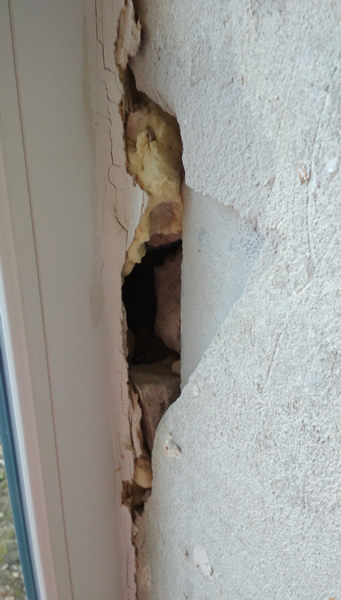
we recently bought a house and are currently in the middle of renovating it.
A few years ago, new windows were installed. While removing the wallpaper, some of the plaster in the window reveals came off. We noticed that the plaster around all the window reveals sounds hollow. Therefore, we plan to completely remove it and replaster the reveals (or have them replastered).
The windows were foamed at the time, but it doesn’t appear that any sealing tape was installed. Now, there are some larger gaps in certain places that go all the way to the brickwork. Of course, we want to properly seal these.
Here are my questions:
- Is it sufficient to foam the cavities again and then plaster them cleanly?
- Should sealing tape be installed as well?
- Would it make sense to install, for example, a waterproof insulation board or something similar?
In addition, we want to close up the wall boxes for the roller shutter straps as well as the opening for the kitchen exhaust hood (about 17cm (7 inches) diameter).
Would you foam and plaster such openings, or is there a better solution for this?
Thank you in advance for your help!
N
nordanney28 Apr 2026 11:37Foam sealing, adhesive sealing tape (! - I like to use illbruck - ME508), then plaster or glue drywall or thin calcium silicate boards (recess insulation due to mold risk)
D
dietrichd28 Apr 2026 12:26Thank you for your reply.
So far, there have been no mold issues.
Nevertheless, I would probably prefer calcium silicate boards, especially for jamb insulation because of the possible risk of mold – that seems reasonable to me.
I would then glue the boards in place and apply a thin layer of plaster over them.
Are calcium silicate boards basically the same as Wedi boards, or are there differences?
So far, there have been no mold issues.
Nevertheless, I would probably prefer calcium silicate boards, especially for jamb insulation because of the possible risk of mold – that seems reasonable to me.
I would then glue the boards in place and apply a thin layer of plaster over them.
Are calcium silicate boards basically the same as Wedi boards, or are there differences?
N
nordanney28 Apr 2026 12:35dietrichd schrieb:
I would probably prefer calcium silicate boards, especially for insulating reveals due to the potential mold risk – that seems more sensible to me.
I would then glue the boards and apply a thin plaster layer.That works. But please use lime finish or something similar to maintain the effect. Avoid gypsum-based products like ready-mixed plaster.dietrichd schrieb:
Are calcium silicate boards the same as Wedi boards, or are they different?No, they are completely different products (also intended for different purposes). Wedi (or other construction boards) consist of a rigid polystyrene core with a grooved surface layer. They are good for bathrooms or similar areas where tiles are installed (the boards can withstand pressure). Polystyrene as EPS/XPS is also used for external thermal insulation composite systems (ETICS / cavity wall insulation) or perimeter insulation.Calcium silicate boards are made from calcium silicate. They are very brittle and more difficult to work with but have major advantages in moisture absorption and mold resistance. They are also significantly more expensive.
Both materials provide good insulation.
D
dietrichd28 Apr 2026 13:40Great, thanks for the clarification.
The rooms will then be wallpapered with paintable fleece.
Is this problematic with calcium silicate boards, or should something else be considered or a different method chosen?
And why use the 2K foam?
The rooms will then be wallpapered with paintable fleece.
Is this problematic with calcium silicate boards, or should something else be considered or a different method chosen?
And why use the 2K foam?
Similar topics