
Hello community,
I would like to get your feedback on the floor plan draft for our single-family house. We are building in Baden-Württemberg.
Below are the completed questionnaire and the floor plan drafts.
Thank you very much.
We are building a KFW40 timber frame house with a basement (waterproof concrete shell). The basement is insulated and heated.
Development Plan/Restrictions
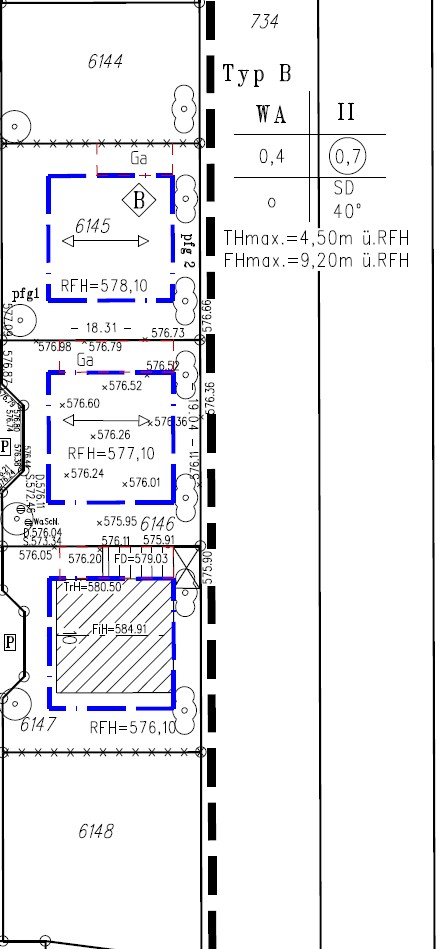
Plot size – 333m² (3583 ft²) – Parcel 6146
Slope – approx. 0.7mm (0.03 inches) gradient from north to south
Site coverage ratio – 0.4
Floor area ratio – 0.7
Building envelope, building line and boundary – see pictures
Edge development – Garage/carport allowed within marked building envelope
Number of parking spaces – 2 – currently only one shown
Number of floors – 1.5
Roof type – gable roof, 40°
Architectural style – classic gable roof
Orientation – see development plan F
Maximum heights/limits – eaves 4.50m (14 ft 9 in) / ridge 9.20m (30 ft 2 in)
Other requirements – mandatory photovoltaic system, mandatory landscaping
Requirements from the homeowners
Style, roof shape, building type – gable roof
Basement, floors – basement, ground floor and upper floor – ground and upper floor approx. 140m² (1507 ft²)
Number of persons, ages – 39 / 38 / 9 / 7
Room requirements on ground and upper floor – wardrobe, shower toilet, pantry, kitchen, living and dining room, 2 children’s bedrooms, master bedroom, walk-in closet, bathroom
Office: family use or home office? – home office in basement / fitness room in basement / workshop in basement
Guests sleeping overnight per year – no
Open or closed architecture – open
Conservative or modern style – modern
Open kitchen, kitchen island – kitchen island planned between kitchen and dining area, but without cooking surface!
Number of dining seats – round table with 6 seats
Fireplace – no
Music/sound system wall – 5.1 sound system plus 77-inch TV
Balcony, roof terrace – no
Garage, carport – carport
Kitchen garden, greenhouse – no
Other wishes/special features/daily routine, also explanations why something should or should not be included
House design
1st draft was an architect’s plan; we consulted with this and further refined the floor plan
What we like in particular:
- Straight staircase
- Spaciousness of the living room and connection to terrace and outdoor area
- Covered connection between carport and house
- Hallway and gallery – I am aware that this is very costly space, but it was chosen intentionally!
What we don’t like:
- I am concerned that the hallway downstairs will be too narrow and dark.
- Children’s rooms too narrow and elongated?
- Walk-in closet/bedroom layout doesn’t fit
- Shower/toilet too small
- Technical room too small
- Sound transfer due to open living concept
Price estimate according to architect/planner: 675k including photovoltaic/storage
Personal budget limit for house, including fittings: 850-880k
Preferred heating technology: air-to-water heat pump with ventilation system
If you had to give up on something, which details/extensions
- Could you give up: walk-in closet / pantry
- Could you not give up: basement with office and hobby room
Why is the design like this now?
Proposal from a construction company that matches our initial planning quite well.
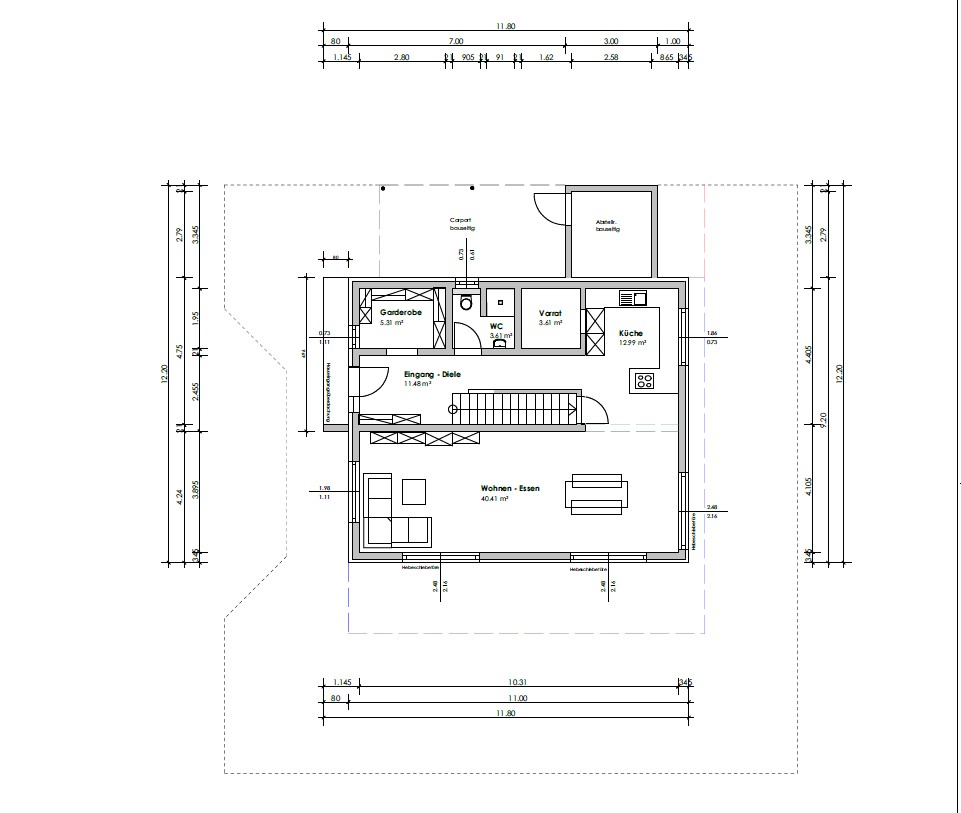
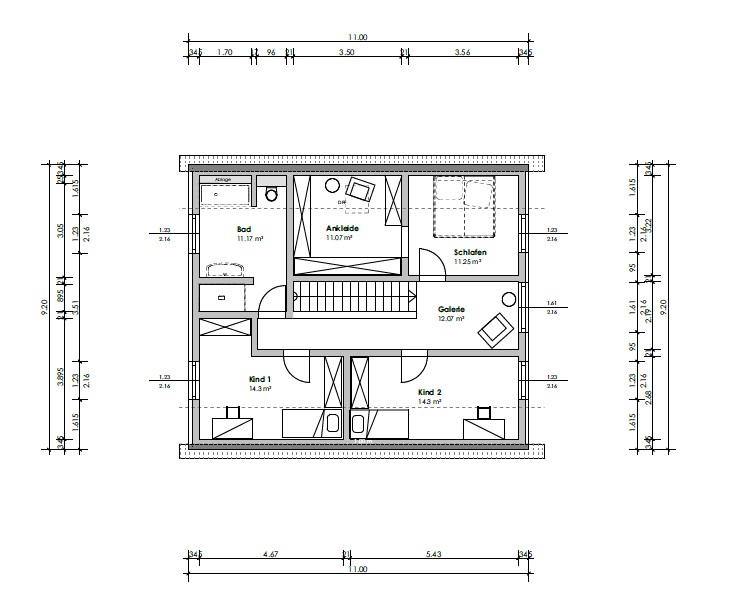
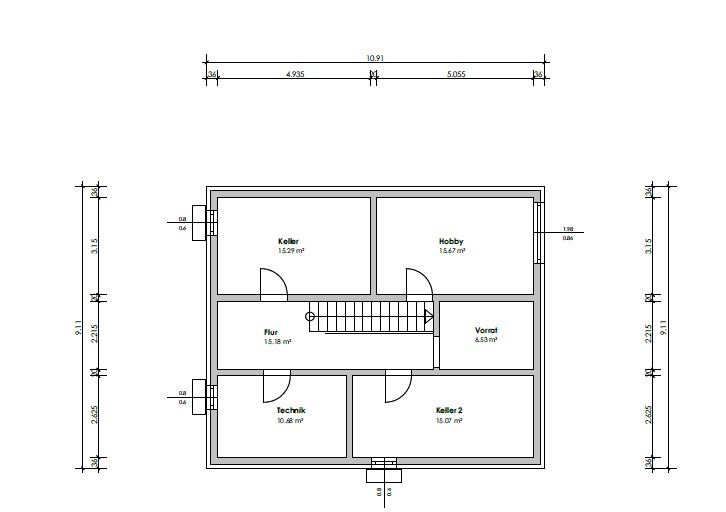
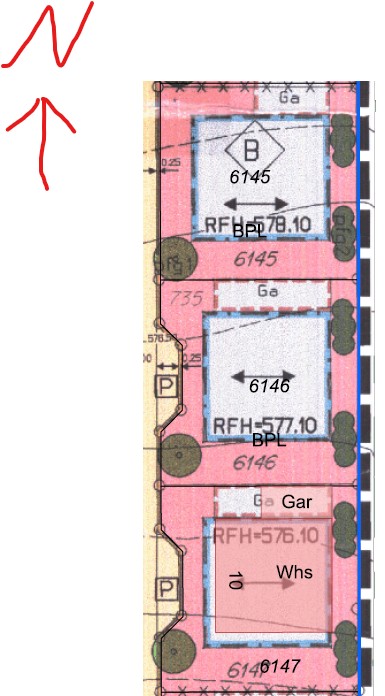
I would like to get your feedback on the floor plan draft for our single-family house. We are building in Baden-Württemberg.
Below are the completed questionnaire and the floor plan drafts.
Thank you very much.
We are building a KFW40 timber frame house with a basement (waterproof concrete shell). The basement is insulated and heated.
Development Plan/Restrictions
Plot size – 333m² (3583 ft²) – Parcel 6146
Slope – approx. 0.7mm (0.03 inches) gradient from north to south
Site coverage ratio – 0.4
Floor area ratio – 0.7
Building envelope, building line and boundary – see pictures
Edge development – Garage/carport allowed within marked building envelope
Number of parking spaces – 2 – currently only one shown
Number of floors – 1.5
Roof type – gable roof, 40°
Architectural style – classic gable roof
Orientation – see development plan F
Maximum heights/limits – eaves 4.50m (14 ft 9 in) / ridge 9.20m (30 ft 2 in)
Other requirements – mandatory photovoltaic system, mandatory landscaping
Requirements from the homeowners
Style, roof shape, building type – gable roof
Basement, floors – basement, ground floor and upper floor – ground and upper floor approx. 140m² (1507 ft²)
Number of persons, ages – 39 / 38 / 9 / 7
Room requirements on ground and upper floor – wardrobe, shower toilet, pantry, kitchen, living and dining room, 2 children’s bedrooms, master bedroom, walk-in closet, bathroom
Office: family use or home office? – home office in basement / fitness room in basement / workshop in basement
Guests sleeping overnight per year – no
Open or closed architecture – open
Conservative or modern style – modern
Open kitchen, kitchen island – kitchen island planned between kitchen and dining area, but without cooking surface!
Number of dining seats – round table with 6 seats
Fireplace – no
Music/sound system wall – 5.1 sound system plus 77-inch TV
Balcony, roof terrace – no
Garage, carport – carport
Kitchen garden, greenhouse – no
Other wishes/special features/daily routine, also explanations why something should or should not be included
House design
1st draft was an architect’s plan; we consulted with this and further refined the floor plan
What we like in particular:
- Straight staircase
- Spaciousness of the living room and connection to terrace and outdoor area
- Covered connection between carport and house
- Hallway and gallery – I am aware that this is very costly space, but it was chosen intentionally!
What we don’t like:
- I am concerned that the hallway downstairs will be too narrow and dark.
- Children’s rooms too narrow and elongated?
- Walk-in closet/bedroom layout doesn’t fit
- Shower/toilet too small
- Technical room too small
- Sound transfer due to open living concept
Price estimate according to architect/planner: 675k including photovoltaic/storage
Personal budget limit for house, including fittings: 850-880k
Preferred heating technology: air-to-water heat pump with ventilation system
If you had to give up on something, which details/extensions
- Could you give up: walk-in closet / pantry
- Could you not give up: basement with office and hobby room
Why is the design like this now?
Proposal from a construction company that matches our initial planning quite well.

Medium schrieb:
You can do it that way. But the staircase running across the space has a very negative impact on all the rooms. I agree with that.
Medium schrieb:
Better is: a two-flight staircase with a landing under the knee wall, and then almost square/rectangular rooms on the left and right in the attic (ground floor), no narrow corridors. I don’t see that working here because it’s too close to the eaves, and a knee wall of one meter (3 feet) is not enough to provide sufficient headroom along the entire run. So, a dormer would be required just for headroom. At the eaves-side exterior wall, only the staircase’s starting point can be placed, and then it must quickly curve to follow the main slope of the roof. The exit should be located close to the ridge, which I already suggested in post #18.
So the staircase placement was correct for a straight run, except that the staircase divides the floor plan in such a way that it splits the attic into rooms under one and the other half of the roof. Moving it closer to the eaves to avoid this unwanted effect has only very limited potential. Therefore, my suggestion is to change the direction: start the stair run parallel to the house axis, then follow the main roof slope and place it perpendicular to the axis for the majority of the climb.
https://www.instagram.com/11antgmxde/
https://www.linkedin.com/company/bauen-jetzt/
Medium schrieb:
That’s one way to do it. You can do anything if money is no object. However, a smart designer plans a load-bearing wall directly above another load-bearing wall below, not just anywhere. Then there are the single-span beams, which already make the vibration analysis quite challenging. I know, you can also skip that, or shh, just don’t tell the client—or even better, don’t let them know what it is in the first place.
Rübe1 schrieb:
I know, you can do without it, or shh, just don’t tell the client, or better yet, don’t even know what it is in the first place. Shh... just don’t explain to the other participants what you mean. It’s better to vaguely suggest that you are much smarter than all of us. Then we’ll admire you reverently, but unfortunately that benefits only you and not the original poster (OP). If that’s your idea of community value, then good night.
The intelligent OP takes the advice to redesign their house plan, and suddenly you can point out entirely different drawbacks that the previously discussed design didn’t even have yet ;-)
https://www.instagram.com/11antgmxde/
https://www.linkedin.com/company/bauen-jetzt/
11ant schrieb:
Shh... better not explain what you mean to the other participants. Just hint vaguely instead. What is unclear about "plan a load-bearing wall above another load-bearing wall below, and not in the middle of nowhere"? Probably because the gentleman with the yellow logo didn’t recognize the problem himself and, in his unfamiliarity with the building regulations, approved it? He, who usually knows everything?
By the way, my question about whether a structural engineer (TWP) has looked into this was not answered.
Rübe1 schrieb:
What is unclear about "plan but a load-bearing wall on top of another load-bearing wall below and not in the middle of nowhere"? Simply that nothing is "in the middle of nowhere" here, but in the basement and ground floor it is just on opposite sides of the staircase. Rübe1 schrieb:
and that he already approved it despite not knowing the structural design report? Especially since you are a vocational school teacher for carpentry, you should be able to clearly explain to us WHERE you see a problem.Rübe1 schrieb:
He, who otherwise knows everything? He does not exist here (anymore) :-(https://www.instagram.com/11antgmxde/
https://www.linkedin.com/company/bauen-jetzt/
Similar topics