
Aloha everyone,
we are currently remodeling our attic and have the following plan:
We would like to convert our kitchen into a bathroom.
That alone might not be such a challenge...
But we have only one water supply and only one drain—both at about 30cm (12 inches) height.
We are considering enlarging the drain from 5cm to 10cm (2 to 4 inches).
Additionally, a substructure of 12.5cm (5 inches) height to lay the supply and drain pipes underneath. Has anyone tried this before? And how does this affect the height difference to the drain? Is this physically feasible?
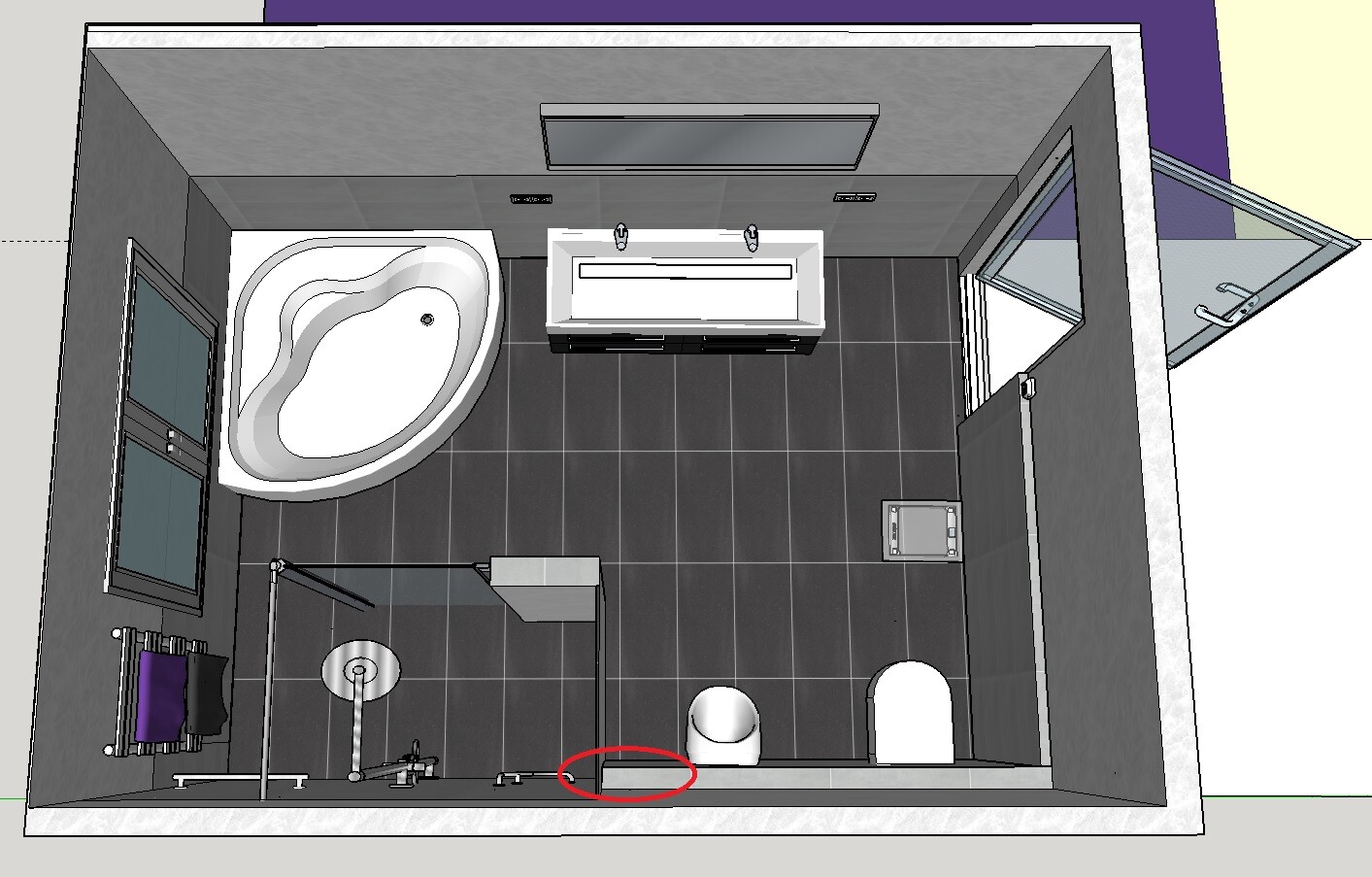
I took the liberty to create a small 3D model and attached it to this post. The supply and drain are marked in the red circle.
Hoping I have explained myself clearly
Elandria
we are currently remodeling our attic and have the following plan:
We would like to convert our kitchen into a bathroom.
That alone might not be such a challenge...
But we have only one water supply and only one drain—both at about 30cm (12 inches) height.
We are considering enlarging the drain from 5cm to 10cm (2 to 4 inches).
Additionally, a substructure of 12.5cm (5 inches) height to lay the supply and drain pipes underneath. Has anyone tried this before? And how does this affect the height difference to the drain? Is this physically feasible?
I took the liberty to create a small 3D model and attached it to this post. The supply and drain are marked in the red circle.
Hoping I have explained myself clearly
Elandria
Moving the kitchen drain to the bathroom is definitely more challenging than the other way around, mainly because the toilet requires a 10cm (4-inch) diameter waste pipe. Expanding the plumbing could also be difficult, depending on how much wall you need to open up. Additionally, the bathtub or shower usually has a drain at floor level, so some floor removal would be necessary. It’s easier to assess the situation if everything is exposed. We once had a plumber who said you would need to break up a bit of the floor to access the soil stack and install a lateral branch at floor level there. So yes, it’s all possible — it just depends on how much work you’re willing to put in.
In my opinion, the success of the project depends entirely on the diameter of the drain pipe running down inside the wall. If the pipe is only 5cm (2 inches) in diameter, it will probably be challenging. In any case, the wall will need to be opened up, which might also allow the height of the drain to be adjusted. If there are no additional drains connected to the downward-running pipe, it is possible that the pipe does not have the required diameter further down either.
Thank you for the responses.
We agreed early on that we can’t avoid opening the wall to enlarge the drainage – but we hadn’t even considered something as simple as changing the opening height. How embarrassing... *facepalm*
In our case, we’re lucky that another drain is connected, so for this old house, we assume there won’t be any issues with additional drainage routes. Has anyone had a different experience?
What about the construction? Is it even possible to build a wooden substructure at that height that can support both the weight of tiles and people? And is a height of 12.5 cm (5 inches) sufficient for this?
Best regards
Elandria
We agreed early on that we can’t avoid opening the wall to enlarge the drainage – but we hadn’t even considered something as simple as changing the opening height. How embarrassing... *facepalm*
In our case, we’re lucky that another drain is connected, so for this old house, we assume there won’t be any issues with additional drainage routes. Has anyone had a different experience?
What about the construction? Is it even possible to build a wooden substructure at that height that can support both the weight of tiles and people? And is a height of 12.5 cm (5 inches) sufficient for this?
Best regards
Elandria
So our wooden structure supports the entire house. Yes, that’s possible. 12.5cm (5 inches) might be a bit tight since the wood itself also has thickness, so I would definitely use 6x8cm (2.4x3.1 inches) squared timber for that. In our older building, as mentioned, the floor also needs to be broken up to connect the floor drain (what exactly is meant by "floor drain" – it runs almost parallel to the floor and requires a slope). That’s why we’re still considering how and if we will implement this. It’s cheaper if you prepare and expose everything first so the plumber only has to make the connection.
By the way, if you open the wall, the wall below it also needs to be open, and ideally the entire route to the nearest soil pipe, because the 10cm (4 inches) diameter applies to the entire length of the toilet waste pipe. Depending on where the soil pipe is located, the amount of work will vary.
By the way, if you open the wall, the wall below it also needs to be open, and ideally the entire route to the nearest soil pipe, because the 10cm (4 inches) diameter applies to the entire length of the toilet waste pipe. Depending on where the soil pipe is located, the amount of work will vary.
Regarding the slope, we hadn’t even considered that we would need more... Thank you, Elina, for pointing that out! I will now take that into account during the planning.
As for the pipe: it can be enlarged! The lines below allow for it, so this concern is also resolved.
Many thanks for the advice and valuable tips so far!
Next stop: the attic -.-
As for the pipe: it can be enlarged! The lines below allow for it, so this concern is also resolved.
Many thanks for the advice and valuable tips so far!
Next stop: the attic -.-
Similar topics