
ᐅ Vinyl vs. Lindura, Cork-Printed Flooring, Laminate? (Logoclic Xtreme)
Created on: 29 Aug 2014 16:20
F
Fantamoax
Hello dear forum community,
we are currently considering the flooring for our upper floor: bedroom, office, dressing room.
We would like to choose a uniform flooring throughout.
At first, we thought of click vinyl. After checking out a few home improvement stores and specialist flooring retailers, the alternatives mentioned above have come up.
Advantages of vinyl: texture, easy installation, moisture resistant.
Disadvantage: plasticizers in the material (although currently considered safe).
Advantages of cork: natural raw material, warm and comfortable underfoot feeling.
Disadvantage: sensitive to moisture, surface relatively soft even in the pressed version. (Possibly problematic in the office)
Lindura (brand name, we are open to alternatives)
Advantages for us personally: best appearance, pleasant underfoot feel, natural raw material, moisture resistant.
Disadvantage: relatively expensive compared to others, limited decor options.
It would be great if you could share your experiences.
Mineral laminate (Logoclic Xtreme)
According to a Bauhaus employee, it has been available for 2 weeks.
Unfortunately, no information besides the promotional video. The friendly staff repeated in a loop that the material is mineral-based, like screed, and that’s all they know...
We liked the decor, it is supposed to be a natural raw material and absolutely moisture resistant.
We are open to manufacturer suggestions, especially regarding Lindura and Logoclic Xtreme.
Good luck Fanta
we are currently considering the flooring for our upper floor: bedroom, office, dressing room.
We would like to choose a uniform flooring throughout.
At first, we thought of click vinyl. After checking out a few home improvement stores and specialist flooring retailers, the alternatives mentioned above have come up.
Advantages of vinyl: texture, easy installation, moisture resistant.
Disadvantage: plasticizers in the material (although currently considered safe).
Advantages of cork: natural raw material, warm and comfortable underfoot feeling.
Disadvantage: sensitive to moisture, surface relatively soft even in the pressed version. (Possibly problematic in the office)
Lindura (brand name, we are open to alternatives)
Advantages for us personally: best appearance, pleasant underfoot feel, natural raw material, moisture resistant.
Disadvantage: relatively expensive compared to others, limited decor options.
It would be great if you could share your experiences.
Mineral laminate (Logoclic Xtreme)
According to a Bauhaus employee, it has been available for 2 weeks.
Unfortunately, no information besides the promotional video. The friendly staff repeated in a loop that the material is mineral-based, like screed, and that’s all they know...
We liked the decor, it is supposed to be a natural raw material and absolutely moisture resistant.
We are open to manufacturer suggestions, especially regarding Lindura and Logoclic Xtreme.
Good luck Fanta
A
Alfredlima24 Nov 2014 17:44I wonder why everyone considers sanding to be the ultimate treatment for hardwood flooring.
Now, I’m curious how many hardwood floor owners have actually had their floors sanded at least once. That can’t be the only main advantage. After all, it costs money, creates a mess, and in some cases, getting a new floor might be the better option.
I looked for statistics but couldn’t find any.
Now, I’m curious how many hardwood floor owners have actually had their floors sanded at least once. That can’t be the only main advantage. After all, it costs money, creates a mess, and in some cases, getting a new floor might be the better option.
I looked for statistics but couldn’t find any.
M
mwislander28 Jan 2015 08:03Hello everyone,
we are also interested in the Lindura flooring and want to install it in all rooms on the ground floor (except the utility room). Can someone share their experience regarding the acoustic properties of this floor?
In hardware stores, the flooring was always installed without any impact sound insulation. Does it make as much noise as laminate flooring?
I look forward to hearing about your experiences.
Thank you!
we are also interested in the Lindura flooring and want to install it in all rooms on the ground floor (except the utility room). Can someone share their experience regarding the acoustic properties of this floor?
In hardware stores, the flooring was always installed without any impact sound insulation. Does it make as much noise as laminate flooring?
I look forward to hearing about your experiences.
Thank you!

Hello mwislander,
Personally, I find the acoustic properties quite pleasant. However, in my opinion, today’s laminate floors don’t sound as bad as they used to. Manufacturers, especially those in the mid to higher price ranges, have clearly improved. In my view, the floor should be glued down over underfloor heating even without impact sound insulation.
I’m always interested in hearing arguments for other installation methods.
Good luck
Fanta
Personally, I find the acoustic properties quite pleasant. However, in my opinion, today’s laminate floors don’t sound as bad as they used to. Manufacturers, especially those in the mid to higher price ranges, have clearly improved. In my view, the floor should be glued down over underfloor heating even without impact sound insulation.
I’m always interested in hearing arguments for other installation methods.
Good luck
Fanta
M
mwislander28 Jan 2015 20:39Thank you, Fanta, for the quick response. That sounds genuinely good.
However, I do not want to forego impact sound insulation. I found the following passage in the installation instructions:
For floors that are not already factory-fitted with impact sound insulation, you must use x-foam foil, x-Silence 15 DB, x-Silence 20, x-Silence 25 DB, or x-Duo-Guard for insulation. (When using x-Silence 25 DB, x-Silence 15 DB, or x-Duo-Guard, an additional 0.2-millimeter (0.008 inch) PE foil is not required.)
[...]
All x-Lindura wooden floors are suitable for installation over controlled warm water underfloor heating.
Please note the following: When installing with x-Silence 25 DB, the x-Lindura wooden floors have a thermal resistance (R-value) of 0.084 m² K/W. Compared to ceramic floors, the underfloor heating can be turned off earlier during transitional seasons due to the natural warmth of the floor. An even surface temperature is also achieved with x-floorboards on underfloor heating.
The floors must not be covered with coverings such as carpets, runners, mats, or other overlays, as these can cause heat buildup. Flooring of this type may react with deformation and joint gaps.
For installation, the product data sheet states:
Suitable for warm water underfloor heating.
Electric underfloor heating is generally suitable only if it is embedded in the screed or concrete layer, and not installed as foil heating on the concrete surface. The heating pipes | tubes | wires must cover the entire area and not be installed partially. If only partial heating areas are installed, the floor covering must be provided with movement joints (system-related rails). The maximum surface temperature of 26°C (79°F) must not be exceeded.
Common foil heating systems cannot generally be approved. An exception applies to self-regulating heating systems, provided the maximum surface temperature of 26°C (79°F) is maintained.
Floating installation
Best regards
------------------------------------
Good evening,
It should not be that difficult to follow the forum rules, right? I have now manually removed all advertising; next time I will delete it because that is faster.
Thank you and best regards, Bauexperte
Bauexperte
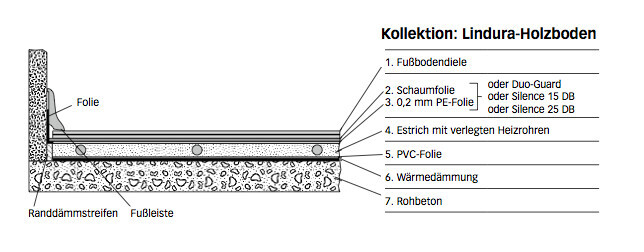
However, I do not want to forego impact sound insulation. I found the following passage in the installation instructions:
For floors that are not already factory-fitted with impact sound insulation, you must use x-foam foil, x-Silence 15 DB, x-Silence 20, x-Silence 25 DB, or x-Duo-Guard for insulation. (When using x-Silence 25 DB, x-Silence 15 DB, or x-Duo-Guard, an additional 0.2-millimeter (0.008 inch) PE foil is not required.)
[...]
All x-Lindura wooden floors are suitable for installation over controlled warm water underfloor heating.
Please note the following: When installing with x-Silence 25 DB, the x-Lindura wooden floors have a thermal resistance (R-value) of 0.084 m² K/W. Compared to ceramic floors, the underfloor heating can be turned off earlier during transitional seasons due to the natural warmth of the floor. An even surface temperature is also achieved with x-floorboards on underfloor heating.
The floors must not be covered with coverings such as carpets, runners, mats, or other overlays, as these can cause heat buildup. Flooring of this type may react with deformation and joint gaps.
For installation, the product data sheet states:
Suitable for warm water underfloor heating.
Electric underfloor heating is generally suitable only if it is embedded in the screed or concrete layer, and not installed as foil heating on the concrete surface. The heating pipes | tubes | wires must cover the entire area and not be installed partially. If only partial heating areas are installed, the floor covering must be provided with movement joints (system-related rails). The maximum surface temperature of 26°C (79°F) must not be exceeded.
Common foil heating systems cannot generally be approved. An exception applies to self-regulating heating systems, provided the maximum surface temperature of 26°C (79°F) is maintained.
Floating installation
Best regards
------------------------------------
Good evening,
It should not be that difficult to follow the forum rules, right? I have now manually removed all advertising; next time I will delete it because that is faster.
Thank you and best regards, Bauexperte
Bauexperte
I have also read the installation instructions.
At first, we wanted to install the floor as a floating floor.
This would have been easier for us as non-professionals.
However, in discussions with the sales specialists, we were repeatedly advised to glue the floor down. On one hand, the sound insulation is supposed to be significantly better, and on the other hand, the heat transfer is said to improve. There are several posts about this on the internet. Gluing is clearly better for heat transfer with underfloor heating. However, it is often criticized that removing the floor later is more time-consuming and especially messier.
It is also frequently mentioned that in some cases the floor was installed too early, before the subfloor was completely dry.
Maybe someone in the forum has glued their finished floor?
I would appreciate any advice on installation.
Good luck
Fanta
At first, we wanted to install the floor as a floating floor.
This would have been easier for us as non-professionals.
However, in discussions with the sales specialists, we were repeatedly advised to glue the floor down. On one hand, the sound insulation is supposed to be significantly better, and on the other hand, the heat transfer is said to improve. There are several posts about this on the internet. Gluing is clearly better for heat transfer with underfloor heating. However, it is often criticized that removing the floor later is more time-consuming and especially messier.
It is also frequently mentioned that in some cases the floor was installed too early, before the subfloor was completely dry.
Maybe someone in the forum has glued their finished floor?
I would appreciate any advice on installation.
Good luck
Fanta
P
powerbook117 Feb 2015 18:42Has anyone here already installed the flooring?
I’m considering Lindura, but I want to install it as a floating floor over underfloor heating (water-based). I still have some doubts about the flooring though (it’s not really real wood, is it?).
I’m considering Lindura, but I want to install it as a floating floor over underfloor heating (water-based). I still have some doubts about the flooring though (it’s not really real wood, is it?).
Similar topics