
Hello,
we are planning to build a new house with an insulated ground slab, but without underfloor heating because we want to lay industrial parquet flooring throughout, and underfloor heating could cause issues.
At the moment, we are considering a ceiling heating system. Our apartment will have an interior height of 3m (10 feet).
Is ceiling heating alone sufficient for heating? I am still concerned about the absence of underfloor heating and whether this might lead to cold feet.
Do you have any experience with this? I find radiant heat itself very comfortable.
ma
we are planning to build a new house with an insulated ground slab, but without underfloor heating because we want to lay industrial parquet flooring throughout, and underfloor heating could cause issues.
At the moment, we are considering a ceiling heating system. Our apartment will have an interior height of 3m (10 feet).
Is ceiling heating alone sufficient for heating? I am still concerned about the absence of underfloor heating and whether this might lead to cold feet.
Do you have any experience with this? I find radiant heat itself very comfortable.
ma
D
DerBjoern8 Oct 2014 08:48I had the opportunity to see ceiling heating in action. It is completely warm and not a problem at all. The radiant heat distributes warmth evenly throughout the room. There are no cold feet, at least no more than with modern underfloor heating. In properly insulated houses with well-designed underfloor heating, the floor nowadays doesn’t actually get warm anymore. Warm floors are a thing of the past from before the 1990s...
D
DerBjoern8 Oct 2014 10:18The point about tiles may certainly be valid. However, with parquet flooring, as planned here, I am less concerned...

You’re probably right, Björn, but for example, even with the laminate flooring we have in the kids’ room, I’ve already noticed differences compared to laminate flooring without underfloor heating. A difference of 2 or 3 degrees Celsius (3.6 or 5.4 degrees Fahrenheit) could already be noticeable here… at least for the female group.
F
frosch0069 Oct 2014 10:12Hello,
Thanks in advance for your answers. As you can see from the discussion here, there are varying opinions on this. I haven’t been able to decide yet which system to choose.
Ceiling heating and wall heating are currently our favorites because of their fast response time, which is said to be up to 15 minutes. Underfloor heating is still quite slow to react even nowadays.
Currently, we have radiators on the ground floor and underfloor heating on the upper floor. However, the underfloor heating is only used in extreme winter because it is in the bedroom. From that, we got an impression that even though the underfloor heating is only 6 years old, it takes several hours until a change is noticeable; it’s best to turn it on in the morning so you can clearly feel the difference in the evening.
We don’t want to use radiators anymore due to clearly noticeable drafts that are unpleasant and also make the room feel several degrees cooler.
Hello Bjoern,
Exactly regarding radiant heat, I found some images to illustrate it, but unfortunately I haven’t experienced it live yet. I only know radiant heat from spa facilities in sauna areas, where it is very pleasant.
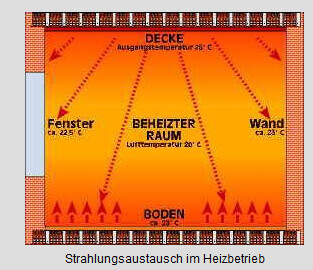
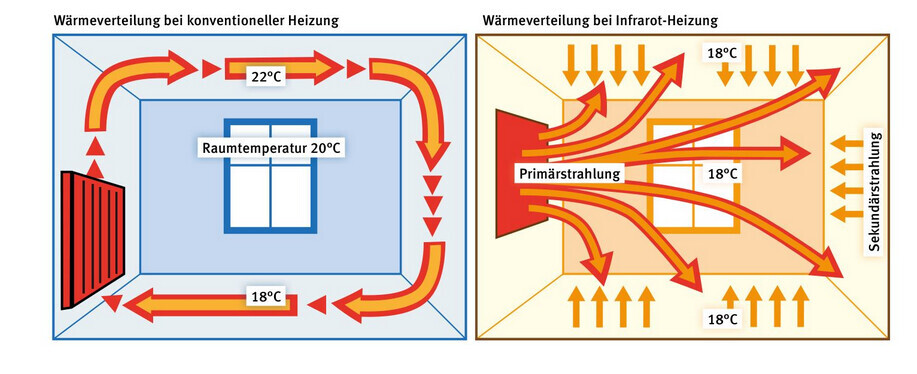
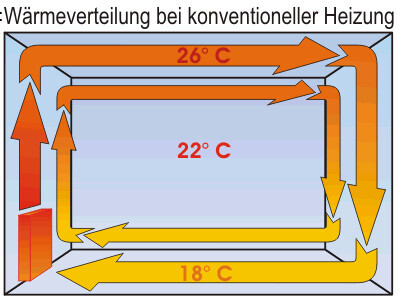
Thanks in advance for your answers. As you can see from the discussion here, there are varying opinions on this. I haven’t been able to decide yet which system to choose.
Ceiling heating and wall heating are currently our favorites because of their fast response time, which is said to be up to 15 minutes. Underfloor heating is still quite slow to react even nowadays.
Currently, we have radiators on the ground floor and underfloor heating on the upper floor. However, the underfloor heating is only used in extreme winter because it is in the bedroom. From that, we got an impression that even though the underfloor heating is only 6 years old, it takes several hours until a change is noticeable; it’s best to turn it on in the morning so you can clearly feel the difference in the evening.
We don’t want to use radiators anymore due to clearly noticeable drafts that are unpleasant and also make the room feel several degrees cooler.
DerBjoern schrieb:
I was once able to see ceiling heating in action. It is absolutely warm and not a problem at all. Thanks to radiant heat, the warmth is well distributed throughout the room. There are no cold feet, at least no more than with modern underfloor heating. Nowadays, in properly insulated houses with well-designed underfloor heating, the floor doesn’t actually get warm anymore. Warm floors are a relic from before the 1990s...
Hello Bjoern,
Exactly regarding radiant heat, I found some images to illustrate it, but unfortunately I haven’t experienced it live yet. I only know radiant heat from spa facilities in sauna areas, where it is very pleasant.

I can only provide a brief statement about the cooling function.
At my wife’s workplace, these ceiling heating panels were installed afterward, not for heating, but only for cooling. She is very impressed with the cooling function. Despite being in the city center with large glass facades, the temperatures remain comfortable.
At my wife’s workplace, these ceiling heating panels were installed afterward, not for heating, but only for cooling. She is very impressed with the cooling function. Despite being in the city center with large glass facades, the temperatures remain comfortable.
B
Bauexperte9 Oct 2014 12:17Hello,
Radiant heat is very pleasant because all solid materials in the room absorb heat while the air itself remains cool. Short or long ventilation does not affect the sensation of warmth. Additionally, they heat indirectly, meaning incoming solar heat or other heat sources, such as baking, cooking, people, etc., are prioritized. And—if you can afford it—custom-made radiators can be ordered; for this, we brought L. Colani on board at the time.
I have no experience with cooling because the carrier—marble—did not allow for it. On the other hand, I’m generally not a fan of combined systems; I much prefer a separate air conditioning unit.
Best regards, Bauexperte

frosch006 schrieb:With this usage pattern, you will pay extra. You should avoid changing a previously set temperature — even in the bedroom. Since all modern heat generators are controlled by the outdoor temperature sensor, they only react when the external sensor reports the corresponding temperature. This not only has the nice side effect of saving money but also ensures continuous temperatures without long start-up times. Not to mention that cold bedrooms are often a main cause of joint problems.
The underfloor heating is only turned on during extreme winter because it is in the bedroom. We were able to get an impression, even though the underfloor heating is only 6 years old, it takes several hours for any change to be noticeable. It’s best to turn it up in the morning, then you can clearly feel the difference in the evening.
frosch006 schrieb:Many years ago, I sold radiant heaters; unfortunately, during those years, the negotiating position with energy providers was not favorable, as they made more profit from gas. In particular, RWE was opposed to granting this system the heat pump tariff. Today, with affordable and additionally subsidized storage media, that is no longer an issue.
I found pictures to illustrate radiant heat but unfortunately haven’t experienced it live yet.
Radiant heat is very pleasant because all solid materials in the room absorb heat while the air itself remains cool. Short or long ventilation does not affect the sensation of warmth. Additionally, they heat indirectly, meaning incoming solar heat or other heat sources, such as baking, cooking, people, etc., are prioritized. And—if you can afford it—custom-made radiators can be ordered; for this, we brought L. Colani on board at the time.
I have no experience with cooling because the carrier—marble—did not allow for it. On the other hand, I’m generally not a fan of combined systems; I much prefer a separate air conditioning unit.
Best regards, Bauexperte
Similar topics