
ᐅ Living Room Lighting for 47 m² with Philips Hue Slim 90 mm – Is the Grid Too Dense or Appropriate?
Created on: 7 Jan 2026 14:52
G
Geomanne
Hello everyone,
this is my first post in this forum, and I haven’t read along here yet. On the recommendation of a user from another forum, I would like to start a discussion here with my question and hope for practical assessments and your support. After almost nine months of renovating my own home by myself, I will likely be able to contribute on other topics in the future as well.
Regarding the topic:
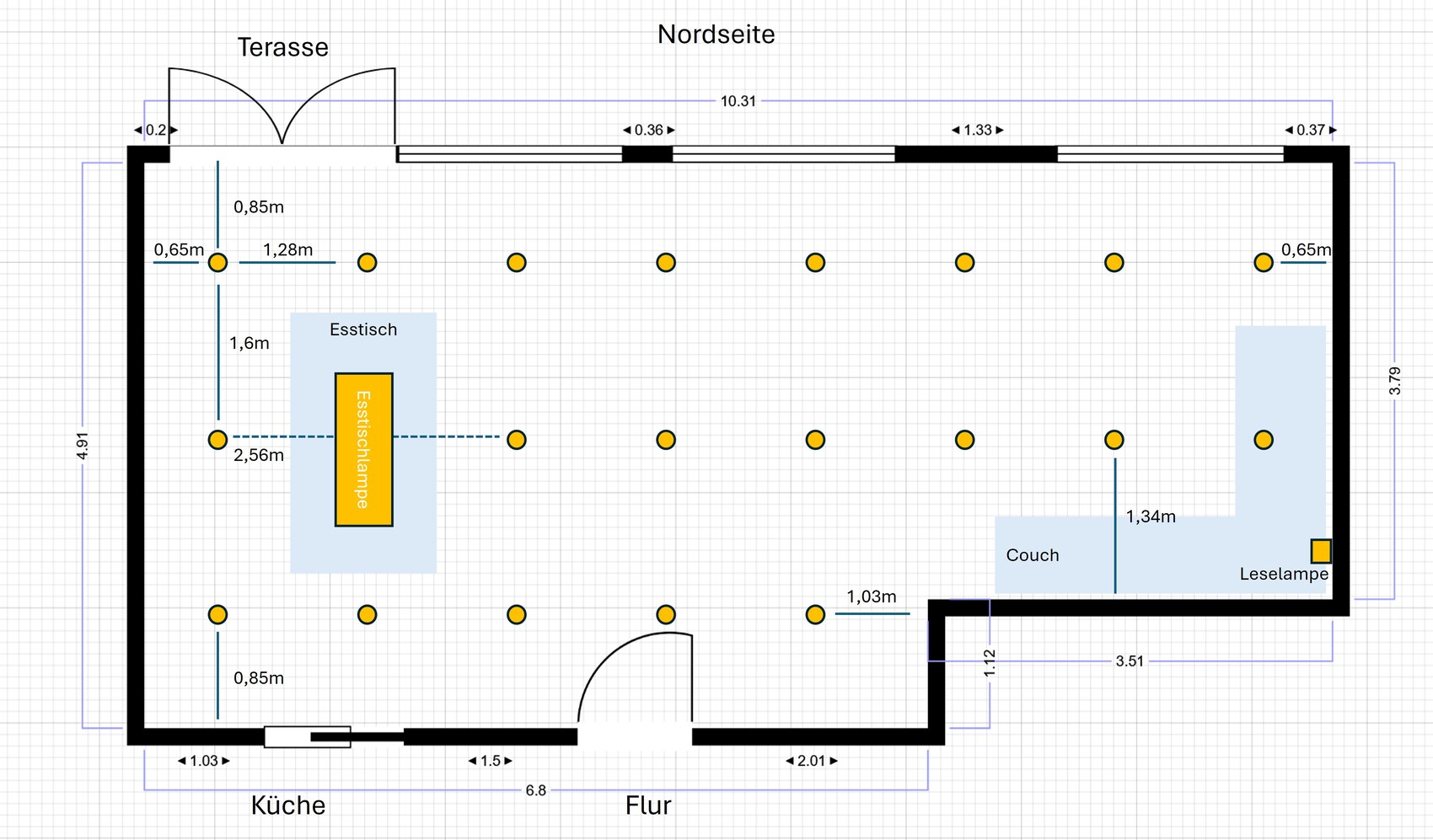
We are currently planning the ceiling lighting for our living room (approx. 47 m² (505 sq ft), ceiling height 2.45–2.50 m (8.0–8.2 ft)) using Philips Hue Slim 90 mm (White & Color Ambiance). I have attached a sketch with the room geometry, distances, and lamp positions.
Current design (general lighting):
The setup shown is a first draft.
The spacing was researched and put together based on various guides, examples, and user experiences found online. That is why my question: Does this look like the right approach, or is it already too dense?
We would like to keep the basic concept of three rows unless there is a fundamental reason not to.
Regarding the appearance:
If the proposed solution is considered oversized, we are thinking about removing one or two spots per row, for example:
I look forward to constructive criticism, experiences especially with the Philips Hue Slim 90 mm, as well as suggestions on whether you would stick to the current number or tend towards one of the reduced variants.
Thank you very much and best regards
this is my first post in this forum, and I haven’t read along here yet. On the recommendation of a user from another forum, I would like to start a discussion here with my question and hope for practical assessments and your support. After almost nine months of renovating my own home by myself, I will likely be able to contribute on other topics in the future as well.
Regarding the topic:
We are currently planning the ceiling lighting for our living room (approx. 47 m² (505 sq ft), ceiling height 2.45–2.50 m (8.0–8.2 ft)) using Philips Hue Slim 90 mm (White & Color Ambiance). I have attached a sketch with the room geometry, distances, and lamp positions.
Current design (general lighting):
- 3 rows of downlights
- currently 20 spots in total
- Row 1: 8
- Row 2: 7 (one position omitted due to a pendant light above the dining table)
- Row 3 (shorter area): 5
- Distances and distances from the walls are shown in the sketch
The setup shown is a first draft.
The spacing was researched and put together based on various guides, examples, and user experiences found online. That is why my question: Does this look like the right approach, or is it already too dense?
We would like to keep the basic concept of three rows unless there is a fundamental reason not to.
Regarding the appearance:
- Ceiling white
- Spots also white
- The Hue Slim are very flat and have a white light surface when switched off → The goal is a discreet ceiling appearance when the lights are off.
If the proposed solution is considered oversized, we are thinking about removing one or two spots per row, for example:
- 7-6-4
- or 6-6-4 (without the extra “gap” above the dining table, since the spacing in row 2 is sufficient for the pendant light anyway)
- There are three separately switchable light circuits:
- Left – dining area
- Middle
- Right – living area
- Additionally, of course, Hue scene control
- A separate circuit switches only the dining table pendant (possibly with subtle dimmed background lighting when seated)
- The other two circuits switch the spots (living area as well as middle/left)
- even general lighting
- mostly dimmed use
- "Hue moods"
- clear zoning (dining / living)
- no “light ceiling,” but also no dark zones
I look forward to constructive criticism, experiences especially with the Philips Hue Slim 90 mm, as well as suggestions on whether you would stick to the current number or tend towards one of the reduced variants.
Thank you very much and best regards
That’s unfortunately all too complicated for me. In the meantime, I found several old 500-watt construction floodlights in the attic. I wrapped some old fabric scraps around them and hung them from the ceiling. It’s something different. So, my issue got resolved faster than I expected after all. Thanks anyway for your efforts.
N
nordanney7 Jan 2026 23:12Geomanne schrieb:
Unfortunately, all of that is just too complicated for me.Well, there are good lighting designers everywhere who can take that work off your hands. But that costs money, and they will quickly advise against using grid lighting like that. Geomanne schrieb:
In the meantime, I found several old 500-watt work lights up in the attic. I’m wrapping some old fabric scraps around them and letting them hang from the ceiling. It’s something different.Have fun with that.It’s a shame you’re not open to criticism and don’t want to follow a constructive approach. There are many good tips here if you put some thought into it and share that. But your lighting plan is like a dish that’s way too salty and burnt. Just redo it.
Have a nice evening.
The tone you are using has completely taken away my motivation. This has nothing to do with constructive criticism or anything like that. We don’t know each other, and there are certain courtesies that should be observed, even online. Frankly, this is quite rude. By the way, you behaved the same way in another forum earlier today. That’s why, based on a recommendation, I registered here with my inquiry because of you. I will find a way to manage on my own. I’m out here.
Are you somewhat skilled with CAD? Then you can quickly explore this using Dialux or Relux. I wouldn’t recommend filling the space entirely with spotlights either.
This is my plan:
Pendant lamp/floor lamp next to the sofa.
A shadow gap all around (wider at the curtains, with the curtains mounted within the shadow gap) to indirectly illuminate the wall.
Scattered "decorative spotlights" close to the walls to cast an arch-shaped light. Also additional indirect lighting.
Two large pendant lamps above the dining table.
Light panels above the living room table for when brighter light is needed.
That’s the general idea. I don’t plan to illuminate the areas between the sofa and table separately.
This is my plan:
Pendant lamp/floor lamp next to the sofa.
A shadow gap all around (wider at the curtains, with the curtains mounted within the shadow gap) to indirectly illuminate the wall.
Scattered "decorative spotlights" close to the walls to cast an arch-shaped light. Also additional indirect lighting.
Two large pendant lamps above the dining table.
Light panels above the living room table for when brighter light is needed.
That’s the general idea. I don’t plan to illuminate the areas between the sofa and table separately.
Geomanne schrieb:
We don’t know each other, and there are certain conventions that definitely apply online as well.Exactly, there are. In forums, this primarily means not just posting immediately, but first reading a bit to understand the topic and learn from other posts, then creating a new thread for any remaining questions. It also means accepting criticism initially. No one here knows you personally or takes that into account; people simply express their opinions. Yes, sometimes it’s tough, but isn’t the point of a forum to be challenged by ideas you or your own bubble haven’t considered before? 😎 Just think about it.
C
chand19868 Jan 2026 06:19From personal experience: No recessed lights if you want a "cozy" atmosphere.
Where are the floor lamps and wall lights? Where are the indirect LEDs that illuminate a wall, lighting the room only indirectly? This always feels more homely than direct lighting.
For example, we have stable lamps and LED strips behind the TV, all directed towards the wall. Our pendant light can also shine downward onto the table and upward to the ceiling. 95% of the time, only the upward-facing light is on.
Where are the floor lamps and wall lights? Where are the indirect LEDs that illuminate a wall, lighting the room only indirectly? This always feels more homely than direct lighting.
For example, we have stable lamps and LED strips behind the TV, all directed towards the wall. Our pendant light can also shine downward onto the table and upward to the ceiling. 95% of the time, only the upward-facing light is on.
Similar topics