
ᐅ Rinn terrace slabs uneven – is the coating missing or can it be repaired?
Created on: 27 Dec 2025 12:50
U
uweuweuweU
uweuweuwe27 Dec 2025 12:50Hello,
does anyone have an idea why the patio slabs look so different?
Is the coating missing?
Can this be repaired?
These are slabs from the company Rinn in Heuchelheim.
Thanks for your help!
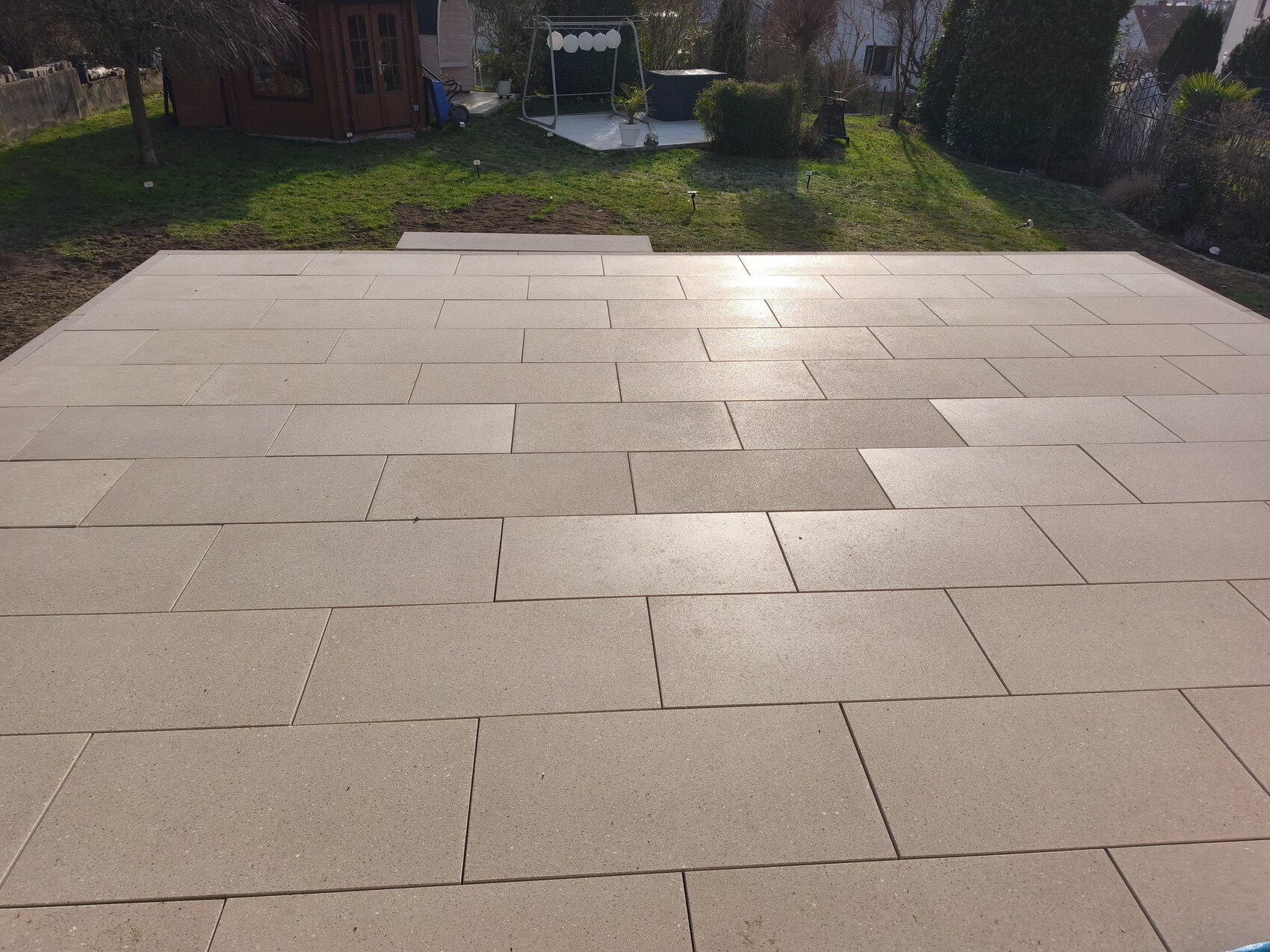
does anyone have an idea why the patio slabs look so different?
Is the coating missing?
Can this be repaired?
These are slabs from the company Rinn in Heuchelheim.
Thanks for your help!
Hi,
It’s easy to see how individual panels reflect sunlight differently. This can happen if the batch wasn’t completely uniform. It then looks as if a coating is missing, although it’s usually just variations in density or a slightly different water-cement ratio from Rinn. In theory, it’s possible to do touch-ups, but in practice, it’s rarely done because any impregnation will cause stains later, creating another “patchwork” effect in a different area. It’s worth giving Rinn a quick call; hopefully, they will be accommodating in such cases.
What do you think, @KlaRa?
It’s easy to see how individual panels reflect sunlight differently. This can happen if the batch wasn’t completely uniform. It then looks as if a coating is missing, although it’s usually just variations in density or a slightly different water-cement ratio from Rinn. In theory, it’s possible to do touch-ups, but in practice, it’s rarely done because any impregnation will cause stains later, creating another “patchwork” effect in a different area. It’s worth giving Rinn a quick call; hopefully, they will be accommodating in such cases.
What do you think, @KlaRa?

Well, it is quite clear that two different production batches were installed here.
As a rule, the installer must check during their work (on each unit) whether the batch numbers match, or equivalently, inspect for deviations before installation.
For a layperson, this sounds simple, and depending on the lighting conditions during installation, comparing batch numbers may be more reliable than subjective visual comparison.
After the fact, making improvements without at least partial dismantling seems unlikely to me personally.
How would the appointed expert assess this situation?
First, they would conclude that the reduced gloss level difference in the rear part of the terrace is already significant and this difference is immediately noticeable under normal viewing conditions.
The question of whether and to what extent a complaint is justified must be answered affirmatively.
However, the follow-up question concerns the necessary or reasonable course of action.
A follow-up sealing with a water-based dispersion coating outdoors would be "completely nonsensical," as it cannot provide an effective long-term solution.
A follow-up sealing with a synthetic resin-based coating would be conceivable outdoors, but unless all truly necessary intermediate steps are executed 100% meticulously, the result would fail to meet the client’s expectations after the first seasonal change at the latest.
My recommendation:
Claim compensation for reduced value. In my opinion, requesting a replacement of the tiles would almost certainly lead to a legal dispute.
If we establish the basis for a "diminution in value," which the expert would also have to reference, we might arrive at an amount of about 10 to a maximum of 15% of the material cost.
The questioner now needs to decide how to proceed.
(There are many situations in construction where the client is right but only partially successful—and must therefore grit their teeth firmly. This is also such a situation.)
---------------------------------
Regards to everyone: KlaRa
As a rule, the installer must check during their work (on each unit) whether the batch numbers match, or equivalently, inspect for deviations before installation.
For a layperson, this sounds simple, and depending on the lighting conditions during installation, comparing batch numbers may be more reliable than subjective visual comparison.
After the fact, making improvements without at least partial dismantling seems unlikely to me personally.
How would the appointed expert assess this situation?
First, they would conclude that the reduced gloss level difference in the rear part of the terrace is already significant and this difference is immediately noticeable under normal viewing conditions.
The question of whether and to what extent a complaint is justified must be answered affirmatively.
However, the follow-up question concerns the necessary or reasonable course of action.
A follow-up sealing with a water-based dispersion coating outdoors would be "completely nonsensical," as it cannot provide an effective long-term solution.
A follow-up sealing with a synthetic resin-based coating would be conceivable outdoors, but unless all truly necessary intermediate steps are executed 100% meticulously, the result would fail to meet the client’s expectations after the first seasonal change at the latest.
My recommendation:
Claim compensation for reduced value. In my opinion, requesting a replacement of the tiles would almost certainly lead to a legal dispute.
If we establish the basis for a "diminution in value," which the expert would also have to reference, we might arrive at an amount of about 10 to a maximum of 15% of the material cost.
The questioner now needs to decide how to proceed.
(There are many situations in construction where the client is right but only partially successful—and must therefore grit their teeth firmly. This is also such a situation.)
---------------------------------
Regards to everyone: KlaRa
N
nordanney4 Jan 2026 15:52KlaRa schrieb:
In my view, requesting a replacement of the panels would inevitably lead to legal proceedings.The thread starter purchased the panels themselves and handed them over to an installer. Just for your information.nordanney schrieb:
The thread starter sourced the boards themselves and handed them over to a fitter. It would be helpful if, in the overall consensus, no abbreviations like "TE" are used, which only challenge the reader’s imagination but offer no chance to clarify the unknown term.
nordanney schrieb:
The original poster procured the panels themselves and handed them over to the installer. In the end, it does not matter WHO procured the panels.
What matters is that a work contract (without a supply contract) was made for the installation of the panels.
With this, the installer also assumes responsibility for the proper installation of the panels.
This means: a work contract does not exclude inspection duties of the substrate and the material.
If the panels deviate from the usual appearance (or other material properties), resulting in an undesirable, therefore non-standard installation pattern, the installer MUST raise an objection and refrain from installing the panels.
If further installation was agreed upon with the client (who was informed), it would be wise for the installer to document this in writing beforehand for his own protection...
This is the expert opinion.
-------------------------
Hoping for a result agreeable to all parties: KlaRa
Similar topics