
ᐅ How to Perform a Hydraulic Balancing of a Radiant Floor Heating System Yourself?
Created on: 2 Jan 2026 12:31
J
Jschm88
Hi,
we have been living in our newly built house for a year now, so I thought it was time to optimize the underfloor heating for this second winter.
There are two heating manifolds on two floors, each with several heating circuits. Some of them are controlled by actuators and electronic radiator regulators (ERR), others are not. Overall, the ground floor tends to be slightly too warm, and the upper floor a bit too cool.
I understand the basic concept of balancing: open everything, lower the heating curve, and then fine-tune. But how do I do this precisely?
we have been living in our newly built house for a year now, so I thought it was time to optimize the underfloor heating for this second winter.
There are two heating manifolds on two floors, each with several heating circuits. Some of them are controlled by actuators and electronic radiator regulators (ERR), others are not. Overall, the ground floor tends to be slightly too warm, and the upper floor a bit too cool.
I understand the basic concept of balancing: open everything, lower the heating curve, and then fine-tune. But how do I do this precisely?
- Topic "Opening everything": Where I have room thermostats, I set them to the maximum. This causes the associated actuator on the heating manifold to open the circuit. But I also have circuits without actuators. Do I need to open these as well? Do I just remove the orange cap and loosen the screw with a wrench (see photo)? Do I need to do anything with the flow meters in this process?
- Topic heating curve: How do I handle this for the two floors? There is only one heating curve. Do I turn everything up at both heating manifolds on ground and upper floors at the same time, or do I proceed floor by floor?
- Topic fine-tuning: In the end, do I close the circuits where necessary that I opened under point 1), or do the circuits stay open, and the adjustment is done via the flow meters (this would make more sense to me)? So, at the end, do I have permanently open circuits that I adjust with the flow meters / flow rate? Can anything go wrong if I open everything fully?
Thanks a lot!!
Hello everyone, thank you very much for the many helpful responses. I now understand the principle, which your posts have confirmed.
My question now is exactly which part of the distribution box I need to adjust 🙂
So, I turn up the room controllers, that’s clear.
Now, I still have pipes without controllers that are sealed with red caps. You say to remove the caps and also use an open-end wrench to open here, correct?
But before that, a pressure relief valve should be closed? Where can I find this in my photo?
And: should I do this procedure on both floors at the same time or one after the other?
Let me first try this with your tips and then I will ask more questions 🙂
Thank you very much!
My question now is exactly which part of the distribution box I need to adjust 🙂
So, I turn up the room controllers, that’s clear.
Now, I still have pipes without controllers that are sealed with red caps. You say to remove the caps and also use an open-end wrench to open here, correct?
But before that, a pressure relief valve should be closed? Where can I find this in my photo?
And: should I do this procedure on both floors at the same time or one after the other?
Let me first try this with your tips and then I will ask more questions 🙂
Thank you very much!
R
RotorMotor2 Jan 2026 20:06Jschm88 schrieb:
So, I’ll turn up the room controllers, of course. I don’t think that’s such a good idea.
I would remove them and disconnect the power.
Jschm88 schrieb:
Right now, I have pipes without controllers that are capped in red. You say remove the caps and use an open-end wrench to open them here as well, correct? Why?
If the rooms are warm enough, I wouldn’t open them.
That’s why I initially asked whether HAR, etc., should be left unheated.
It also looks like two of them are not in use.
Why would you want to open those?!
Jschm88 schrieb:
But there should be an overcurrent valve closed before that? Where can I find it in my picture? That shouldn’t be necessary if all circuits are open.
Jschm88 schrieb:
And: should I do this procedure on both floors at the same time or one after the other? At the same time.
Hi,
As a first step, I would leave the room controllers as they are. It’s simply faster, and there are probably supporters of this approach. I can always change it later.
All circuits are assigned. In the upper floor, there are also circuits without room controllers that don’t get warm enough. So, at the latest there, I need to know how to open the heating circuit. Is my description above correct?
And what do I need these flow meters for if I open everything with a wrench? Are they relevant later for fine-tuning?
As a first step, I would leave the room controllers as they are. It’s simply faster, and there are probably supporters of this approach. I can always change it later.
All circuits are assigned. In the upper floor, there are also circuits without room controllers that don’t get warm enough. So, at the latest there, I need to know how to open the heating circuit. Is my description above correct?
And what do I need these flow meters for if I open everything with a wrench? Are they relevant later for fine-tuning?
R
RotorMotor2 Jan 2026 20:34Jschm88 schrieb:
As a first step, I would keep the room thermostats in place. It’s just faster, and some people support that approach. I can always adjust it later. Normally, you set the flow rate at the valve under the actuator.
So those will have to come off anyway, right?
But it’s also possible that for your system, you can and should adjust it at the flow meters.
Check the manual.
Jschm88 schrieb:
All circuits are assigned. On the upper floor, there are also circuits without room thermostats that aren’t warm enough. At the latest then, I need to know how to turn up the heating circuit. Is my description above correct? Usually, those are open if the yellow cap is removed.
Why is that cap even there in some rooms, and why are the actuators missing?
If the rooms are completely closed off by the yellow caps, it’s clear that they won’t be warm enough, right?
Jschm88 schrieb:
And what do I need these flow meters for if I just open everything with an open-ended wrench? Are they relevant later for fine-tuning? They help you see whether the flow matches your expectations or your design plans.
But what exactly do you want to do with an open-ended wrench?
I understand that the yellow caps are only there for protection. I can easily unscrew them. Underneath is a thread that can be opened or closed with a wrench. Someone else in this thread described it the same way. But as I said, I have no experience.
I only have actuators on loops where there are also room controllers. For example, there are no controllers in the bathrooms, which is apparently common. So in those cases, I would have to open and close the valve with a wrench?
I can also open and close the flow meters to increase or decrease the flow. So I’m wondering what the difference is compared to turning the screw under the actuators.
I only have actuators on loops where there are also room controllers. For example, there are no controllers in the bathrooms, which is apparently common. So in those cases, I would have to open and close the valve with a wrench?
I can also open and close the flow meters to increase or decrease the flow. So I’m wondering what the difference is compared to turning the screw under the actuators.
RotorMotor schrieb:Well, when I open the room controllers, the actuators ensure that there is flow. So I don’t have to unscrew them for that, right?
Normally, the flow is adjusted at the valve below the actuator.
So you have to remove them anyway?!
Hi everyone,
I have now got a key, removed the orange caps, and… I see that all the circuits were open! The pins are visible from the top. To check, I also removed an actuator, and here the pin was at the same height with the room thermostat open… so – everything is open! Yet it still feels a bit chilly upstairs with a high heating curve!
How does it work with the flow meters? They affect each other because the total water volume remains constant, right? So if I simply have two flow meters and fully open one, the water flow in the other decreases—in my case at least. What setting should I initially set all the flow meters to? Fully open? At the moment, they are just above minimum (there are 12 in total per floor).
What do you think? Is it okay to leave it like this for now and wait? But actually, I don’t see the potential to lower the heating curve… and it was apparently too cold in the upper floor with open circuits at the current high curve.
This made me think that the system pressure might need to be increased? It is in the minimal but still in the green range; photos attached!
Thanks to everyone who can help!
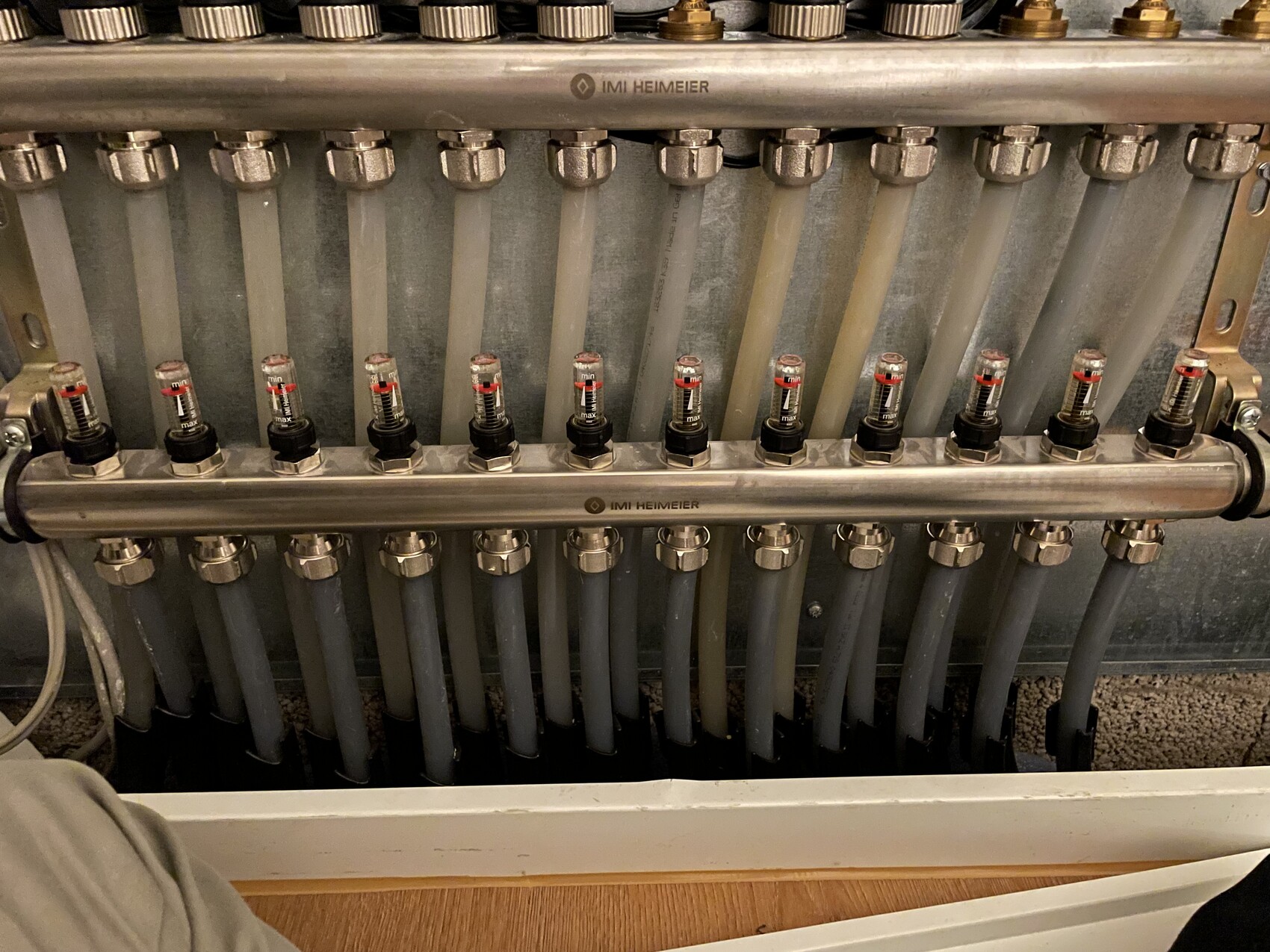

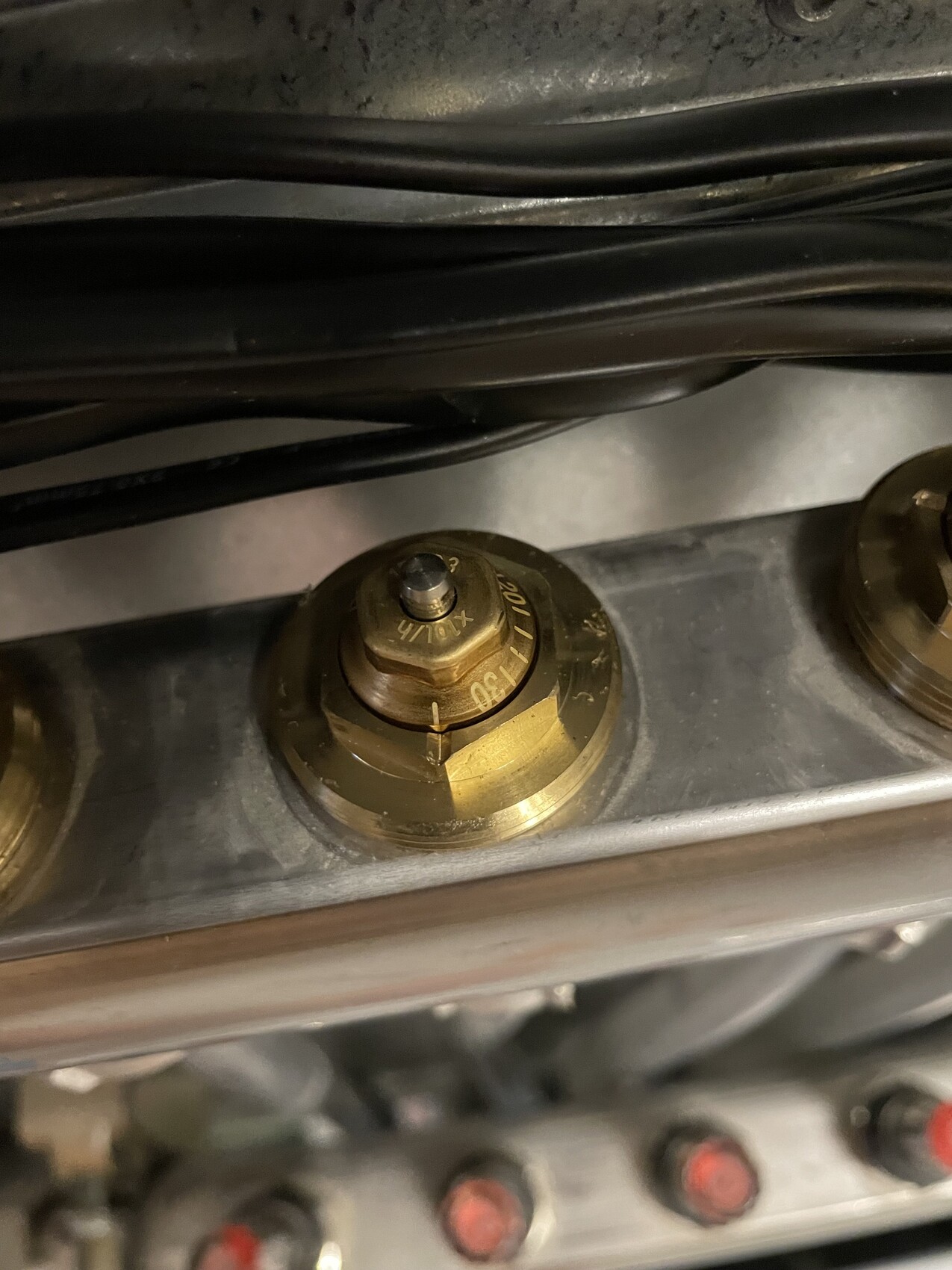
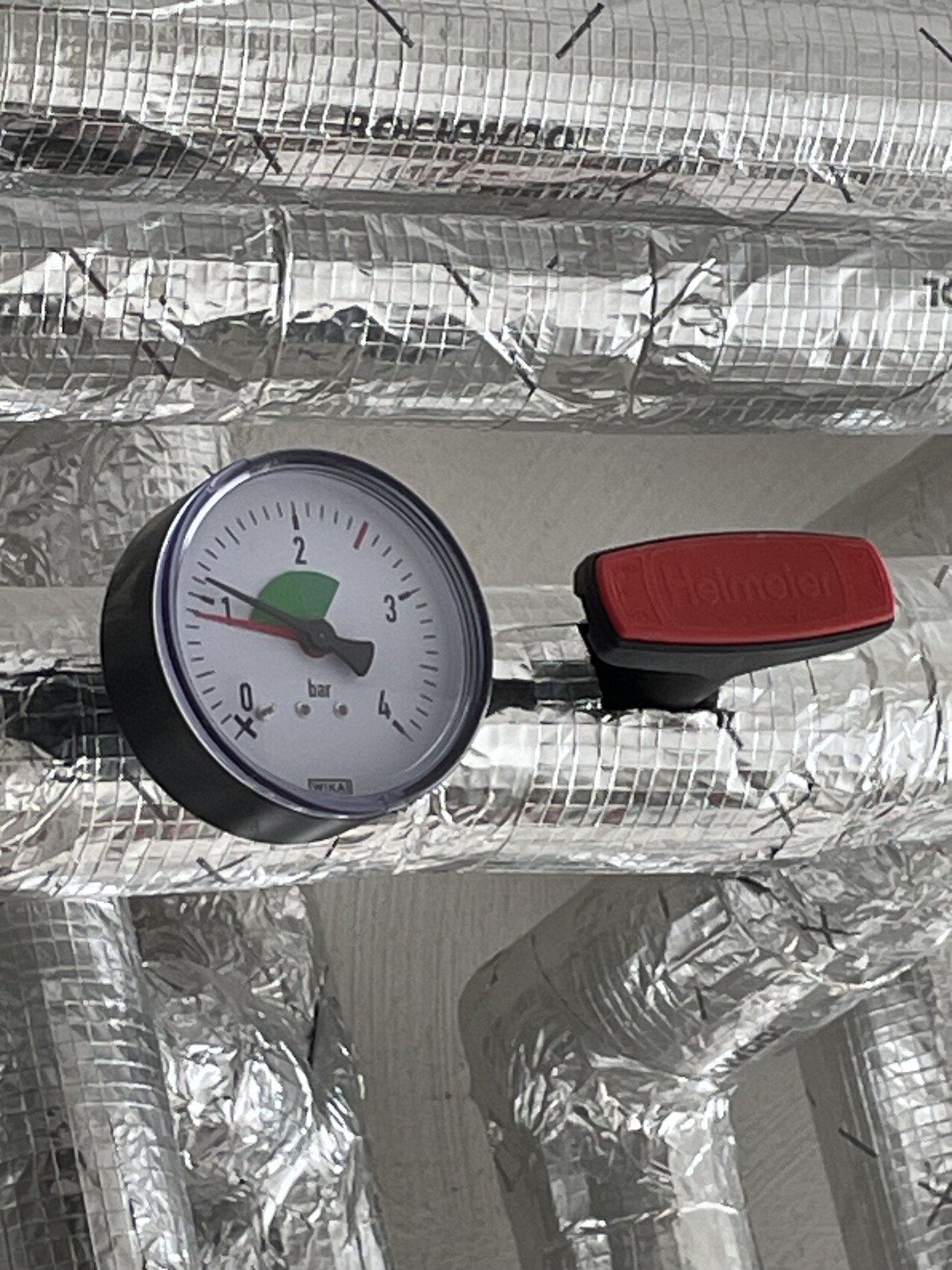
I have now got a key, removed the orange caps, and… I see that all the circuits were open! The pins are visible from the top. To check, I also removed an actuator, and here the pin was at the same height with the room thermostat open… so – everything is open! Yet it still feels a bit chilly upstairs with a high heating curve!
How does it work with the flow meters? They affect each other because the total water volume remains constant, right? So if I simply have two flow meters and fully open one, the water flow in the other decreases—in my case at least. What setting should I initially set all the flow meters to? Fully open? At the moment, they are just above minimum (there are 12 in total per floor).
What do you think? Is it okay to leave it like this for now and wait? But actually, I don’t see the potential to lower the heating curve… and it was apparently too cold in the upper floor with open circuits at the current high curve.
This made me think that the system pressure might need to be increased? It is in the minimal but still in the green range; photos attached!
Thanks to everyone who can help!