
ᐅ Single-family house ~200 m² floor plan design on a gentle slope
Created on: 23 Dec 2025 17:18
H
huhxkux
Development Plan / Restrictions
Plot size: 512 m² (5509 sq ft)
Slope: Yes
Site coverage ratio: 0.4
Floor area ratio: N/A
Building setback lines, building line, and boundaries: See overview
Edge development: N/A
Number of parking spaces: 3
Number of floors: 2
Roof type: Gable roof
Architectural style: N/A
Garden orientation: West
Maximum heights / limits: 9 m (30 ft) ridge height from a specific terrain point on the plot
Additional requirements
Client Requirements
Style, roof type, building type: Single-family house, 2 full floors, gable roof
Basement, floors: Basement yes, 2 full floors
Number of occupants, ages: Currently 3, soon 4, planned 5 → Persons: 2 adults over 30, 1 child (1 year), 1 unborn, 1 planned
Room requirements on ground floor (GF), upper floor (UF):
GF: Kitchen (with pantry if possible), dining area, living room, toilet, utility room.
UF: 3 children’s rooms, 1 storage room.
GF or UF: Parents’ area with private bathroom, office
Office use: Family use or home office? Home office
Guest stays per year: About 40 nights per year (3x parents and siblings live far away)
Open or closed architecture: Open?
Conservative or modern construction style: ???
Open kitchen, kitchen island: Open kitchen with kitchen island desired
Number of dining seats: 8
Fireplace: No
Music / stereo wall: Yes, near the TV
Balcony, roof terrace: No
Garage, carport: Yes, 1 garage in the house and either another garage or carport next to the house
Utility garden, greenhouse: No
Additional wishes / special features / daily routine, also reasons why some things should or should not be: N/A
House Design
Planning by: Architect
What do you like most? Why? We like almost everything in the floor plan very much, especially the option to use the office upstairs while the children are small and move the office downstairs, and then later move it back downstairs when the children are older.
What do you not like? Why? Only minor details that we would still like to adjust. As nothing will be revised over Christmas, feel free to point out anything we might have missed.
Price estimate by architect/planner: €790,000 including additional costs / photovoltaic / kitchen / driveway / terrace, excluding finished basement apartment
Personal price limit for the house including features: €800,000
Preferred heating system: Air-to-water heat pump
If you have to give up on certain details / expansions
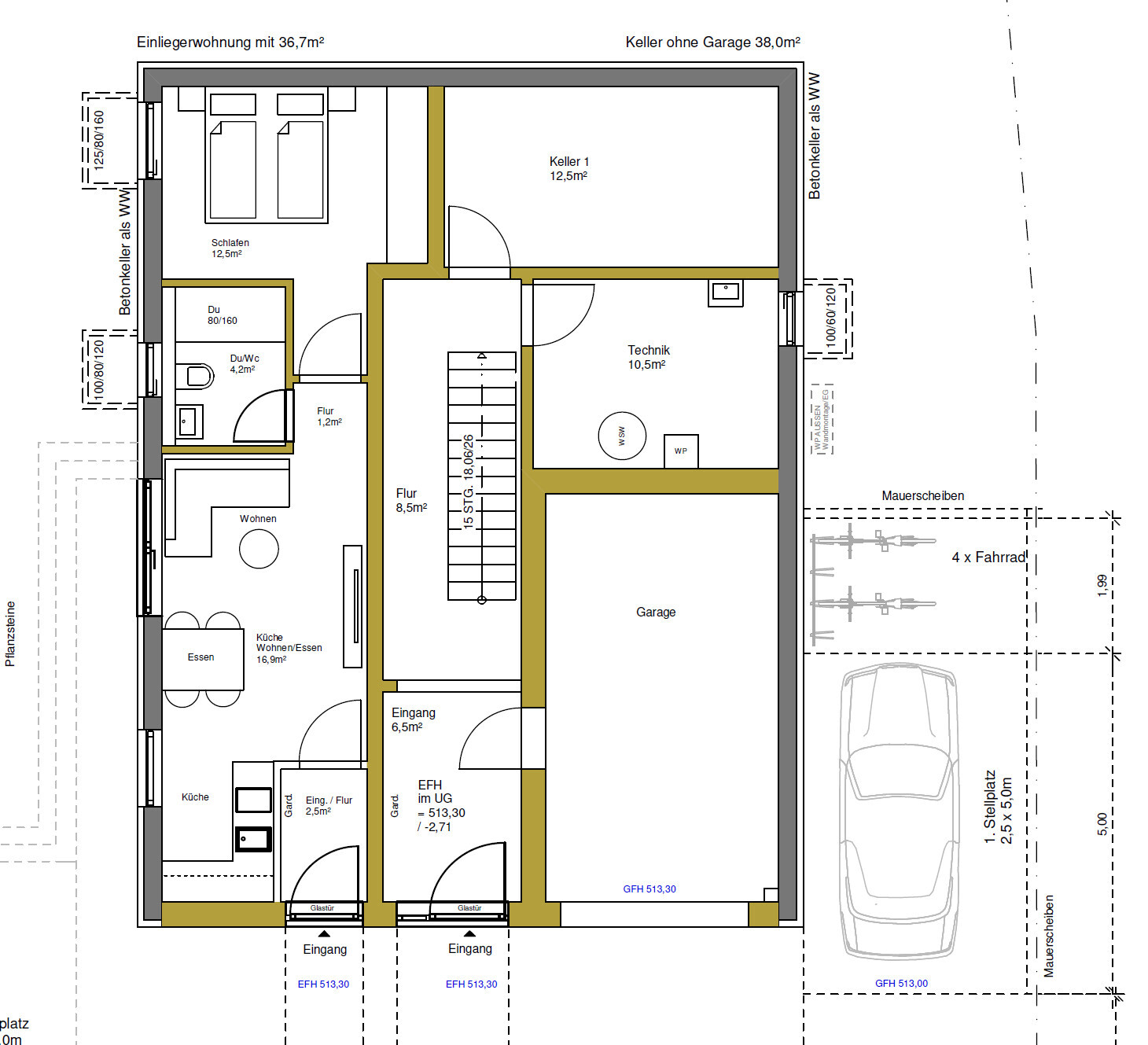
- What can you do without: Basement (but ideally not because of the slope), basement apartment (guest room would otherwise suffice)
- What you cannot do without: 2 shower bathrooms for parents/children, straight staircase
Why did the design turn out as it is now?
For example:
At first, we really wanted to build simply without a basement to avoid exceeding our budget. The initial plans, however, had very steep driveways or the driveway was on the south side. Since we have been reading intensively here for many months, we decided to hire a surveyor because of the slight slope to clarify the planning. And yes, what can I say—our plot became a victim of the “11ant’s basement rule” 😱. Consequently, we continued planning, a bit smaller but this time with a basement. As we do not really need the space in the basement, we now have a basement apartment prepared for finishing, where we would initially only complete the bathroom and finish the rest ourselves. To have a parking space already, the garage was placed inside the house.
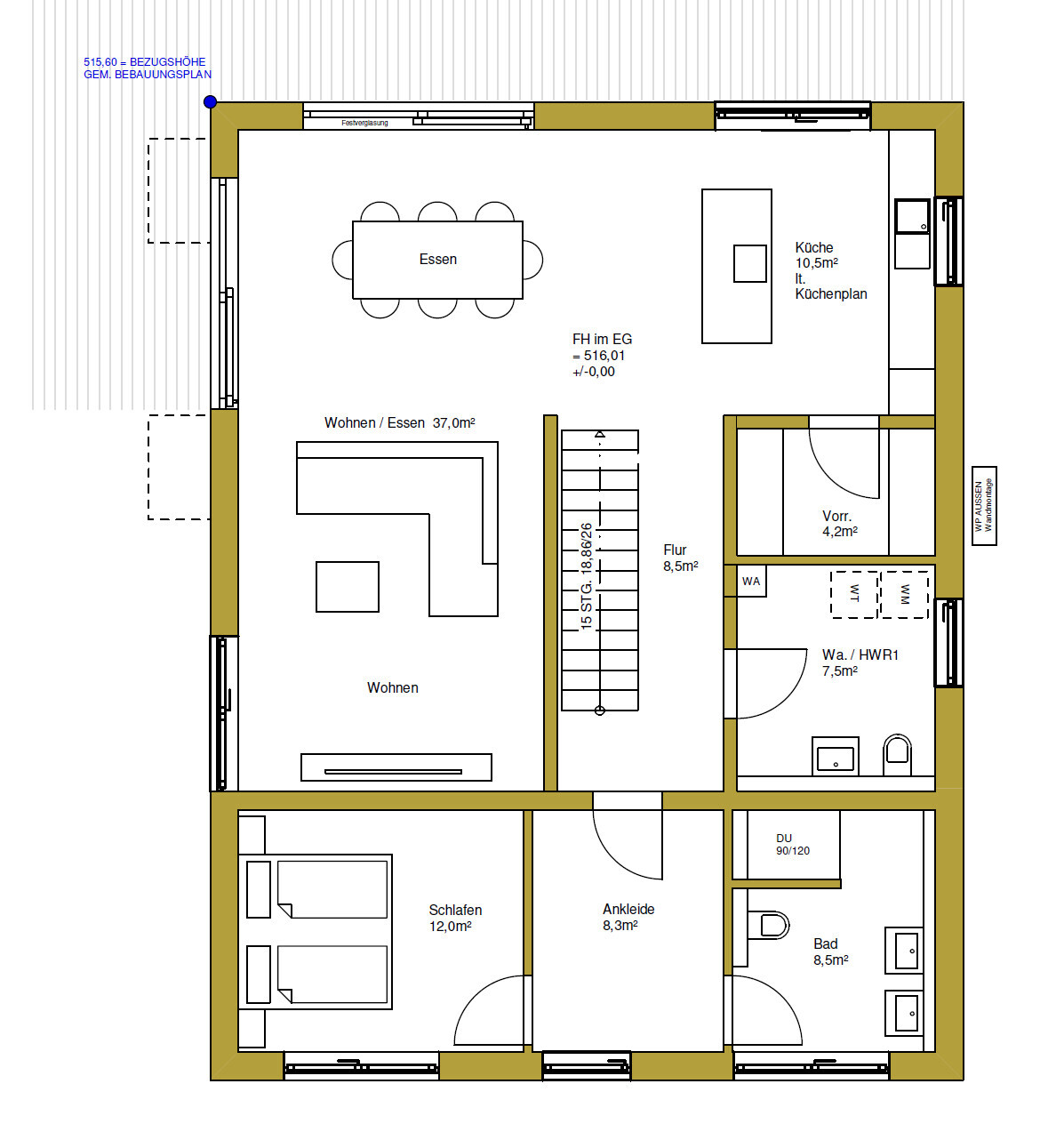
We thought a lot about whether we wanted a proper hallway. In the end, we left it open in the current plan because the designs with a hallway made the kitchen and dining areas feel very tight.
The furniture positions in the floor plan are only examples, and we would probably still adjust a few things, for example, arranging the kitchen in an L-shape with a passage through a cabinet to the pantry, or possibly placing the sofa more in the corner of the living room and slightly moving the corresponding window with a lower sill height forward. Also, the terrace should only be on the west side with doors leading out from both the kitchen and dining area. The south side of the dining area would have a fixed window only.
Since we are now slowly moving towards signing the contract, I would like to get your feedback on whether it makes sense to change or add anything and include it in the offer, or if we should reconsider the floor plan entirely.
Thank you very much in advance for your feedback!
UG:
GF:
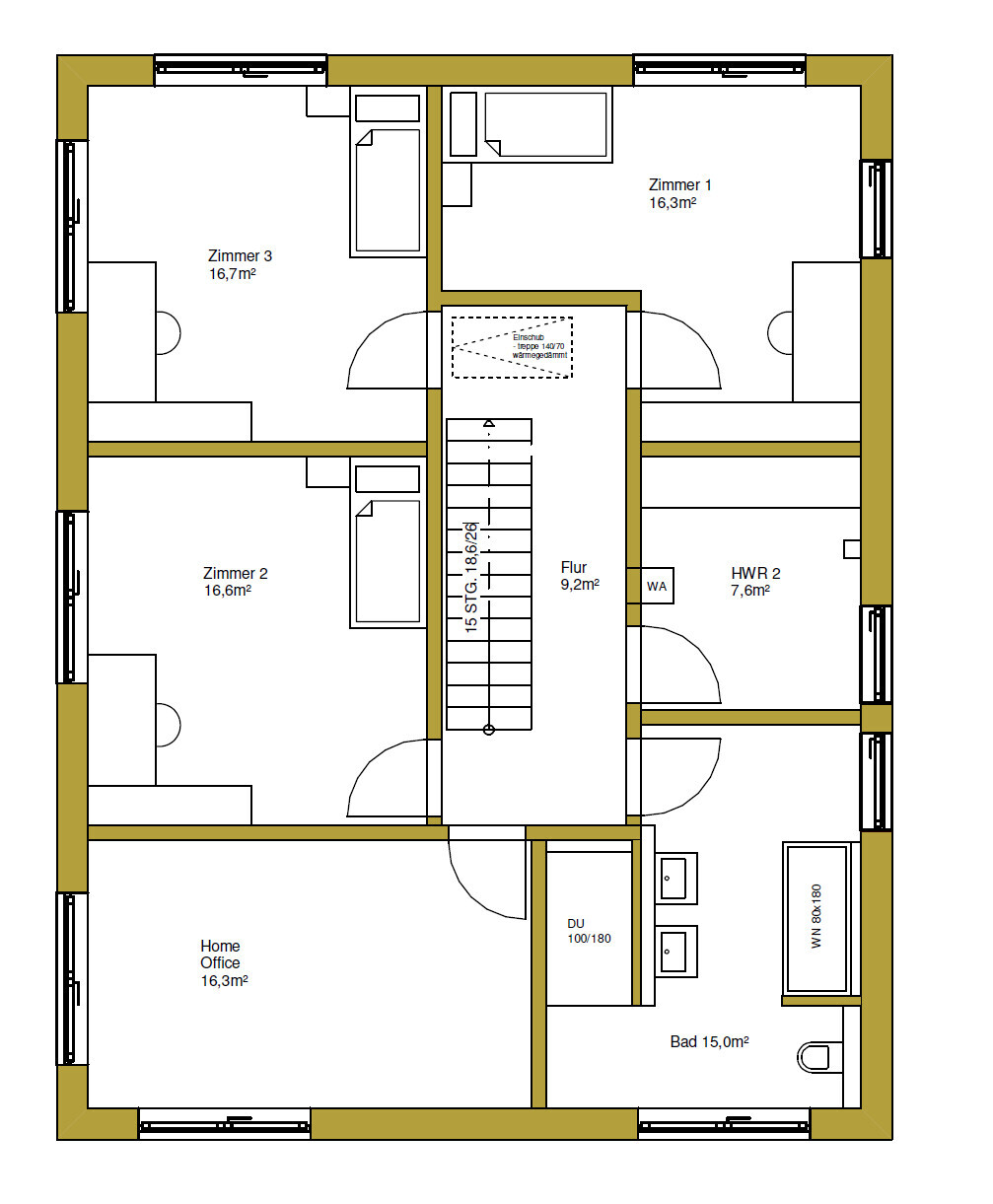
UF:
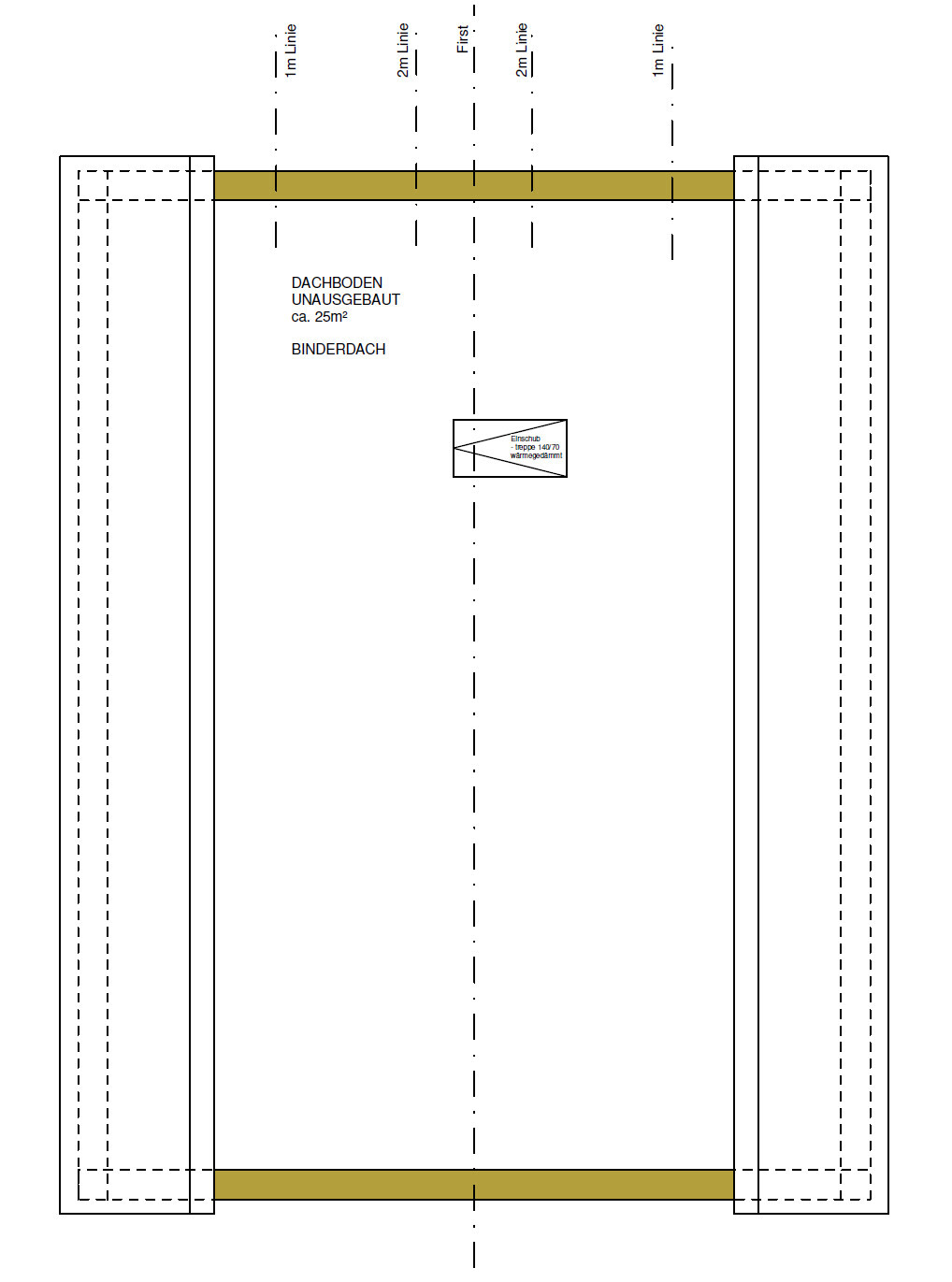
Attic:
North view:
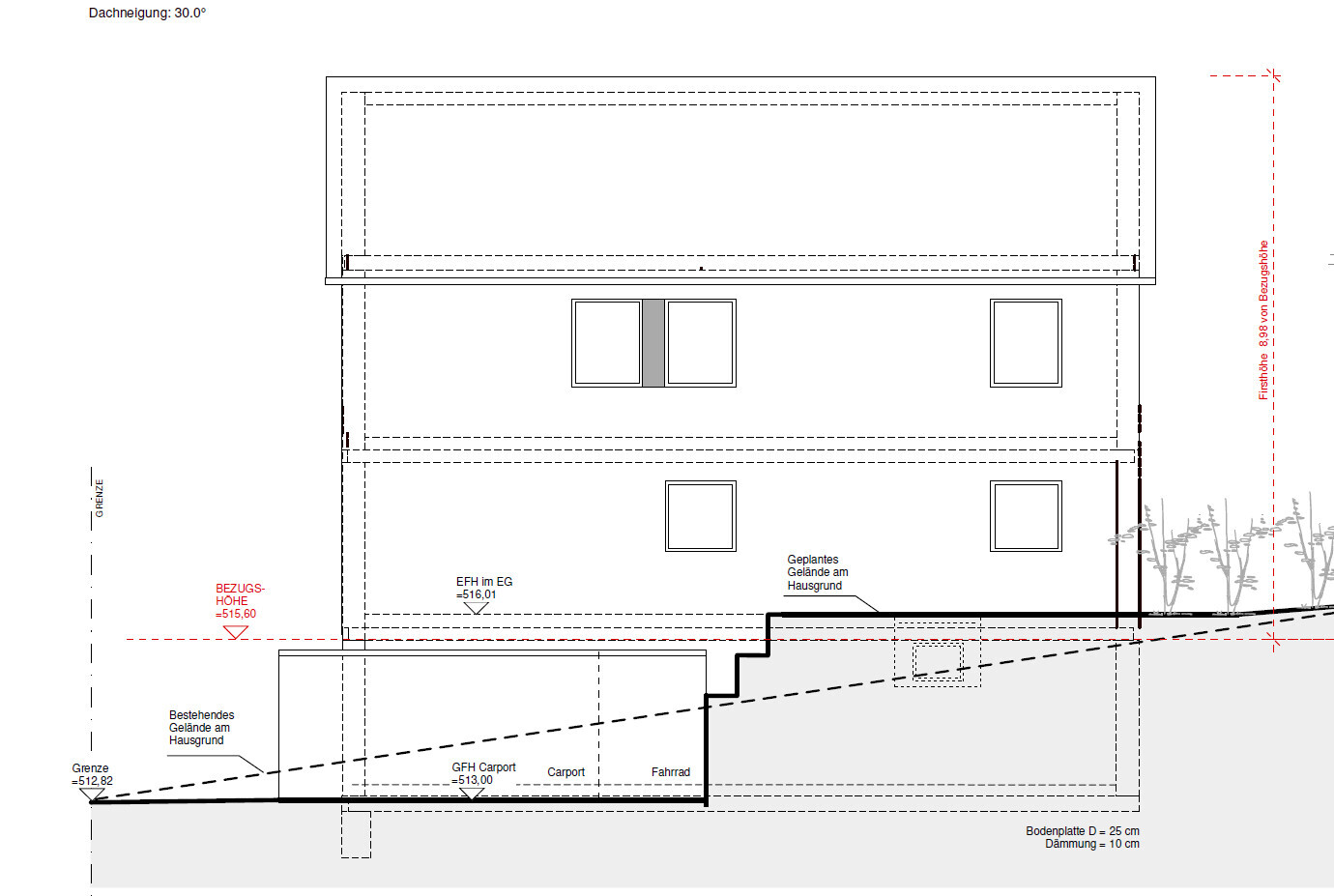
East view:
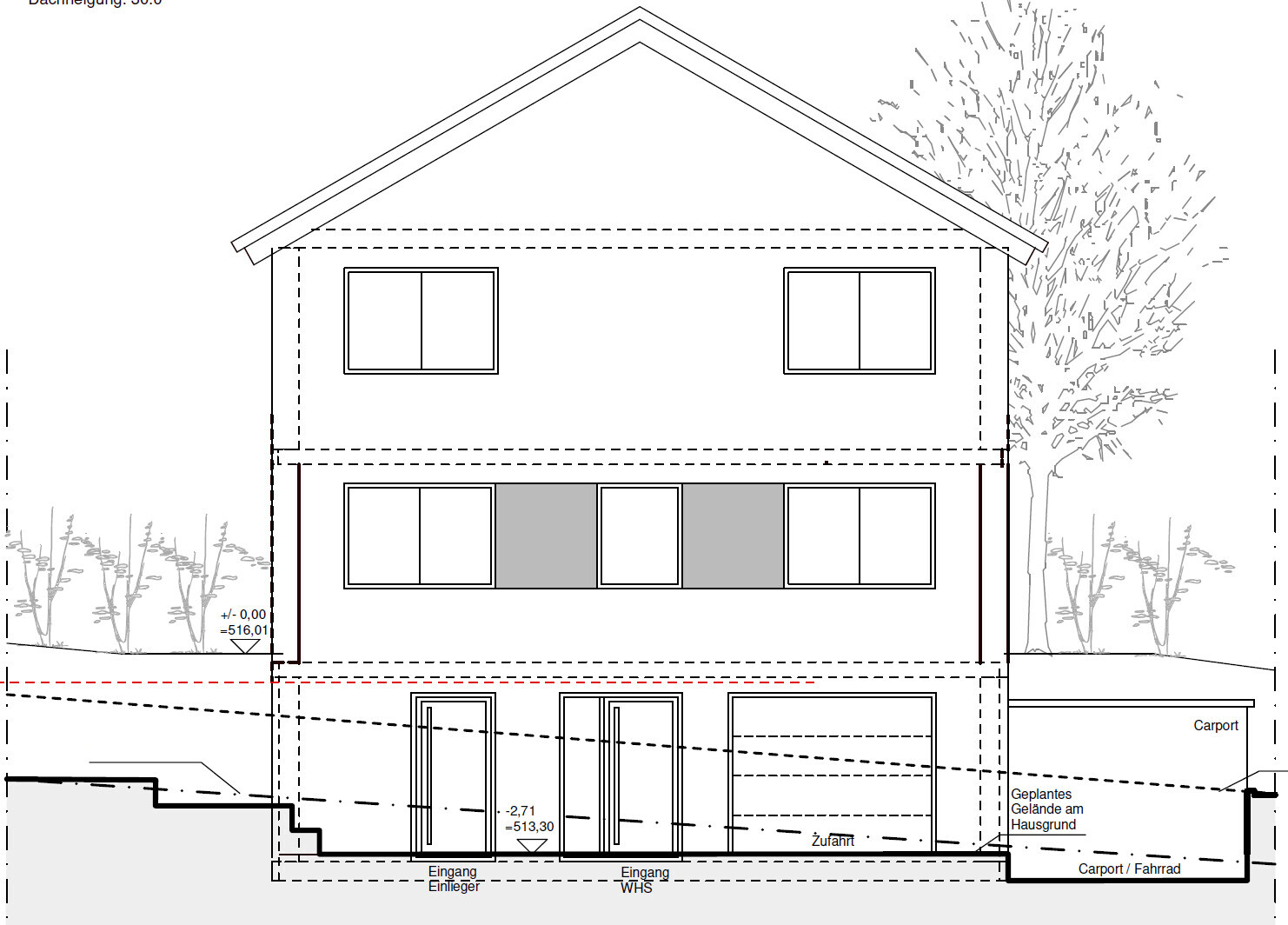
South view:
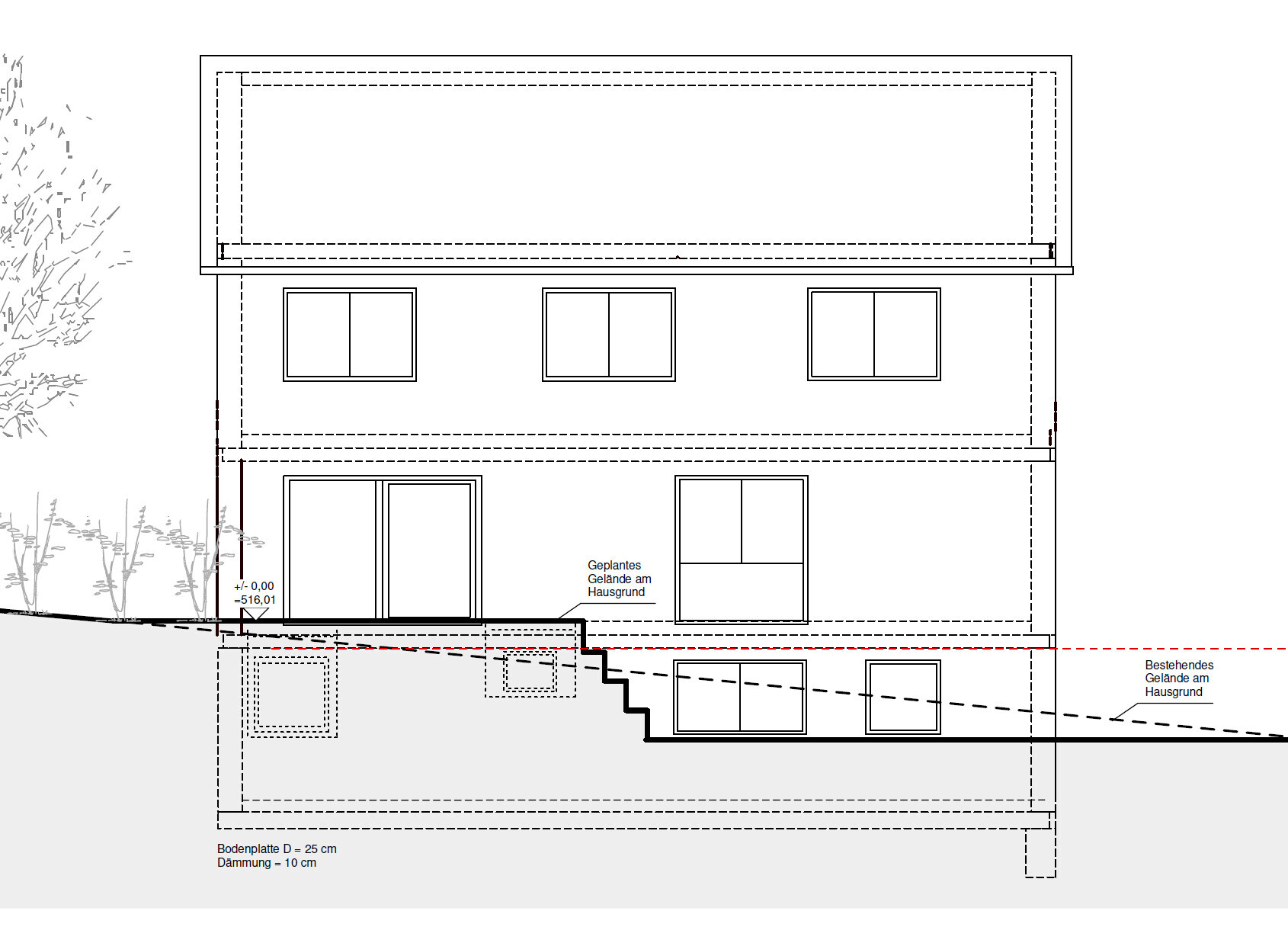
West view:
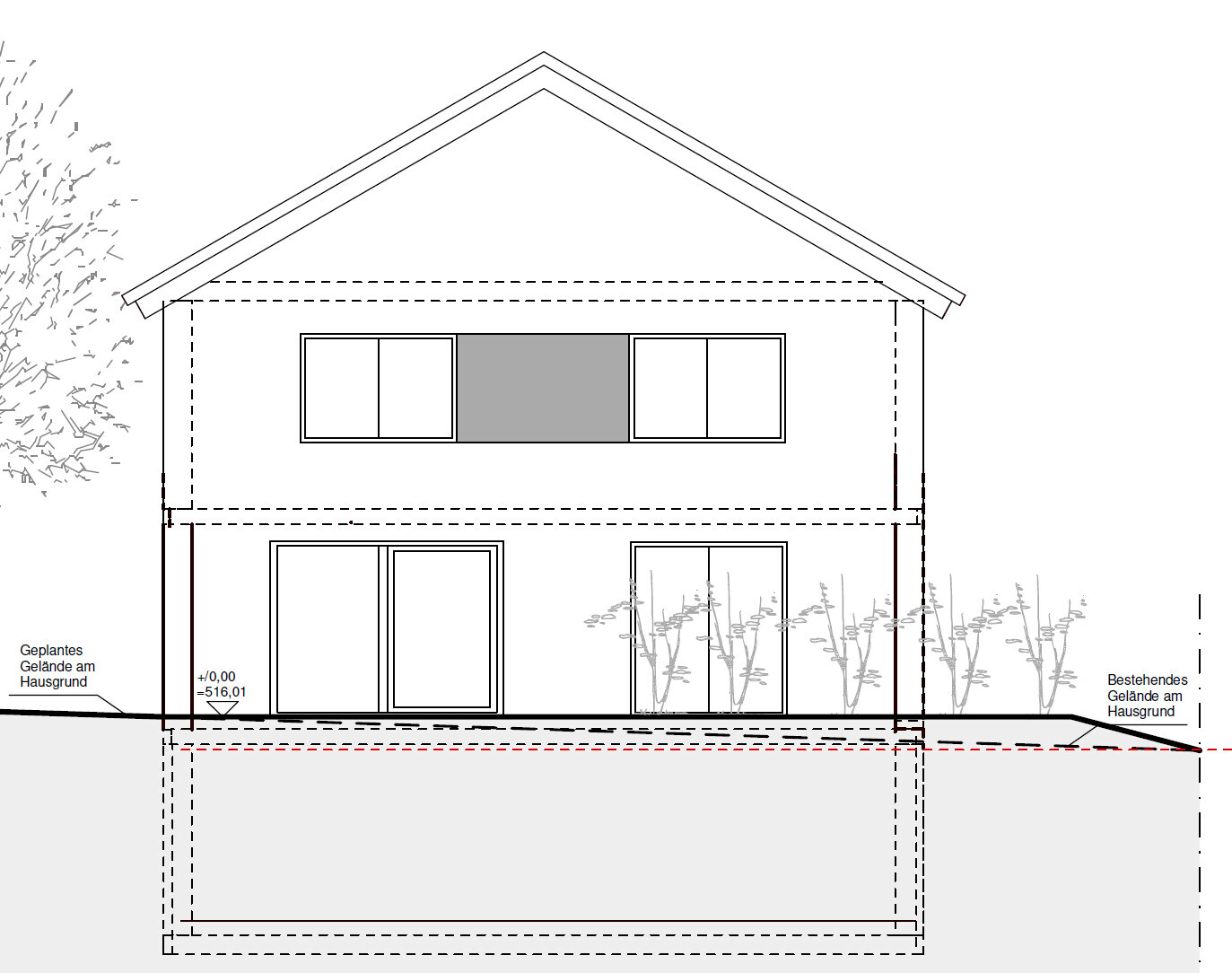
Plot size: 512 m² (5509 sq ft)
Slope: Yes
Site coverage ratio: 0.4
Floor area ratio: N/A
Building setback lines, building line, and boundaries: See overview
Edge development: N/A
Number of parking spaces: 3
Number of floors: 2
Roof type: Gable roof
Architectural style: N/A
Garden orientation: West
Maximum heights / limits: 9 m (30 ft) ridge height from a specific terrain point on the plot
Additional requirements
Client Requirements
Style, roof type, building type: Single-family house, 2 full floors, gable roof
Basement, floors: Basement yes, 2 full floors
Number of occupants, ages: Currently 3, soon 4, planned 5 → Persons: 2 adults over 30, 1 child (1 year), 1 unborn, 1 planned
Room requirements on ground floor (GF), upper floor (UF):
GF: Kitchen (with pantry if possible), dining area, living room, toilet, utility room.
UF: 3 children’s rooms, 1 storage room.
GF or UF: Parents’ area with private bathroom, office
Office use: Family use or home office? Home office
Guest stays per year: About 40 nights per year (3x parents and siblings live far away)
Open or closed architecture: Open?
Conservative or modern construction style: ???
Open kitchen, kitchen island: Open kitchen with kitchen island desired
Number of dining seats: 8
Fireplace: No
Music / stereo wall: Yes, near the TV
Balcony, roof terrace: No
Garage, carport: Yes, 1 garage in the house and either another garage or carport next to the house
Utility garden, greenhouse: No
Additional wishes / special features / daily routine, also reasons why some things should or should not be: N/A
House Design
Planning by: Architect
What do you like most? Why? We like almost everything in the floor plan very much, especially the option to use the office upstairs while the children are small and move the office downstairs, and then later move it back downstairs when the children are older.
What do you not like? Why? Only minor details that we would still like to adjust. As nothing will be revised over Christmas, feel free to point out anything we might have missed.
Price estimate by architect/planner: €790,000 including additional costs / photovoltaic / kitchen / driveway / terrace, excluding finished basement apartment
Personal price limit for the house including features: €800,000
Preferred heating system: Air-to-water heat pump
If you have to give up on certain details / expansions
- What can you do without: Basement (but ideally not because of the slope), basement apartment (guest room would otherwise suffice)
- What you cannot do without: 2 shower bathrooms for parents/children, straight staircase
Why did the design turn out as it is now?
For example:
At first, we really wanted to build simply without a basement to avoid exceeding our budget. The initial plans, however, had very steep driveways or the driveway was on the south side. Since we have been reading intensively here for many months, we decided to hire a surveyor because of the slight slope to clarify the planning. And yes, what can I say—our plot became a victim of the “11ant’s basement rule” 😱. Consequently, we continued planning, a bit smaller but this time with a basement. As we do not really need the space in the basement, we now have a basement apartment prepared for finishing, where we would initially only complete the bathroom and finish the rest ourselves. To have a parking space already, the garage was placed inside the house.
We thought a lot about whether we wanted a proper hallway. In the end, we left it open in the current plan because the designs with a hallway made the kitchen and dining areas feel very tight.
The furniture positions in the floor plan are only examples, and we would probably still adjust a few things, for example, arranging the kitchen in an L-shape with a passage through a cabinet to the pantry, or possibly placing the sofa more in the corner of the living room and slightly moving the corresponding window with a lower sill height forward. Also, the terrace should only be on the west side with doors leading out from both the kitchen and dining area. The south side of the dining area would have a fixed window only.
Since we are now slowly moving towards signing the contract, I would like to get your feedback on whether it makes sense to change or add anything and include it in the offer, or if we should reconsider the floor plan entirely.
Thank you very much in advance for your feedback!
UG:
GF:
UF:
Attic:
North view:
East view:
South view:
West view:
huhxkux schrieb:
Although with the fast process we could have a building permit around early February, Rushing and impatience have never been good advisors.
huhxkux schrieb:
As mentioned, we would like to have 2 spaces that are protected from snow, frost, and sun. A carport can also serve this purpose well. Compared to a garage, a carport has the advantage that nothing rusts quickly because the airflow helps everything dry faster. In older houses from the 1960s, where garages are built into the basement, people nowadays tend to convert these garages because they consume a lot of energy. However, these garages were integrated into the house rather than being insulated from the rest of the building.
However, since you have a slope, you need to make the best of the situation. Expanding sideways is not an option, so make the most of the basement: with three children, you will need a spacious room accessible from the outside, for the kids’ vehicles. Your bicycles would also be well stored there. You should think more about everyday practicalities. This applies to coming home, going out, meals, sleep and illness, as well as evening routines and garden work.
I would also recommend setting the basement a bit further inside to automatically create a covered entrance area and add some structure to the facade.
huhxkux schrieb:
But I can quite imagine coming up from below and not standing in a hallway, but directly in the living area. Sure, but then shoes should be off and all coats put away.
As I mentioned before: a shower toilet and guest room/office in the basement. I would go further: the pantry should also not be far from the bottom of the stairs! Because somewhere the drink crates and canned goods need to go if you don’t want to carry everything upstairs right away. If you space out the children’s births, you will have years to focus on better things than immediately lugging groceries upstairs.
And when the teenage kids come home in the evening with friends, they should be properly dressed — that’s the price for having a staircase that opens into the living room.
huhxkux schrieb:
The children’s rooms could be 1m² smaller eventually, but since we are building new, we don’t want to cut too much on size. Good point. But it applies less to children’s rooms. Whether 15 or 16 square meters doesn’t really matter. Kids are more likely to complain about teachers, pocket money, or parenting styles than argue over one or two square meters.
huhxkux schrieb:
And yes, the upstairs bathroom is very large, but it should also have enough space for bathroom cabinets and accommodate up to 5 people at the same time. Children don’t need bathroom cabinets. They need space to place their toothbrushes. Towel ownership or cream jars are usually shared within the family at first. For items like acne cream or small personal products, you don’t need cabinets but just some space inside a cabinet. Assigning each child a drawer is already very generous. Personally, I find storage space next to the washbasin very convenient.
huhxkux schrieb:
I’m curious to see what the kitchen studio says about the size. The question is really how much too small the kitchen is? That can’t be answered generally.
huhxkux schrieb:
Yes, my first quick sketch was a bit counterproductive. Here it is more accurately drawn. We will discuss these details in the kitchen studio. But even at the kitchen studio, they will only design the kitchen perfectly to fit the space. I return to your argument: if you are building new, the kitchen should serve its purpose well and suit your needs.
A pantry is for food storage but also for storing appliances you don’t use often.
As a rough guideline for the kitchen: one 60cm (24 inch) tall cabinet for ceramics, one for oven and cooking equipment, and one for the refrigerator. Approximately 120cm (47 inches) length for the sink, waste bin, and dishwasher.
Wall cabinet for glasses and cups. What else is needed: roughly the size of a 60cm (24 inch) base cabinet for easily accessible storage for spices, vinegar/oil, drawers for cutlery, wraps and foil, one for handheld appliances, one for storage containers, one for mixing bowls, one for cookbooks and miscellaneous items (sets, napkins, etc.). But I assure you, these are minimum or rough guidelines. For example, we need more space for pots and pans because the tall cabinet contains two appliances, but pots and pans are more numerous. We also need more ceramics because I am a fan of tableware. The rule is: everything you use daily should fit in the kitchen. Some people always want their Thermomix (or similar) within reach. Maybe now an air fryer belongs there too. Kitchen needs and cooking habits change.
Work surface: You should review your doubled work surface on the island based on your usage. Our depth is only 95cm (37 inches), but for me it’s a no-go to cut bread there (because of crumbs) in the dining area. Also, chopping far from the sink should be carefully considered. If you want a 90cm (35 inch) stove and like symmetry, you only have 45cm (18 inches) on each side. Is that enough to chop and prepare a baking tray? If the sink, coffee machine, kettle, and baby food maker stand next to each other, it can get cramped for a sandwich.
Bread: we keep it accessible in our food cabinet. With five people, you don’t store bread or the fruit basket in the pantry anymore.
And @Arauki11 seems to have the same challenge as I do: individual dietary requirements—lactose intolerance, other intolerances, one teenager wants protein shakes, another is vegan, and the head of the household only eats sugar-free. Maybe then the housekeeper likes to hide in the pantry to enjoy their diet secretly, while the rest of the kitchen surface is full of shakers, protein powders, supplements, and all sorts of stuff 😉 As I said: everyday items in the kitchen; groceries in the pantry.
If a dog moves in later, you could plan an extra 40cm (16 inch) base cabinet for treats, bowls, etc. The 10 kg (22 lb) bags can go in the pantry. I don’t want to exaggerate, but for us the problem was that after moving in I bought my first kitchen machine, and over 10 years, both nutrition and kitchen habits changed so much that space became tight. This is not personal, but simply the way time passes, and the kitchen is the heart of the house.
So, assess what you currently use and what might be added later. A lightweight wall between kitchen and pantry makes it easier to open up the space later.
Combining pantry and utility room is also a good solution, but I would do it without toilet access — guests can use a toilet one floor down or your own.
 Papierturm28 Dec 2025 08:11
huhxkux schrieb:
Regarding the budget:
Which items would presumably be significantly higher here? We calculated the costs for the house with a construction company that offered us a fixed price including earthworks but excluding excavation. We then planned an additional €60,000 for excavation, utility connections, building permit / planning permission, temporary construction power and water, barriers, crane, and construction fence. And then there are the costs for the driveway, photovoltaic system, kitchen, as well as materials and foundations for the outdoor garden area, where we will carry out the work ourselves.
Thanks again for all the great contributions! Just briefly because I’m on my phone:
It really depends on how the contract is written.
Often, certain quantities, working hours, and ground conditions (e.g., specific soil classes, groundwater levels, etc.) are assumed.
If there are deviations, it becomes more expensive. The reason is (almost always) the owner’s risk!
Therefore, it’s best to have a soil report done as soon as possible. At least then you can say later, “it was known.”
But even that doesn’t protect against quantities that are underestimated in the contract.
Papierturm28 Dec 2025 10:14And PS, since posts cannot be edited:
Make sure to factor in the disposal of excavated soil!
You can try calculating it yourself for fun. Without a slope (which makes it cheaper) and based on disposal costs here (rather mid-range) and assuming Z0 (top disposal category), I come to around €35,000 just for soil disposal. However, the slope significantly reduces costs. Possibly between €20,000 and €25,000? You would need to calculate that using the height measurements.
If it is not Z0, the costs could rise accordingly. Here in this area: Z1 about 30% more, Z1.2 about 50% more, Z2 about 150% more.
Again: get a soil report!
(Any sewage pipes, access paths, cisterns, and so on during excavation are not included, only the excavation for the house itself.)
Make sure to factor in the disposal of excavated soil!
You can try calculating it yourself for fun. Without a slope (which makes it cheaper) and based on disposal costs here (rather mid-range) and assuming Z0 (top disposal category), I come to around €35,000 just for soil disposal. However, the slope significantly reduces costs. Possibly between €20,000 and €25,000? You would need to calculate that using the height measurements.
If it is not Z0, the costs could rise accordingly. Here in this area: Z1 about 30% more, Z1.2 about 50% more, Z2 about 150% more.
Again: get a soil report!
(Any sewage pipes, access paths, cisterns, and so on during excavation are not included, only the excavation for the house itself.)
I really want to bring up the staircase again. All visitor traffic will always go through the living room. Always. At any time. And everyone. This can become really annoying and uncomfortable. The whole family ends up compromising for the sake of a single personal preference.
Joedreck schrieb:
I really want to revisit the topic of the staircase. All foot traffic always goes through the living room. Always. Anytime. Everyone. That can really become annoying and uncomfortable. The entire family compromises for a single personal preference. Always
Through
Anytime
Everyone
No, not everyone goes through the living room all the time and anytime.
“Everyone” can be limited to visitors or service providers.
“Always/Anytime”: not 24/7, but only when you actually let guests or service people into the house.
And as for “through,” I don’t quite see it here—you actually exit into the dining area.
By the way, I grew up in a house with an open staircase in the dining area, we had a terraced/row house with an open staircase, and now without children we built a house with an open staircase between the dining and lounge areas. So it’s not necessarily that problematic.
However, I agree that it’s something to consider and think over carefully.
ypg schrieb:
With three children, you need a spacious room that is accessible from outside for their vehicles. Your bicycles would also be well stored there. You should consider more practical daily scenarios. This applies to coming home, leaving, meals, sleep and illness, as well as evening activities and gardening.
As I mentioned: a shower toilet and guest room/office in the basement. I would go further: the pantry should not be far from the stairs! Because at some point you will have to put away beverage crates and canned food somewhere if you don’t want to carry them all upstairs at once. If you space out the three children a lot, that means you’ll have better things to do for years than carrying groceries upstairs immediately. Valid point and actually the main reason why we initially wanted to build without a basement, so we wouldn’t have to carry everything upstairs all the time. Still, right now I would prefer not to use one of the front rooms that are easy to live in as storage/basement space, but rather the ones in the back of the house on the slope. But then, of course, you can carry things upstairs directly.
ypg schrieb:
And when the teenage kids come home in the evening with their friends, they should be properly dressed, because that’s the price for having a staircase ending in the living area. Yes, that’s the price. On the other hand, with this setup, groceries and such are always right where they’re needed. Or when you come home, you can stop by the kitchen to quickly grab a drink or pick up an apple on your way.
ypg schrieb:
Children don’t need bathroom cabinets. They need space for their toothbrush. Families usually share towels or cream containers at first. And for acne treatment cream or small-sized sanitary products, you don’t need cabinets, just some space inside a cabinet. If you assign each child a drawer, that’s already very generous. Personally, I consider counter space next to the washbasin very comfortable. For us, currently everything like towels, hygiene supply stock, bathroom cleaning products, toilet paper, etc. is stored in the bathroom. So either we’d have to relocate those items somewhere else or definitely have some kind of bathroom cabinet.
ypg schrieb:
But even at a kitchen showroom, they will plan the kitchen perfectly to fit the room. I return to your argument: “if you’re building new.” Then it should serve its purpose well, exactly how you want it. That’s also a bit of a concern—that they’ll say “definitely make it bigger” right from the start, because naturally they can generate more sales that way. So some caution is definitely advised.
ypg schrieb:
A pantry is for storing supplies but also for equipment that you don’t use often.
Generally in the kitchen: a 60cm (24 inch) tall cabinet for ceramics, one for oven and cooking equipment, one for the refrigerator. A total of 120cm (48 inch) length for sink, waste separation, and dishwasher.
Wall cabinet for glasses and mugs. What else? More or less the size of a 60cm (24 inch) base cabinet: easily accessible space for spices and oils/vinegars, one drawer for cutlery, foil and such, one for small appliances, one for storage containers, one for blender accessories. One for cookbooks and miscellaneous (sets, napkins, etc.). But I can assure you: these are only minimum or rough estimates. For example, the two of us already need more space for pots because the tall cabinet holds two appliances, but pots and pans are more. We also need more ceramics since I’m a fan of dishware. The rule is: everything you use daily should have its place in the kitchen. Some people always need their Thermomix (or similar) within reach. Now, the Airfryer might also belong there. Kitchen requirements and cooking habits change over time.
Counter space: Your doubled countertop area on the island should be reviewed based on your usage. Ours is only 95cm (37 inches) deep, but for me it’s a no-go to cut the long loaf of bread there (because of crumbs) right in the dining area. Also, consider whether you want to do prep work far from the sink. If you want a 90cm (36 inch) stove and prefer symmetry, then you only have 45cm (18 inch) of counter space on either side of the stove. Is that enough to chop and prepare a baking sheet? If the sink area holds a coffee machine, kettle, and baby food maker, it gets tight for preparing a sandwich there. Bread is stored within reach in our tall food cabinet. With five people, bread is no longer stored in the pantry—neither is the fruit bowl.
And @Arauki11 seems to have the same problem as I do: individual dietary needs—lactose intolerance, other allergies, one teenager shakes protein drinks, another is vegan, and the head of household must avoid sugar. Maybe the housekeeper likes to hide in the pantry to enjoy a diet secretly, since the rest of the countertop is full of shakers, protein powder, supplements, and various other items. As I said: daily-use items belong in the kitchen, supplies in the pantry.
If a dog moves in later, you can plan another 40cm (16 inch) base cabinet for treats, bowls, etc. Ten-kilogram (22 pound) bags can be stored in the pantry. I don’t want to sound exaggerated, but our real problem was that after moving in I bought my first kitchen machine, and over 10 years, dietary habits and usage changed entirely, making space tight. This is not personal but a natural process, and the kitchen is the central place in a home.
So, assess for yourselves what you currently use and what might still come in. Thanks for the list; it definitely helps to better estimate size requirements. Currently, in our apartment, we have one freestanding refrigerator, one tall cabinet, and 2.8 meters (9 feet) of countertop with sink, stove, oven, and dishwasher underneath. Plus one wall cabinet for glasses and no pantry, and we’re managing quite well with that.
With the current plan, we would have over 4 meters (13 feet) of countertop, three tall cabinets (one with the oven, one with the dishwasher integrated), the pantry, and a very deep island. That feels quite large for us.
The difficult part is, as you said, accurately estimating future needs.
ypg schrieb:
Counter space: Your doubled countertop area on the island should be checked against your usage. Our depth is 95cm (37 inches), and I consider it a no-go to cut the long bread loaf there (because of crumbs) right in the dining area. Also, consider chopping away from the sink. If you want a 90cm (36 inch) stove and like symmetry, you only have 45cm (18 inch) left and right of the stove. For us, the doubled countertop is mainly meant as a place to put down groceries immediately after bringing them in, and the area can also be used for prep. The area further in can be permanently used for something like a fruit bowl. We viewed the 45cm (18 inch) width critically too, but it does look better symmetry-wise. Also, it makes sense that on one side you have some space for things coming out of the fridge, and on the other side some space to put down plates before loading the dishwasher.
ypg schrieb:
A lightweight partition wall between kitchen and pantry makes it easier to open up the room later. I think that’s definitely the idea of the day. If you really run out of space later, you can fairly easily enlarge the area.
Another idea would be to design the island about 90cm (36 inches) deep from the start, then extend it and reduce the pantry size accordingly, starting the wall between the hallway and pantry lower down. But then the kitchen would extend somewhat into the hallway, and you’d have to zigzag a bit when coming in and going to the kitchen.
Similar topics