
ᐅ Evaluate Basement Construction of KfW40 House: Inspect Perimeter Insulation, Masonry, and Structural Integrity
Created on: 9 Dec 2025 21:05
D
D-Zug88Hello everyone,
We are currently in the planning phase (no service contracts signed yet), and the general contractor proposes the following construction method. The soil report recommends a waterproof concrete basement according to exposure class W2.1-E.
We plan to build a KfW 40 house to take advantage of the current conditions. The house will have 36.5cm (14.4 inches) masonry walls on the ground floor and upper floor. This type of brick was approved by the energy consultant.
However, the energy consultant requires 16cm (6.3 inches) insulation on the perimeter insulation instead of 12cm (4.7 inches), and 12cm (4.7 inches) insulation on the end faces of the concrete ceilings is sufficient for him.
As a result, the general contractor now proposes this design. I find it a bit odd and, based on my gut feeling, questionable in terms of structural integrity and waterproofing concerning settlements and joints... I am not an expert, but this is my intuition.
Due to the 16cm (6.3 inches) insulation on the basement, the 24cm (9.4 inches) basement wall is set further outwards. How do you evaluate such a construction detail?
Attached is a design that I would consider acceptable.
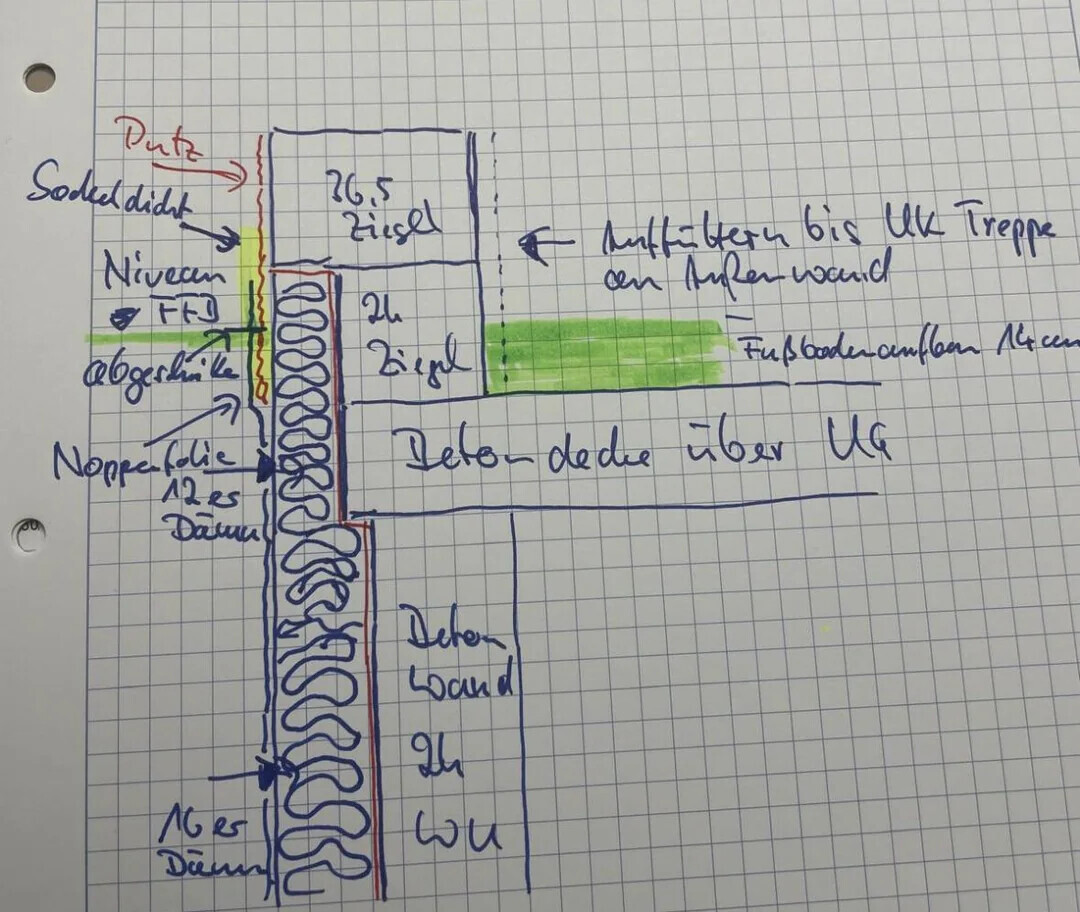
We are currently in the planning phase (no service contracts signed yet), and the general contractor proposes the following construction method. The soil report recommends a waterproof concrete basement according to exposure class W2.1-E.
We plan to build a KfW 40 house to take advantage of the current conditions. The house will have 36.5cm (14.4 inches) masonry walls on the ground floor and upper floor. This type of brick was approved by the energy consultant.
However, the energy consultant requires 16cm (6.3 inches) insulation on the perimeter insulation instead of 12cm (4.7 inches), and 12cm (4.7 inches) insulation on the end faces of the concrete ceilings is sufficient for him.
As a result, the general contractor now proposes this design. I find it a bit odd and, based on my gut feeling, questionable in terms of structural integrity and waterproofing concerning settlements and joints... I am not an expert, but this is my intuition.
Due to the 16cm (6.3 inches) insulation on the basement, the 24cm (9.4 inches) basement wall is set further outwards. How do you evaluate such a construction detail?
Attached is a design that I would consider acceptable.

It looks almost exactly like what your general contractor suggested (just with 18cm (7 inches) of perimeter insulation and 42.5cm (17 inches) brickwork). This was coordinated with the brick manufacturer due to structural reasons and approved by them.
By the way: I wouldn’t build to KfW standards anymore 😀
By the way: I wouldn’t build to KfW standards anymore 😀
familie_s schrieb:
In our case, it looks almost the same as what your general contractor suggested (just with 18cm (7 inches) perimeter insulation and 42.5cm (17 inches) bricks).
This was confirmed with the brick manufacturer due to structural requirements and approved by them.
By the way: I wouldn’t build to KfW standards anymore 😀 Hi, could you maybe share a sketch of your wall assembly? Was the choice of 42.5cm (17 inches) bricks due to structural reasons or insulation?
I’m also really annoyed by KfW right now, but the interest rates are just insane at the moment.
D-Zug88 schrieb:
Hi, could you maybe share a sketch of your wall construction? Was the 42.5cm (17 inches) brick chosen for structural reasons or insulation? Sure.
We used an unfilled brick; with a thinner one, we wouldn’t have met the KfW40 standard.
D-Zug88 schrieb:
I’m also quite frustrated with KfW right now, but the interest rates are just crazy at the moment. For us, the 300mm (12 inches) wall was very attractive too. In hindsight, though, I would have preferred to avoid some of the disproportionate extra costs to save on interest.
familie_s schrieb:
Sure.
We used an unfilled brick; with a thinner one, we wouldn’t have achieved KfW40.
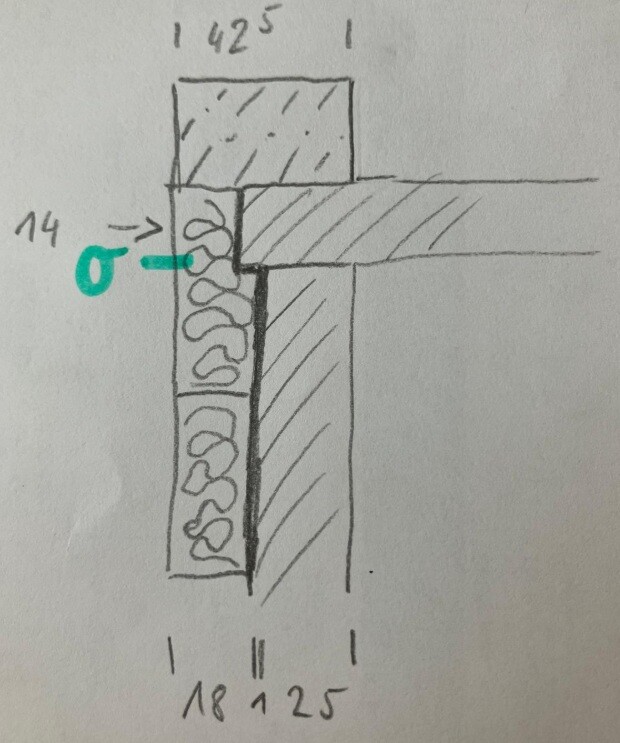
The 300mm (12 inches) wall was very attractive for us as well. Looking back, however, I would have preferred to avoid some of the disproportionate extra costs for the interest savings. Thanks a lot! The green O marks the ground level, right? So soil below and air above.
Yes, from the start we wanted a filled brick (without KfW) and are currently using the FZ6 from Schlagmann (no endorsement), so KfW suddenly became a topic in line with KfW interest rate reductions.
Was a chamfer or bevel created on the basement wall, and how were the waterproofing measures applied to the wall? Do you perhaps have a photo of that?
D-Zug88 schrieb:
Many thanks! The green circle marks the terrain surface, right? So, soil below and air above. Yes, exactly. That’s why we didn’t extend the polystyrene foam (Styrofoam) as high as you did. The rest of the construction (delta membrane, etc.) is the same.
D-Zug88 schrieb:
Was a chamfer applied to the basement wall, and how were the waterproofing layers applied to the wall? Do you happen to have a photo? I’m not quite sure where you expect a chamfer. Do you mean at the bottom of the slab?
We don’t have groundwater pressure, so we built a waterproof concrete basement with Styrodur (extruded polystyrene) spot-glued in place. We sealed the formwork holes with fiber cement plugs fixed with epoxy adhesive. A drainage system was deemed unnecessary but we installed one anyway.
Similar topics