
ᐅ Floor Plan Ideas for New Build 2026: Modern House with Single-Slope Roof, South-Facing Terrace & Garage
Created on: 7 Dec 2025 14:01
J
jannick93
Hello everyone,
I have been a silent reader for a long time, but next year we plan to build a new house after looking at numerous old houses and coming to this decision. Hopefully, there will be a KfW EH55 subsidy available again in 2026.
Regarding the questionnaire:
Zoning plan / Restrictions
Plot size: 860m² (0.21 acres)
Slope: Unfortunately yes; within the buildable area, there is a 2m (6.5 ft) drop across a width of 11m (36 ft) from east to west, but this provides a nice southwest view.
Otherwise, no zoning plan or restrictions. The surrounding houses were built in the 1950s.
Homeowners’ Requirements
Style, roof design, building type:
- Modern with variation in the facade depth and integration of the garage with a flat roof. The plan is for a mono-pitched roof with an 8° slope facing south to maximize solar panels.
Basement, stories:
- No basement, ground floor on the east side partly embedded 1-1.5m (3-5 ft) into the ground. Garage at the rear fully underground. Two stories in total.
Number and age of occupants:
- 4 people aged 36, 32, 4 years, and a toddler of 7 months.
Room requirements on ground and upper floors:
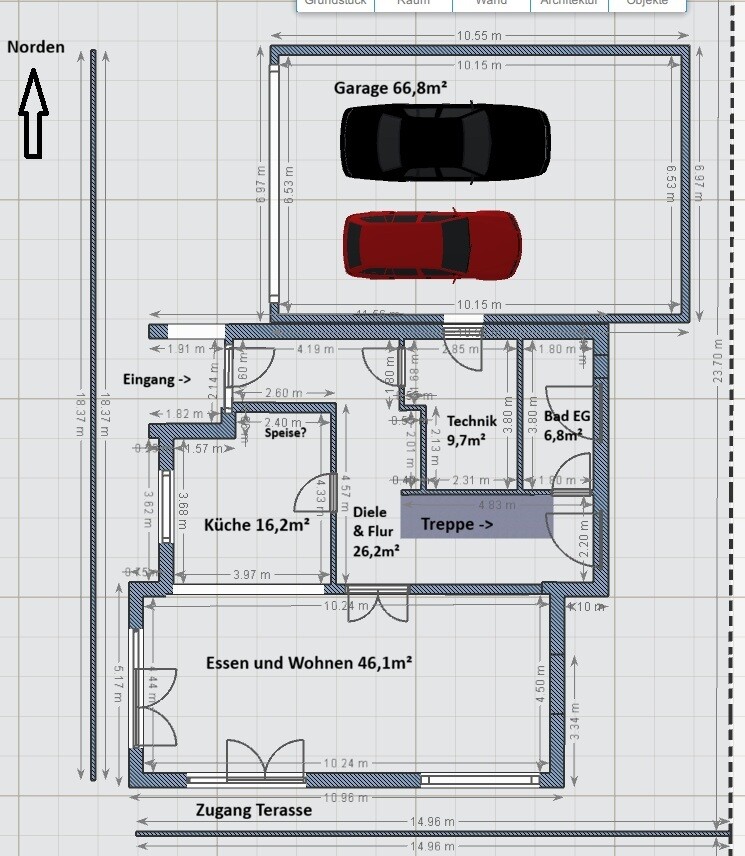
- Due to no basement, a large garage is included. 160-180m² (1720-1940 sq ft) would suffice, but I couldn’t manage that size exactly.
Office:
- Home office use.
Guests per year:
- Almost none, but children and godchildren will likely sleep in the children’s rooms.
Open or closed layout:
- Open layout with the option to separate the upper floor and create a separate entrance from the east (future option in 20-25 years; something to plan for, but not a pressing concern).
Conservative or modern construction:
- Modern.
Open kitchen, kitchen island:
- Both yes, definitely. However, given the kitchen width, I don’t think a freestanding island is possible. Most of our daily life happens in the kitchen and dining-living area, so this is designed generously. We cook daily.
Number of dining seats:
- 6-8 seats for a large family (3m (10 ft) long dining table) plus 2-3 seats at the island.
Fireplace:
- No.
Music / stereo wall:
- No.
Balcony, roof terrace:
- Yes, on the south side. Possibly with an outdoor kitchen in the future (preparatory plumbing should be planned).
Garage / carport:
- Yes, double garage with additional storage space for shelves and possibly future technology, where a separate room can be added later. The garage has separate walls (is this advisable?) and is not within the insulated envelope of the house.
Kitchen garden, greenhouse:
- Raised bed.
Other wishes, special features, daily routine, reasons why certain things are included or excluded:
- Short and practical route from the garage to the kitchen for groceries. I’ve drawn a very small pantry, reducing it by 60cm (2 ft) from the former 2.20m (7 ft) wide hallway, and I’d appreciate your advice on whether this makes sense.
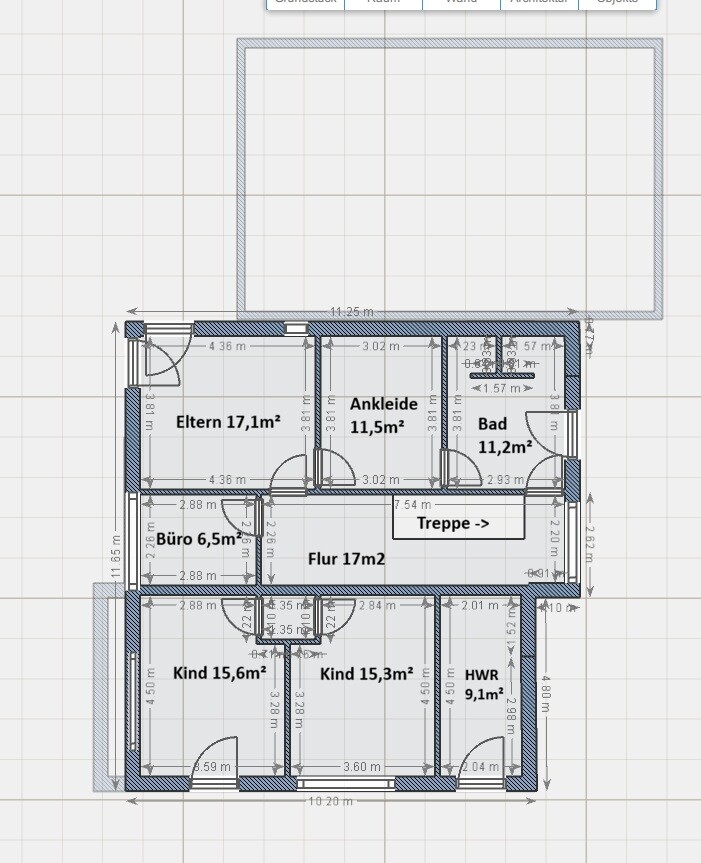
Laundry room on the upper floor where laundry is handled; in summer, clothes will be dried outside on the garage roof.
Regarding the technical room, I’m unsure if it is large enough for: heat pump indoor unit, domestic hot water heat pump, inverter, battery storage, meter cabinet, server cabinet, ventilation system. Less sensitive equipment could be placed in a separate room in the garage.
Regarding technical room location: I know the main connection is covered and not located closest to the street, but perhaps it can be argued that the small room between the two masonry walls of house and garage works. Also, neighboring houses have rooftop antennas, and the type of connection I will receive is yet to be clarified.
House design
Who created the design:
- Former head of the building authority, adjusted by me.
What do you particularly like? Why?
- The open kitchen with dining-living area and the layout of the upper floor with the utility room including shelf space and the size of the children’s rooms. Terrace facing south with a nice view.
What do you dislike? Why?
- The very long and large “expensive” hallway on the ground floor. I am still looking for a solution here. The main issue is the location of the staircase. When trying to place it next to the kitchen, I reached my design limits on the upper floor. This is the main reason I am turning to you.
Estimated cost according to architect/planner: about 450,000 with a lot of own labor on the shell work.
Personal budget limit for the house, including fittings: My biggest wish is to build the house mostly myself to reach around 2000€/m² (185 sq ft) . Next year, I have already arranged 78 days off for this.
Preferred heating system: Heat pump with underfloor heating (flow30) and domestic hot water heat pump. I am still looking for a suitable location for the outdoor unit, possibly on the garage roof. Air conditioning will be installed in both floors’ hallways.
If you had to give up certain details or extras, what could you omit
- Could give up: hallway 😉, size of the master bedroom (we only need about 1m (3 ft) space around the bed if we have a separate room for clothes), large bathrooms.
- Cannot give up: kitchen size, preferably even more generous.
Why is the design the way it is?
For example, based on sun orientation of the south-facing terrace and views from the upper floor. The garage location follows from the driveway and the entrance location. I couldn’t find any other combination that makes sense.
I have been a silent reader for a long time, but next year we plan to build a new house after looking at numerous old houses and coming to this decision. Hopefully, there will be a KfW EH55 subsidy available again in 2026.
Regarding the questionnaire:
Zoning plan / Restrictions
Plot size: 860m² (0.21 acres)
Slope: Unfortunately yes; within the buildable area, there is a 2m (6.5 ft) drop across a width of 11m (36 ft) from east to west, but this provides a nice southwest view.
Otherwise, no zoning plan or restrictions. The surrounding houses were built in the 1950s.
Homeowners’ Requirements
Style, roof design, building type:
- Modern with variation in the facade depth and integration of the garage with a flat roof. The plan is for a mono-pitched roof with an 8° slope facing south to maximize solar panels.
Basement, stories:
- No basement, ground floor on the east side partly embedded 1-1.5m (3-5 ft) into the ground. Garage at the rear fully underground. Two stories in total.
Number and age of occupants:
- 4 people aged 36, 32, 4 years, and a toddler of 7 months.
Room requirements on ground and upper floors:
- Due to no basement, a large garage is included. 160-180m² (1720-1940 sq ft) would suffice, but I couldn’t manage that size exactly.
Office:
- Home office use.
Guests per year:
- Almost none, but children and godchildren will likely sleep in the children’s rooms.
Open or closed layout:
- Open layout with the option to separate the upper floor and create a separate entrance from the east (future option in 20-25 years; something to plan for, but not a pressing concern).
Conservative or modern construction:
- Modern.
Open kitchen, kitchen island:
- Both yes, definitely. However, given the kitchen width, I don’t think a freestanding island is possible. Most of our daily life happens in the kitchen and dining-living area, so this is designed generously. We cook daily.
Number of dining seats:
- 6-8 seats for a large family (3m (10 ft) long dining table) plus 2-3 seats at the island.
Fireplace:
- No.
Music / stereo wall:
- No.
Balcony, roof terrace:
- Yes, on the south side. Possibly with an outdoor kitchen in the future (preparatory plumbing should be planned).
Garage / carport:
- Yes, double garage with additional storage space for shelves and possibly future technology, where a separate room can be added later. The garage has separate walls (is this advisable?) and is not within the insulated envelope of the house.
Kitchen garden, greenhouse:
- Raised bed.
Other wishes, special features, daily routine, reasons why certain things are included or excluded:
- Short and practical route from the garage to the kitchen for groceries. I’ve drawn a very small pantry, reducing it by 60cm (2 ft) from the former 2.20m (7 ft) wide hallway, and I’d appreciate your advice on whether this makes sense.
Laundry room on the upper floor where laundry is handled; in summer, clothes will be dried outside on the garage roof.
Regarding the technical room, I’m unsure if it is large enough for: heat pump indoor unit, domestic hot water heat pump, inverter, battery storage, meter cabinet, server cabinet, ventilation system. Less sensitive equipment could be placed in a separate room in the garage.
Regarding technical room location: I know the main connection is covered and not located closest to the street, but perhaps it can be argued that the small room between the two masonry walls of house and garage works. Also, neighboring houses have rooftop antennas, and the type of connection I will receive is yet to be clarified.
House design
Who created the design:
- Former head of the building authority, adjusted by me.
What do you particularly like? Why?
- The open kitchen with dining-living area and the layout of the upper floor with the utility room including shelf space and the size of the children’s rooms. Terrace facing south with a nice view.
What do you dislike? Why?
- The very long and large “expensive” hallway on the ground floor. I am still looking for a solution here. The main issue is the location of the staircase. When trying to place it next to the kitchen, I reached my design limits on the upper floor. This is the main reason I am turning to you.
Estimated cost according to architect/planner: about 450,000 with a lot of own labor on the shell work.
Personal budget limit for the house, including fittings: My biggest wish is to build the house mostly myself to reach around 2000€/m² (185 sq ft) . Next year, I have already arranged 78 days off for this.
Preferred heating system: Heat pump with underfloor heating (flow30) and domestic hot water heat pump. I am still looking for a suitable location for the outdoor unit, possibly on the garage roof. Air conditioning will be installed in both floors’ hallways.
If you had to give up certain details or extras, what could you omit
- Could give up: hallway 😉, size of the master bedroom (we only need about 1m (3 ft) space around the bed if we have a separate room for clothes), large bathrooms.
- Cannot give up: kitchen size, preferably even more generous.
Why is the design the way it is?
For example, based on sun orientation of the south-facing terrace and views from the upper floor. The garage location follows from the driveway and the entrance location. I couldn’t find any other combination that makes sense.

I won’t comment on the floor plan since I’m not an expert, but I’d like to share some thoughts on personal work contributions and costs:
- We’re doing a lot of the work ourselves to achieve a price per square meter of just under 3000 €/m² (about $280 per sq ft). We’re in Bavaria, not the Saarland, but I find the 2000 €/m² (about $185 per sq ft) target very ambitious.
- Doing personal work with two small children will also be challenging. Usually, only one of you can be on the construction site.
- The cost driver is not the area, but the complexity. (Of course, extra square meters still add to the cost.) You can save money with simple structural engineering, straightforward plumbing and wiring runs, good planning, and as few corners as possible. There are already a few special features hidden in the first draft.
- Find a building materials supplier that offers good terms, and sometimes you can find good deals in classified ads, too.
- We’re doing a lot of the work ourselves to achieve a price per square meter of just under 3000 €/m² (about $280 per sq ft). We’re in Bavaria, not the Saarland, but I find the 2000 €/m² (about $185 per sq ft) target very ambitious.
- Doing personal work with two small children will also be challenging. Usually, only one of you can be on the construction site.
- The cost driver is not the area, but the complexity. (Of course, extra square meters still add to the cost.) You can save money with simple structural engineering, straightforward plumbing and wiring runs, good planning, and as few corners as possible. There are already a few special features hidden in the first draft.
- Find a building materials supplier that offers good terms, and sometimes you can find good deals in classified ads, too.
J
jannick939 Dec 2025 13:21Hello everyone,
After exploring some floor plan ideas, I decided to move away from the garage location since it limited the options for the front door. The hallway areas are now more straightforward and smaller, seamlessly flowing into the open-plan living area on the ground floor, which we really like based on the images. The structural design will probably require a steel beam in the middle of the hallway with a supporting column, if I understand the plans from the show home correctly.
The floor plan is mirrored along the centerline and is almost identical to one from a well-known prefab home manufacturer, with 171m² (1840 sq ft) of living space. The utility room and office have been slightly reduced to create more space in the open living area.
On the upper floor, it might be possible to move the entrance doors of the master bedroom and utility room closer to the staircase, allowing space in front of the hallway window for something like a small desk with a view. An entrance to the master bedroom through the walk-in closet would also be possible but would reduce the available storage space there.
Unfortunately, the options for window and door elements are limited: the openings for the patio doors are missing in the open living area, and all double casement windows should only have one sash that can be opened.
After exploring some floor plan ideas, I decided to move away from the garage location since it limited the options for the front door. The hallway areas are now more straightforward and smaller, seamlessly flowing into the open-plan living area on the ground floor, which we really like based on the images. The structural design will probably require a steel beam in the middle of the hallway with a supporting column, if I understand the plans from the show home correctly.
The floor plan is mirrored along the centerline and is almost identical to one from a well-known prefab home manufacturer, with 171m² (1840 sq ft) of living space. The utility room and office have been slightly reduced to create more space in the open living area.
On the upper floor, it might be possible to move the entrance doors of the master bedroom and utility room closer to the staircase, allowing space in front of the hallway window for something like a small desk with a view. An entrance to the master bedroom through the walk-in closet would also be possible but would reduce the available storage space there.
Unfortunately, the options for window and door elements are limited: the openings for the patio doors are missing in the open living area, and all double casement windows should only have one sash that can be opened.

So, have you proceeded as suggested in a "top-down" approach? And how did you fit the house into the terrain?
What is the advantage of using double casement windows with one fixed sash?
Which house model is that, then?
As I keep emphasizing, only a proven house model built with its original supplier has advantages; trying to rebuild it with a different supplier is pointless in terms of gaining any advantage compared to an unproven design!
By the way, a timber frame panel house model usually does not incorporate steel in the structural design.
https://www.instagram.com/11antgmxde/
https://www.linkedin.com/company/bauen-jetzt/
What is the advantage of using double casement windows with one fixed sash?
jannick93 schrieb:
The structural calculation probably requires a steel beam in the middle of the hallway with a support, if I interpret the plans of the show home correctly.
The floor plan is mirrored on the centerline and is almost identical to a well-known prefabricated house manufacturer’s design with 171m² (1840 sq ft) of living space.
Which house model is that, then?
As I keep emphasizing, only a proven house model built with its original supplier has advantages; trying to rebuild it with a different supplier is pointless in terms of gaining any advantage compared to an unproven design!
By the way, a timber frame panel house model usually does not incorporate steel in the structural design.
https://www.instagram.com/11antgmxde/
https://www.linkedin.com/company/bauen-jetzt/
 Papierturm9 Dec 2025 13:54
First of all: I like this design significantly more than the previous one!
My usual two cents:
- The pantry should be 140cm (55 inches) deep, but at least 130cm (51 inches). The 120/121cm (47/48 inches) planned in many floor plans is generally too shallow for everyday use. I wouldn’t cut corners by just a few centimeters if I’m going to include something like that.
- In terms of circulation paths, the bedroom should be at the far end and not serve as a passageway to the dressing room. (In daily life: one person gets up, goes to the bathroom, returns, goes into the dressing room, retrieves or even puts on clothes, and then either goes back to the bathroom to get ready or heads downstairs to the kitchen. Either way, the foot traffic is likely to disturb anyone who is still trying to sleep.)
My usual two cents:
- The pantry should be 140cm (55 inches) deep, but at least 130cm (51 inches). The 120/121cm (47/48 inches) planned in many floor plans is generally too shallow for everyday use. I wouldn’t cut corners by just a few centimeters if I’m going to include something like that.
- In terms of circulation paths, the bedroom should be at the far end and not serve as a passageway to the dressing room. (In daily life: one person gets up, goes to the bathroom, returns, goes into the dressing room, retrieves or even puts on clothes, and then either goes back to the bathroom to get ready or heads downstairs to the kitchen. Either way, the foot traffic is likely to disturb anyone who is still trying to sleep.)
J
jannick939 Dec 2025 22:5511ant schrieb:
So, did you proceed “top down” as suggested; and how did you fit the house into the terrain? Yes, I chose a floor plan that is longer than it is wide to minimize the slope from east to west. For that reason, I also thought it made sense to choose a straight staircase starting as far forward as possible on the north side to keep the hallway small there. I also looked at narrower houses extended to about 14–15m (46–49 feet) in length, but I didn’t like that option. In those plans, the entrance was always in the middle, which makes sense for this type of design but doesn’t suit our plot. Another feature is the open living space on the south side. A mirrored layout was applied to place utility areas such as the mechanical room and laundry toward the east, effectively into the slope. The living room is also on the east side, which doesn’t require as much natural light as, for example, the kitchen and the views associated with cooking and dining.
11ant schrieb:
What benefit does it have to equip double-wing windows with one fixed sash? None, unless there is a collision. So it stays as planned.
11ant schrieb:
Which house model is that? Luxhaus Gable Roof Country House 171
Papierturm schrieb:
My usual €0.02: Both points were implemented and considered reasonable.
I also applied your earlier suggestions: disregarding the garage for now, which enabled a central entrance, and exploring floor plans. It is now much simpler and also more efficient at 171 sqm (1840 sq ft). I still need to come up with a more varied facade design for the west side, where there were previously segmented surfaces. I have to think of something simple here. Overall, I am already much more satisfied with the floor plan.
jannick93 schrieb:
Luxhaus Gable Roof Country House 171As mentioned: if you build with this provider, it makes sense to choose the proven model (at most: mirrored).https://www.instagram.com/11antgmxde/
https://www.linkedin.com/company/bauen-jetzt/
Similar topics