
ᐅ Floor Plan Ideas for New Build 2026: Modern House with Single-Slope Roof, South-Facing Terrace & Garage
Created on: 7 Dec 2025 14:01
J
jannick93J
jannick937 Dec 2025 14:01Hello everyone,
I have been a silent reader for a long time, but next year we plan to build a new house after looking at numerous old houses and coming to this decision. Hopefully, there will be a KfW EH55 subsidy available again in 2026.
Regarding the questionnaire:
Zoning plan / Restrictions
Plot size: 860m² (0.21 acres)
Slope: Unfortunately yes; within the buildable area, there is a 2m (6.5 ft) drop across a width of 11m (36 ft) from east to west, but this provides a nice southwest view.
Otherwise, no zoning plan or restrictions. The surrounding houses were built in the 1950s.
Homeowners’ Requirements
Style, roof design, building type:
- Modern with variation in the facade depth and integration of the garage with a flat roof. The plan is for a mono-pitched roof with an 8° slope facing south to maximize solar panels.
Basement, stories:
- No basement, ground floor on the east side partly embedded 1-1.5m (3-5 ft) into the ground. Garage at the rear fully underground. Two stories in total.
Number and age of occupants:
- 4 people aged 36, 32, 4 years, and a toddler of 7 months.
Room requirements on ground and upper floors:
- Due to no basement, a large garage is included. 160-180m² (1720-1940 sq ft) would suffice, but I couldn’t manage that size exactly.
Office:
- Home office use.
Guests per year:
- Almost none, but children and godchildren will likely sleep in the children’s rooms.
Open or closed layout:
- Open layout with the option to separate the upper floor and create a separate entrance from the east (future option in 20-25 years; something to plan for, but not a pressing concern).
Conservative or modern construction:
- Modern.
Open kitchen, kitchen island:
- Both yes, definitely. However, given the kitchen width, I don’t think a freestanding island is possible. Most of our daily life happens in the kitchen and dining-living area, so this is designed generously. We cook daily.
Number of dining seats:
- 6-8 seats for a large family (3m (10 ft) long dining table) plus 2-3 seats at the island.
Fireplace:
- No.
Music / stereo wall:
- No.
Balcony, roof terrace:
- Yes, on the south side. Possibly with an outdoor kitchen in the future (preparatory plumbing should be planned).
Garage / carport:
- Yes, double garage with additional storage space for shelves and possibly future technology, where a separate room can be added later. The garage has separate walls (is this advisable?) and is not within the insulated envelope of the house.
Kitchen garden, greenhouse:
- Raised bed.
Other wishes, special features, daily routine, reasons why certain things are included or excluded:
- Short and practical route from the garage to the kitchen for groceries. I’ve drawn a very small pantry, reducing it by 60cm (2 ft) from the former 2.20m (7 ft) wide hallway, and I’d appreciate your advice on whether this makes sense.
Laundry room on the upper floor where laundry is handled; in summer, clothes will be dried outside on the garage roof.
Regarding the technical room, I’m unsure if it is large enough for: heat pump indoor unit, domestic hot water heat pump, inverter, battery storage, meter cabinet, server cabinet, ventilation system. Less sensitive equipment could be placed in a separate room in the garage.
Regarding technical room location: I know the main connection is covered and not located closest to the street, but perhaps it can be argued that the small room between the two masonry walls of house and garage works. Also, neighboring houses have rooftop antennas, and the type of connection I will receive is yet to be clarified.
House design
Who created the design:
- Former head of the building authority, adjusted by me.
What do you particularly like? Why?
- The open kitchen with dining-living area and the layout of the upper floor with the utility room including shelf space and the size of the children’s rooms. Terrace facing south with a nice view.
What do you dislike? Why?
- The very long and large “expensive” hallway on the ground floor. I am still looking for a solution here. The main issue is the location of the staircase. When trying to place it next to the kitchen, I reached my design limits on the upper floor. This is the main reason I am turning to you.
Estimated cost according to architect/planner: about 450,000 with a lot of own labor on the shell work.
Personal budget limit for the house, including fittings: My biggest wish is to build the house mostly myself to reach around 2000€/m² (185 sq ft) . Next year, I have already arranged 78 days off for this.
Preferred heating system: Heat pump with underfloor heating (flow30) and domestic hot water heat pump. I am still looking for a suitable location for the outdoor unit, possibly on the garage roof. Air conditioning will be installed in both floors’ hallways.
If you had to give up certain details or extras, what could you omit
- Could give up: hallway 😉, size of the master bedroom (we only need about 1m (3 ft) space around the bed if we have a separate room for clothes), large bathrooms.
- Cannot give up: kitchen size, preferably even more generous.
Why is the design the way it is?
For example, based on sun orientation of the south-facing terrace and views from the upper floor. The garage location follows from the driveway and the entrance location. I couldn’t find any other combination that makes sense.
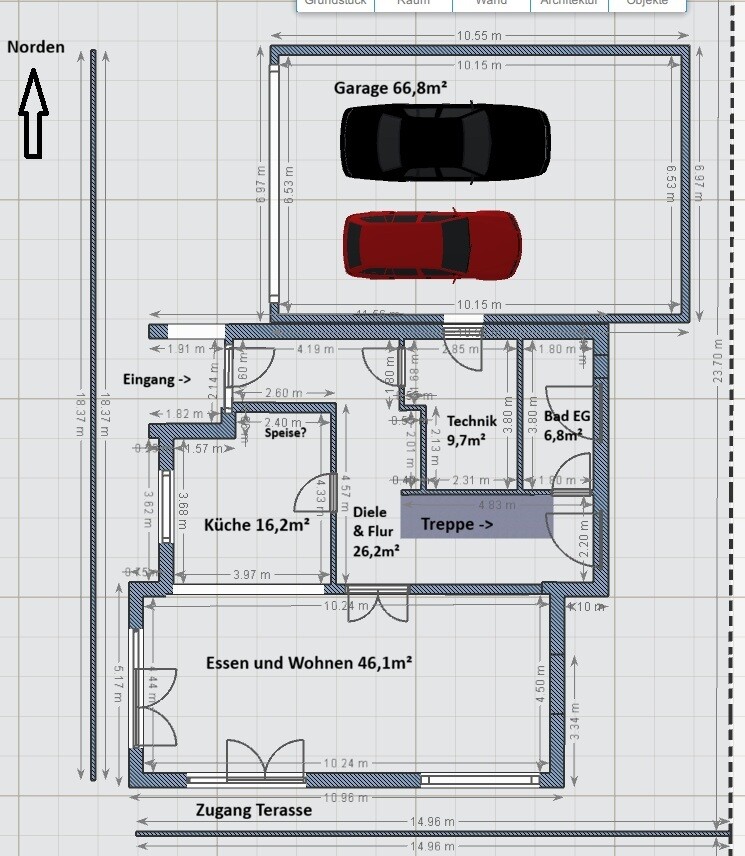
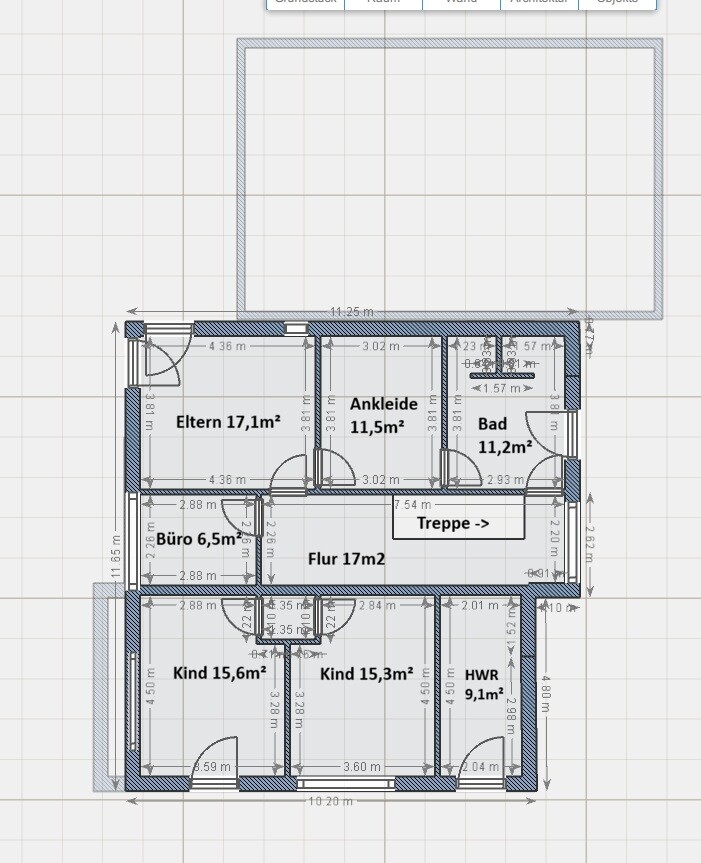
I have been a silent reader for a long time, but next year we plan to build a new house after looking at numerous old houses and coming to this decision. Hopefully, there will be a KfW EH55 subsidy available again in 2026.
Regarding the questionnaire:
Zoning plan / Restrictions
Plot size: 860m² (0.21 acres)
Slope: Unfortunately yes; within the buildable area, there is a 2m (6.5 ft) drop across a width of 11m (36 ft) from east to west, but this provides a nice southwest view.
Otherwise, no zoning plan or restrictions. The surrounding houses were built in the 1950s.
Homeowners’ Requirements
Style, roof design, building type:
- Modern with variation in the facade depth and integration of the garage with a flat roof. The plan is for a mono-pitched roof with an 8° slope facing south to maximize solar panels.
Basement, stories:
- No basement, ground floor on the east side partly embedded 1-1.5m (3-5 ft) into the ground. Garage at the rear fully underground. Two stories in total.
Number and age of occupants:
- 4 people aged 36, 32, 4 years, and a toddler of 7 months.
Room requirements on ground and upper floors:
- Due to no basement, a large garage is included. 160-180m² (1720-1940 sq ft) would suffice, but I couldn’t manage that size exactly.
Office:
- Home office use.
Guests per year:
- Almost none, but children and godchildren will likely sleep in the children’s rooms.
Open or closed layout:
- Open layout with the option to separate the upper floor and create a separate entrance from the east (future option in 20-25 years; something to plan for, but not a pressing concern).
Conservative or modern construction:
- Modern.
Open kitchen, kitchen island:
- Both yes, definitely. However, given the kitchen width, I don’t think a freestanding island is possible. Most of our daily life happens in the kitchen and dining-living area, so this is designed generously. We cook daily.
Number of dining seats:
- 6-8 seats for a large family (3m (10 ft) long dining table) plus 2-3 seats at the island.
Fireplace:
- No.
Music / stereo wall:
- No.
Balcony, roof terrace:
- Yes, on the south side. Possibly with an outdoor kitchen in the future (preparatory plumbing should be planned).
Garage / carport:
- Yes, double garage with additional storage space for shelves and possibly future technology, where a separate room can be added later. The garage has separate walls (is this advisable?) and is not within the insulated envelope of the house.
Kitchen garden, greenhouse:
- Raised bed.
Other wishes, special features, daily routine, reasons why certain things are included or excluded:
- Short and practical route from the garage to the kitchen for groceries. I’ve drawn a very small pantry, reducing it by 60cm (2 ft) from the former 2.20m (7 ft) wide hallway, and I’d appreciate your advice on whether this makes sense.
Laundry room on the upper floor where laundry is handled; in summer, clothes will be dried outside on the garage roof.
Regarding the technical room, I’m unsure if it is large enough for: heat pump indoor unit, domestic hot water heat pump, inverter, battery storage, meter cabinet, server cabinet, ventilation system. Less sensitive equipment could be placed in a separate room in the garage.
Regarding technical room location: I know the main connection is covered and not located closest to the street, but perhaps it can be argued that the small room between the two masonry walls of house and garage works. Also, neighboring houses have rooftop antennas, and the type of connection I will receive is yet to be clarified.
House design
Who created the design:
- Former head of the building authority, adjusted by me.
What do you particularly like? Why?
- The open kitchen with dining-living area and the layout of the upper floor with the utility room including shelf space and the size of the children’s rooms. Terrace facing south with a nice view.
What do you dislike? Why?
- The very long and large “expensive” hallway on the ground floor. I am still looking for a solution here. The main issue is the location of the staircase. When trying to place it next to the kitchen, I reached my design limits on the upper floor. This is the main reason I am turning to you.
Estimated cost according to architect/planner: about 450,000 with a lot of own labor on the shell work.
Personal budget limit for the house, including fittings: My biggest wish is to build the house mostly myself to reach around 2000€/m² (185 sq ft) . Next year, I have already arranged 78 days off for this.
Preferred heating system: Heat pump with underfloor heating (flow30) and domestic hot water heat pump. I am still looking for a suitable location for the outdoor unit, possibly on the garage roof. Air conditioning will be installed in both floors’ hallways.
If you had to give up certain details or extras, what could you omit
- Could give up: hallway 😉, size of the master bedroom (we only need about 1m (3 ft) space around the bed if we have a separate room for clothes), large bathrooms.
- Cannot give up: kitchen size, preferably even more generous.
Why is the design the way it is?
For example, based on sun orientation of the south-facing terrace and views from the upper floor. The garage location follows from the driveway and the entrance location. I couldn’t find any other combination that makes sense.
N
nordanney7 Dec 2025 14:34jannick93 schrieb:
I have reached the limits of my planning abilities on the upper floor. That’s exactly why you should have someone with expertise do it. My opinion: have it redone (by a professional).
jannick93 schrieb:
Cost estimate according to the architect/planner: roughly 450,000 with a lot of self-labor on the shell construction.
Personal price limit for the house, including fixtures: My biggest wish is to build the house myself to reach 2,000€/m² (approximately $185 per sq ft). Next year, I have already arranged 78 days off for this. How is the self-labor specifically planned? By the way – I had a good laugh about the 78 days off. Everyone I know who built completely on their own took between two and three years. Also, they paid from their own equity, as 99% of banks do not provide loans for this kind of project (neither do we).
jannick93 schrieb:
Otherwise no building plan and no restrictions. Does the Section 34 of the Building Code apply then? If so, the neighboring developments would be interesting, because Section 34 can impose quite a few restrictions that a layperson might not consider.
jannick93 schrieb:
No basement, ground floor partially buried approximately 1–1.5m (3.3–5 feet) underground in the east, garage fully underground in the rear part. Two stories. So, basement and upper floor :]
You have far too much circulation space. Besides the outrageously wasteful corridors, you also create a second imaginary corridor on the upper floor. This area cannot be used as room space or furnished because that’s where the doors are set. The access point between the children’s bedrooms is a sign of poor planning. If the bedroom was accessed through the dressing room, it would be much easier to organize the rest of the rooms.
The staircase could also be positioned better.
[ATTACH alt="IMG_1897.jpeg"]94141[/ATTACH]
Even in the basement, the red areas basically show the spaces that are unusable and make the level quite complicated.
jannick93 schrieb:
Former building authority manager and adapted by me. It’s not good when a layperson meddles and ends up ruining everything. No offense. But this is far from ideal.
What did the so-called expert achieve without your input? Show whether there is potential.
The idea of completing a lot of work in 78 days yourself, which would lead to significant cost savings, seems very ambitious and unrealistic. The two of us took 20 working days to paint the interior and install the flooring upstairs. Honestly, there wasn’t much more time available, even with all our efforts.

Traveling around the world in eighty days might be possible, but moving into a finished house in 78 days is not.
https://www.instagram.com/11antgmxde/
https://www.linkedin.com/company/bauen-jetzt/
jannick93 schrieb:Many silent readers are not necessarily attentive ones: the EH55 standard has long been achieved, so there will be no more subsidies for it.
I have been a silent reader for a long time, but next year we are planning a new build after looking at all sorts of old houses and finally coming to this decision. Hopefully, the KfW EH55 subsidy will be available again in 2026.
jannick93 schrieb:That’s exactly why the professionals start planning "from the top."
I have reached the limit of my planning ideas on the upper floor.
https://www.instagram.com/11antgmxde/
https://www.linkedin.com/company/bauen-jetzt/
jannick93 schrieb:
Laundry room upstairs where the laundry is collected; in summer, it gets taken outside to the garage roof for drying. You have to ask whether this use will be approved, and it must be built to be walkable (flat roof) with additional costs for insulation, a large railing, etc. — quite expensive just for drying some laundry.
jannick93 schrieb:
Slope: unfortunately yes — within the building plot there is a 2m (6.6 ft) slope across 11m (36 ft) from east to west Have you properly accounted for this steep slope both in planning and financially?
jannick93 schrieb:
160-180m² (1700-1938 sq ft) would also be sufficient, but I couldn’t manage that way
Office: Have you tried standard floor plans? There are plenty available online. In my opinion, your planning attempt would fail right away at the jagged corner near the entrance and definitely in the hallway labyrinth.
Try drawing real furniture dimensions in the ground floor bathroom, and you’ll see the problems there as well. Doors opening outward usually indicate weak planning.
Also, I don’t see a pantry, only an alcove, and there’s no indication how the kitchen is supposed to be arranged.
As so often, the straight staircase creates problems — so why is it designed like that?
My impression, as often, is that this forced walk-through to the garage (which probably smells quite unpleasant inside the house) heavily dictates the rest of the floor plan. I think you are giving this impressive garage too much importance, and you will probably run out of money for the things that could really improve living quality. You will see many skip over controlled ventilation, air conditioning, shading, patio roofing, furniture, landscaping, photovoltaics, and so on.
On the upper floor, just looking at the door positions you will notice that the layout is simply flawed. In the bathroom, the door and window clash anyway, the hallway is 17m² (183 sq ft), and the office is only 6.5m² (70 sq ft)... Please find suitable standard floor plans and adapt them for your needs or, even better, hire an architect.
There’s no shame in not being able to do this yourself; just recognize it in time. Since you’ve been following along for a while, you should already know this.
jannick93 schrieb:
I have reached my planning limits on the upper floor. This is actually the main reason why I’m reaching out to you. This is a classic misjudgment, which actually started much earlier, probably with the building permit officer as well.
If you plan so much DIY work and have experience, why then only use such weak insulation? Doing it yourself with second-rate insulation would have had especially high saving potential.
 Papierturm7 Dec 2025 19:26
Hmm.
A friend of mine, who has a background in skilled trades, completed all the work himself in areas such as installing insulation, drywalling, spackling and painting, as well as flooring (except for tiled rooms). It took him over a year (despite a similar amount of vacation time as here), and in the end, he still had to hire painters and others because the combined burden of rent and loan payments became too high.
Without a support network in the background, this becomes very challenging.
I cannot estimate feasibility from a financial perspective. I suspect that the possibility of self-performed work is overestimated here (e.g., material costs are not included, and personal time requirements are underestimated).
My recommendation:
Go back to square one.
1. The 11ant’s basement rule will likely suggest having a basement here.
2. Quote: “Regarding the location of the utility room: Yes, I know that the main connection will be built over and is not in the closest position to the street” – whether this is even allowed depends on the local authority. Even if it is, it’s not sensible. I wouldn’t start with that at all!
3. Since finances are expected to become an issue, I would plan the building as simply as possible: rectangular. Postpone the garage “for later” (if there is still money left). First, make sure the house functions as planned.
4. Structurally, I would build it like this:
“Basement” / lower ground floor: partially built into the slope. Utility rooms preferably “into the slope,” where light strips can still be installed above. The living area and access to the terrace should be where the view is.
Answer the following questions: Where should the main entrance be? How and where will the staircase be located / what shape will it have? (Both have a major impact on the floor plan.)
Based on this (staircase!), plan the upper floor first, then the lower ground floor. (If this doesn’t work, it is usually due to the staircase.)
Tip: You can also look at proven floor plans and customize them as needed.
In the current floor plan, I see several points that I find problematic (including not adapting to the needs of the plot, too many circulation areas, issues with the main utility connection, and much more), so unfortunately, I cannot provide specific suggestions here.
A friend of mine, who has a background in skilled trades, completed all the work himself in areas such as installing insulation, drywalling, spackling and painting, as well as flooring (except for tiled rooms). It took him over a year (despite a similar amount of vacation time as here), and in the end, he still had to hire painters and others because the combined burden of rent and loan payments became too high.
Without a support network in the background, this becomes very challenging.
I cannot estimate feasibility from a financial perspective. I suspect that the possibility of self-performed work is overestimated here (e.g., material costs are not included, and personal time requirements are underestimated).
My recommendation:
Go back to square one.
1. The 11ant’s basement rule will likely suggest having a basement here.
2. Quote: “Regarding the location of the utility room: Yes, I know that the main connection will be built over and is not in the closest position to the street” – whether this is even allowed depends on the local authority. Even if it is, it’s not sensible. I wouldn’t start with that at all!
3. Since finances are expected to become an issue, I would plan the building as simply as possible: rectangular. Postpone the garage “for later” (if there is still money left). First, make sure the house functions as planned.
4. Structurally, I would build it like this:
“Basement” / lower ground floor: partially built into the slope. Utility rooms preferably “into the slope,” where light strips can still be installed above. The living area and access to the terrace should be where the view is.
Answer the following questions: Where should the main entrance be? How and where will the staircase be located / what shape will it have? (Both have a major impact on the floor plan.)
Based on this (staircase!), plan the upper floor first, then the lower ground floor. (If this doesn’t work, it is usually due to the staircase.)
Tip: You can also look at proven floor plans and customize them as needed.
In the current floor plan, I see several points that I find problematic (including not adapting to the needs of the plot, too many circulation areas, issues with the main utility connection, and much more), so unfortunately, I cannot provide specific suggestions here.
Similar topics