
Maybe someone here can help us. Thanks in advance.
About a year ago, we bought a house from the mid-1990s, with a ground floor plus an attic featuring a half-hipped roof. It’s located on a quiet suburban street in a small town in the north, generally peaceful except for commuter traffic (sometimes annoying in the mornings) and nightlife traffic (especially on Friday and Saturday nights).
For the building, we have since replaced all windows and doors with triple-glazed units (well, the bathrooms and the utility room still have the original windows and doors). The cavity between the masonry and the brick veneer is now insulated as well. The roof was already insulated with insulation between the rafters.
Unfortunately, engine noise seems to be poorly insulated from reaching the bedrooms in the attic, in my opinion. On the ground floor, the new windows have completely solved this issue.
There are large knee walls at the roof eaves. No additional insulation there besides the existing insulation between the rafters.
How could I find out WHERE the sound enters my attic?
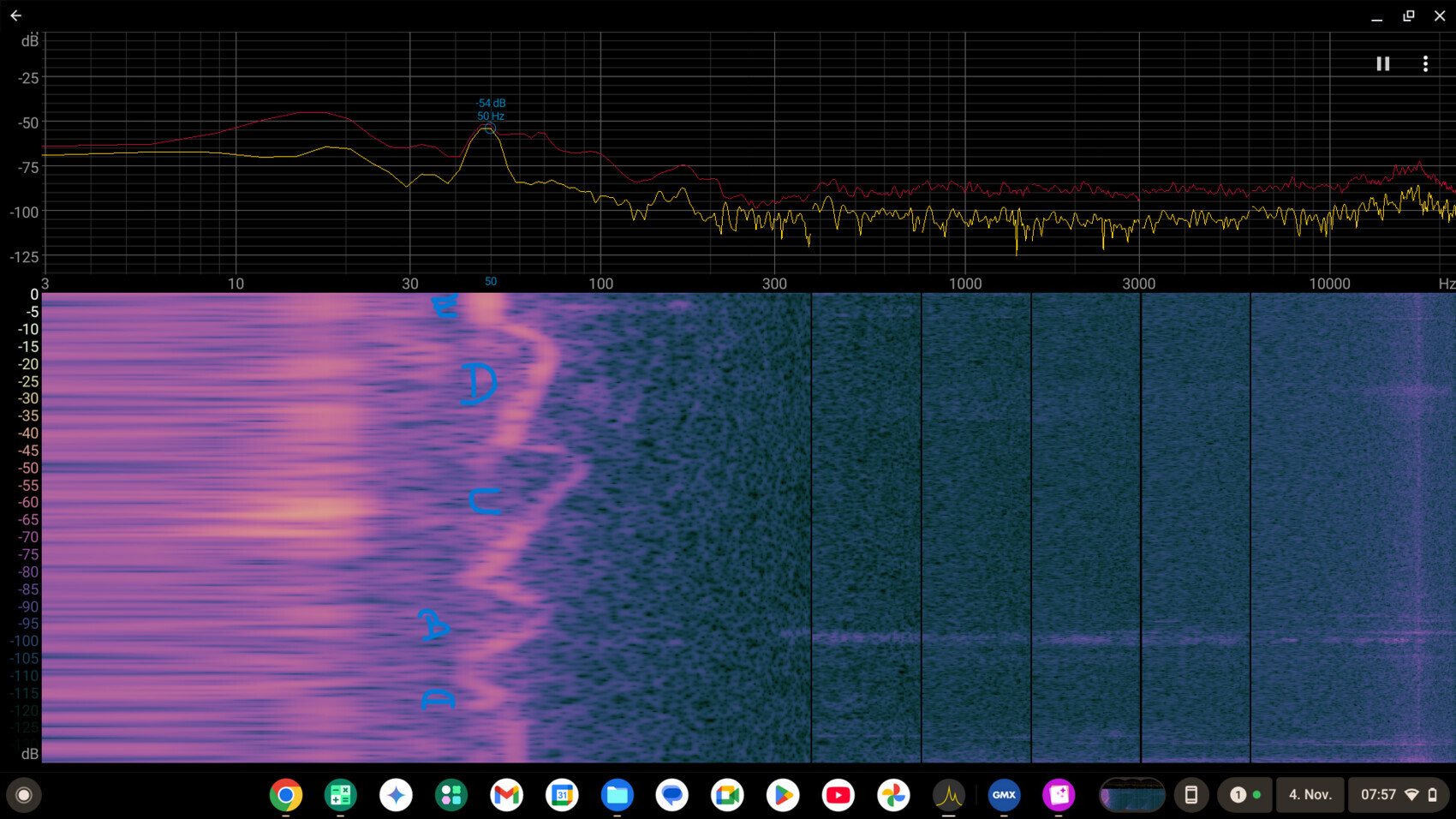
Initial recordings upstairs already show this quite clearly: the car slows down before the intersection (A), then accelerates through the gears (B, C, D) until it finally reaches its normal speed again (E). This pattern occurs with ordinary cars driven normally. No cut-off exhaust pipes, at most high-revving engines, or speeding...
We also removed the existing paneling on the sloped ceiling in the stairwell and were very surprised how large the air gaps towards the knee wall were (we had already suspected something due to the cold interior wall).
About a year ago, we bought a house from the mid-1990s, with a ground floor plus an attic featuring a half-hipped roof. It’s located on a quiet suburban street in a small town in the north, generally peaceful except for commuter traffic (sometimes annoying in the mornings) and nightlife traffic (especially on Friday and Saturday nights).
For the building, we have since replaced all windows and doors with triple-glazed units (well, the bathrooms and the utility room still have the original windows and doors). The cavity between the masonry and the brick veneer is now insulated as well. The roof was already insulated with insulation between the rafters.
Unfortunately, engine noise seems to be poorly insulated from reaching the bedrooms in the attic, in my opinion. On the ground floor, the new windows have completely solved this issue.
There are large knee walls at the roof eaves. No additional insulation there besides the existing insulation between the rafters.
How could I find out WHERE the sound enters my attic?
Initial recordings upstairs already show this quite clearly: the car slows down before the intersection (A), then accelerates through the gears (B, C, D) until it finally reaches its normal speed again (E). This pattern occurs with ordinary cars driven normally. No cut-off exhaust pipes, at most high-revving engines, or speeding...
We also removed the existing paneling on the sloped ceiling in the stairwell and were very surprised how large the air gaps towards the knee wall were (we had already suspected something due to the cold interior wall).
N
nordanney4 Dec 2025 08:32You won’t find a single “point” that the sound uses. The entire roof will be the issue.
Solution: Renew the insulation to modern standards using wood wool (I assume you still have old and thin insulation).
Solution: Renew the insulation to modern standards using wood wool (I assume you still have old and thin insulation).
The insulation in the roof slope is old and not done according to current standards, but it does fill the space between the rafters.
When we built the staircase, we were surprised by the size of the gaps between the “living” space and the uninsulated outside air (knee wall).
Before tearing everything down, I wanted to at least locally rule out such problem areas in the bedroom, but I’m not sure where it makes sense to look: gable, side space, knee wall, knee wall height, the horizontal part of the ceiling, or the roof slope itself.
How could the transitions between the sole plate and the room, as well as the transitions between rafters and the gable wall, be constructed?

When we built the staircase, we were surprised by the size of the gaps between the “living” space and the uninsulated outside air (knee wall).
Before tearing everything down, I wanted to at least locally rule out such problem areas in the bedroom, but I’m not sure where it makes sense to look: gable, side space, knee wall, knee wall height, the horizontal part of the ceiling, or the roof slope itself.
How could the transitions between the sole plate and the room, as well as the transitions between rafters and the gable wall, be constructed?
W
wiltshire4 Dec 2025 12:48Your measurement shows a peak at 50 Hz. This is a fairly typical resonance frequency for roofs with purlins and rafters from that period.
Adding windows or insulation to reduce air transmission won’t help here because you’re dealing with structure-borne sound.
You can effectively dampen the resonance frequency by implementing elastic supports. For this purpose, insulation strips—such as Regupol—can be inserted as elastic springs under the purlins and rafters, which are typically raised a few millimeters (mm) with a temporary support.
The points where the loads converge are the most effective locations to reduce structure-borne sound through damping—so I would initially focus on the purlin supports. If you do this yourself, it is very cost-effective but time-consuming—I would roughly estimate about 30 minutes per point. At first, it takes longer, but with practice it becomes faster. If someone has to pay for labor, costs can add up quickly, and it might be worth considering whether it’s more economical to have a decoupled interior lining installed with acoustic hangers.
Also, you can measure the resonance shifts to see how much improvement you achieve with the first points and whether that’s sufficient for you. The purlin supports should account for about 80% of the effect; adding many more points to support the rafters brings less additional benefit. Pareto principle applies.
Adding windows or insulation to reduce air transmission won’t help here because you’re dealing with structure-borne sound.
You can effectively dampen the resonance frequency by implementing elastic supports. For this purpose, insulation strips—such as Regupol—can be inserted as elastic springs under the purlins and rafters, which are typically raised a few millimeters (mm) with a temporary support.
The points where the loads converge are the most effective locations to reduce structure-borne sound through damping—so I would initially focus on the purlin supports. If you do this yourself, it is very cost-effective but time-consuming—I would roughly estimate about 30 minutes per point. At first, it takes longer, but with practice it becomes faster. If someone has to pay for labor, costs can add up quickly, and it might be worth considering whether it’s more economical to have a decoupled interior lining installed with acoustic hangers.
Also, you can measure the resonance shifts to see how much improvement you achieve with the first points and whether that’s sufficient for you. The purlin supports should account for about 80% of the effect; adding many more points to support the rafters brings less additional benefit. Pareto principle applies.
Thank you for your important comments.
Actually, I had ruled out resonance frequencies, but of course it is true that I tried to determine them for different rooms, but not for the entire upper floor / the pitched roof (so my approach of "different resonance frequencies due to different room sizes" no longer applies).
Do you perhaps even have examples of how I could visualize something like this? How would one get beneath the necessary building components since the house is already fully constructed?
Actually, I had ruled out resonance frequencies, but of course it is true that I tried to determine them for different rooms, but not for the entire upper floor / the pitched roof (so my approach of "different resonance frequencies due to different room sizes" no longer applies).
Do you perhaps even have examples of how I could visualize something like this? How would one get beneath the necessary building components since the house is already fully constructed?
W
wiltshire4 Dec 2025 13:22obod0002 schrieb:
Do you perhaps even have examples of how I can envision something like this? How would one access the necessary components when the house is already fully built?For this purpose, there are support props or steel jacks. You can rent them.I haven’t done this myself yet, but I wouldn’t have any technical concerns about taking on such a project independently. The mechanics are straightforward, and the risk of damage is low.
Similar topics