
ᐅ Planning a Modern Single-Family Home with Accessible Design, Ground-Floor Bedroom, Fireplace, and Photovoltaic System
Created on: 3 Dec 2025 12:55
D
Darbo19Development Plan/Restrictions
Plot size: approx. 1000m² (0.25 acres)
Slope: no
Site occupancy index: Paragraph 34
Floor area ratio: Paragraph 34
Building window, building line and boundary
Edge development: not applicable
Number of parking spaces: 2
Number of floors: Paragraph 34
Roof style: Paragraph 34
Architectural style: Paragraph 34
Orientation: Paragraph 34
Maximum heights/limits
Additional requirements: none
Clients’ Requirements
Architectural style, roof form, building type
Basement, floors: rather modern, gable roof, no basement, 2 full floors, attic not developed.
Number of persons, age: 33, 29, and 1 year old, possibly another child in the future.
Space requirements on ground floor and upper floor
Office: family use or home office? Family use.
Number of overnight guests per year: none
Open or closed architecture: open
Conservative or modern design: rather modern
Open kitchen, cooking island: open with peninsula
Number of dining seats: 6–8
Fireplace: yes, with water jacket as firewood is regularly sourced from own forest.
Music/stereo wall: no
Balcony, roof terrace: no
Garage, carport: garage already existing.
Utility garden, greenhouse: yes
Additional wishes/special features/daily routine, including reasons why certain things should or should not be included:
An important point for us when we get older is to have the possibility to live only on the ground floor.
House Design
Who created the design
- Planner from a construction company
- Architect: friendly architect
- Do-it-yourself
What do you like most? Why? The possibility to have a bedroom in the open-plan area for later in life.
What do you like least? Why? Staircase located at the front door.
Cost estimate according to architect/planner: 620,000 including demolition of existing outbuilding and all additional costs.
Personal price limit for the house, including fittings: 700,000
Preferred heating system: heat pump + photovoltaic system with battery storage and fireplace with water jacket.
If you have to give up something, which details/extra features
- Can you do without: lift-and-slide door, a few floor-to-ceiling windows.
- Cannot do without: bathroom with shower on the ground floor, possibility to set up an additional bedroom on the ground floor.
Why is the design like it is now? For example:
Standard design from the planner?
Which wishes were implemented by the architect?
A mix of many examples from various magazines: exactly this.
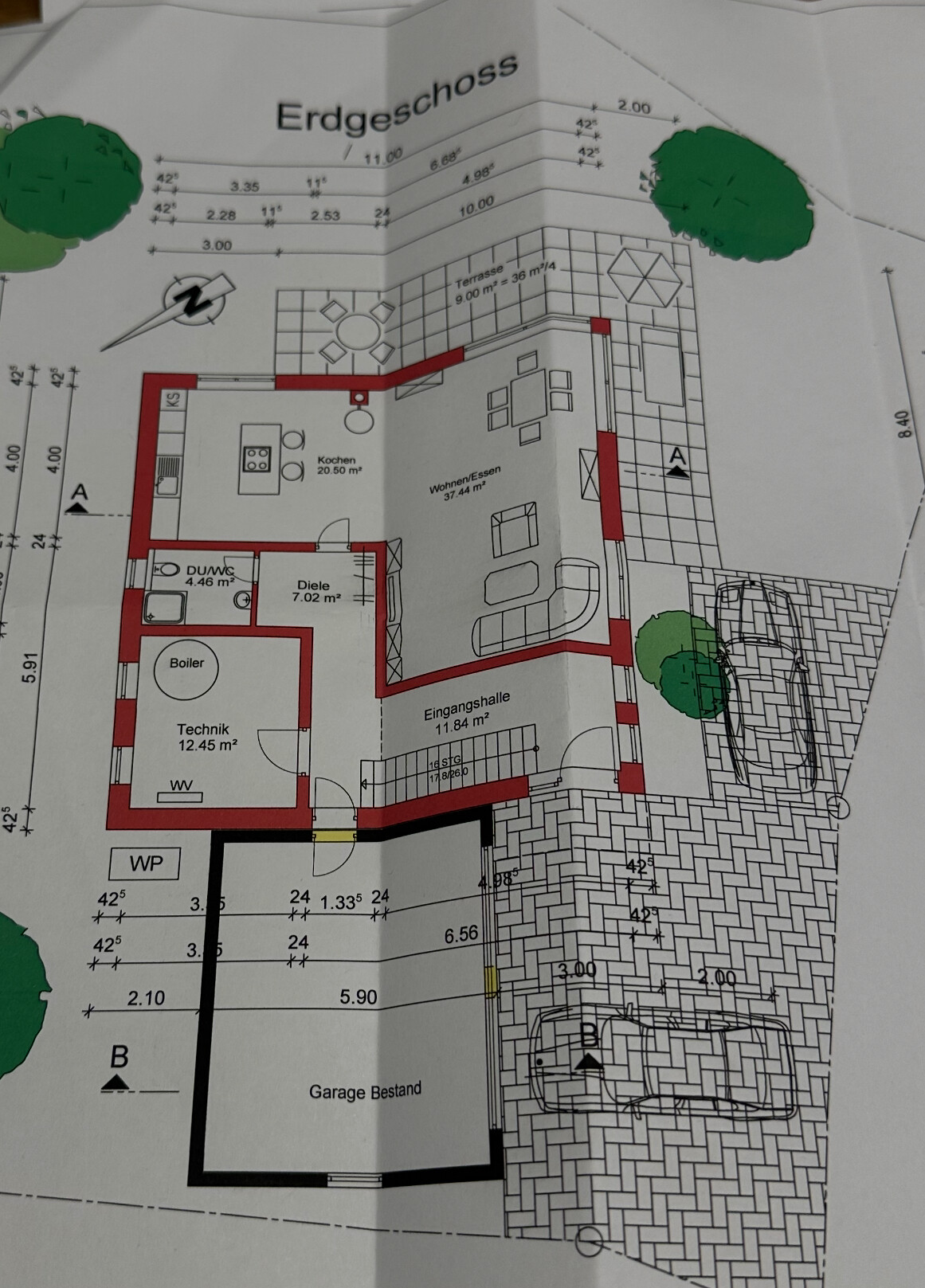
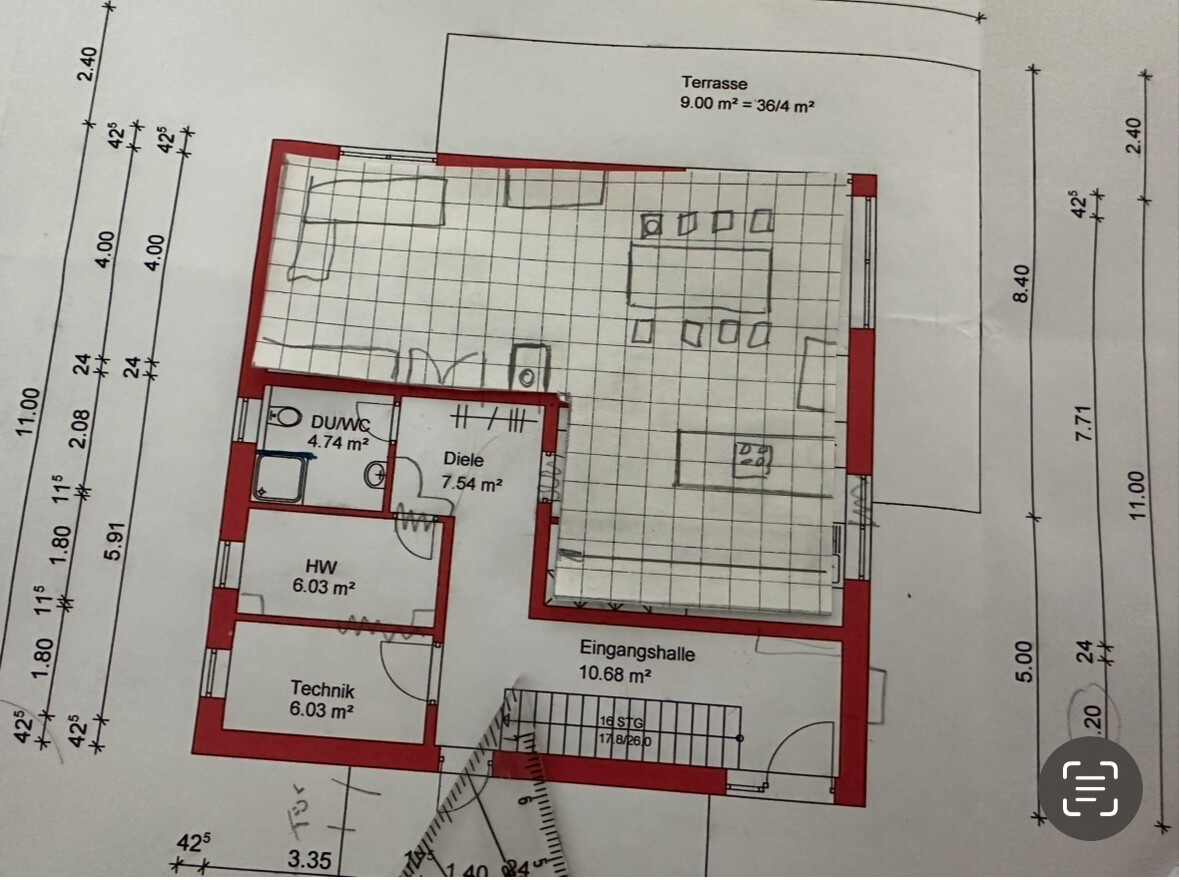
What makes it particularly good or bad in your opinion? The hallway feels quite large yet also narrow to me, but maybe I am mistaken.
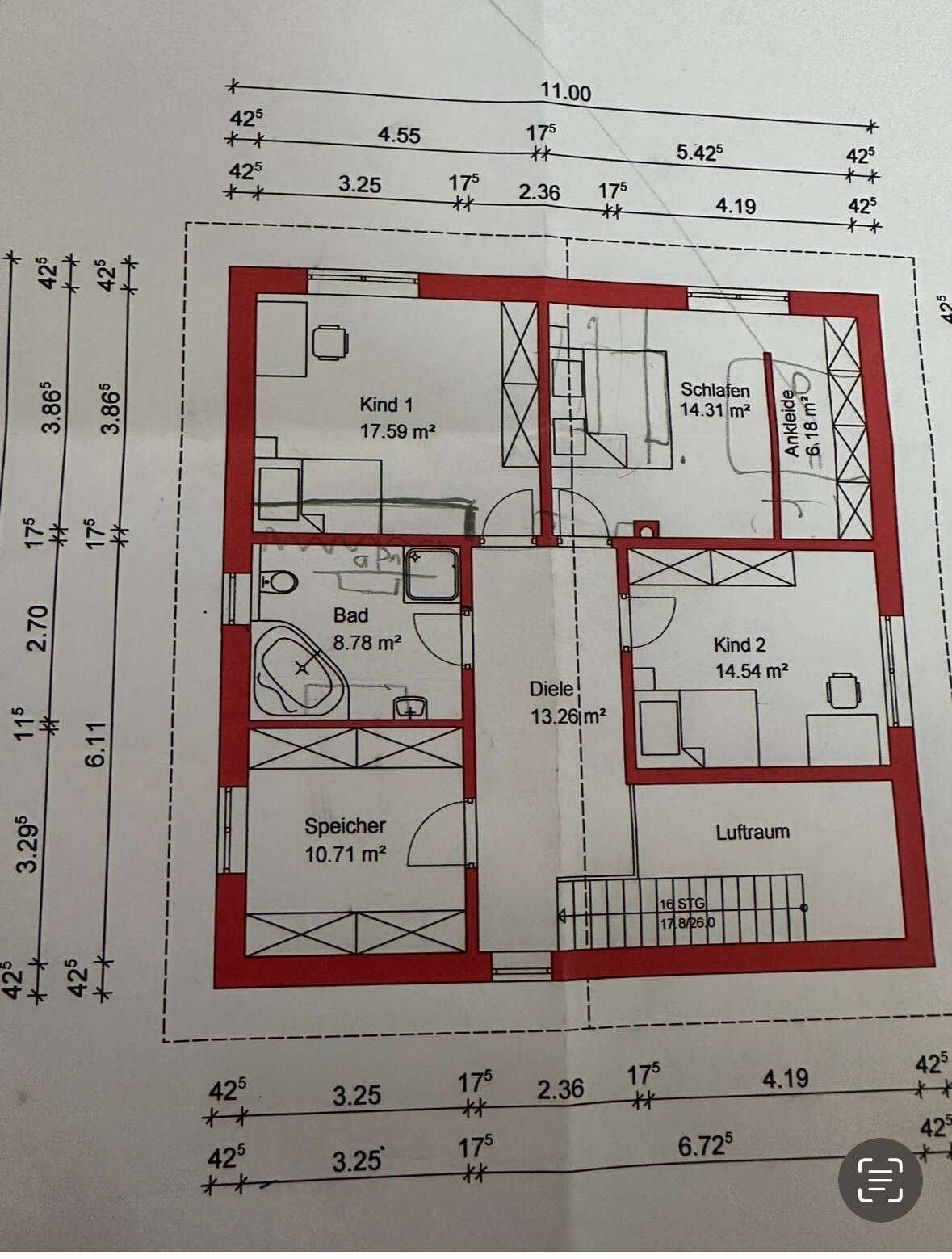
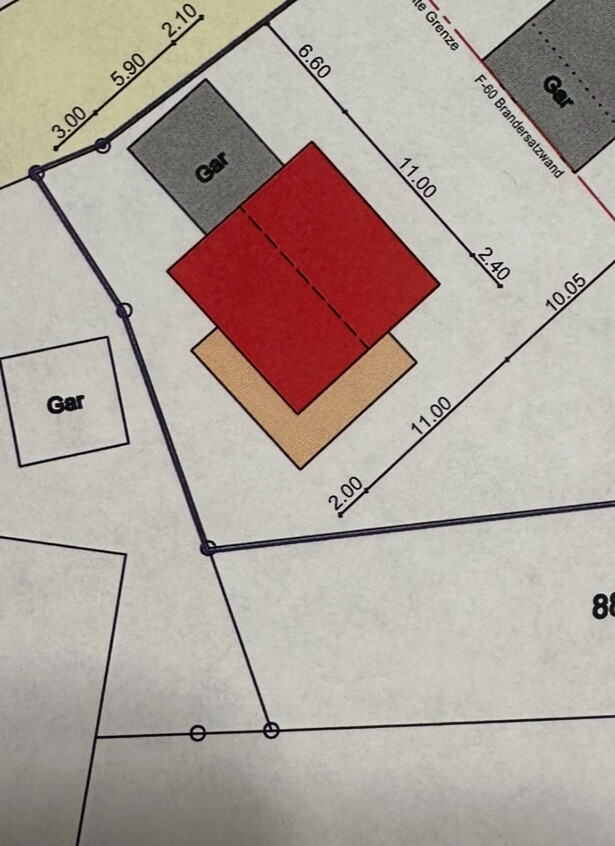
Here is the first draft, partly with pencil markings for changes.
Plot size: approx. 1000m² (0.25 acres)
Slope: no
Site occupancy index: Paragraph 34
Floor area ratio: Paragraph 34
Building window, building line and boundary
Edge development: not applicable
Number of parking spaces: 2
Number of floors: Paragraph 34
Roof style: Paragraph 34
Architectural style: Paragraph 34
Orientation: Paragraph 34
Maximum heights/limits
Additional requirements: none
Clients’ Requirements
Architectural style, roof form, building type
Basement, floors: rather modern, gable roof, no basement, 2 full floors, attic not developed.
Number of persons, age: 33, 29, and 1 year old, possibly another child in the future.
Space requirements on ground floor and upper floor
Office: family use or home office? Family use.
Number of overnight guests per year: none
Open or closed architecture: open
Conservative or modern design: rather modern
Open kitchen, cooking island: open with peninsula
Number of dining seats: 6–8
Fireplace: yes, with water jacket as firewood is regularly sourced from own forest.
Music/stereo wall: no
Balcony, roof terrace: no
Garage, carport: garage already existing.
Utility garden, greenhouse: yes
Additional wishes/special features/daily routine, including reasons why certain things should or should not be included:
An important point for us when we get older is to have the possibility to live only on the ground floor.
House Design
Who created the design
- Planner from a construction company
- Architect: friendly architect
- Do-it-yourself
What do you like most? Why? The possibility to have a bedroom in the open-plan area for later in life.
What do you like least? Why? Staircase located at the front door.
Cost estimate according to architect/planner: 620,000 including demolition of existing outbuilding and all additional costs.
Personal price limit for the house, including fittings: 700,000
Preferred heating system: heat pump + photovoltaic system with battery storage and fireplace with water jacket.
If you have to give up something, which details/extra features
- Can you do without: lift-and-slide door, a few floor-to-ceiling windows.
- Cannot do without: bathroom with shower on the ground floor, possibility to set up an additional bedroom on the ground floor.
Why is the design like it is now? For example:
Standard design from the planner?
Which wishes were implemented by the architect?
A mix of many examples from various magazines: exactly this.
What makes it particularly good or bad in your opinion? The hallway feels quite large yet also narrow to me, but maybe I am mistaken.
Here is the first draft, partly with pencil markings for changes.
Darbo19 schrieb:
The hallway seems quite large but still narrow to me, maybe I’m mistaken. You’re not mistaken – this exact area is already completely unacceptable as “designed.” In both versions, you have to walk through a narrow, winding maze just to hopefully reach the living area. This change will completely overturn the entire “plan” and necessarily send it back to the drawing board. Assuming the front door is 1 meter wide (3 feet 3 inches), the two doors to the kitchen and guest bathroom are probably only 60-70 cm wide (24-28 inches); luckily, at least there are doors drawn in at all. It’s a bad joke to have to enter the open-plan area through such a narrow slit, and then only through the kitchen. Honestly, who needs an “entry hall” in an ordinary single-family home? I think this term was just used to disguise the fact that more expensive hallway space was wasted there, resulting in an 18 sqm (194 sq ft) corridor overall. The staircase in that spot also seems completely misplaced to me; the open space will only cause unnecessary sound transmission and heat loss without creating any positive spatial feeling. Darbo19 schrieb:
Architect: Friend who is an architect That might be tempting but also risky. In this case, I would try to bring it to an end as soon as possible, while a fair cooperation might still be possible. Presenting something like this as an architect frankly scares me. I would first look for one of the many standard floor plans available online and then slightly modify it to my needs. I find this attempt completely messed up and frankly terrible as a result of architectural work, also because the measurements are imprecise. Darbo19 schrieb:
What do you like especially? Why? The possibility of having a bedroom in the open-plan area in old age. This is not specially planned here. In almost any open-plan area, a lightweight partition wall could be installed later to separate a room. However, at the age of 30, this shouldn’t influence your planning. I built my first house at 30 and the third at 63. It doesn’t have to be the standard, but general life experience shows that things change completely over 30-40 years and you will need to make new decisions repeatedly. A partition wall is a minor consideration in that regard. Darbo19 schrieb:
Fireplace: yes, with a water jacket since firewood is always available from our own forest. Okay, then perhaps also consider a masonry heater with auxiliary heating for cost reasons. Darbo19 schrieb:
- you could do without: lift-and-slide door and some floor-to-ceiling windows. That’s a good decision. By the third house, I finally implemented that: no more lift-and-slide doors. Regular doors are much easier to operate and also cheaper; next to them can be a large fixed-glass element. Floor-to-ceiling windows only on the ground floor anyway, and even there, I prefer windows with about 40 cm (16 inches) sill height for views. Darbo19 schrieb:
- you cannot do without: bathroom with shower on the ground floor. I understand that, but then make it a bit more spacious if you’re already thinking about old age.N
nordanney3 Dec 2025 13:44Darbo19 schrieb:
An important point for us as we get older is to have the option to live only on the ground floor. I’m no floor plan expert (but even I find the very long hallway quite negative…), but please don’t plan a house for 40 years from now. When the time comes, at worst you end up with a large, worn-out house where the upper floor is no longer used and the ground floor needs to be remodeled.
Either plan right from the start so it can be divided into two separate apartments, or—much simpler—just plan it as you need the house now and for a foreseeable period.
Or do you also want to plan for situations like
- divorce
- job change
- disability and wheelchair use
- having triplets as children
and so on? It might be that these situations arise and require different arrangements.
P.S. I bought my first house at your age as well. Since then, I have lived in two more houses and an apartment (all owned—of course also self-built). Life can develop in different ways, even if your “life plan” looked different 25 years ago…

I actually don’t think having a living and shower area on the ground floor is a bad idea. However, you should make sure to have sufficiently wide doors and easy access into the house (avoiding steps). This isn’t only important if you become in need of care yourself, but also if you ever get injured or need to accommodate elderly or less mobile parents for a week.
Short-term care is mostly just theoretical when you really need it on short notice.
Your floor plan seems quite inconsistent in this regard. Try using the search function to find a better floor plan. What you are building (160 m² (1,722 sq ft), 2 bedrooms and 2 bathrooms) is pretty much standard.
Short-term care is mostly just theoretical when you really need it on short notice.
Your floor plan seems quite inconsistent in this regard. Try using the search function to find a better floor plan. What you are building (160 m² (1,722 sq ft), 2 bedrooms and 2 bathrooms) is pretty much standard.
 Papierturm3 Dec 2025 13:54
Okay. First, about the floor plan:
- I would strongly recommend reconsidering the door by the garage. The main entrance is directly next to the garage. The question is how the space under the stairs will be used. This area would be almost ideal for storage—built-in cupboards or something similar. The door makes this much more difficult.
- Garage in general: If I understand correctly, the garage is accessed from the side (so turned 90° relative to the street)? Is there enough space for maneuvering? I’m not 100% sure this will work well or be easy to drive into.
- This leads me to the basement: Perhaps some of this could be rearranged. I find it inconvenient that the places to wash your hands are located so far away. Also, the second design has a very long walk to the kitchen.
- Something I would consider: Move the garage (since it’s currently unclear if it’s usable as planned). Put the entrance where the garage door is now (this could solve several issues at once -> no stairs in a dirty zone, shorter path to the guest toilet and kitchen, guest toilet not in the dirty zone either). Use a quarter-turn staircase that angles upwards (exit leading to the hallway instead of facing a wall). There will still be some “dead space” on the ground floor due to the long pathway along the stairs. However, this can’t be avoided with this shape and placement of the stairs.
- I don’t like the upper floor for the following reasons:
-> The “storage” room is mostly empty space. It could be made narrower without losing functionality.
-> Having the walk-in closet located behind the bedroom means the partner can be disturbed when it’s used.
-> You potentially have to walk into a wardrobe at child’s room 1.
-> Window layout: Child 1 only has windows on one wall. Are there no windows in the open space?
-> You approach the stairs facing a wall.
-> There is a lot of corridor space that is difficult to use effectively.
=> I would redesign a lot here. The first point above ties into the quarter-turn staircase idea upstairs.
Now the big “but”: There is one fundamental thing I don’t like, and that is the staircase. The stairs are a key design element because they fundamentally define the floor plan. I would not plan a straight staircase given the house dimensions. And if I do, I would place it differently. However, doing that means reworking the entire floor plan.
Aaargs.
But that would allow for a much better layout upstairs and save expensive hallway space on the ground floor.
Therefore: On to version 2.
I also have to agree with @Arauki11: This is not a pleasing plan. I don’t know to what extent a friend who is an architect can fix this. It can go wrong.
And when working with friends, there is also the problem that no one wants to step on each other’s toes. A good architect also has to advise against bad ideas. At the same time, as a client, you have to feel able to say “I don’t like this or that.” Without this willingness to challenge each other professionally, it will be difficult.
- I would strongly recommend reconsidering the door by the garage. The main entrance is directly next to the garage. The question is how the space under the stairs will be used. This area would be almost ideal for storage—built-in cupboards or something similar. The door makes this much more difficult.
- Garage in general: If I understand correctly, the garage is accessed from the side (so turned 90° relative to the street)? Is there enough space for maneuvering? I’m not 100% sure this will work well or be easy to drive into.
- This leads me to the basement: Perhaps some of this could be rearranged. I find it inconvenient that the places to wash your hands are located so far away. Also, the second design has a very long walk to the kitchen.
- Something I would consider: Move the garage (since it’s currently unclear if it’s usable as planned). Put the entrance where the garage door is now (this could solve several issues at once -> no stairs in a dirty zone, shorter path to the guest toilet and kitchen, guest toilet not in the dirty zone either). Use a quarter-turn staircase that angles upwards (exit leading to the hallway instead of facing a wall). There will still be some “dead space” on the ground floor due to the long pathway along the stairs. However, this can’t be avoided with this shape and placement of the stairs.
- I don’t like the upper floor for the following reasons:
-> The “storage” room is mostly empty space. It could be made narrower without losing functionality.
-> Having the walk-in closet located behind the bedroom means the partner can be disturbed when it’s used.
-> You potentially have to walk into a wardrobe at child’s room 1.
-> Window layout: Child 1 only has windows on one wall. Are there no windows in the open space?
-> You approach the stairs facing a wall.
-> There is a lot of corridor space that is difficult to use effectively.
=> I would redesign a lot here. The first point above ties into the quarter-turn staircase idea upstairs.
Now the big “but”: There is one fundamental thing I don’t like, and that is the staircase. The stairs are a key design element because they fundamentally define the floor plan. I would not plan a straight staircase given the house dimensions. And if I do, I would place it differently. However, doing that means reworking the entire floor plan.
Aaargs.
But that would allow for a much better layout upstairs and save expensive hallway space on the ground floor.
Therefore: On to version 2.
I also have to agree with @Arauki11: This is not a pleasing plan. I don’t know to what extent a friend who is an architect can fix this. It can go wrong.
And when working with friends, there is also the problem that no one wants to step on each other’s toes. A good architect also has to advise against bad ideas. At the same time, as a client, you have to feel able to say “I don’t like this or that.” Without this willingness to challenge each other professionally, it will be difficult.
Schmirgel schrieb:
I don’t think having living and shower facilities on the ground floor is a bad idea at all. Of course, that’s not a bad idea, especially if there is a coherent plan with proper execution and a suitable budget behind it. But in this case, it’s not really a deliberately planned living option, rather just the rather basic possibility to separate the living room from the bedroom; something that is almost always possible. If accessibility or similar requirements were to be taken into account, the entire house project including the house entrance, bathroom, kitchen, etc., would have to be designed accordingly, which is clearly not the case here (and not necessary at all).
Schmirgel schrieb:
However, one should also ensure sufficiently wide doors and easier access into the house (avoiding steps). This isn’t only important if you need care yourself, but also if you get injured or have to host elderly or less agile parents for a week. Yep... at least that, but there is no identifiable special risk or higher probability for this than for anyone else.
Papierturm schrieb:
I would strongly recommend considering the door near the garage here. A widely discussed topic with an almost unanimous opinion that it seems more like a trend or some unclear concern about potential raindrops or something else. Arguing against it are always the costs, the lack of real benefit, and the negative effects on the floor plan or even the positioning of the garage (if such an expensive structure is even necessary and not just a budget-friendly carport). For example, I read about a garage but nothing about mechanical ventilation or usually costly patio covers, when the car is already supposed to be under a roof.
Papierturm schrieb:
But if I do that, I have to redo the entire floor plan.
Aaargs. So what...?
Of course, nobody likes that, especially when you already feel close to the goal. I know that feeling very well, but I prefer to remember how happy we were—and still are—after finding a better solution for us. We have a whole drawer full of such plans (mostly painstakingly revised by ourselves), and our current house ended up completely different. Even if it costs money, I would never want to build a lazy compromise.
Similar topics