
ᐅ Planning Light Switches for a (Pass-Through) Kitchen Between Dining and Living Areas
Created on: 18 Nov 2025 14:44
K
kasper_repsak
Dear community,
I am feeling a bit confused and uncertain:
We have purchased a new build house (in the Netherlands) where some elements, like the small entrance area and the “pass-through kitchen,” are definitely not ideal and represent a compromise. I have attached the standard electrical plan along with a few changes we would like to make. When you walk down the stairs, there is only one light switch to turn off the first floor light (h), but no switch to turn on the ground floor lights. All light switches for the ground floor (c) (d) (e) and (f) are located near the entrance area at the bottom, a few meters away from the stairs (so you have to walk a few meters in the dark).
Is it sensible to position the additional (d) (e) and relocated (f) switches as shown here?
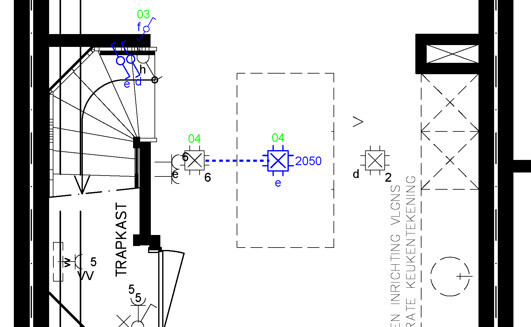
The idea is that you are basically standing in the kitchen when you come down the stairs, so you can switch on these “visible” lights (d) and (e), or if you want to go into the living room, the corresponding light switch (f) is just around the corner, as if the living room were a separate room.
I am unsure if this will be practical, especially since switch (f) is around the corner and I am not sure whether the kitchen light should be the one you want to turn on here (instead of the living room light (f) and/or the dining table light (c) being positioned here—right at (h)).
I have considered five other (discarded) ideas but would be very grateful for your input!
Thanks in advance,
Kasper
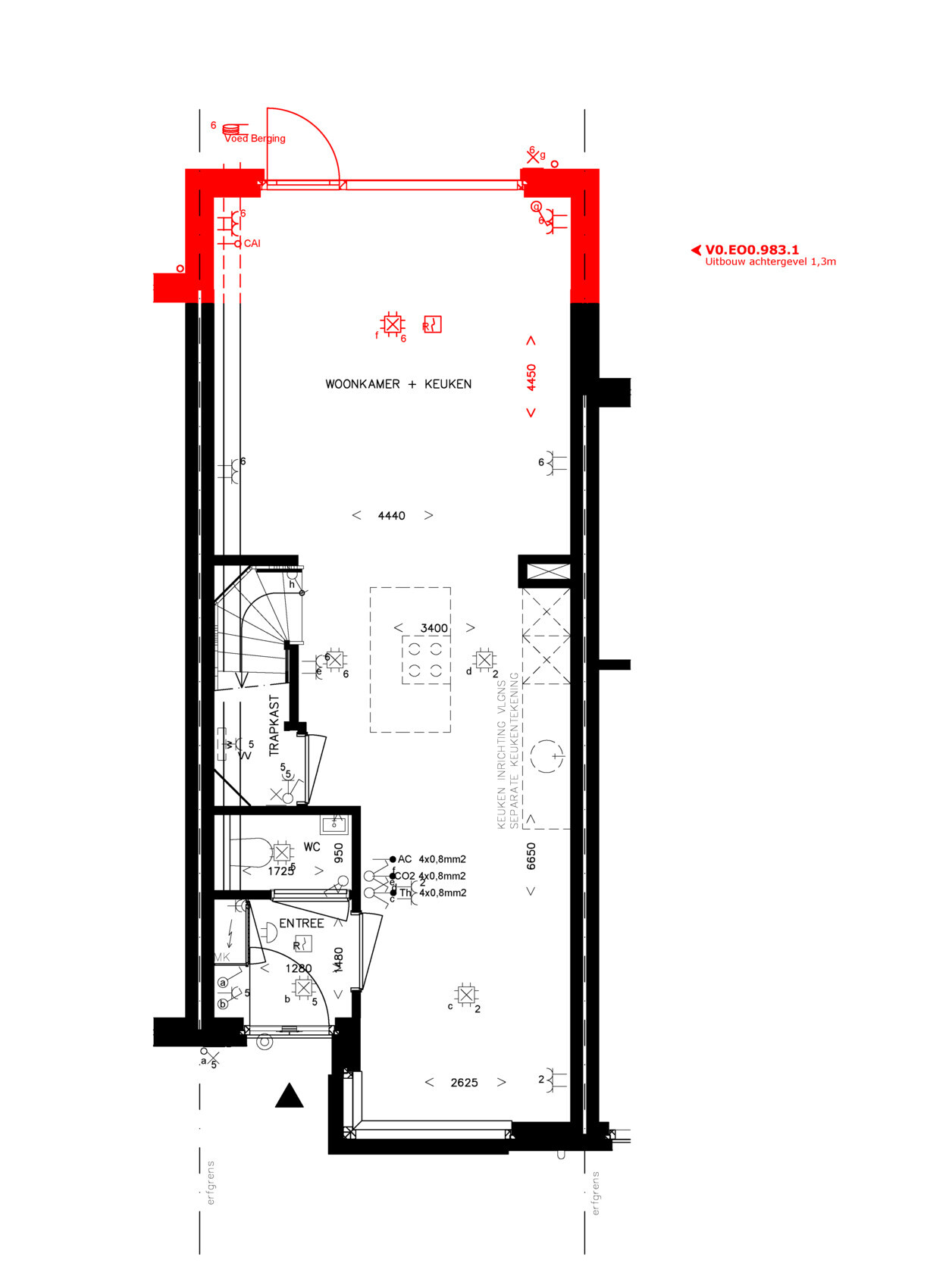
I am feeling a bit confused and uncertain:
We have purchased a new build house (in the Netherlands) where some elements, like the small entrance area and the “pass-through kitchen,” are definitely not ideal and represent a compromise. I have attached the standard electrical plan along with a few changes we would like to make. When you walk down the stairs, there is only one light switch to turn off the first floor light (h), but no switch to turn on the ground floor lights. All light switches for the ground floor (c) (d) (e) and (f) are located near the entrance area at the bottom, a few meters away from the stairs (so you have to walk a few meters in the dark).
Is it sensible to position the additional (d) (e) and relocated (f) switches as shown here?
The idea is that you are basically standing in the kitchen when you come down the stairs, so you can switch on these “visible” lights (d) and (e), or if you want to go into the living room, the corresponding light switch (f) is just around the corner, as if the living room were a separate room.
I am unsure if this will be practical, especially since switch (f) is around the corner and I am not sure whether the kitchen light should be the one you want to turn on here (instead of the living room light (f) and/or the dining table light (c) being positioned here—right at (h)).
I have considered five other (discarded) ideas but would be very grateful for your input!
Thanks in advance,
Kasper
K
kasper_repsak19 Nov 2025 13:30Thank you for the ideas and suggestions! I will still consider option (f), either on the living room side or on the staircase side (otherwise the triple switch will cost an additional EUR 370, since there is already an (f) switch at the exit to the garden).
I’m not sure if I understood that …
Thanks and best regards,
Kasper
Ganneff schrieb:
But have you looked at the plan – in the kitchen row on the stove side towards the living room. How often will that happen to you? Is it practical to always have to go all the way over there?
I’m not sure if I understood that …
Thanks and best regards,
Kasper
kasper_repsak schrieb:
I'm not sure if I understood that correctly...If I read the plan correctly, you have a kitchen island. You can access the living room via the staircase side, or on the other side, between the kitchen island and the kitchen units. Under the lamp labeled "d 2" there is the "corridor." If you go through there, you currently have no way to turn on the living room light and must first go over to the staircase.
K
kasper_repsak19 Nov 2025 16:18Ganneff schrieb:
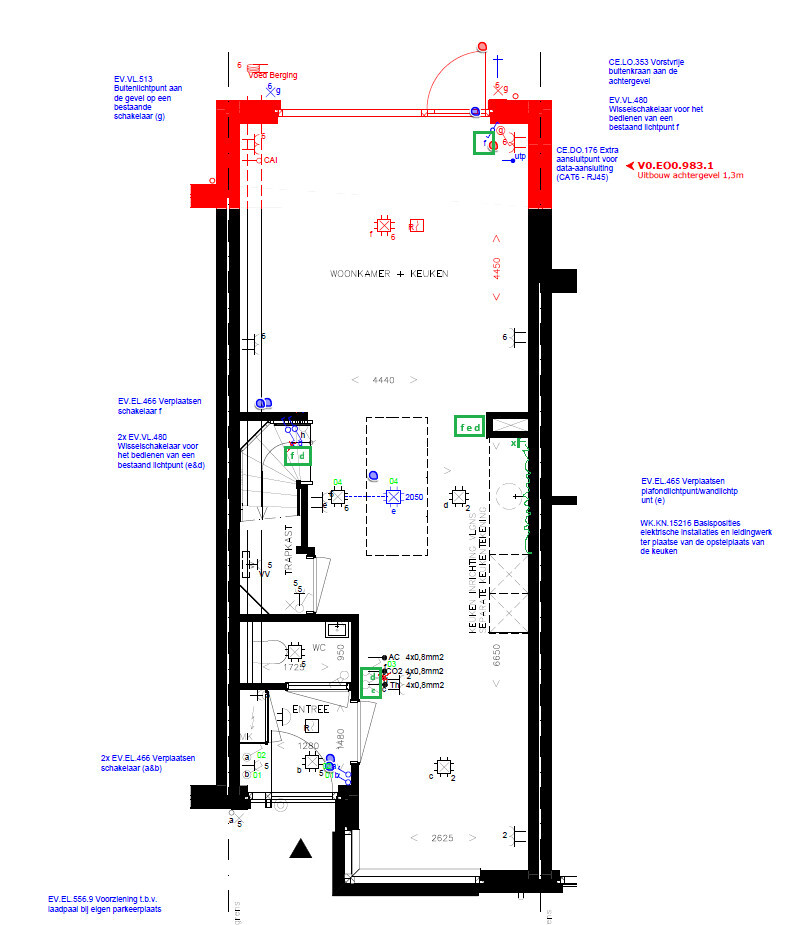
If I understand the plan correctly, you have a kitchen island. You can access the living room via the stairs on one side, or on the other side, between the kitchen island and the kitchen units. Under the lamp labeled "d 2" is the "hallway". If you pass through there, currently you have no way to turn on the living room lights and have to walk over to the stairs first.Thank you, yes, that’s correct. To turn off the kitchen light and turn on the living room light, you have to walk about 2 meters (6.5 feet) to the stairs (and the switches are located on two different sides there).Would this be better/more sensible?
- Stairs: living room (f), general kitchen lighting (d), and stairs (h) = all on the same (stair) side.
- Kitchen/living room transition (as mentioned above): living room (f), general kitchen lighting (d), and kitchen island (e) – the integrated switch for the task lighting (x) will also be nearby later – power is planned, but adding a separate switch at (f), (e), and (d) would cost about EUR 370 more.
- Entrance from the hallway: dining table (c) and general kitchen lighting (d)
- Entrance from the garden: living room (f)
Advantages: living room and kitchen lights can be controlled from all three corners; switches at the stairs on the same side.
Disadvantage: kitchen island can only be switched from one location now (no longer from the entrance area and the stairs, but only inside the kitchen, where the switch for the other task lighting will also be near).
Cost: about EUR 700 more, as (d) and (f) would be triple-switchable.
PS: kitchen adjusted based on the standard kitchen plan.
Thank you very much!
K
kasper_repsak19 Nov 2025 19:30PPS: Attached is a clearer version again (green)
Your current plan makes more sense (to me).
Regarding costs, I highly recommend checking out systems like Homematic, Shelly, or one of the many other wireless-based systems. Possibly combined with a Home Assistant. This way, you can easily retrofit and install switches wirelessly in places where you don’t want to pay for expensive wiring work by an electrician.
Downside: These are battery-powered, of course. Depending on usage, you will need to replace the batteries approximately every 2 years. And of course, it’s not enough to just stick a Homematic (or whichever) switch on the wall—you also need something to process their signals. If you enjoy tinkering and can imagine setting this up, you can get several switches and a central unit for about the price of one switch from your electrician. And that’s just the beginning…
As an added bonus, you also get the option to control everything via an app on your phones. (And depending on what else you have in your home, you might also be able to integrate heating control, blinds control, switchable sockets, and dimmable lights.)
Regarding costs, I highly recommend checking out systems like Homematic, Shelly, or one of the many other wireless-based systems. Possibly combined with a Home Assistant. This way, you can easily retrofit and install switches wirelessly in places where you don’t want to pay for expensive wiring work by an electrician.
Downside: These are battery-powered, of course. Depending on usage, you will need to replace the batteries approximately every 2 years. And of course, it’s not enough to just stick a Homematic (or whichever) switch on the wall—you also need something to process their signals. If you enjoy tinkering and can imagine setting this up, you can get several switches and a central unit for about the price of one switch from your electrician. And that’s just the beginning…
As an added bonus, you also get the option to control everything via an app on your phones. (And depending on what else you have in your home, you might also be able to integrate heating control, blinds control, switchable sockets, and dimmable lights.)
K
kasper_repsak20 Nov 2025 10:23Ganneff schrieb:
Your current plan makes more sense (to me).
Regarding costs, seriously take a look at systems like Homematic or Shelly, or one of the many other wireless-based systems. Possibly in combination with a Home Assistant. This way, you can easily retrofit and install switches wirelessly in locations where you don’t want to spend on expensive wiring by an electrician. Alright, thank you very much, that’s what we’ll do! 🙂
Similar topics