
ᐅ Floor plan discussion of a medium-small single-family house with a pitched roof and a double garage
Created on: 9 Nov 2025 18:08
B
Baumweg32
Hello everyone,
we plan to build a single-family house in 2026/27. We are both 30 years old (and intend to stay that way), have no children, and work full-time in the office/from home. Below we have completed the questionnaire and look forward to you brutally roasting our current floor plan – what have we overlooked?
Zoning Plan / Restrictions
Plot size – just under 400 m² (about 4300 sq ft), access and road to the south
Slope – no
Site coverage ratio – no zoning plan, according to §34, neighbors have between 0.3-0.4
Floor area ratio – no zoning plan, according to §34
Building envelope, building line and boundary – no zoning plan, according to §34
Edge development – no, the surrounding area consists of other semi-detached and single-family houses
Number of parking spaces – double garage + carport + theoretically two spaces in front of the garage in the courtyard
Number of floors – 2 full stories + basement
Roof type – gable roof
Style – modern
Orientation – south
Maximum heights / limits
Other requirements – development according to §34
Homeowners’ Requirements
Style, roof type, building type – gable roof with sufficient eaves, otherwise the house looks like a thumb
Basement, floors – basement yes, ground floor, upper floor
Number of people, age – 2, 30 years
Room requirements on ground and upper floor – Ground floor: entrance, shower, WC, kitchen, dining area, living room; Upper floor: 2 offices, bathroom with bathtub, bedroom, walk-in closet
Office: family use or home office? – home office
Number of overnight guests per year – 1
Open or closed layout – preferably closed
Conservative or modern building method – solid construction, modern, no porous clay bricks (Poroton)
Open kitchen, kitchen island – closed kitchen
Number of dining seats – 4-6
Fireplace – yes, sometime when budget allows
Music/sound wall – yes, living room
Balcony, roof terrace – no
Garage, carport – yes and yes (carport only if budget allows)
Utility garden, greenhouse – no
Other wishes / special features / daily routine, also reasons why this or that should or should not be included – Ideally, when one person gets up, they leave the bedroom without having to go back in to get clothes, so the other can continue sleeping. Also, we work from home a lot. That means each person needs their own office so they don’t disturb each other during calls etc.
House Design
Who made the design: architect based on our initial PowerPoint sketches
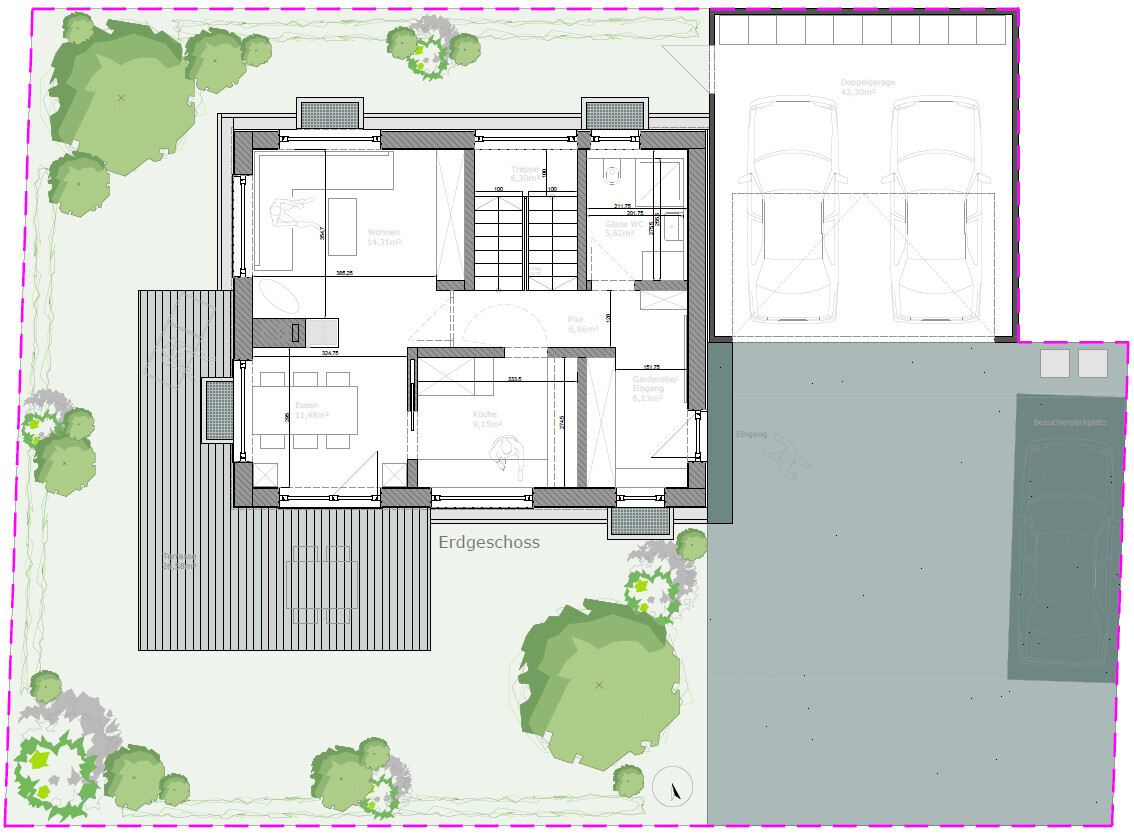
What do you particularly like? Why? – We like the visual axes, from the staircase through the kitchen to the garden and from the hallway past the fireplace into the garden. A generous entrance area is important to avoid future frustration when entering the house and not knowing where to put groceries.
What don’t you like? Why? – The bedroom-walk-in closet situation is tight. We have thought and struggled with this a lot. Maybe we can expand the house by 50 cm (20 inches) to the south. Then a 1.5 m (59 inch) wide walk-in closet would fit.
Price estimate from architect/designer: 600,000 €
Personal price limit for the house, including fittings: 650,000 € (fittings? Kitchen and furniture on top)
Preferred heating technology: heat pump
If You Have to Give Up on which details/extensions
You can live without: laundry chute
You cannot live without: separate office rooms, walk-in closet, separate kitchen, staircase as straight as possible (in our case a half-landing staircase max?)
Why is the Design as It Is?
Standard design from the planner? – No, we came with a rough plan sketched in PowerPoint to the architect
Which wishes were implemented by the architect? – All our wishes were implemented by the architect
What do you think is especially good or bad? – We actually like the floor plan very much. As mentioned, the walk-in closet is tight but so far we have not found a better alternative that still allows easy access around the bed. We would also like a T-shaped bathroom layout mainly to hide the WC. But probably there is no space for that, or maybe you have a sudden idea?

we plan to build a single-family house in 2026/27. We are both 30 years old (and intend to stay that way), have no children, and work full-time in the office/from home. Below we have completed the questionnaire and look forward to you brutally roasting our current floor plan – what have we overlooked?
Zoning Plan / Restrictions
Plot size – just under 400 m² (about 4300 sq ft), access and road to the south
Slope – no
Site coverage ratio – no zoning plan, according to §34, neighbors have between 0.3-0.4
Floor area ratio – no zoning plan, according to §34
Building envelope, building line and boundary – no zoning plan, according to §34
Edge development – no, the surrounding area consists of other semi-detached and single-family houses
Number of parking spaces – double garage + carport + theoretically two spaces in front of the garage in the courtyard
Number of floors – 2 full stories + basement
Roof type – gable roof
Style – modern
Orientation – south
Maximum heights / limits
Other requirements – development according to §34
Homeowners’ Requirements
Style, roof type, building type – gable roof with sufficient eaves, otherwise the house looks like a thumb
Basement, floors – basement yes, ground floor, upper floor
Number of people, age – 2, 30 years
Room requirements on ground and upper floor – Ground floor: entrance, shower, WC, kitchen, dining area, living room; Upper floor: 2 offices, bathroom with bathtub, bedroom, walk-in closet
Office: family use or home office? – home office
Number of overnight guests per year – 1
Open or closed layout – preferably closed
Conservative or modern building method – solid construction, modern, no porous clay bricks (Poroton)
Open kitchen, kitchen island – closed kitchen
Number of dining seats – 4-6
Fireplace – yes, sometime when budget allows
Music/sound wall – yes, living room
Balcony, roof terrace – no
Garage, carport – yes and yes (carport only if budget allows)
Utility garden, greenhouse – no
Other wishes / special features / daily routine, also reasons why this or that should or should not be included – Ideally, when one person gets up, they leave the bedroom without having to go back in to get clothes, so the other can continue sleeping. Also, we work from home a lot. That means each person needs their own office so they don’t disturb each other during calls etc.
House Design
Who made the design: architect based on our initial PowerPoint sketches
What do you particularly like? Why? – We like the visual axes, from the staircase through the kitchen to the garden and from the hallway past the fireplace into the garden. A generous entrance area is important to avoid future frustration when entering the house and not knowing where to put groceries.
What don’t you like? Why? – The bedroom-walk-in closet situation is tight. We have thought and struggled with this a lot. Maybe we can expand the house by 50 cm (20 inches) to the south. Then a 1.5 m (59 inch) wide walk-in closet would fit.
Price estimate from architect/designer: 600,000 €
Personal price limit for the house, including fittings: 650,000 € (fittings? Kitchen and furniture on top)
Preferred heating technology: heat pump
If You Have to Give Up on which details/extensions
You can live without: laundry chute
You cannot live without: separate office rooms, walk-in closet, separate kitchen, staircase as straight as possible (in our case a half-landing staircase max?)
Why is the Design as It Is?
Standard design from the planner? – No, we came with a rough plan sketched in PowerPoint to the architect
Which wishes were implemented by the architect? – All our wishes were implemented by the architect
What do you think is especially good or bad? – We actually like the floor plan very much. As mentioned, the walk-in closet is tight but so far we have not found a better alternative that still allows easy access around the bed. We would also like a T-shaped bathroom layout mainly to hide the WC. But probably there is no space for that, or maybe you have a sudden idea?
Baumweg32 schrieb:
We are both 30 years old (and want to stay that way) Funny 🙂 Unfortunately, I can’t offer you much hope there.
Baumweg32 schrieb:
Otherwise, the house looks like a thumb Not bad either. Hehe, good sense of humor.
Baumweg32 schrieb:
We actually like the floor plan a lot. That is quite possible and likely because you have spent (a lot of) time working on your design.
However, there are many design flaws. Kerstin @kbt09 already pointed out the window heights on the upper floor.
Baumweg32 schrieb:
We like the sight lines, from the stairs through the kitchen into the garden, and from the hallway past the fireplace also into the garden. A generous entrance area is important to us, to avoid future frustration when entering the house and not knowing where to put the groceries. When I read this, I was curious to see what you had planned. Many people omit sight lines or have to because they need to maximize space for children on a small footprint, so details like that often get lost. However, there are actually no sight lines towards the garden here. Looking from the stairs towards the kitchen door, you are facing the (right side) corner of the kitchen; from the hallway towards the fireplace, you see the fireplace but not the window. To see the window, you would need to be at stair landing height. Also, the entrance area at 150cm (59 inches) wide is not really generous. On the plus side, you have a nice spot for a wardrobe cabinet, which I like.
Baumweg32 schrieb:
Price estimate according to architect/designer: €600,000 Of course, that has been promised, but I wonder where the costs come from (apart from the basement). The house is very compact — in my opinion, too compact.
Many rooms are quite narrow, nearly too narrow for their intended use. The dressing room is a tiny chamber where you can hardly turn around. The quarter-round wardrobe is not functional. There should be at least 90cm (35 inches) in front of a wardrobe so you can have a good overview within your field of vision. The optimum is about 120cm (47 inches). The bedroom, with furniture (bed approx. 210cm (83 inches) long), has very little walking space. It must be noted that these plans show raw construction dimensions, so additional centimeters will be lost to plaster and finishes.
It gets worse in the bathroom. 210cm (83 inches) is not enough once you include stud walls and tiles. Then we are down to about 2 meters (79 inches). I once had a terraced house bathroom with tiles that was 230cm (90 inches) wide, and that already felt very narrow for two people; you could only pass each other by with contact. That’s not a big problem, but honestly, you don’t build a house to have cramped spaces. Currently, the washbasin water pipes run through the load-bearing staircase wall.
270cm (106 inches) width in the office is okay, but with a length of 455cm (179 inches), the rooms feel like narrow tubes again.
You could overlook this if everything else fit, but downstairs the areas around the fireplace are too narrow, as Kerstin already mentioned — and I have a fireplace myself. It’s better to sit at some distance, or else you risk damage. There should be about 1 meter (39 inches) clearance between the flame and any fabric, furniture, or upholstery to avoid scorching from heat. This makes the dining area rather awkward to use. The living room is longer than it is wide, which is doable but tends to feel less cozy. The fireplace here divides a space that is already quite tight. The kitchen is also not very generous: with two tall cabinets for the oven and pantry, only 2.40m (7 ft 10 in) plus a small storage corner remain, after accounting for 60cm (24 inches) sink and 60cm (24 inches) stove units. This sounds like a lot but isn’t. There is currently no sufficient 65cm (26 inch) depth for the countertop under the window because the door to the dining area takes that space.
The platform in front of the entrance is also too narrow. You have a shower on the ground floor that doesn’t really serve a purpose right now.
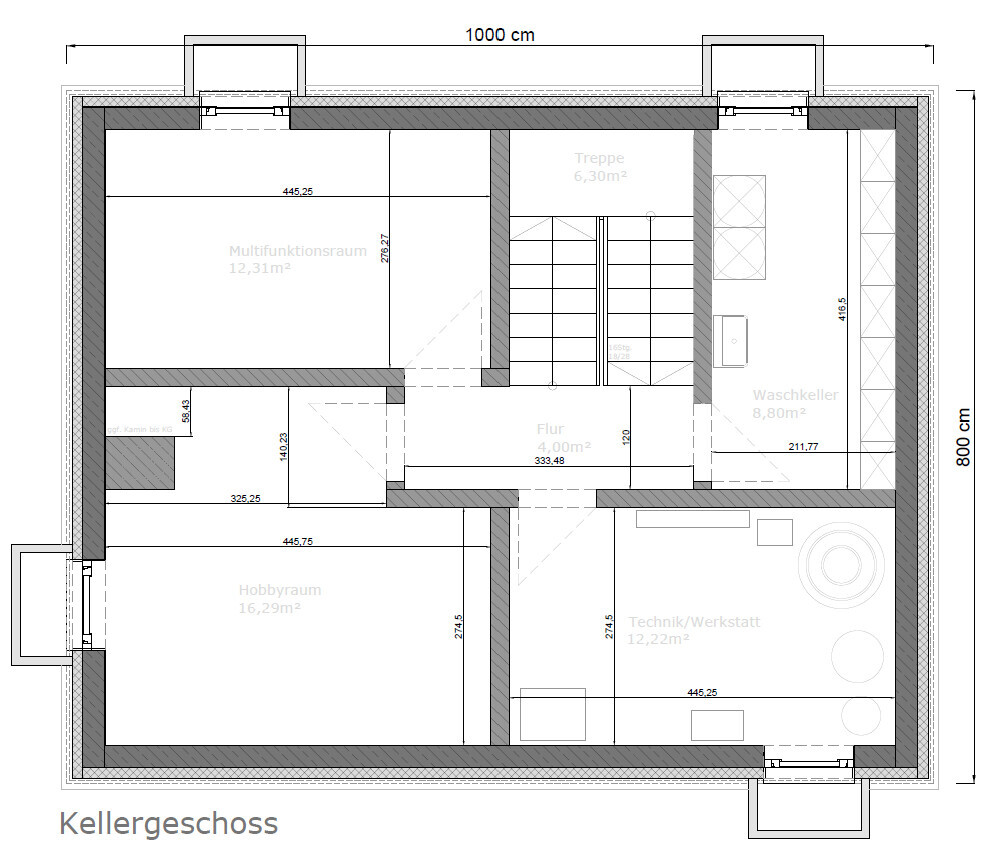
In the basement there are unusable spaces. One room even has a window into the terrace.
From a design perspective, I would avoid the bend in the hallway — it makes it unnecessarily long.
Do yourselves a favor: drop the basement and use your money to build a generous ground floor and a suitable upper floor. At least make the rooms functional. Then you could manage with about €500,000, and still have budget for a double garage. Whether you go with an extension or keep a rectangular footprint, but with a lower knee wall and a roof cut-off, is something to consider.
I don’t think you have to reinvent the wheel here. There are clever house designs available online and as standard plans from builders and general contractors with storage or utility rooms on the ground floor. You can of course have an architect design a plan, but I wouldn’t take the one who just approved your current design.
Do you actually miss a corner on the top right of your plot, or is that just badly drawn?
Baumweg32 schrieb:
We actually like the floor plan a lot. What exactly do you like? I’m curious.

GeraldG schrieb:
I have a somewhat provocative question. Looking at your basement, it seems to have almost no real purpose.
Wouldn’t it make more sense to eliminate the “basement” requirement and plan a slightly larger main floor (and possibly also the upper floor)? The square meters in the basement cost roughly the same as living space on the main floor. Even if your lot is small, there should still be room for a “larger house.” It could even be more comfortable and still cheaper. We’re attaching our basement layout plan here (mainly: workshop, gym, technical room, laundry including washing/drying/ironing, guest bed for 2–5 overnight stays per year). Maybe this justifies having the basement? We find it difficult to fit all these functions on the main and upper floors without making our garden too narrow or making the house encroach too much on neighboring properties (according to the architect’s estimate, 10m x 10m (33ft x 33ft) is the maximum footprint here).
kbt09 schrieb:
So, I think we should start over.
The walk-in closet on the upper floor is problematic, especially with the recess directly above the chimney shaft — what is that supposed to achieve?
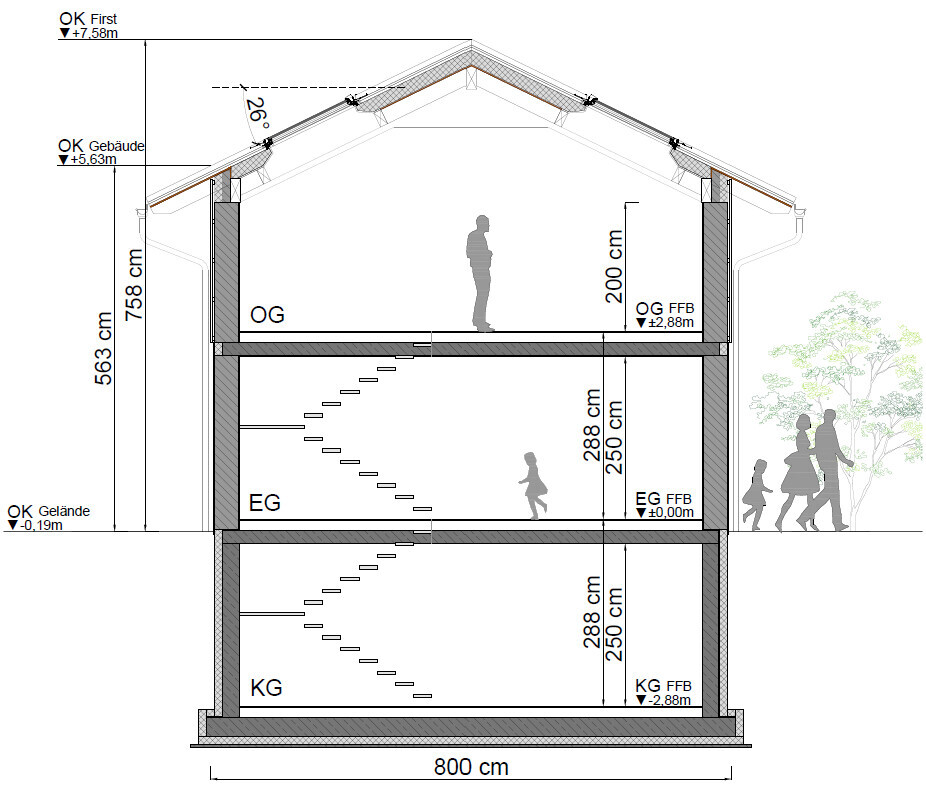
The office with a knee wall height of 200 cm (79 inches) ... the windows will be poor. You enter the office and can’t really look out the windows because the top of the glass will be around 150 cm (59 inches).
The dining table and the potential fireplace are too close together. If the fireplace is on while sitting at the dining table, it will simply get too warm.
... and that made me smile 🙂 🙂Yes, the walk-in closet is far from ideal, which is why we’re reaching out here 🙂. Do you have any ideas on how it could be arranged differently or better?
The point about the windows is valid. How high should the knee wall be to fit a “regular” window? We will discuss with the architect again whether increasing the knee wall height fits the budget.
11ant schrieb:
Thanks for the reminder that we still too rarely (or too quietly?) advise against “grafting” the architect.
Yes, the 11ant basement rule is often overlooked as well.
Those are two decisions I consider unwise: the construction method and the specific wall structure. Make the decision about the construction method only after the >soft phase during the >proofing stage, and then follow the >stone mantra.
Starting with the 50 cm (20 inches) rule, many regional building codes include the roof overhang in the setback distances.Yes, we later reconsidered the point about “grafting.” We went back to a home builder with a blank sheet of paper to explore an alternative. We know they focus on ease of construction, but even so, we didn’t like the new approach.
We reviewed the basement rule but it didn’t add any new input for our considerations. Omitting the basement only works if you don’t need the entire floor area. We do need it (as shown in the attached basement usage plan), which means the house would have to be 8 x 12 m (26 x 39 ft) or 10 x 14 m (33 x 46 ft). Unfortunately, that’s too large for the plot.
When would you decide on the wall construction? For us, it was a fundamental decision based on bad experiences living in a timber frame rental.
Papierturm schrieb:
Unsorted thoughts:
Topic 1: The walk-in closet
- A key but unanswered question is: How large should/must the home office workstations be?
- How much closet space is needed?
These two questions are connected. Currently (unfortunately) I assume that the wardrobe space upstairs will not work and will be a pure waste of money and space. The room is simply too small to be used effectively. This can be changed, for example, we planned so that we don’t put closets in the bedroom and accordingly made the bedroom smaller. Instead, we have a larger dressing room. Possibly, some space could also be taken from the home office workstations.
Topic 2: Financial planning
- Fireplaces are expensive. If you love a fire, fine, it’s your dream home after all. However: even KfW 55 standard houses overheat very quickly because of fireplaces. People I know who built with a fireplace in recent years rarely use it, and if they do, only sporadically.
- I would carefully consider whether investing in a basement is justified by the benefits. The plot does not require a basement. A basement is a significant investment.
- Cars also survive outside in the fresh air or under carports. Double garages, on the other hand, are quite expensive.
Topic 3: Knee wall height:
- If not specified by the zoning plan (which does not apply here), I would avoid building within the knee wall area. Either make it high enough so you can still have a good view despite shading (usually from about 240cm (7 ft 10 in) clear knee wall height depending on the supplier, or two full stories), or go for a classic one-and-a-half story with a low knee wall, steep roof, and skylights. With this design, when you stand on the upper floor, your sightline always ends at a wall.
Topic 4: Kitchen:
- A somewhat provocative idea: place the door directly between the entrance area and the kitchen, instead of in the hallway. The door as currently planned is an accident waiting to happen. Eventually, someone will get hit by it. And if the goal is, and I quote, "We want a generous entrance area to avoid future tantrums when entering the house and not knowing where to put the groceries", then I think… "okay, then carry that through consistently and avoid accident risks." (And if you want to see the garden from the stairs, an internal window would work as well. The upper kitchen door lies directly on the walking path from the stairs and living area, which you must also pass to reach the bathroom. Alternatively: a glass sliding door with some frosted elements.)Thank you very much for the detailed response!
The home office spaces should be large enough to function as multifunctional rooms. That means, even if we sell the house one day, they could also be used as children’s bedrooms. A bed and a closet should definitely fit well. And if next to the desk there is room for a reading chair and a bookcase or an easel, that would be great as well.
Closet space:
In recent years, we have managed very well with three IKEA Pax closets each 1m (3 ft 3 in) wide. We don’t expect this need to change significantly (assumption). On the contrary – for example, heavy ski jackets and pants will be stored in the hallway closet or garage, as planned.
Financial planning:
A fireplace is an emotional decision. We don’t really need one. That’s true. We will reconsider this. Are there any guidelines or figures on how much can be saved here (especially in installation costs)?
Unlike the fireplace, the double garage is non-negotiable 😀 We are planning a prefabricated double garage.
Omitting the basement only works under the assumption that we don’t need the entire floor area. If we do, the house would have to be 8x12 or 10x14 meters (26x39 or 33x46 ft), which is unfortunately too big for the plot. Our thoughts that we need the full basement space are based on the attached plan above.
Knee wall height:
That’s a good point, also made by @kbt09. We will discuss with the architect how much more expensive a higher knee wall would be.
Kitchen:
We had also considered in the kitchen showroom placing a door from the entrance area instead of in the northern hallway (or as a pass-through only). We then abandoned this idea because we didn’t want to always go through the dirty entrance zone to get to the kitchen. Of course, one could enter the kitchen from the dining area inside the house. Either way, the kitchen would then only be accessible by detours. We wanted to avoid that with the central door. That was our reasoning. A sliding door might solve this, true. We will check that. However, the future homeowner has a strong aversion to sliding doors (fragile mechanics, rollers, etc.).
N
nordanney9 Nov 2025 22:21Baumweg32 schrieb:
Omitting the basement only works under the assumption that we don't need the entire space. But we actually do (as shown in the attached basement usage plan above). I don’t see in the plan that you really “need” the space. The workshop will be an extension of the garage. The guest bed will be placed in a home office. Three drying racks?
People tend to convince themselves they “need” something. I see a space requirement, but not in the form of a plain basement costing 75-100k.
Similar topics