
ᐅ Terrace Planning for an End-Row House with a Large Garden – What to Consider?
Created on: 4 Aug 2025 13:41
B
Bauherrin123
Hello everyone,
we are now moving on to the outdoor area. We have an end-terrace house with a relatively large garden but a small budget. Still, we want to build a large, beautiful terrace.
We have contacted various craftsmen, gardeners, and companies with offers ranging from $5,000 to $25,000 (or equivalent), so all kinds of quotes.
I need some ideas now:
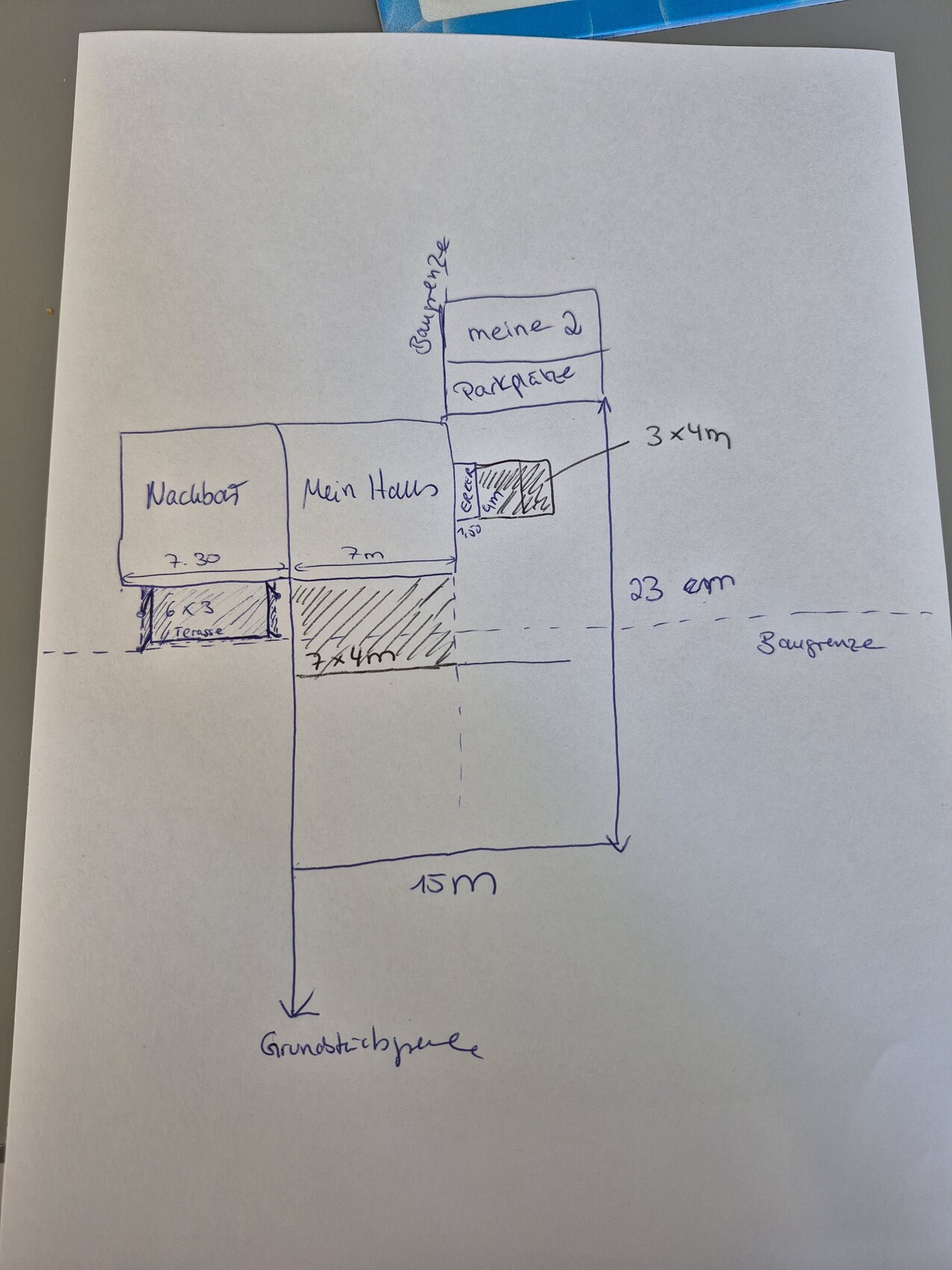
Below is the sketch: The main point is that I definitely want two terraces: one main terrace along the house in the front, 28m² (301 sq ft), and a smaller one on the side, 12m² (129 sq ft). Now I want to connect the terraces, and I have heard different opinions on this. Some recommend offsetting the terrace stones as a pathway, etc. I have actually decided to close off the corner, meaning to expand the main terrace on the side, creating a corner terrace. Sometimes I worry that it might not look good and I’m unsure. We have a large family; I want large tables with chairs, swings, and more solid surface, but without overdoing it. Also, I don’t want to have to take care of a huge garden, so that would be practical for me. The neighbor was not allowed to build wider or bigger due to property division rules limiting the sealed area, but for Jens, that should not be a problem.
Now my question to you:
How would you plan the terrace? The bigger it is, the more expensive it will be.
What kind of slabs do you have, what material and installation method? I have quotes for 2cm (3/4 inch) slabs set in concrete or 4cm (1 1/2 inch) slabs on a gravel/sand base. I want large slabs.
I would like light-colored slabs with anthracite edging. Regarding roofing, I’m not sure if I’m allowed to build 7m (23 ft) wide and whether I can exceed the building limit line. I would like about 7 by 4m (23 by 13 ft)... but that would be 1m (3 ft) over the building limit. On the side, I have already enlarged the living space with a bay window under a special permit; I don’t know if I can add a roof there too. Now I need advice, ideas, tips—I’m a bit lost about what to consider, etc.
I’m also happy to hear about your experiences with terraces, what mistakes you made, what worked well, what you would do differently. Especially, what did your terraces cost.
Thank you
we are now moving on to the outdoor area. We have an end-terrace house with a relatively large garden but a small budget. Still, we want to build a large, beautiful terrace.
We have contacted various craftsmen, gardeners, and companies with offers ranging from $5,000 to $25,000 (or equivalent), so all kinds of quotes.
I need some ideas now:
Below is the sketch: The main point is that I definitely want two terraces: one main terrace along the house in the front, 28m² (301 sq ft), and a smaller one on the side, 12m² (129 sq ft). Now I want to connect the terraces, and I have heard different opinions on this. Some recommend offsetting the terrace stones as a pathway, etc. I have actually decided to close off the corner, meaning to expand the main terrace on the side, creating a corner terrace. Sometimes I worry that it might not look good and I’m unsure. We have a large family; I want large tables with chairs, swings, and more solid surface, but without overdoing it. Also, I don’t want to have to take care of a huge garden, so that would be practical for me. The neighbor was not allowed to build wider or bigger due to property division rules limiting the sealed area, but for Jens, that should not be a problem.
Now my question to you:
How would you plan the terrace? The bigger it is, the more expensive it will be.
What kind of slabs do you have, what material and installation method? I have quotes for 2cm (3/4 inch) slabs set in concrete or 4cm (1 1/2 inch) slabs on a gravel/sand base. I want large slabs.
I would like light-colored slabs with anthracite edging. Regarding roofing, I’m not sure if I’m allowed to build 7m (23 ft) wide and whether I can exceed the building limit line. I would like about 7 by 4m (23 by 13 ft)... but that would be 1m (3 ft) over the building limit. On the side, I have already enlarged the living space with a bay window under a special permit; I don’t know if I can add a roof there too. Now I need advice, ideas, tips—I’m a bit lost about what to consider, etc.
I’m also happy to hear about your experiences with terraces, what mistakes you made, what worked well, what you would do differently. Especially, what did your terraces cost.
Thank you
B
Bauherrin1236 Nov 2025 23:47Hello everyone,
Unfortunately, the start of the project has been delayed. The contractors didn’t show up when they were supposed to, and then we had a rainy period. Now we have almost two weeks of dry weather in a row. On Wednesday at 8 a.m., the work finally began: the exterior wall was coated with bitumen. Insulation was applied. On Wednesday morning, it was 6°C (43°F), rising to 15°C (59°F) during the day. At night, the temperature dropped to 3°C (37°F). When I left for work on Thursday morning (today), some spots were still sticky and wet. The landscaper came by around 9 a.m. and applied the second layer.
Today was noticeably colder. Around 7°C (45°F) during the day, with 4°C (39°F) at night now. The landscaper says it’s no problem, but according to the manufacturer, the temperature should not fall below 5°C (41°F). I checked myself and it’s still wet in many spots—still not dry. Starting this work in November was already somewhat risky, but I did not expect the contractors to come so late despite promises. Now I’m worried that they will just continue working or wrongly claim everything is fine, which might cause damage later on.
The forecast says the weather should improve a bit in the next few days. I hope it dries quickly, as then the Styrodur insulation boards and the dimpled membrane will be installed, followed by the patio slabs. The target completion date is November 15, but judging by the progress, I’m not confident it will be finished by then.
Does anyone have experience with whether 3°C (37°F) really harms the drying process? Are there long-term damages?
Unfortunately, the start of the project has been delayed. The contractors didn’t show up when they were supposed to, and then we had a rainy period. Now we have almost two weeks of dry weather in a row. On Wednesday at 8 a.m., the work finally began: the exterior wall was coated with bitumen. Insulation was applied. On Wednesday morning, it was 6°C (43°F), rising to 15°C (59°F) during the day. At night, the temperature dropped to 3°C (37°F). When I left for work on Thursday morning (today), some spots were still sticky and wet. The landscaper came by around 9 a.m. and applied the second layer.
Today was noticeably colder. Around 7°C (45°F) during the day, with 4°C (39°F) at night now. The landscaper says it’s no problem, but according to the manufacturer, the temperature should not fall below 5°C (41°F). I checked myself and it’s still wet in many spots—still not dry. Starting this work in November was already somewhat risky, but I did not expect the contractors to come so late despite promises. Now I’m worried that they will just continue working or wrongly claim everything is fine, which might cause damage later on.
The forecast says the weather should improve a bit in the next few days. I hope it dries quickly, as then the Styrodur insulation boards and the dimpled membrane will be installed, followed by the patio slabs. The target completion date is November 15, but judging by the progress, I’m not confident it will be finished by then.
Does anyone have experience with whether 3°C (37°F) really harms the drying process? Are there long-term damages?
N
nordanney7 Nov 2025 07:58Bauherrin123 schrieb:
And does anyone have experience, are 3 degrees really harmful for the drying process or not?Which product exactly? Which manufacturer?
1K or 2K?
Why wasn’t the base of the house treated completely during construction?
The site is unproblematic, but with 1K it is time-consuming. 2K usually dries significantly faster.
B
Bauherrin1237 Nov 2025 12:01nordanney schrieb:
Which product exactly?
Which manufacturer?
1K or 2K?
Why wasn’t the base of the house fully treated during construction?
Plot is unproblematic, but with 1K it takes a lot of time. 2K usually dries significantly faster. Hello, thank you very much for your reply.
I’m uploading a picture of the product; it is from Bauhaus. I believe posting links is not allowed here.
I am currently looking for the posts related to the base of my house. It was a matter of some confusion—I’m not exactly sure what was done. I had already posted pictures or information about it, and some users thought it was already completed and that just a drainage membrane would be sufficient, while others said it needs to be properly insulated. Since I was uncertain and the landscaping contractor recommended it, we decided to have it redone.
I have pictures from the house construction: There is some green material attached to the foundation slab that looks like Styrofoam in the photos... on top of that, bitumen was applied. Inside, a bitumen sheet membrane was laid on the foundation slab as a black waterproofing layer. Apparently, it was then plastered, and my husband applied a waterproof slurry on top. Now we are having a bitumen coating applied. The windows were sealed with a film, and we had everything painted twice. After that, Styrodur insulation boards and then a dimpled membrane will be installed.
If you like, I can send you more photos of the house and the construction so you can better assess the situation?!
Thanks again for your support; I really appreciate it.
Kind regards
N
nordanney7 Nov 2025 12:08Bauherrin123 schrieb:
I’m uploading a picture of the product. It’s from Bauhaus; I believe links are not allowed here. It takes a while to dry. The temperature is still acceptable for the product, though borderline.
Bauherrin123 schrieb:
I have photos from the construction, and there’s something green on the concrete slab. Usually insulation – that’s how it should be.
Feel free to upload more pictures to be sure.
B
Bauherrin1237 Nov 2025 12:16nordanney schrieb:
It takes time to dry. The temperature is still acceptable for the product, although it’s at the limit.
Normally insulation — that’s how it should be.
Feel free to upload more pictures just to be safe.Gladly, I have these two pictures ready; I would need to search for more. Does that help you?
What do you see in the pictures?
Best regards
B
Bauherrin12315 Nov 2025 11:50Hello, the work starts on Monday. Unfortunately, the last landscaping contractor got injured on another site, so we had to find a different one again.
The new landscaping contractor wants to put down 30cm (12 inches) of gravel, then a sloped screed concrete layer on top, and then tile over it with water-impermeable joints. I spoke to the landscaping contractor about this, and now my husband did as well: We want to use drainage mortar (that is, a mix of gravel and cement at a 4:1 ratio), then tile over it with water-permeable joints. The water needs to be able to drain not only by slope but also through infiltration. He says that he has been working with screed concrete like this for 30 years, it is very stable, and others would become loose after a few years.
My plan was: 30cm (12 inches) of gravel, then 7cm (3 inches) of drainage mortar, and then tile.
The discussion now is mainly about the 7cm (3 inches) mortar layer — whether it should be mortar, concrete, screed, or something else.
I have read a lot about this, and it was always recommended to use a water-permeable material. But the man, our landscaping contractor with 30 years of experience, says he will do it the way we want, but he can only guarantee screed concrete. According to him, the gravel-cement mix we want would become loose after a few years.
As a layperson, it is hard for me to question an experienced professional, but it doesn’t make sense to me. I understand our approach better, with water-permeable joints and a permeable sub-base, so that water does not remain trapped between the concrete and the tiles.
The new landscaping contractor wants to put down 30cm (12 inches) of gravel, then a sloped screed concrete layer on top, and then tile over it with water-impermeable joints. I spoke to the landscaping contractor about this, and now my husband did as well: We want to use drainage mortar (that is, a mix of gravel and cement at a 4:1 ratio), then tile over it with water-permeable joints. The water needs to be able to drain not only by slope but also through infiltration. He says that he has been working with screed concrete like this for 30 years, it is very stable, and others would become loose after a few years.
My plan was: 30cm (12 inches) of gravel, then 7cm (3 inches) of drainage mortar, and then tile.
The discussion now is mainly about the 7cm (3 inches) mortar layer — whether it should be mortar, concrete, screed, or something else.
I have read a lot about this, and it was always recommended to use a water-permeable material. But the man, our landscaping contractor with 30 years of experience, says he will do it the way we want, but he can only guarantee screed concrete. According to him, the gravel-cement mix we want would become loose after a few years.
As a layperson, it is hard for me to question an experienced professional, but it doesn’t make sense to me. I understand our approach better, with water-permeable joints and a permeable sub-base, so that water does not remain trapped between the concrete and the tiles.
Similar topics