
ᐅ Construction Companies in Hamburg for Single-Family and Semi-Detached Homes – Reviews and Quality Rankings
Created on: 28 Oct 2025 00:07
G
guub_bautG
guub_baut28 Oct 2025 00:07nordanney schrieb:
Just create a new thread with the question "affordable house building companies in Hamburg and surrounding areas" or search the forum. Searching the forum has helped me a bit (for example, “Building on an existing plot in Hamburg” or “Construction companies from Schleswig-Holstein,” though both are somewhat outdated and not actively maintained).
But while I was diligently reading through various threads, I also came across this:
Papierturm schrieb:
House providers are sort of ranked in "equipment tiers." These range from Dacia to Golf to Lamborghini. If you want to step outside a provider’s tier, it usually costs more than staying within the right tier and searching there directly.
Neither are the “premium” providers very good at reducing their scope, nor are the “basic” providers very good at upgrading.
This can be a risky situation, especially when you can’t properly assess the providers. I don’t find the term "equipment tier" entirely ideal, since it also relates somewhat to price, value for money, brand names, etc. But I can’t think of a better term. And I’m not familiar enough to properly judge what all is implied.
Since I’m already known for starting general discussions (for frequent readers: I’ll get back to the other thread eventually), I figured it might be better to ask something a bit more general here. Maybe more people will benefit from it.
Which construction companies are suitable for building in Hamburg (north of the Elbe)? And what “equipment tier” would you assign to each?
I’m mainly thinking of general contractors.
Additional question: Which of these companies would likely be open or willing to work with a plan provided by an architect from service phase 5?
I tried to classify the companies into tiers myself, but I simply don’t have enough insight into the different tiers.
- Team Massivhaus (regional Hamburg, Schleswig-Holstein, Mecklenburg-Western Pomerania, partly Lower Saxony)
- Town & Country
- Elbe-Haus
- Roth Massivhaus
- Breyer und Seck
- Eco System Haus
- Viebrockhaus
- Haus Compagnie
- Blohm Bau
- Virtus Haus (Schleswig-Holstein, but also Hamburg)
- Metis Haus
- Stollhaus
- Generalbau Peters
- Ö-Haus
- KSW Massivhaus
- Kalksandstein Bau Tornesch
- Kraft & Pahlke
- . . .

guub_baut schrieb:
Additional question: Which of the companies would likely be willing or happy to work with a design provided by an architect who has completed design phase 5?
I wanted to try categorizing the companies into tiers, but I simply don’t have the overview of these tiers. While I fully agree with the quote
Papierturm schrieb:
House providers basically have "equipment tiers." They range from Dacia to Golf to Lamborghini, so to speak. Once you want to move outside the tier of a given provider, it usually costs more than searching directly within the appropriate tier.
Neither are the "premium" providers particularly good at reducing their range of services, nor are the "lower tier" providers particularly skilled at upgrading their offerings.
Especially when you can’t properly assess the providers, this is a risky situation. because it accurately describes the essence, I would not draw the recommendation from that to categorize companies into tiers. The companies you mentioned are mostly familiar to me professionally (as general contractors), though only partially from my own projects. Professionally, I advise clients on general contractors and have a knack for this, which I use more intuitively rather than being able to write you a formula or recipe for it. Having already worked with a self-hired architect up to design phase 5, I would not approach general contractors specifically or exclusively as such; rather, I would include companies with individual lots in a tender process, who in turn are welcome to submit bids as general contractors for multiple or all lots. But not working from their standard scope of work, rather from what my architect would prepare. Design phase 5 is, according to my concept, the completion of "Module B" and thus the "prelude" to "Module C." Since I would never use the appointment of a general contractor’s construction manager as a reason to dispense with my own architect’s site manager (or independent construction supervisor), I do see a meaningful contractual boundary between phases 5 and 6, but otherwise consider the entire "second half" (design phases 5 through 8) as one consolidated "package."
In my projects, I approach companies in two stages: during the "resting dough" phase for initial orientation and budget calibration, just before transitioning from preliminary design to design development (including strategic decisions), I typically involve three masonry companies and three carpentry companies—as general contractors—but without committing to a bundled contract yet. Afterwards, the architect either further develops the preliminary design or shifts to adapting a proven building proposal based on the responses to question 2. Depending on the chosen approach, the process continues differently—in fact, only then does design phase 5 by the independent architect serve as a kind of "stop" on this track. My housebuilding roadmap is more of a guideline than a rigid path from phases 1 through 8 with the same architect as exclusive planner. If after the first round of inquiries a counterproposal is chosen, the collaboration proceeds in a mixed "independent architect / general contractor planner" team.
I don’t consider it advisable to appoint the independent architect for design phase 5 before finishing the "resting dough" phase.
In the world of my concept / roadmap, there are two possible switching points to general contractors: one before and one after "Module B." If switching occurs before Module B, then design phase 5 doesn’t come into play as it would if switching happens after Module B.
The two inquiry rounds are also not structured like a sports tournament: in the second phase, the participants can be a completely different group than in the first phase; it is not a filtering cascade like quarter-finals and semi-finals.
https://www.instagram.com/11antgmxde/
https://www.linkedin.com/company/bauen-jetzt/
 Papierturm28 Oct 2025 05:06
guub_baut schrieb:
Searching the forum helped me a bit (for example, "Building on an existing plot in Hamburg" or "Construction companies from Schleswig-Holstein," both somewhat outdated and not much recent activity).
But while reading through various threads, I also came across this:
I don’t find the term "equipment league" quite ideal. It’s also somewhat about price and value for money, brand names, and so on. But I can’t think of a better term. I’m also not familiar enough to judge what all is involved. That’s actually a valid point. It is a bit like cars, where you can have very similar models from the same manufacturer with significantly different pricing.
I’m not very familiar with the many local construction companies.
Regarding the ones mentioned, I can say the following:
- Town & Country: A franchise name with very diverse general contractors behind it. Basically (and this is not intended as a criticism) the equivalent of a Dacia, focused on minimizing costs. Consequently, its standard of fittings is lower than others.
- Viebrockhaus: Higher quality fittings, targeting more premium buyer groups, like those for Porsche and others. Whether the value for money is right here, others can better assess.
N
nordanney28 Oct 2025 07:55There are too many providers for me to really categorize.
Our AI says:
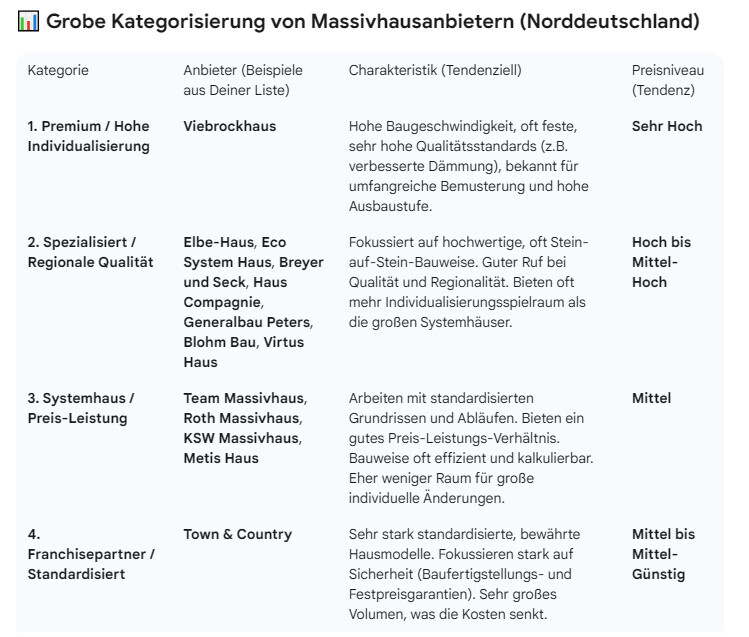
And even here, there is a note:
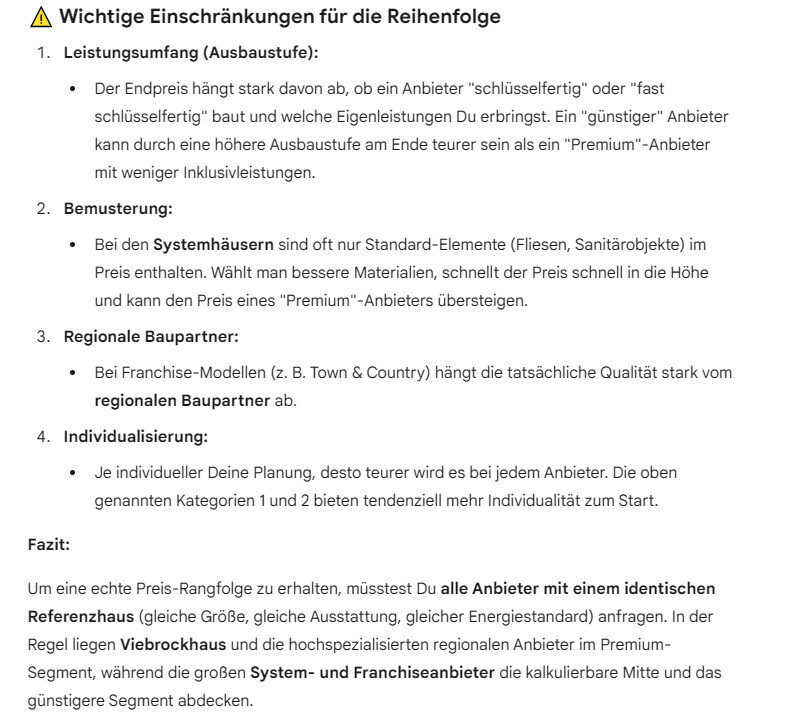
I think this is not bad at all for an automated response and reflects the general sentiment here in the forum.

Our AI says:
And even here, there is a note:
I think this is not bad at all for an automated response and reflects the general sentiment here in the forum.
guub_baut schrieb:
Additional question: Which of the companies would likely be open or willing to work if you come to them with a design from an architect at service phase 5?
G
guub_baut28 Oct 2025 10:25For us, the question of KfW 40+ is also important (otherwise financing will be difficult). Then there's the question of whether it makes sense to look for a company that operates at that level. Otherwise, you might face an unpleasant surprise during the final inspection. Right?
M
MachsSelbst28 Oct 2025 10:46Maybe you could start by sharing your budget with the interested readers. It doesn’t make sense to warmly recommend Viebrockhaus if you can only invest 350,000 EUR (about 370,000 USD) for a 150m² (1,615 sq ft) urban villa.
The car comparisons tend to be exaggerated. Viebrockhaus is neither a Porsche nor is Town & Country a Dacia. Dacia uses technology from the 1980s (torque converter automatics, hydraulic power steering), which does not apply to the equipment of a Town & Country house. Their standard features are actually considered state of the art by normal standards.
And a Porsche would be more like the custom-designed architect houses, such as the user with the 80m³ (2,825 cu ft) cistern in the garden—not a Viebrockhaus from the catalog—just because they have Villeroy & Boch sinks instead of Vigour.
Town & Country is like a basic Golf car, while Viebrockhaus is like a BMW 5 Series. That fits better, including the price differences. A Dacia costs starting from about 15,000 EUR (17,000 USD), a Porsche from 100,000 EUR (110,000 USD)… a completely absurd comparison.
The car comparisons tend to be exaggerated. Viebrockhaus is neither a Porsche nor is Town & Country a Dacia. Dacia uses technology from the 1980s (torque converter automatics, hydraulic power steering), which does not apply to the equipment of a Town & Country house. Their standard features are actually considered state of the art by normal standards.
And a Porsche would be more like the custom-designed architect houses, such as the user with the 80m³ (2,825 cu ft) cistern in the garden—not a Viebrockhaus from the catalog—just because they have Villeroy & Boch sinks instead of Vigour.
Town & Country is like a basic Golf car, while Viebrockhaus is like a BMW 5 Series. That fits better, including the price differences. A Dacia costs starting from about 15,000 EUR (17,000 USD), a Porsche from 100,000 EUR (110,000 USD)… a completely absurd comparison.
Similar topics