
ᐅ Floor Plan Design for a Single-Family Home with Garage and Roof Terrace
Created on: 8 Oct 2025 20:00
L
leah1003
Hello everyone,
We are a young couple (26 and 28 years old) currently planning to build our single-family home. Two children are planned for the future. We have already purchased the suitable plot – it is located on the edge of a field in a small village, so it is a very quiet location.
At the moment, we are about to commit to a construction company that will handle both the building permit (planning permission) and most of the construction as general contractor. However, we would like to carry out some trades as self-performed work.
We designed the floor plan together with a friend who is studying for a Master’s degree in architecture. So far, these are still draft drawings, which we now want to turn into permit-ready plans. However, we have reached a point where we feel “stuck” – we literally can’t see the forest for the trees. Unfortunately, we don’t like the floor plan 100%, some rooms are missing, and we are unsure how to proceed.
Therefore, we would appreciate any input, ideas, or suggestions for improvements – but first, here is an overview following the question checklist:
Plot & Development
Our Preferences & Requirements
Building Style & Construction
Rooms & Layout Concept
Building Services (planned)
Special Features & Current Challenges
What we like about the draft:
We were uncertain for a long time whether the gable or the eaves should face the field. The current plan has the eaves facing the field – this seems more generous towards the garden. We are open to opinions on this!
What currently bothers us:
Garage idea:
Budget & Self-performed Work
What could we possibly do without?
What we do not want to give up:
About the development of the draft
Our main question(s) to you:
Final summary
We are trying to create a modern, well-thought-out, and suitable home for our needs – with a realistic budget and self-performed work where it makes sense. It is important to us that the house is special but not excessive or “over the top.”
We look forward to any feedback – whether on room layout, building services, facade design, roof terrace, or details.
Thank you very much in advance!
We are a young couple (26 and 28 years old) currently planning to build our single-family home. Two children are planned for the future. We have already purchased the suitable plot – it is located on the edge of a field in a small village, so it is a very quiet location.
At the moment, we are about to commit to a construction company that will handle both the building permit (planning permission) and most of the construction as general contractor. However, we would like to carry out some trades as self-performed work.
We designed the floor plan together with a friend who is studying for a Master’s degree in architecture. So far, these are still draft drawings, which we now want to turn into permit-ready plans. However, we have reached a point where we feel “stuck” – we literally can’t see the forest for the trees. Unfortunately, we don’t like the floor plan 100%, some rooms are missing, and we are unsure how to proceed.
Therefore, we would appreciate any input, ideas, or suggestions for improvements – but first, here is an overview following the question checklist:
Plot & Development
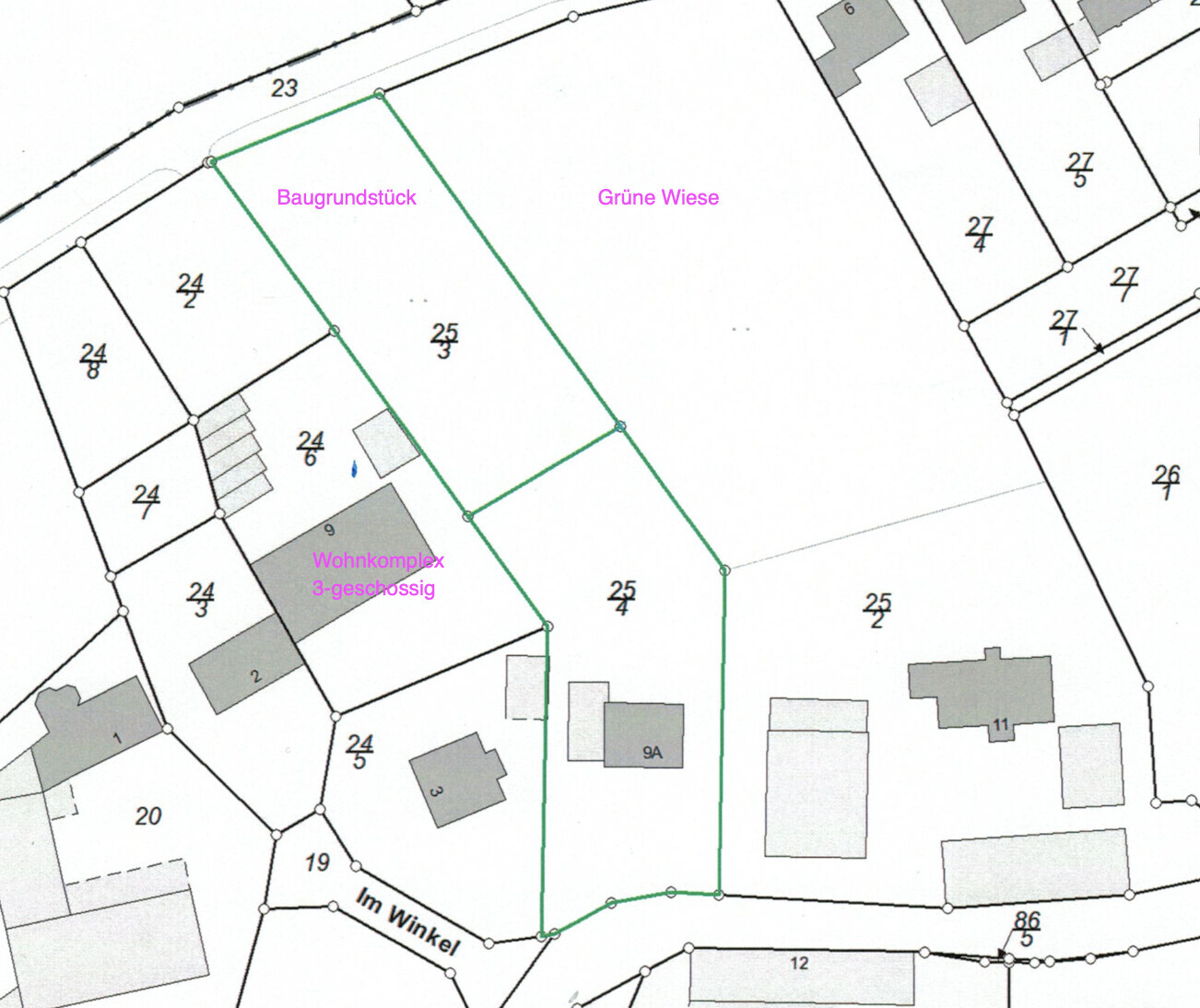
- Size: approx. 1,600 m² (17,220 sq ft)
- Dimensions: approx. 26 m (85 ft) wide × 60 m (197 ft) deep
- Topography: flat plot, no slope
- Location: edge of field in a small village
- Neighboring buildings:
- Northwest: Residential complex with two full stories + converted attic
- Northeast: large open meadow
- Development plan: none
- Requirements from building pre-application (preliminary enquiry):
- No explicit restrictions
- Recommendation to build towards the front (street side)
Our Preferences & Requirements
Building Style & Construction
- Two full stories
- Attic space used for storage
- Gable roof
- Timber frame construction
- Facade: combination of wood cladding and brickwork
- Style: modern, “clean”, clear lines – rather simple than ornate
- Basement: not planned
Rooms & Layout Concept
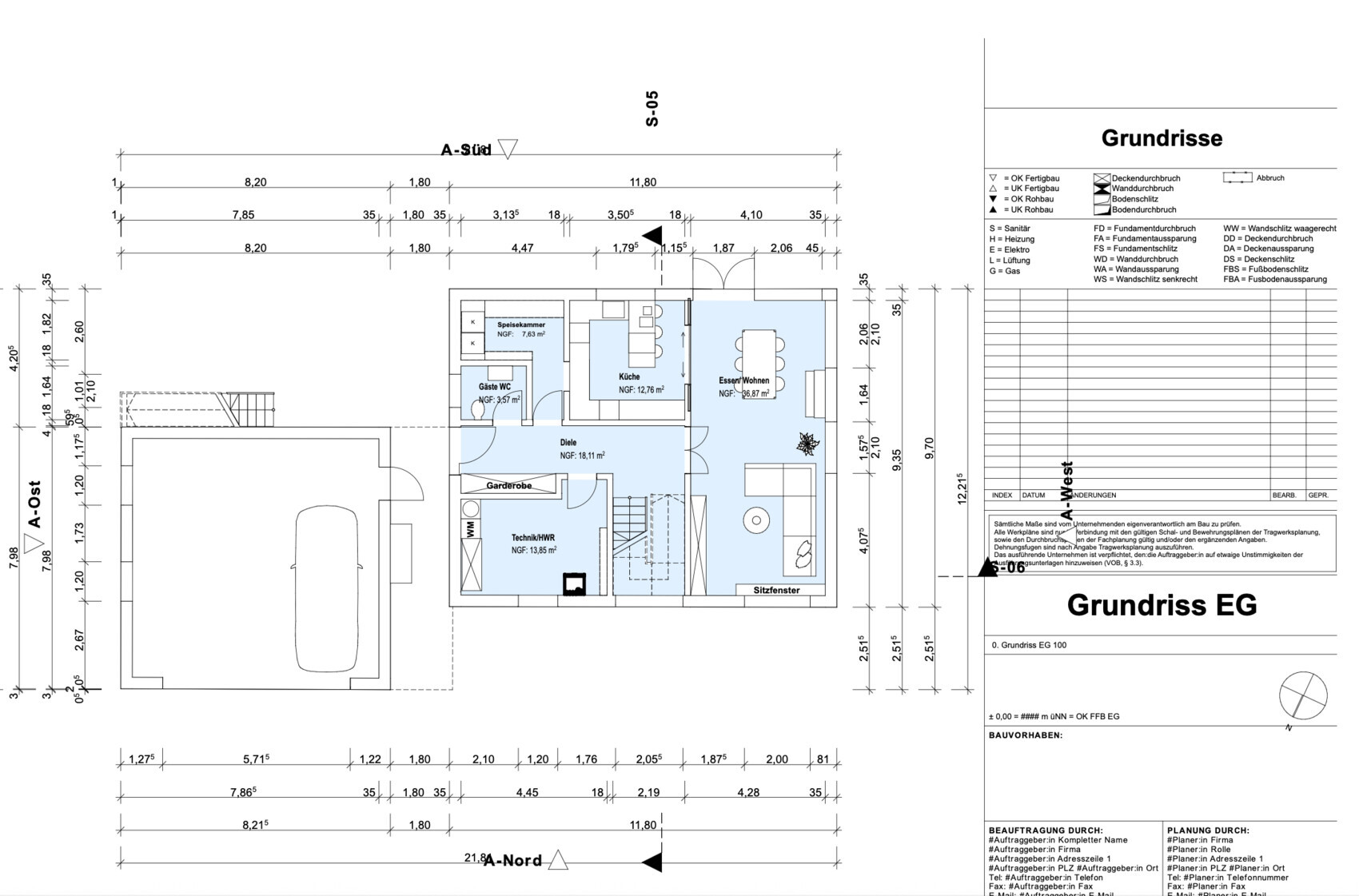
- Kitchen:
- Open, but separable with glass sliding door
- Pantry directly adjacent to the kitchen, ideally integrated into the kitchen cabinet front
- Dining/Living area:
- Open and spacious
- Dining table for 6 people, extendable to 10–12 people
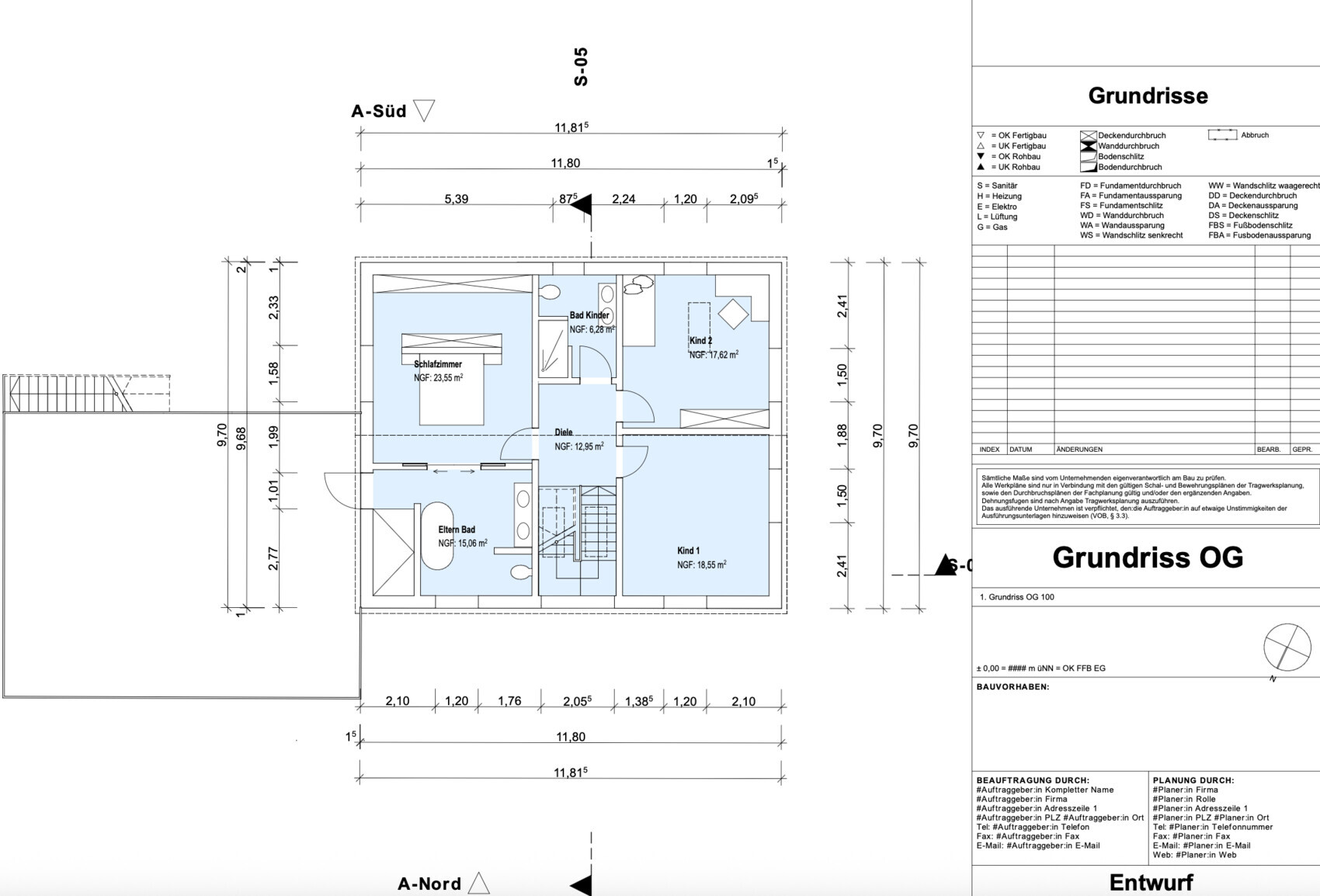
- Master area:
- Bedroom with direct access to walk-in closet and separate bathroom
- Children’s rooms:
- Two equivalent children’s bedrooms
- Bathrooms:
- Children’s bathroom on upper floor
- Guest toilet on ground floor, ideally with shower
- Office/guest room (currently not included in the draft)
- Utility room:
- For washing, drying, and hanging laundry
- Technical room:
- Housing building services, possibly integrated into garage
- Garage:
- Simple design
- Technical room + separate toilet as an “external WC” can be integrated (as an idea, not yet part of the plan)
- Roof terrace over the garage desired (to enjoy unobstructed views of the sunset and the field)
Building Services (planned)
- Heat pump
- Photovoltaic system
- Ventilation system
- Smart home technology
- KfW-40 standard (energy efficiency standard)
Special Features & Current Challenges
What we like about the draft:
- Good orientation of rooms according to cardinal directions
- Simple, modern design without bay windows or building projections
- Long side of the house facing the garden = more openness to the south
We were uncertain for a long time whether the gable or the eaves should face the field. The current plan has the eaves facing the field – this seems more generous towards the garden. We are open to opinions on this!
What currently bothers us:
- The office/guest room is completely missing
- The laundry area is not ideally planned yet – e.g., where exactly do we dry clothes in winter?
- Covered entrance area – but will it be too dark there?
- Children’s bathroom vs. office/laundry room: We are considering giving up the separate children’s bathroom to instead integrate the office or laundry/ironing room there. On the ground floor, the guest toilet could be made slightly larger and include a shower – in case mornings get busy or guests want to shower on the ground floor.
Garage idea:
- Relatively simple garage, only the technical room should be insulated and have a concrete floor slab
- The rest of the garage could remain paved and uninsulated
- Roof terrace on the garage with views over the fields – our heartfelt wish
Budget & Self-performed Work
- Total house cost including garage: €550,000–600,000 (without landscaping)
- Self-performed work:
- Earthworks
- Roofing
- Flooring
- Electrical work
- Painting
- Landscaping: currently approx. €15,000 planned for basic paving
- Overall budget including fixtures: €650,000–700,000
What could we possibly do without?
- If necessary, we could do without the separate children’s bathroom – although of course that would reduce comfort.
- Instead, a larger guest toilet with shower on the ground floor, and use the upper floor room as laundry space.
What we do not want to give up:
- Generous, well-equipped kitchen – we love cooking.
- The roof terrace on the garage – the view is really unique and very important to us.
About the development of the draft
- Currently, we are probably on the fourth draft
- Originally, the house was larger and had a gallery and open staircase – but that was not affordable
- The garage was initially attached directly to the house – now it is detached with a covered walkway
Our main question(s) to you:
- Do you have any ideas on how to integrate the missing office without losing the spaciousness of the design?
- Could the covered entrance become too dark?
- What do you think about orienting the eaves side to the field instead of the gable?
- Are there sensible alternatives for better positioning the laundry/drying area?
- Do you see ways to better tailor the room program to our needs without exceeding the budget?
Final summary
We are trying to create a modern, well-thought-out, and suitable home for our needs – with a realistic budget and self-performed work where it makes sense. It is important to us that the house is special but not excessive or “over the top.”
We look forward to any feedback – whether on room layout, building services, facade design, roof terrace, or details.
Thank you very much in advance!
W
wiltshire8 Oct 2025 23:53leah1003 schrieb:
- Do you have any ideas on how we can meaningfully integrate the missing office without losing the spaciousness of the design?
- Could the covered entrance area make the entryway too dark?
- What do you think about orienting the eaves side toward the field side instead of the gable?
- Are there any practical alternatives for better accommodating the laundry/drying area?
- Do you see any ways to better tailor the room layout to our needs without exceeding the budget?
Since you are presenting a design without an office, you probably don’t really need one. Consider the cost per square meter and conclude that it might be better to simply set it aside. Trying to squeeze an office into an existing design afterward usually isn’t worth it. Either leave it out or rethink the design from scratch. Sometimes I smile when I think about how people invest a net annual income or more of their own money just to be able to work from home.It’s clear that the entrance area won’t get much natural light, but that doesn’t matter because your house concept obviously doesn’t treat the hallway as a living space. I wouldn’t worry about that if you otherwise like the design. Like @ypg, I would rather question the width and what fits through the space.
I can’t judge the orientation without knowing the site conditions. The overall width of the building pretty much fills the plot width—this might complicate getting a building permit / planning permission. What I find a little amusing is that on one hand you appreciate the view of the landscape, but on the other hand you place the sofas with their backs to the windows. I’m sure there’s a good reason for that.
The laundry/drying area in the utility room works if you like the overall design. The route from the wardrobe to the laundry and back isn’t ideal but doesn’t really affect quality of life, considering the locations of rooms where people spend most of their time. Without completely redesigning the plan, I can’t think of a better option.
leah1003 schrieb:
We are trying to create a modern, well-thought-out home that suits our needs—with a realistic budget and some DIY where it makes sense.That’s a good approach. I hope you can clearly distinguish between room descriptions (which you give in your text) and needs (beyond the preference for cooking often and watching the field there is little) during your decision-making process. It’s only when you know how you want to live and what adds to your quality of life that individual homebuilding really makes sense. Unfortunately, the question “for what purpose” is often treated superficially and quickly replaced by “in which space.” To build something well-thought-out, you need to carefully consider the real goals. If I were an architect, I wouldn’t lift a pencil before fully understanding how you live. The architect’s task is to design the right “container” for the life of the client. You are the experts on your wishes, habits, and desires. Focus on that and then let the architect devise and present ideas. It goes against the impulse, but when the process is set up correctly, an excellent result is almost guaranteed. Those who don’t want to engage in this process usually do just as well with a standard design and save a lot of money.K a t j a schrieb:
I think your dream request is nonsense. Roof terraces and balconies are only needed in multi-family homes.This is exactly where our opinions often differ. Those who build what “people need” don’t even bother with a custom design. There are plenty of well-established standard designs by now. If it’s a heartfelt wish to have a raised space with a view in a specific direction, that has the same importance as a climate-controlled wine cellar or a well-equipped kitchen. Of course, these desires should be questioned during the planning process — but that doesn’t work with snap judgments.ypg schrieb:
However, brick cladding is actually affordable and for the upper part Meaning: brick cladding is not affordable 🙂
roteweste schrieb:
No, not quite. 174 square meters (1875 square feet). Update will come again when the shell is finished. ;-) Still fits. 3 children in 174 sqm (1875 sqft), 2 children in 160 sqm (1722 sqft).
K a t j a schrieb:
Roof terraces and balconies are only really necessary for multi-family houses. In a single-family home, no one really uses the balcony or roof terrace. People prefer to go into the garden.
Especially not through the bathroom to get outside. You’re just wasting a lot of money for nothing. Exactly. Even with a sauna, it doesn’t make sense to sit up there like on a display for passersby, while the garden downstairs could be created and enjoyed. Nice roof terraces require irrigation systems and other equipment as well as a lot of maintenance, which you don’t necessarily need in a garden. And how would that even work? Constantly running up and down the stairs for stuff like drinks or water? And every 10 minutes because the child wants a cookie or a glass of milk. Not to mention you wouldn’t leave the toddler alone up there. So you stay downstairs on a nice terrace, from where you can also look east.
Hi,
You’ve already raised a lot of specific points—and it feels like even more questions than those addressed in the original draft. That’s meant as a compliment: you’re thinking about many details, but at the moment, you seem to be getting caught up in certain floor areas and still miss the key improvements for circulation and everyday functionality.
The floor plan on the upper level, in particular, is surprisingly impractical—very long distances, a large footprint, and unfortunately, neither flexibility for an office/guest room nor a convincing concept for private and shared spaces. Having the bedroom as a central hub between the bathroom and the dressing room is always a sore spot for planners. At the same time, the children's bathroom will likely remain unused for a long time, reducing flexibility and future-proofing.
Regarding the decision to skip the basement: have you thoroughly reconsidered storage and space for building services for everyday use? Using the garage as a substitute for both is hardly suitable in the layout shown—especially if an outdoor WC is planned there as well. Are you aware of the increased effort and additional costs involved if more complex waterproofing/hygiene regulations for sanitary rooms integrated into the garage become necessary? Together with the roof terrace, this is quite a challenge.
The size you have planned for the mechanical room—has that been confirmed by the building services company, taking all equipment and maintenance clearances into account? Photovoltaics, ventilation system, heat pump, storage tank, possibly central water softening, IT—all easily accessible? This is often underestimated, and then bikes and e-scooters end up parked in front.
I would strongly recommend that you don’t get discouraged by criticism of the room arrangement and connections on the ground floor. Instead, ask yourself specifically: Could the circulation areas be reduced to a reasonable size by cleverly rearranging the kitchen/pantry/hall? Could that even create space for an additional room and a bright, open entrance? Try experimenting with planning software, and at the same time, check whether the pantry could suffice as a storage room with just one practical access instead of two.
As for building service issues (type of heat pump, sensible room layout with a utility room, etc.), I suggest coordinating closely with the respective manufacturers/installers before proceeding with detailed plans. There are significant differences from one state/region to another regarding which installation areas are approved.
Honestly: having many rooms and spaces won’t help you any more in daily life than an unused children’s bathroom or a roof terrace will if the zoning and natural light on the ground floor aren’t right. Maybe prioritize without sticking to the current framework: What will still be important to you in 10 years? What has simply become the standard in neighborhood houses? And do you already have ideas on how to make the beautiful eastern view work and still create the most inviting south side on the ground floor?
Good luck!
You’ve already raised a lot of specific points—and it feels like even more questions than those addressed in the original draft. That’s meant as a compliment: you’re thinking about many details, but at the moment, you seem to be getting caught up in certain floor areas and still miss the key improvements for circulation and everyday functionality.
The floor plan on the upper level, in particular, is surprisingly impractical—very long distances, a large footprint, and unfortunately, neither flexibility for an office/guest room nor a convincing concept for private and shared spaces. Having the bedroom as a central hub between the bathroom and the dressing room is always a sore spot for planners. At the same time, the children's bathroom will likely remain unused for a long time, reducing flexibility and future-proofing.
Regarding the decision to skip the basement: have you thoroughly reconsidered storage and space for building services for everyday use? Using the garage as a substitute for both is hardly suitable in the layout shown—especially if an outdoor WC is planned there as well. Are you aware of the increased effort and additional costs involved if more complex waterproofing/hygiene regulations for sanitary rooms integrated into the garage become necessary? Together with the roof terrace, this is quite a challenge.
The size you have planned for the mechanical room—has that been confirmed by the building services company, taking all equipment and maintenance clearances into account? Photovoltaics, ventilation system, heat pump, storage tank, possibly central water softening, IT—all easily accessible? This is often underestimated, and then bikes and e-scooters end up parked in front.
I would strongly recommend that you don’t get discouraged by criticism of the room arrangement and connections on the ground floor. Instead, ask yourself specifically: Could the circulation areas be reduced to a reasonable size by cleverly rearranging the kitchen/pantry/hall? Could that even create space for an additional room and a bright, open entrance? Try experimenting with planning software, and at the same time, check whether the pantry could suffice as a storage room with just one practical access instead of two.
As for building service issues (type of heat pump, sensible room layout with a utility room, etc.), I suggest coordinating closely with the respective manufacturers/installers before proceeding with detailed plans. There are significant differences from one state/region to another regarding which installation areas are approved.
Honestly: having many rooms and spaces won’t help you any more in daily life than an unused children’s bathroom or a roof terrace will if the zoning and natural light on the ground floor aren’t right. Maybe prioritize without sticking to the current framework: What will still be important to you in 10 years? What has simply become the standard in neighborhood houses? And do you already have ideas on how to make the beautiful eastern view work and still create the most inviting south side on the ground floor?
Good luck!

Committing to a construction company this early is far too soon. Being already at the fourth draft and still missing entire rooms is a clear sign of a completely wrong approach: skipping conceptual planning and immediately jumping into drawing. The result is dissatisfaction with the "outcome," but this is not a coincidence—it’s a direct cause-and-effect situation. This is not proper building planning; it’s like reading tea leaves (so early before New Year’s Eve?).
Young children who are not yet ready for school often do it this way: listing all the flavors they have ever liked or recently learned the names of. The ice cream sundae then costs a fortune, leads to a stomach ache for sure, and even the largest bowls would need to be doubled to fit all scoops. Too expensive?—hmm, then maybe leave off the whipped cream or perhaps just take the cone instead?
So the order form gets crumpled up and a new wish list is started. Now this is the fourth one, still not fitting, and likely not the last. Maybe ask the audience—a call to grandma, oh no—answering machine.
A friend who helps with the tiny house drawings, unfortunately only an architecture student. Then a construction company is supposed to finesse it into a building permit application, for which you only have to “get engaged” with the builder. Lord, send some intelligence from above (in Bavaria they’d say “Maria help”), oh dear. This nightmare will probably only be solved by waking up—and then approaching the whole thing like adults:
Create and define the room program, build a virtual wireframe model, preliminary design. First, allow the dough to rest and set the course, while roughly calibrating the budget. All of this with a freelance, already qualified architect.
The construction method decision follows no earlier than the course-setting stage; then the architect either develops the preliminary design used for the inquiry phase or an alternative proposal (one of the answers to question 2 of the course-setting) into the design to be pursued. Only in this stage do windows receive opening directions and the facade a material—never before.
Laypeople’s own designs regularly end up about 20 percent too large (and therefore too expensive); having an architecture student involved unfortunately doesn’t fix this phenomenon. And companies that prepare building permit applications only troubleshoot what would prevent approval—they do not bring the anticipated professional insights into the planning process. If your bank agrees, the construction company will gladly build the house too large. Especially if you are willing to finish the house yourself at the end of your budget.
https://www.instagram.com/11antgmxde/
https://www.linkedin.com/company/bauen-jetzt/
Young children who are not yet ready for school often do it this way: listing all the flavors they have ever liked or recently learned the names of. The ice cream sundae then costs a fortune, leads to a stomach ache for sure, and even the largest bowls would need to be doubled to fit all scoops. Too expensive?—hmm, then maybe leave off the whipped cream or perhaps just take the cone instead?
So the order form gets crumpled up and a new wish list is started. Now this is the fourth one, still not fitting, and likely not the last. Maybe ask the audience—a call to grandma, oh no—answering machine.
A friend who helps with the tiny house drawings, unfortunately only an architecture student. Then a construction company is supposed to finesse it into a building permit application, for which you only have to “get engaged” with the builder. Lord, send some intelligence from above (in Bavaria they’d say “Maria help”), oh dear. This nightmare will probably only be solved by waking up—and then approaching the whole thing like adults:
Create and define the room program, build a virtual wireframe model, preliminary design. First, allow the dough to rest and set the course, while roughly calibrating the budget. All of this with a freelance, already qualified architect.
The construction method decision follows no earlier than the course-setting stage; then the architect either develops the preliminary design used for the inquiry phase or an alternative proposal (one of the answers to question 2 of the course-setting) into the design to be pursued. Only in this stage do windows receive opening directions and the facade a material—never before.
Laypeople’s own designs regularly end up about 20 percent too large (and therefore too expensive); having an architecture student involved unfortunately doesn’t fix this phenomenon. And companies that prepare building permit applications only troubleshoot what would prevent approval—they do not bring the anticipated professional insights into the planning process. If your bank agrees, the construction company will gladly build the house too large. Especially if you are willing to finish the house yourself at the end of your budget.
https://www.instagram.com/11antgmxde/
https://www.linkedin.com/company/bauen-jetzt/
W
wiltshire9 Oct 2025 00:13ypg schrieb:
And how is that supposed to work? Ultimately, it doesn't matter how "one" imagines it. What counts is how the homeowners themselves evaluate it. They would do well to answer and assess the questions you have for themselves. Your considerations about the additional effort and challenges that such a terrace might bring are helpful in the evaluation.
Nauer schrieb:
still avoids important improvements in circulation paths and everyday practicality. If those were important for the needs, the design would be flawed. That’s what I mean about focusing on the "how" instead of the "what." In our house planning, circulation paths were not a top priority — and even after 6 years, we are still very satisfied with it.
Nauer schrieb:
And do you already have an idea of how to capture the beautiful eastern view while still making the south-facing ground floor as inviting as possible? This could also be a task for the architect. When we built, it was important to us to enjoy the beautiful view from every living area on our property. The architect achieved that — even better than we could have imagined ourselves.
11ant schrieb:
Committing to a construction company is still far too early. Yes, that would be like deciding on a car dealership before even discussing your mobility needs together.
We had a similar situation, so as an amateur I spent some time dealing with it. For your plot, I would divide the sides into two “types”: good sides and bad sides. The good sides face the meadow and garden, the bad sides face the neighbor and the street.
Personally, I would try to position the living room, dining room, kitchen, and office on the good sides. At the corners adjacent to the bad sides, I would place the kitchen and office, since the bad side bothers me less there. On the bad sides, I would put spaces like the guest bathroom, staircase, and technical rooms.
What I learned is that the shape of the staircase is very important because it affects the entire floor plan. I would try placing different types of stairs on the bad sides and see how the upper floor develops. The ground floor then naturally results from having good and bad sides. Personally, I would assign the good side upstairs to the children, as they spend a lot of time there during the day and will look outside occasionally. The bedroom is usually only used by the parents in the evening, so an outside view is less frequently needed there.
One more thing, as I ended up thinking about this more than I intended: a U-shaped kitchen is often not ideal because it can feel enclosed. If you have a pantry, you need much less storage space in the kitchen itself. A well-equipped kitchen typically requires at least three tall units (dishwasher, refrigerator, and oven). Ideally, position the sink and cooktop so that when using them, you are facing a “pleasant direction,” usually toward the garden or living room.
Personally, I would try to position the living room, dining room, kitchen, and office on the good sides. At the corners adjacent to the bad sides, I would place the kitchen and office, since the bad side bothers me less there. On the bad sides, I would put spaces like the guest bathroom, staircase, and technical rooms.
What I learned is that the shape of the staircase is very important because it affects the entire floor plan. I would try placing different types of stairs on the bad sides and see how the upper floor develops. The ground floor then naturally results from having good and bad sides. Personally, I would assign the good side upstairs to the children, as they spend a lot of time there during the day and will look outside occasionally. The bedroom is usually only used by the parents in the evening, so an outside view is less frequently needed there.
One more thing, as I ended up thinking about this more than I intended: a U-shaped kitchen is often not ideal because it can feel enclosed. If you have a pantry, you need much less storage space in the kitchen itself. A well-equipped kitchen typically requires at least three tall units (dishwasher, refrigerator, and oven). Ideally, position the sink and cooktop so that when using them, you are facing a “pleasant direction,” usually toward the garden or living room.
Similar topics