
ᐅ Single-family home with an accessible granny flat on the ground floor
Created on: 30 Sep 2025 12:03
W
WoodyXYZ
Hello everyone,
we are currently facing the challenge of planning a single-family house for a family of four, including a barrier-free basement apartment on the ground floor for my parents. The whole project is on a 550sqm (5920 sq ft) mostly flat plot, with the requirement not to build over the garden.
Development Plan / Restrictions
Plot size: approx. 550sqm (5920 sq ft)
Slope: no (approx. 0.5m (1.6 ft) height difference over 22m (72 ft) plot width)
Site coverage ratio: 0.4
Floor area ratio: n.a.
Building envelope, building line and boundary: 16m (52.5 ft) west-east + 3m (9.8 ft) boundary setbacks each side, 14m (46 ft) north-south, 5m (16 ft) setback to street in front of the house
Edge development: yes (north: public access road, west and south: bike path, east: neighboring development with a semi-detached house, currently vacant)
Number of parking spaces: 4
Number of storeys: 2
Roof pitch: 0-35°
Architectural style: no hipped roof and no Bauhaus style
Orientation: south-facing (garden)
Maximum heights / limits: eaves height 5.5-7m (18-23 ft), building height 10m (33 ft)
Additional requirements: The development plan reads as eaves height must be at least 5.5m (18 ft). Our design includes a single-story “extension” that falls below this. According to the building authority, the eaves height applies only to pitched roofs, and even a bungalow would be allowed here.
Client Requirements
Style, roof type, building type: preferably converted attic with a gable roof
Basement, floors: no basement, 2 full floors + attic
Number of occupants, ages: 4 for the main unit (2 adults aged 41, 2 children aged 9 and 7) and 2 for the basement apartment (80+)
Room requirements on ground floor and upper floor:
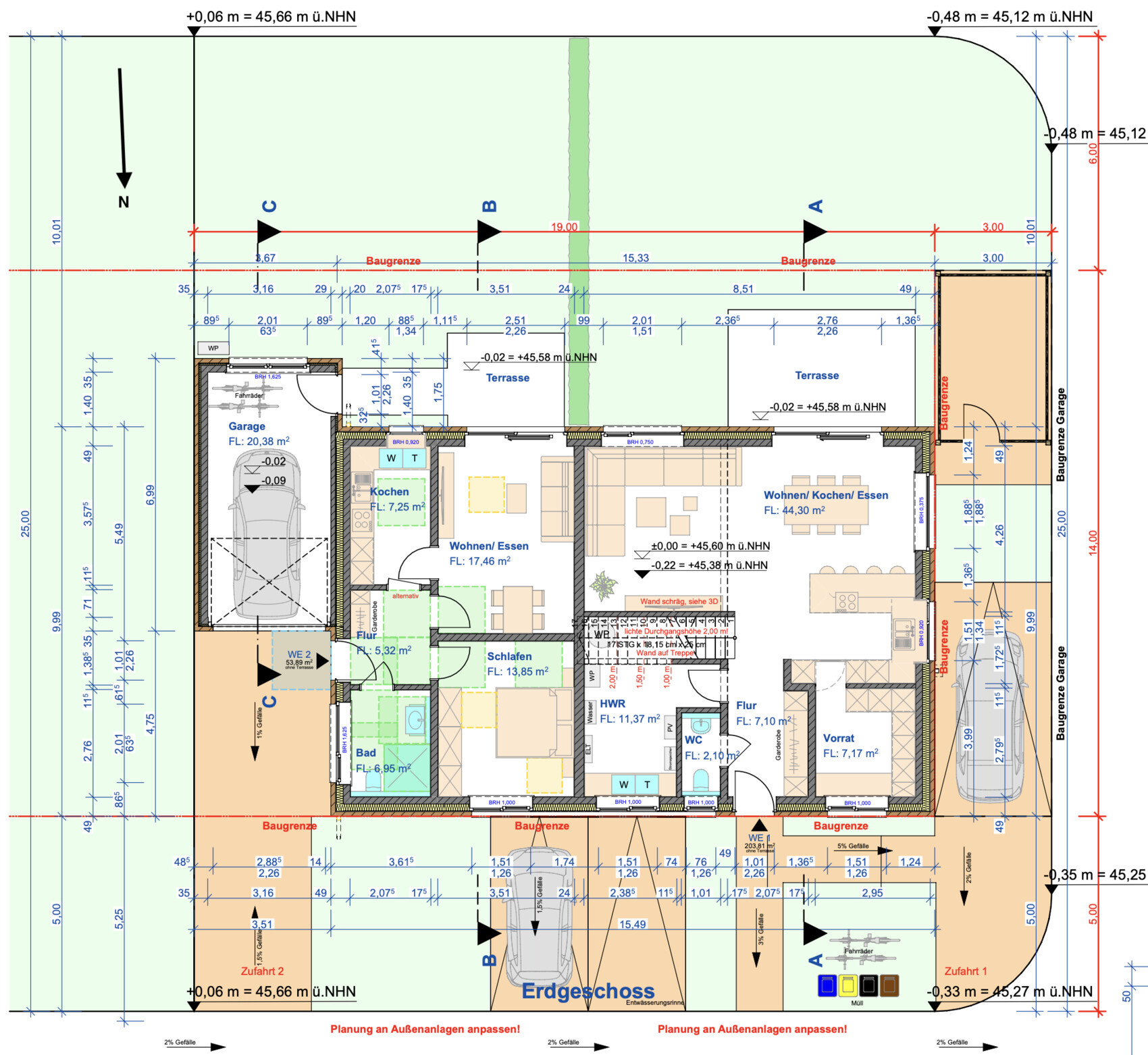
Ground floor: barrier-free basement apartment with bedroom, shower bathroom, living room, kitchen, optional small storage room (approx. 50sqm (538 sq ft)); main apartment: living-dining area, open kitchen, (small backup kitchen/pantry), guest toilet, utility/technical room
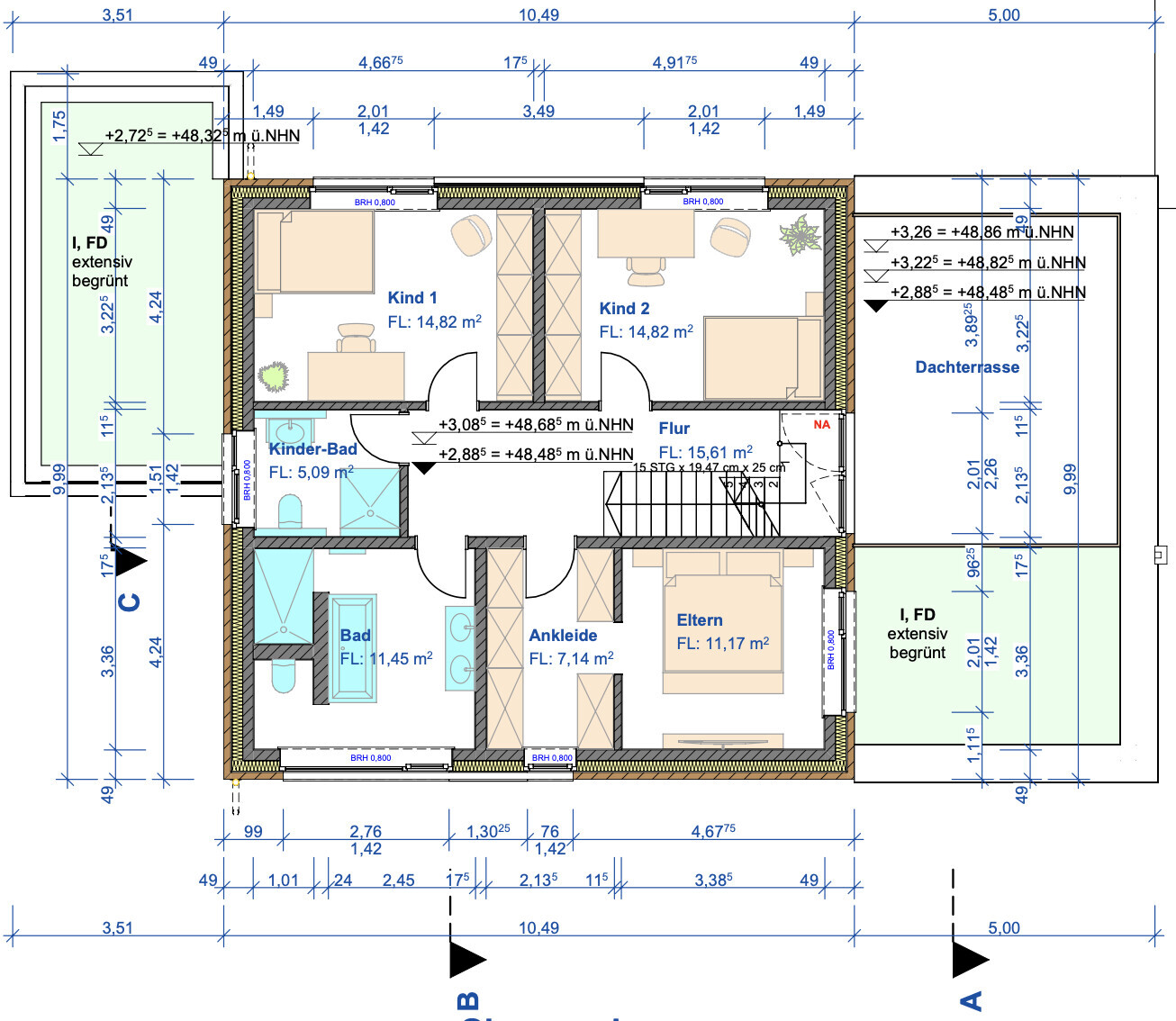
First floor: 2 children’s rooms approx. 15sqm (161 sq ft) each facing south, master bedroom with west-facing window plus a small dressing room, bathroom with T-layout accessible to all, children’s bathroom with shower
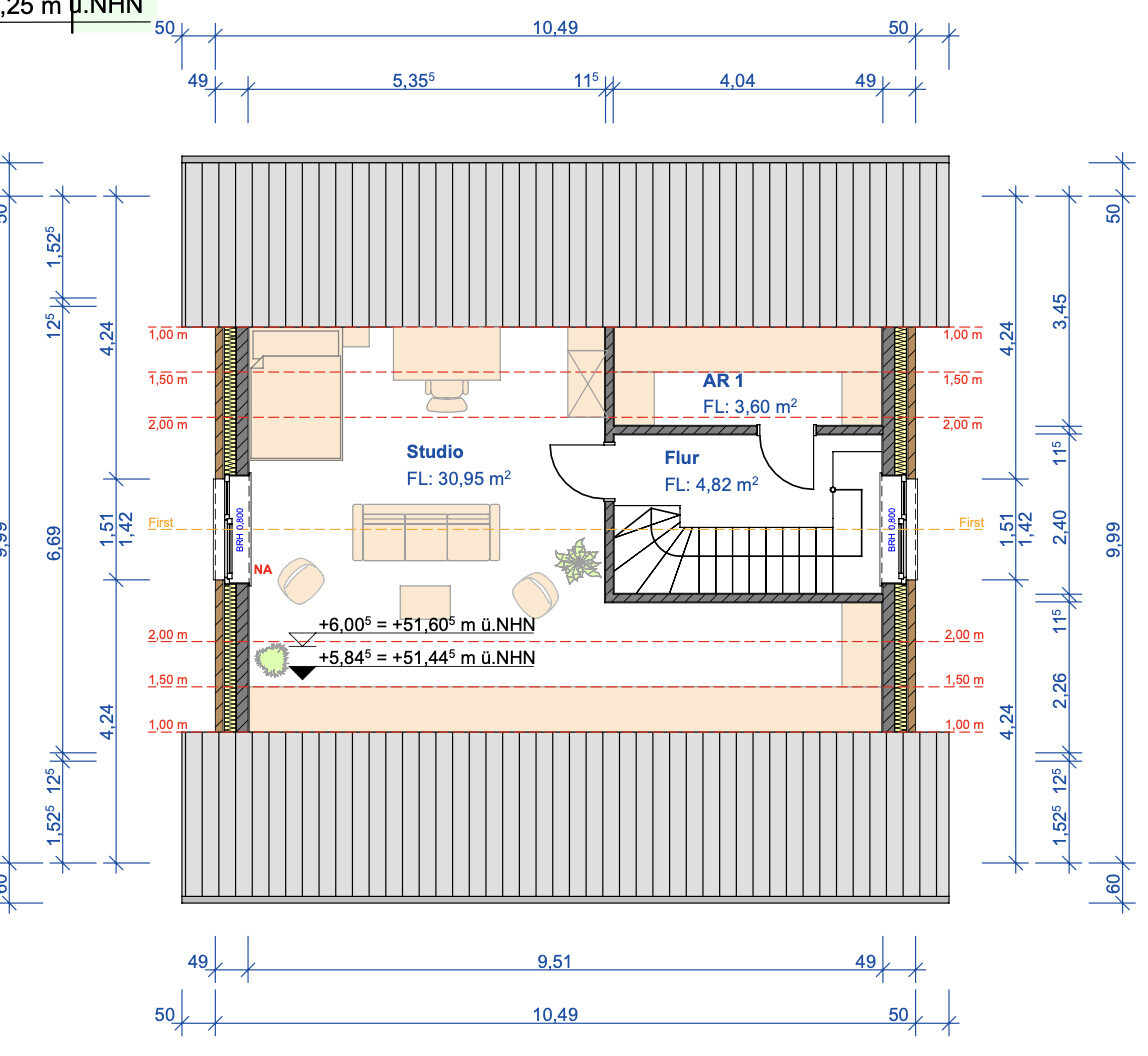
Attic: multipurpose room (fitness, office) + storage space due to no basement
Office: family use or home office? Home office
Guest rooms per year
Open or closed layout: rather open (not including open galleries)
Conservative or modern construction: yes
Open kitchen, kitchen island: both yes
Number of dining seats: 6 in main apartment, 2(-4) in basement apartment
Fireplace: no
Music/sound wall: no idea what that is
Balcony, roof terrace: roof terrace as a nice-to-have (see design)
Garage, carport: preferably on the east side next to the basement apartment
Utility garden, greenhouse: no
Additional wishes/special features/daily routine, including reasons for or against certain features
House Design
Planner: architect
What do you like? Why?
What do you dislike? Why?
Estimated cost according to architect/planner: 500,000 (without attic)
Personal budget limit for house including equipment: 600,000
Preferred heating technology: ground source heat pump (local heating network is mandatory)
If you need to give up something, which details/extensions?
- What can you do without: garage
- What can you absolutely not do without: basement apartment
Why is the design as it is now? For example:
Which requests were implemented by the architect?
Primarily based on our wishes, which were mostly implemented already. However, we are especially bothered by the arrangement/design of the utility room, staircase, and pantry layout—at least on paper—as it’s hard to imagine this part clearly.
What makes it, in your opinion, particularly good or bad?
Fairly compact, as the entire ground floor area is not built over on the first floor.
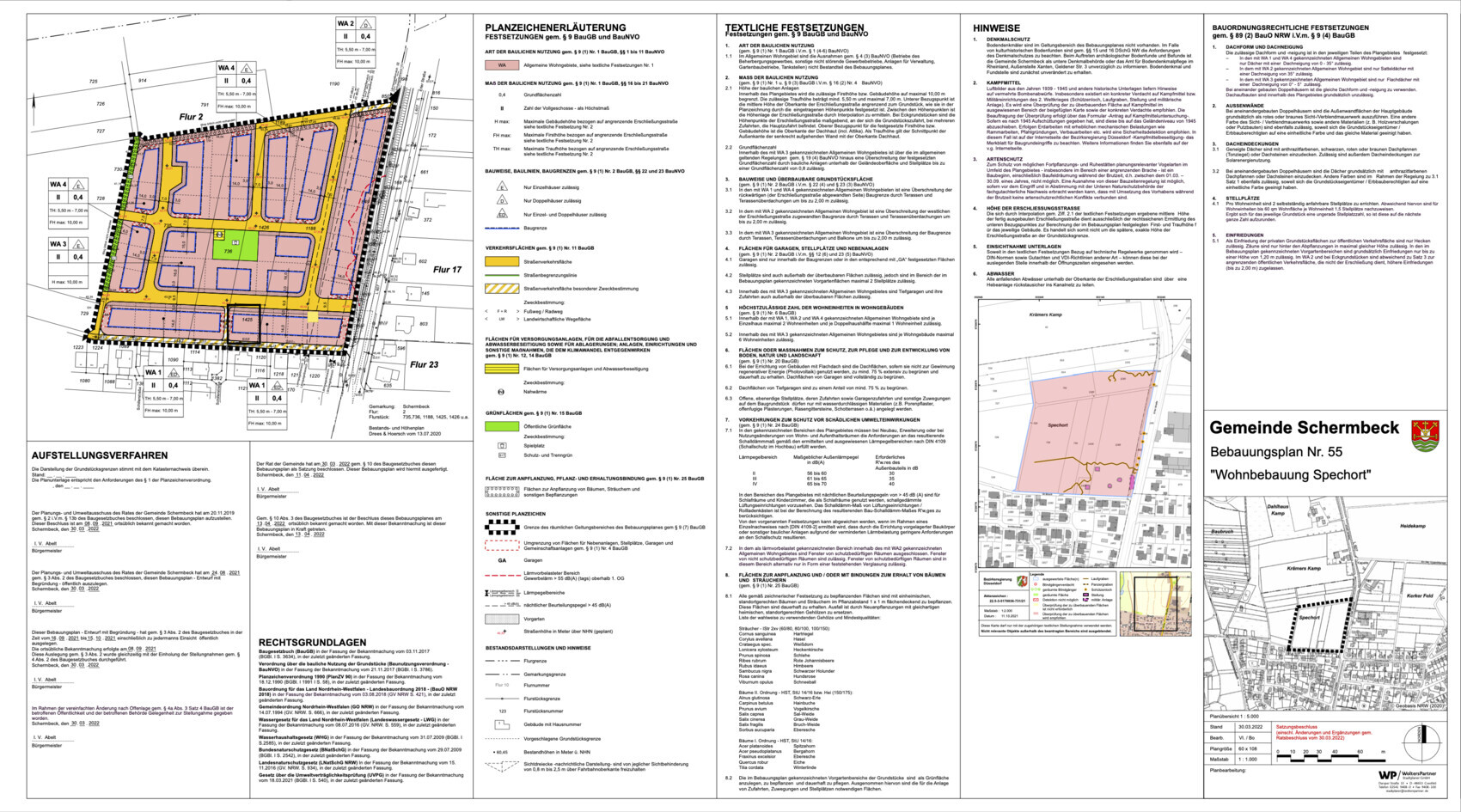
And of course the development plan including our plot.
we are currently facing the challenge of planning a single-family house for a family of four, including a barrier-free basement apartment on the ground floor for my parents. The whole project is on a 550sqm (5920 sq ft) mostly flat plot, with the requirement not to build over the garden.
Development Plan / Restrictions
Plot size: approx. 550sqm (5920 sq ft)
Slope: no (approx. 0.5m (1.6 ft) height difference over 22m (72 ft) plot width)
Site coverage ratio: 0.4
Floor area ratio: n.a.
Building envelope, building line and boundary: 16m (52.5 ft) west-east + 3m (9.8 ft) boundary setbacks each side, 14m (46 ft) north-south, 5m (16 ft) setback to street in front of the house
Edge development: yes (north: public access road, west and south: bike path, east: neighboring development with a semi-detached house, currently vacant)
Number of parking spaces: 4
Number of storeys: 2
Roof pitch: 0-35°
Architectural style: no hipped roof and no Bauhaus style
Orientation: south-facing (garden)
Maximum heights / limits: eaves height 5.5-7m (18-23 ft), building height 10m (33 ft)
Additional requirements: The development plan reads as eaves height must be at least 5.5m (18 ft). Our design includes a single-story “extension” that falls below this. According to the building authority, the eaves height applies only to pitched roofs, and even a bungalow would be allowed here.
Client Requirements
Style, roof type, building type: preferably converted attic with a gable roof
Basement, floors: no basement, 2 full floors + attic
Number of occupants, ages: 4 for the main unit (2 adults aged 41, 2 children aged 9 and 7) and 2 for the basement apartment (80+)
Room requirements on ground floor and upper floor:
Ground floor: barrier-free basement apartment with bedroom, shower bathroom, living room, kitchen, optional small storage room (approx. 50sqm (538 sq ft)); main apartment: living-dining area, open kitchen, (small backup kitchen/pantry), guest toilet, utility/technical room
First floor: 2 children’s rooms approx. 15sqm (161 sq ft) each facing south, master bedroom with west-facing window plus a small dressing room, bathroom with T-layout accessible to all, children’s bathroom with shower
Attic: multipurpose room (fitness, office) + storage space due to no basement
Office: family use or home office? Home office
Guest rooms per year
Open or closed layout: rather open (not including open galleries)
Conservative or modern construction: yes
Open kitchen, kitchen island: both yes
Number of dining seats: 6 in main apartment, 2(-4) in basement apartment
Fireplace: no
Music/sound wall: no idea what that is
Balcony, roof terrace: roof terrace as a nice-to-have (see design)
Garage, carport: preferably on the east side next to the basement apartment
Utility garden, greenhouse: no
Additional wishes/special features/daily routine, including reasons for or against certain features
- Backup kitchen is a long-cherished wish of my wife and should not be missing.
- Utility room must provide at least 3 x 1.9m (10 x 6.2 ft) space for the heat pump and the hot water system connected to the local heating network. The room should also be used for washing and drying laundry.
- Children’s rooms facing south with about 15sqm (161 sq ft) each are mandatory.
- Building mass should not extend too deeply, to preserve garden space on the south side.
House Design
Planner: architect
What do you like? Why?
- Living-dining area plus kitchen fits our requirements. We saw it in a show home and immediately agreed we wanted it like that.
- The basement apartment is barrier-free, and the room layout basically fits well.
- No complaints about the first floor:
- Both children’s rooms are the same size (approx. 15sqm (161 sq ft)) and face south.
- Master bedroom is in the (north-)west with a west-facing window.
- Two bathrooms as requested.
- Converted attic as extra space for home office, fitness, and hobbies.
- The building is not too deep at 10m (33 ft), leaving enough garden space.
What do you dislike? Why?
- The pantry (backup kitchen) seems a bit large.
- The area around the staircase, door to the utility room, and guest toilet feels cramped and awkward.
- We actually like the straight staircase, but it is completely hidden, so only the stairwell is visible.
- The attic staircase is placed on the west gable side; we would prefer it centrally placed or at least on the north eaves side.
- No access from the basement apartment to the utility room (e.g., to do laundry).
- Garden shed currently planned in the southwest; if anything, it should go to the northwest for garden tools and bikes.
Estimated cost according to architect/planner: 500,000 (without attic)
Personal budget limit for house including equipment: 600,000
Preferred heating technology: ground source heat pump (local heating network is mandatory)
If you need to give up something, which details/extensions?
- What can you do without: garage
- What can you absolutely not do without: basement apartment
Why is the design as it is now? For example:
Which requests were implemented by the architect?
Primarily based on our wishes, which were mostly implemented already. However, we are especially bothered by the arrangement/design of the utility room, staircase, and pantry layout—at least on paper—as it’s hard to imagine this part clearly.
What makes it, in your opinion, particularly good or bad?
Fairly compact, as the entire ground floor area is not built over on the first floor.
And of course the development plan including our plot.

The design doesn’t make sense to me. You’re building a large ground floor to fit the basement apartment. On the upper floor, you set it back so that half of it remains as a flat roof, and then you add a dormer? Is it just me, or does that seem odd? Why not build the upper floor as a full pitched roof with, for example, knee walls 1.40m (4 ft 7 in) high, and leave out the dormer? Who wants to climb three flights of stairs unnecessarily when two would be much more practical and probably cheaper?
M
MachsSelbst3 Oct 2025 20:15And especially when only two floors are allowed... there is also something like the maximum ridge height.
K a t j a schrieb:
Why not build the upper floor as a gable roof with, for example, a knee wall of 1.40 m (4 ft 7 in) all the way? Probably because the eave height specified in the development plan is at least 5.50 m (18 ft) and a maximum of 7.00 m (23 ft). There are contradictions in the development plan that have already been discussed "elsewhere." However, you are of course right—rather than adding a third floor, simply simplify the building volume.
And yes: in the development plan I do not see any permission to increase the floor area ratio according to Section 9 of the Building Code or to allocate half of it for garages and access paths.
M
MachsSelbst3 Oct 2025 23:06Well, in our case, any exceedance in the zoning plan was explicitly prohibited. So I assume that if nothing is specified, it is allowed.
Though it is somewhat ironic to want to develop 550m² (5,920 sq ft) with 2 residential units, 4 parking spaces, and so on, but not actually "build" on it. That simply doesn’t work.
Even exceeding the floor area ratio by 50% would have to be carefully calculated. Parking spaces, access paths, terraces—all of these take up a lot of square meters.
But build the granny flat in a way that you can use it for other purposes in the future, whatever that may be. Hoping that one of the children will move in later rarely works out.
The other criticism has already been mentioned. If proper care is really intended, there is a lack of a living space for a “caregiver who can take care of things.” True around-the-clock care cannot be provided by anyone unless it is done full-time professionally for pay.
Though it is somewhat ironic to want to develop 550m² (5,920 sq ft) with 2 residential units, 4 parking spaces, and so on, but not actually "build" on it. That simply doesn’t work.
Even exceeding the floor area ratio by 50% would have to be carefully calculated. Parking spaces, access paths, terraces—all of these take up a lot of square meters.
But build the granny flat in a way that you can use it for other purposes in the future, whatever that may be. Hoping that one of the children will move in later rarely works out.
The other criticism has already been mentioned. If proper care is really intended, there is a lack of a living space for a “caregiver who can take care of things.” True around-the-clock care cannot be provided by anyone unless it is done full-time professionally for pay.
11ant schrieb:
A shared room plan primarily means taking into account the needs of the user groups—parents with children and live-in elderly parents—in a combined calculation for the space requirements.
...
This was neglected here (with the result of an extension) and afterward (with the Z-tower shift) an unsuitable attempt was made to fix it. Hence, among other things, my clear advice to relaunch (which consistently implies avoiding any forced adjustments to the shown design). Sorry, but of course we have thought about this and discussed it with the architect. We didn’t just go to the architect and say, “We are two adults, two small children, and two elderly people and need a house,” right? 😉
The relocation was not present in the first preliminary draft (yes, you wouldn’t have called it that either), but we didn’t like it very much because the hallway was on the east side and the children’s bathroom on the west side. We prefer the new version because the hallway gets more light in the afternoon and evening hours, which is important for us.
11ant schrieb:
Only the main house entrances must be on the ground floor. Stricter requirements would have no legal basis known to me, and technically they would be unfounded, excessive, and therefore inadmissible. Here is an excerpt from the technical specifications of the municipal utilities: “The installation room for the ventilation system must be located on the ground floor or basement and must be accessible via publicly accessible rooms, e.g., stairwell. Installing the room on an upper floor is not allowed.” A query with the municipal utilities also confirmed that installation on an upper floor will not be approved. If you have more information on this, please share it.
11ant schrieb:
Properly stated, the task is to design a two-generation house for six occupants in two households, with the grandparents’ unit being barrier-free. “… and the living-dining area of the main apartment is located on the ground floor.” In my opinion, it amounts to the same thing, but feel free to show me a floor plan that handles a similar situation “better” as an example.
MachsSelbst schrieb:
It’s hard to tell from the development plan. Are you even allowed to build 2 full floors plus an attic and 2 residential units? Your building footprint, parking spaces, and terraces clearly exceed the 0.4 floor-area ratio. Is this excess permitted or strictly prohibited? Yes, 2 full floors with a floor-area ratio of 0.4 are allowed, with a 50% increase permitted for garages, parking spaces, terraces, etc.
K a t j a schrieb:
The design doesn’t make sense to me. You’re building a large ground floor to fit the granny flat. On the upper floor, you pull back so half remains as a flat roof, then you add a roof peak? Is it just me, or does that seem odd? Why not cover the entire upper floor with a pitched roof, e.g., with a knee wall of 1.40m (4 ft 7 in), and leave out the peak? Who wants to climb three levels unnecessarily when two are more practical and probably cheaper? That’s an absolutely valid and understandable question, and thank you very much for suggesting an alternative. We have actually considered both options, although maybe not deeply enough. We might revisit this. The reason for the current design is that we want two full floors upstairs. Building the entire area of 15.5 x 10m (51 x 33 ft) as a full floor and then adding a gable or hip roof would probably exceed our budget because we do not like the Bauhaus style.
Therefore, the idea was to build only part of the upper floor and since a roof is needed anyway, directly use an attic with a pitched roof. The attic will house the home office and fitness area, which—unlike the other living spaces—are used less frequently. So it’s not just the model train running around up there.
WoodyXYZ schrieb:
Yes, two full floors are allowed with a floor area ratio of 0.4, and an additional 50% excess is permitted for garages, parking spaces, terraces, etc.Where did you read that? There are only exceptions concerning terraces and building boundary lines. At least, I couldn’t find anything else regarding paragraph 9 of the building code. The terrace is always considered part of the house and the floor area ratio I.
Similar topics