
ᐅ Single-family home with an accessible granny flat on the ground floor
Created on: 30 Sep 2025 12:03
W
WoodyXYZ
Hello everyone,
we are currently facing the challenge of planning a single-family house for a family of four, including a barrier-free basement apartment on the ground floor for my parents. The whole project is on a 550sqm (5920 sq ft) mostly flat plot, with the requirement not to build over the garden.
Development Plan / Restrictions
Plot size: approx. 550sqm (5920 sq ft)
Slope: no (approx. 0.5m (1.6 ft) height difference over 22m (72 ft) plot width)
Site coverage ratio: 0.4
Floor area ratio: n.a.
Building envelope, building line and boundary: 16m (52.5 ft) west-east + 3m (9.8 ft) boundary setbacks each side, 14m (46 ft) north-south, 5m (16 ft) setback to street in front of the house
Edge development: yes (north: public access road, west and south: bike path, east: neighboring development with a semi-detached house, currently vacant)
Number of parking spaces: 4
Number of storeys: 2
Roof pitch: 0-35°
Architectural style: no hipped roof and no Bauhaus style
Orientation: south-facing (garden)
Maximum heights / limits: eaves height 5.5-7m (18-23 ft), building height 10m (33 ft)
Additional requirements: The development plan reads as eaves height must be at least 5.5m (18 ft). Our design includes a single-story “extension” that falls below this. According to the building authority, the eaves height applies only to pitched roofs, and even a bungalow would be allowed here.
Client Requirements
Style, roof type, building type: preferably converted attic with a gable roof
Basement, floors: no basement, 2 full floors + attic
Number of occupants, ages: 4 for the main unit (2 adults aged 41, 2 children aged 9 and 7) and 2 for the basement apartment (80+)
Room requirements on ground floor and upper floor:
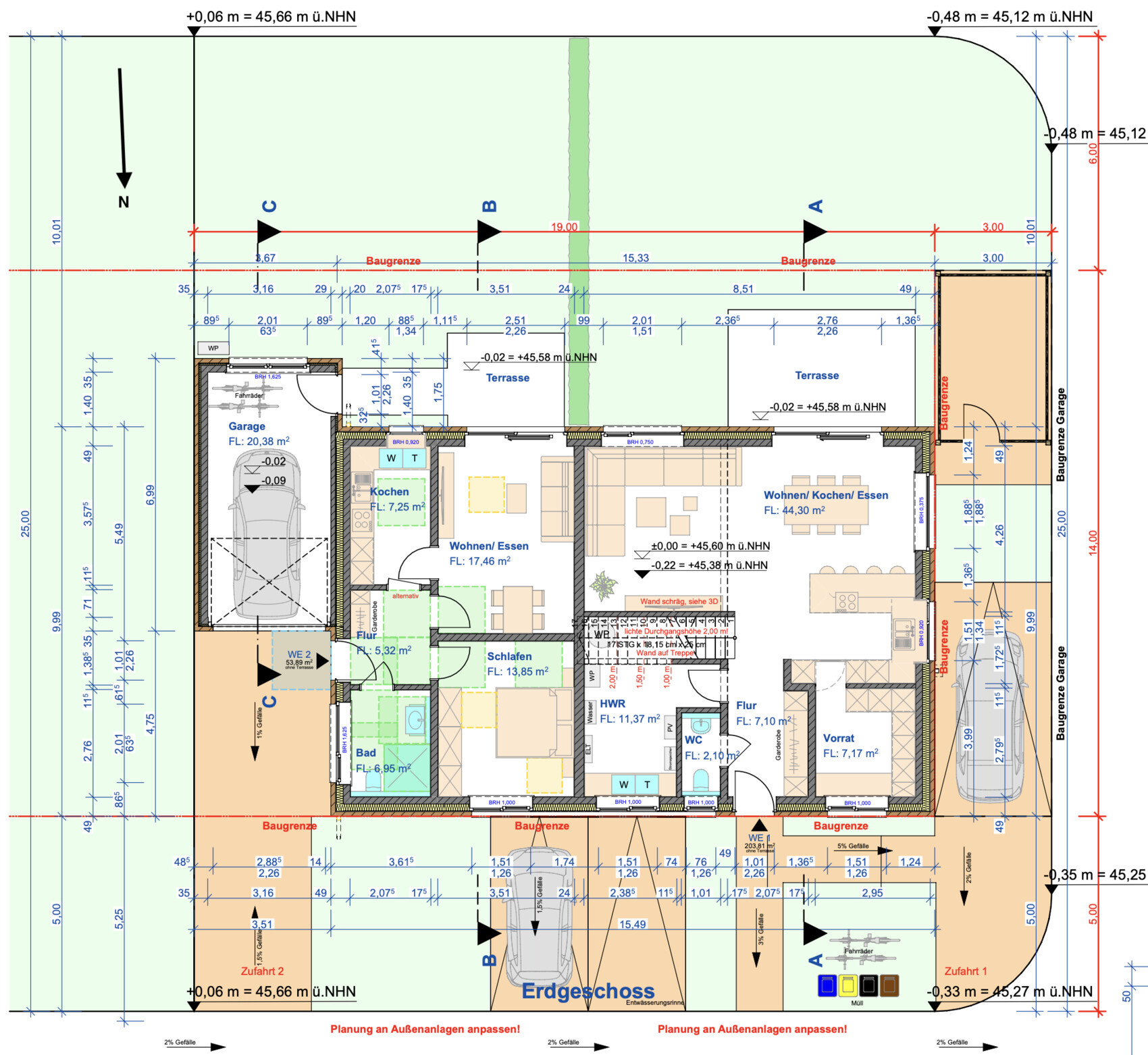
Ground floor: barrier-free basement apartment with bedroom, shower bathroom, living room, kitchen, optional small storage room (approx. 50sqm (538 sq ft)); main apartment: living-dining area, open kitchen, (small backup kitchen/pantry), guest toilet, utility/technical room
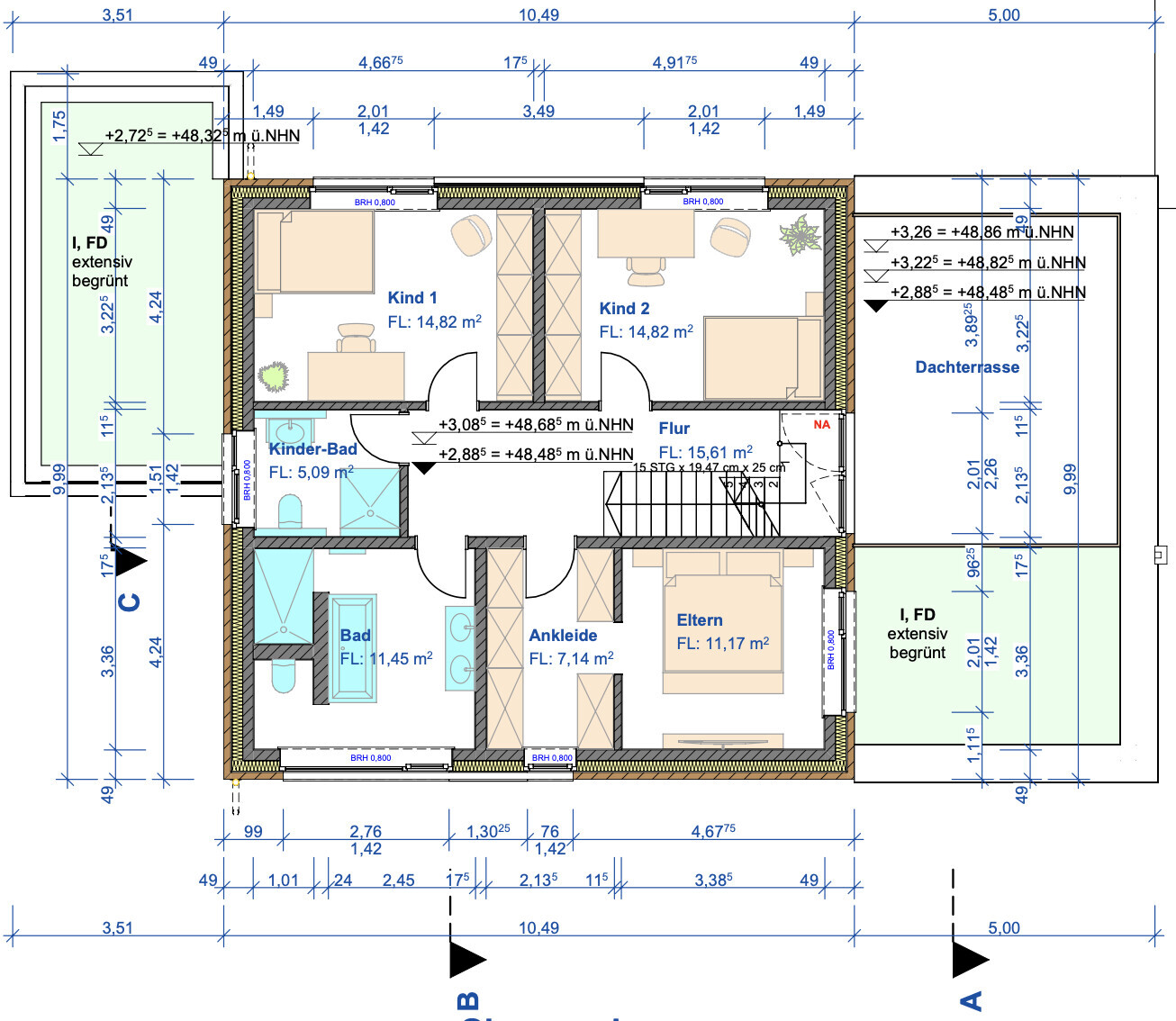
First floor: 2 children’s rooms approx. 15sqm (161 sq ft) each facing south, master bedroom with west-facing window plus a small dressing room, bathroom with T-layout accessible to all, children’s bathroom with shower
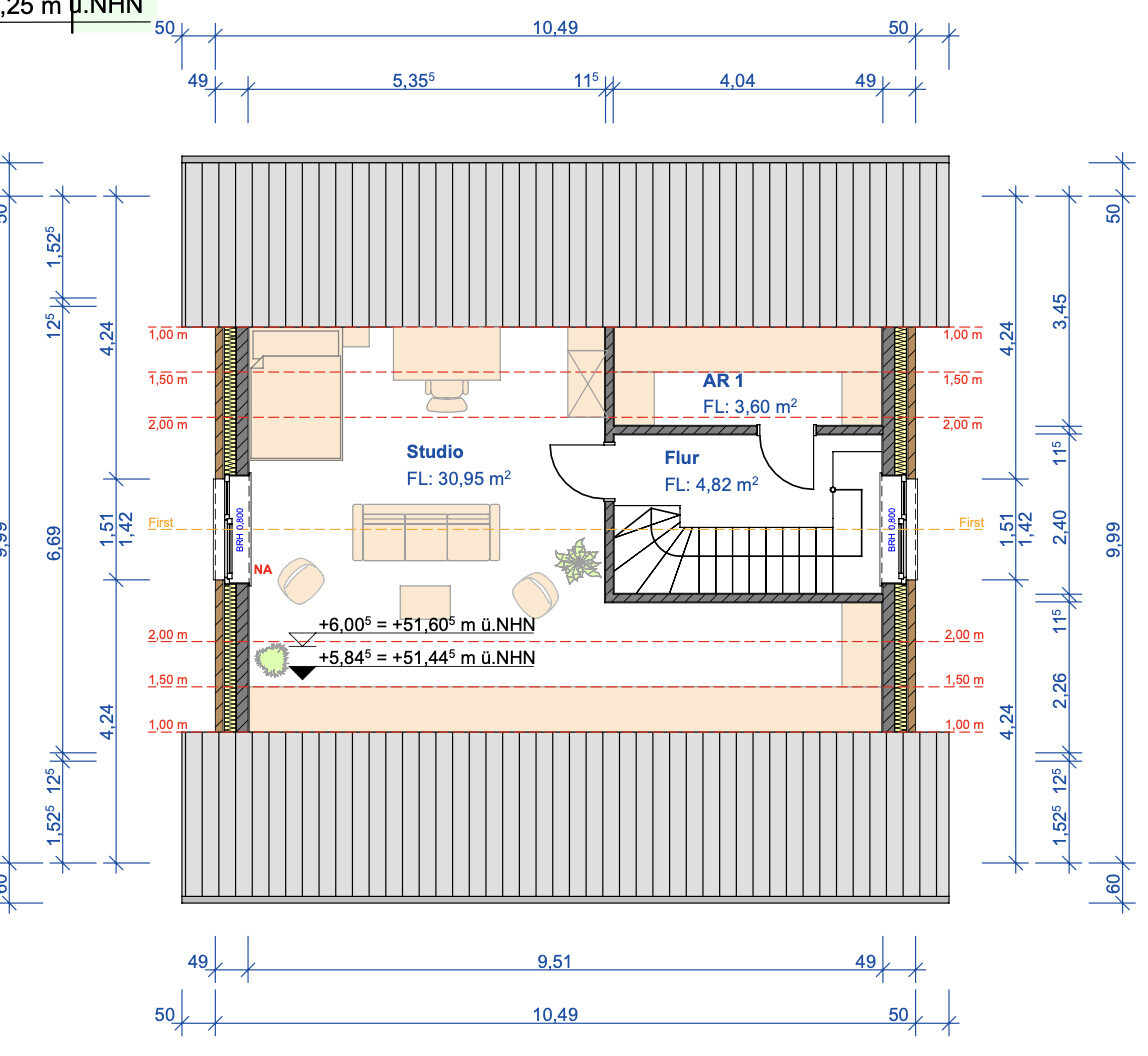
Attic: multipurpose room (fitness, office) + storage space due to no basement
Office: family use or home office? Home office
Guest rooms per year
Open or closed layout: rather open (not including open galleries)
Conservative or modern construction: yes
Open kitchen, kitchen island: both yes
Number of dining seats: 6 in main apartment, 2(-4) in basement apartment
Fireplace: no
Music/sound wall: no idea what that is
Balcony, roof terrace: roof terrace as a nice-to-have (see design)
Garage, carport: preferably on the east side next to the basement apartment
Utility garden, greenhouse: no
Additional wishes/special features/daily routine, including reasons for or against certain features
House Design
Planner: architect
What do you like? Why?
What do you dislike? Why?
Estimated cost according to architect/planner: 500,000 (without attic)
Personal budget limit for house including equipment: 600,000
Preferred heating technology: ground source heat pump (local heating network is mandatory)
If you need to give up something, which details/extensions?
- What can you do without: garage
- What can you absolutely not do without: basement apartment
Why is the design as it is now? For example:
Which requests were implemented by the architect?
Primarily based on our wishes, which were mostly implemented already. However, we are especially bothered by the arrangement/design of the utility room, staircase, and pantry layout—at least on paper—as it’s hard to imagine this part clearly.
What makes it, in your opinion, particularly good or bad?
Fairly compact, as the entire ground floor area is not built over on the first floor.
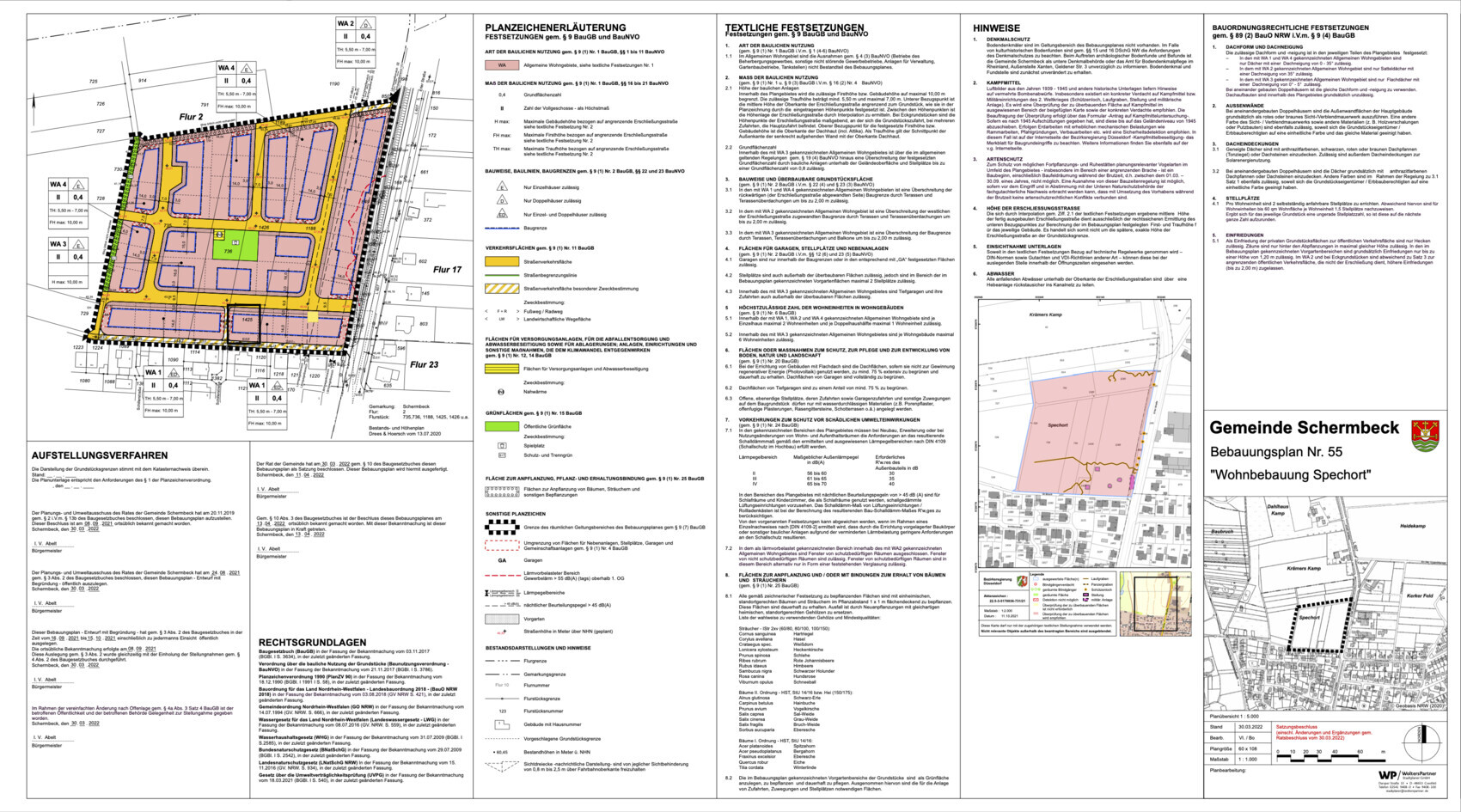
And of course the development plan including our plot.
we are currently facing the challenge of planning a single-family house for a family of four, including a barrier-free basement apartment on the ground floor for my parents. The whole project is on a 550sqm (5920 sq ft) mostly flat plot, with the requirement not to build over the garden.
Development Plan / Restrictions
Plot size: approx. 550sqm (5920 sq ft)
Slope: no (approx. 0.5m (1.6 ft) height difference over 22m (72 ft) plot width)
Site coverage ratio: 0.4
Floor area ratio: n.a.
Building envelope, building line and boundary: 16m (52.5 ft) west-east + 3m (9.8 ft) boundary setbacks each side, 14m (46 ft) north-south, 5m (16 ft) setback to street in front of the house
Edge development: yes (north: public access road, west and south: bike path, east: neighboring development with a semi-detached house, currently vacant)
Number of parking spaces: 4
Number of storeys: 2
Roof pitch: 0-35°
Architectural style: no hipped roof and no Bauhaus style
Orientation: south-facing (garden)
Maximum heights / limits: eaves height 5.5-7m (18-23 ft), building height 10m (33 ft)
Additional requirements: The development plan reads as eaves height must be at least 5.5m (18 ft). Our design includes a single-story “extension” that falls below this. According to the building authority, the eaves height applies only to pitched roofs, and even a bungalow would be allowed here.
Client Requirements
Style, roof type, building type: preferably converted attic with a gable roof
Basement, floors: no basement, 2 full floors + attic
Number of occupants, ages: 4 for the main unit (2 adults aged 41, 2 children aged 9 and 7) and 2 for the basement apartment (80+)
Room requirements on ground floor and upper floor:
Ground floor: barrier-free basement apartment with bedroom, shower bathroom, living room, kitchen, optional small storage room (approx. 50sqm (538 sq ft)); main apartment: living-dining area, open kitchen, (small backup kitchen/pantry), guest toilet, utility/technical room
First floor: 2 children’s rooms approx. 15sqm (161 sq ft) each facing south, master bedroom with west-facing window plus a small dressing room, bathroom with T-layout accessible to all, children’s bathroom with shower
Attic: multipurpose room (fitness, office) + storage space due to no basement
Office: family use or home office? Home office
Guest rooms per year
Open or closed layout: rather open (not including open galleries)
Conservative or modern construction: yes
Open kitchen, kitchen island: both yes
Number of dining seats: 6 in main apartment, 2(-4) in basement apartment
Fireplace: no
Music/sound wall: no idea what that is
Balcony, roof terrace: roof terrace as a nice-to-have (see design)
Garage, carport: preferably on the east side next to the basement apartment
Utility garden, greenhouse: no
Additional wishes/special features/daily routine, including reasons for or against certain features
- Backup kitchen is a long-cherished wish of my wife and should not be missing.
- Utility room must provide at least 3 x 1.9m (10 x 6.2 ft) space for the heat pump and the hot water system connected to the local heating network. The room should also be used for washing and drying laundry.
- Children’s rooms facing south with about 15sqm (161 sq ft) each are mandatory.
- Building mass should not extend too deeply, to preserve garden space on the south side.
House Design
Planner: architect
What do you like? Why?
- Living-dining area plus kitchen fits our requirements. We saw it in a show home and immediately agreed we wanted it like that.
- The basement apartment is barrier-free, and the room layout basically fits well.
- No complaints about the first floor:
- Both children’s rooms are the same size (approx. 15sqm (161 sq ft)) and face south.
- Master bedroom is in the (north-)west with a west-facing window.
- Two bathrooms as requested.
- Converted attic as extra space for home office, fitness, and hobbies.
- The building is not too deep at 10m (33 ft), leaving enough garden space.
What do you dislike? Why?
- The pantry (backup kitchen) seems a bit large.
- The area around the staircase, door to the utility room, and guest toilet feels cramped and awkward.
- We actually like the straight staircase, but it is completely hidden, so only the stairwell is visible.
- The attic staircase is placed on the west gable side; we would prefer it centrally placed or at least on the north eaves side.
- No access from the basement apartment to the utility room (e.g., to do laundry).
- Garden shed currently planned in the southwest; if anything, it should go to the northwest for garden tools and bikes.
Estimated cost according to architect/planner: 500,000 (without attic)
Personal budget limit for house including equipment: 600,000
Preferred heating technology: ground source heat pump (local heating network is mandatory)
If you need to give up something, which details/extensions?
- What can you do without: garage
- What can you absolutely not do without: basement apartment
Why is the design as it is now? For example:
Which requests were implemented by the architect?
Primarily based on our wishes, which were mostly implemented already. However, we are especially bothered by the arrangement/design of the utility room, staircase, and pantry layout—at least on paper—as it’s hard to imagine this part clearly.
What makes it, in your opinion, particularly good or bad?
Fairly compact, as the entire ground floor area is not built over on the first floor.
And of course the development plan including our plot.

WoodyXYZ schrieb:
The roof terrace is out now.It’s impossible to remove it with this design because the living room is directly underneath. Skipping the tiling alone saves a ridiculous amount, so it’s not worth it. Such a major change must be made at the preliminary design stage, not this late. I would have rejected the angled concept of the staggered floor plan from the beginning. In my opinion, that’s where you went wrong by not including the granny flat in a shared spatial program; as a result, an extension was created conceptually. Shifting the upper floors above was not an elegant solution, just a superficial one. A rearrangement conceived but a dilemma made. For the relaunch, make the adjoining space two-part: bottom only the entrance areas, and the technical equipment can even go into the roof apex. After all, the model railway only runs in the studio.My impression is that this detour is a consequence of considering a contractor’s plan sufficient where a free architectural design—in both senses of the word—would have been appropriate.
https://www.instagram.com/11antgmxde/
https://www.linkedin.com/company/bauen-jetzt/
hanghaus2023 schrieb:
That helps even if you shift the upper floor onto the ground floor of the client’s part. Just to understand, how does that affect the costs?
ypg schrieb:
Simple design and construction often fits better than clinging to the extension. Even with 10m x 7m (33 ft x 23 ft) on the ground floor of the main apartment, it’s still an extension. So I don’t understand your statement.
11ant schrieb:
It can’t be removed in this design because the living room is underneath. Such a significant change must be done during the preliminary design phase, not so late. We are still in the preliminary design stage, so the roof terrace can be removed. I just mentioned it, and the architect implemented it. In fact, I don’t need one and will plan without it.
11ant schrieb:
From the start, I would have abandoned the angled concept of the staggered floor layout. Could you explain why?
11ant schrieb:
In my opinion, you went down the wrong path by not handling the secondary apartment within a common spatial program; this is conceptually how the extension came about. What does a common spatial program mean to you? How would it have looked without an extension?
11ant schrieb:
For the redesign, divide the connecting room into two parts: only the entry points below, and the technical equipment can even go into the roof apex. The studio only runs the model train anyway. We will actually do that. The architect hasn’t included it yet because he implemented our changes shortly before his vacation. Unfortunately, the heat pump and hot water storage with a required space of 3m x 1.9m (10 ft x 6 ft) (specified by the local district heating network) must go on the ground floor. The controlled mechanical ventilation will definitely be on the upper floor. Other equipment like the inverter and battery storage possibly as well? I don’t know what else can fit in the attic.
11ant schrieb:
My impression is: this detour is the result of considering a contractor-based plan sufficient, where a truly open architectural design was needed in the fullest sense. As I said, we are in the preliminary design phase and asking here for feedback. You don’t like the design but don’t offer many suggestions to improve it (except for moving technical equipment to the upper floor). That’s fine with me as well.
WoodyXYZ schrieb:
As I said, we are in the preliminary design phase and are asking for feedback here. You will get that for sure!
WoodyXYZ schrieb:
You don’t like the design but don’t provide any suggestions for improvement. No one here is obligated to provide improvement suggestions. If a design in this forum (not referring to yours) is truly terrible and amateurish, people point out the flaws but don’t have to offer improvements, especially if starting over from scratch is necessary.
WoodyXYZ schrieb:
Even with a 10x7m (33x23 ft) ground floor in the main dwelling, there will still be an extension. So I don’t understand your statement. No, there will be no extension if you significantly reduce the size, meaning your budget.
So if you don’t understand certain statements, it’s not necessarily the fault of those of us who have been involved in house planning for many years.
WoodyXYZ schrieb:
As I said, we are still in the preliminary design phase and are asking for feedback here. You don’t like the design but don’t offer any suggestions for improvement (except for the technology on the upper floor). That’s fine by me. I don’t find it acceptable to provide precise criticism and then be told I didn’t offer any suggestions for improvement. Please don’t read my post any less carefully than I have read your entire thread up to this point. You may still be in the "not yet final approval" stage, but what you are showing is clearly no longer a preliminary design. Unfortunately, it’s not even good craftsmanship, and in terms of the drawing detail already too developed for a preliminary design. This unfortunately means a waste of time and money and confirms my justified suspicion that the "architect" is an “architect” in quotation marks (also known as a draftsman or even a technical illustrator).
WoodyXYZ schrieb:
Even at 10x7m (33x23 feet) on the ground floor of the main dwelling, there’s still an extension. So I don’t understand your comment. WoodyXYZ schrieb:
Just for understanding, how does this affect the costs? Reducing the size of the main dwelling alone would not make the extension unnecessary. A simpler building form (with integration of the secondary dwelling) would significantly reduce construction costs in terms of effort and thus expenses.
WoodyXYZ schrieb:
What does a shared spatial program mean to you? How would it have looked without an extension? WoodyXYZ schrieb:
Could you explain why? A shared spatial program means first and foremost that the needs of the user groups – the parent-child family and the secondary dwelling for the parents – are combined into a joint requirements analysis for the spatial program. This is the basis for an economical determination of the building form (design phase 2), even though according to my approach a ground floor larger than the upper floors is not necessarily avoided, bypassed, or excluded. The reason for this strategy, to first produce a balanced calculation of spatial needs before any design drawings, lies simply in the economy of the planning effort. This step was missed here (resulting in an extension), and afterwards (with the offset of the stair tower) unsuccessfully and unsuitably attempted to be fixed. That is why I strongly recommend a complete relaunch (which clearly implies not trying to tweak the design shown here).
WoodyXYZ schrieb:
Unfortunately, the heat pump and hot water storage tank with a space requirement of 3x1.9m (10x6 feet) (requirement from the local heating network) must go in the ground floor. The controlled ventilation system will definitely go in the upper floor. Other technical equipment like the inverter and battery storage might also be placed there? Only the building service penetrations must be located on the ground floor. Stricter requirements could not have any legal basis known to me; technically, they would be unjustified, excessive, and therefore inadmissible.
https://www.instagram.com/11antgmxde/
https://www.linkedin.com/company/bauen-jetzt/
The proper way to state the task is to design a two-generation house for six residents living in two separate households, with the living unit for the grandparents being wheelchair accessible.
This is an inaccurate description of the task. It diverges significantly by treating the planning requirement for the in-law unit as a separate subset, which tends to lead to the kind of extension that, due to shifting the upper main part of the house, only makes things worse rather than better.
https://www.instagram.com/11antgmxde/
https://www.linkedin.com/company/bauen-jetzt/
WoodyXYZ schrieb:
We are currently facing the challenge of planning a single-family house for a family of four, along with a wheelchair-accessible in-law apartment on the ground floor for my parents.
This is an inaccurate description of the task. It diverges significantly by treating the planning requirement for the in-law unit as a separate subset, which tends to lead to the kind of extension that, due to shifting the upper main part of the house, only makes things worse rather than better.
https://www.instagram.com/11antgmxde/
https://www.linkedin.com/company/bauen-jetzt/
M
MachsSelbst3 Oct 2025 18:36It is difficult to see clearly in the development plan. Are you even allowed to build 2 full stories plus an attic and 2 residential units? With your construction, parking spaces, and terraces, you clearly exceed the 0.4 floor area ratio. Is this exceedance permitted or is it prohibited?
Similar topics