
ᐅ Floor plan design for a single-family house on a 10% south-facing slope. Entrance with a landing staircase.
Created on: 2 Aug 2025 23:15
H
Hanger1
Hello everyone,
Some time ago, I created a post about the layout and optimal use of our approximately 600 sqm (6460 sq ft) plot of land with about a 10% south-facing slope.
We have now spent some time drawing, considering, erasing, and so on, and have developed the following floor plan.
Since we have about a 10% slope, I want to make optimal use of the hillside. My idea is that the main entrance is on the landing staircase, meaning on the level between the ground floor and the first floor, but with an enlarged landing.
From there, half a flight of stairs leads up to the upper floor (sleeping area) or half a flight down to the ground floor (living area).
This idea comes from the split-level concept.
Development Plan / Restrictions
Size of the plot: 600 sqm (6460 sq ft)
Slope: 10% south-facing slope
Site coverage ratio: 0.3
Floor area ratio: 0.6
Number of parking spaces: not yet decided, probably 2
Number of stories: currently planning 2 full stories
Roof type: gable or hip roof
Architectural style: classic
Orientation: north-south
Owners’ Requirements
Style, roof type, building type
Basement, number of floors
Number of residents, age: 2 adults, currently 1 child, 2-3 children planned in future
Space requirements on ground floor and upper floor
Office: family use or home office? The office could alternatively be used as a third child’s bedroom
Overnight guests are negligible
Open or closed architecture: open design
Conservative or modern construction: conservative
Open kitchen, cooking island: U-shaped kitchen, already planned at the kitchen studio. The optimal size for us is 3 x 4 m (10 x 13 ft). We want a hidden door on the short side leading to the storage/pantry.
Number of dining seats: 1
Fireplace: no
Guest WC should include a shower, as my wife will be working shift work again in the future and having a shower away from the bedrooms is convenient.
House Design
Who created the plan:
- Planner from a building company: ideas from a builder, but we are doing it ourselves (DIY)
What do you like about it? Why?
What do you not like? Why? We are uncertain whether the north side near the entrance on the intermediate level looks too disjointed, because the upper floor windows start at the height where the front door ends.
Personal budget limit for the house, including fittings: 500k
Preferred heating technology: heat pump
If you have to give up anything, which details or extras
- could you give up? Preferably less square meters.
- cannot do without? WC/shower on the ground floor.
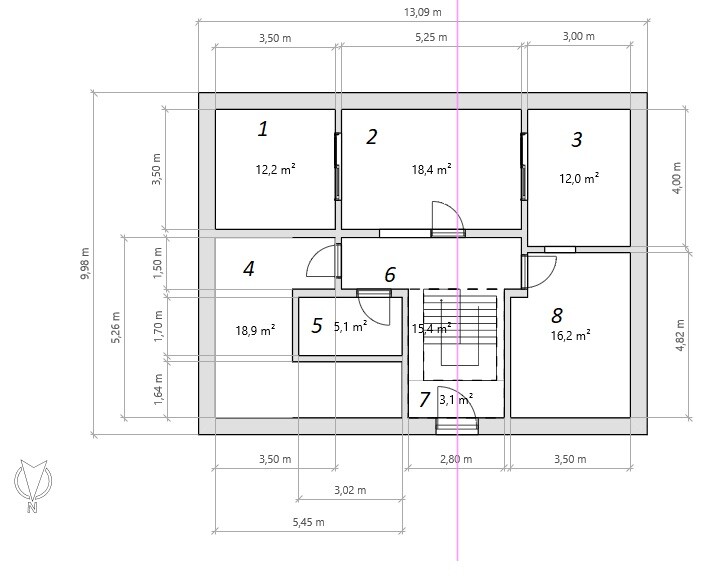
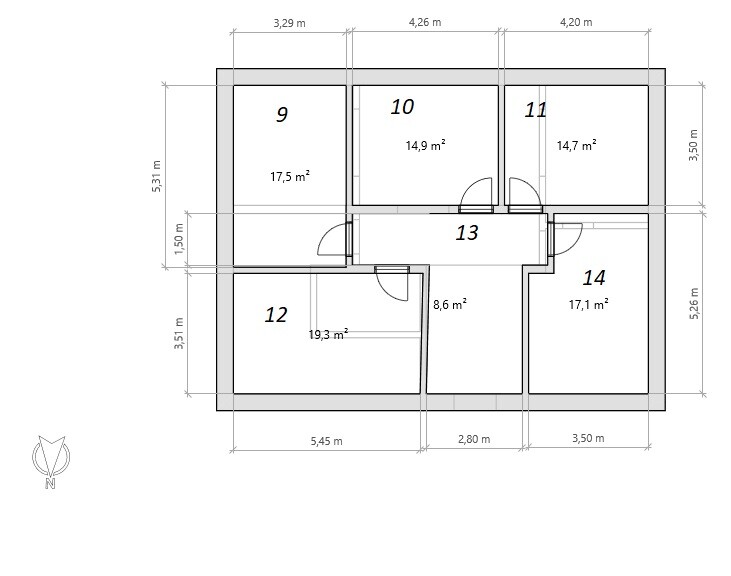
The following rooms are planned:
1: Living room with sliding door to dining area
2: Dining area
3: Kitchen with sliding door to dining area
4: Utility room
5: Guest WC/shower
6: Corridor
7: Landing staircase with enlarged landing
8: Storage room
9: Bathroom
10: Child I
11: Child II
12: Parents’ bedroom, possibly with a partition wall so you enter the bedroom through a small dressing room
13: Corridor (the landing staircase is not shown here)
14: Office / Child III
I look forward to your feedback!
Some time ago, I created a post about the layout and optimal use of our approximately 600 sqm (6460 sq ft) plot of land with about a 10% south-facing slope.
We have now spent some time drawing, considering, erasing, and so on, and have developed the following floor plan.
Since we have about a 10% slope, I want to make optimal use of the hillside. My idea is that the main entrance is on the landing staircase, meaning on the level between the ground floor and the first floor, but with an enlarged landing.
From there, half a flight of stairs leads up to the upper floor (sleeping area) or half a flight down to the ground floor (living area).
This idea comes from the split-level concept.
Development Plan / Restrictions
Size of the plot: 600 sqm (6460 sq ft)
Slope: 10% south-facing slope
Site coverage ratio: 0.3
Floor area ratio: 0.6
Number of parking spaces: not yet decided, probably 2
Number of stories: currently planning 2 full stories
Roof type: gable or hip roof
Architectural style: classic
Orientation: north-south
Owners’ Requirements
Style, roof type, building type
Basement, number of floors
Number of residents, age: 2 adults, currently 1 child, 2-3 children planned in future
Space requirements on ground floor and upper floor
Office: family use or home office? The office could alternatively be used as a third child’s bedroom
Overnight guests are negligible
Open or closed architecture: open design
Conservative or modern construction: conservative
Open kitchen, cooking island: U-shaped kitchen, already planned at the kitchen studio. The optimal size for us is 3 x 4 m (10 x 13 ft). We want a hidden door on the short side leading to the storage/pantry.
Number of dining seats: 1
Fireplace: no
Guest WC should include a shower, as my wife will be working shift work again in the future and having a shower away from the bedrooms is convenient.
House Design
Who created the plan:
- Planner from a building company: ideas from a builder, but we are doing it ourselves (DIY)
What do you like about it? Why?
What do you not like? Why? We are uncertain whether the north side near the entrance on the intermediate level looks too disjointed, because the upper floor windows start at the height where the front door ends.
Personal budget limit for the house, including fittings: 500k
Preferred heating technology: heat pump
If you have to give up anything, which details or extras
- could you give up? Preferably less square meters.
- cannot do without? WC/shower on the ground floor.
The following rooms are planned:
1: Living room with sliding door to dining area
2: Dining area
3: Kitchen with sliding door to dining area
4: Utility room
5: Guest WC/shower
6: Corridor
7: Landing staircase with enlarged landing
8: Storage room
9: Bathroom
10: Child I
11: Child II
12: Parents’ bedroom, possibly with a partition wall so you enter the bedroom through a small dressing room
13: Corridor (the landing staircase is not shown here)
14: Office / Child III
I look forward to your feedback!
H
hanghaus20239 Sep 2025 08:41Could you please answer the question from post #26? What does the eaves height refer to?
What are the drawbacks of such an arrangement?
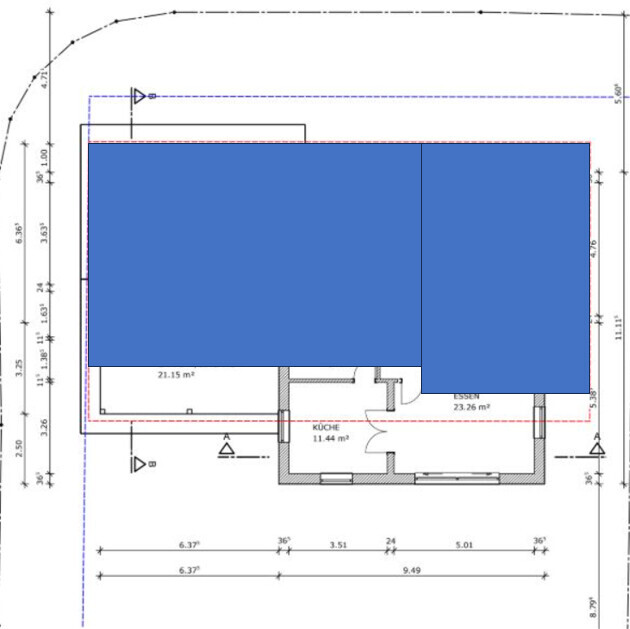
What are the drawbacks of such an arrangement?
H
hanghaus20239 Sep 2025 08:58Did I overlook the elevation plan? Where did the planner get the elevation data from?
Why was the site plan kept from us at the beginning? There is so much information missing here. Why are there suddenly 3 children's rooms?
Photos might also help to get an idea of the terrain. It’s also useful to know about the surroundings.
Why was the site plan kept from us at the beginning? There is so much information missing here. Why are there suddenly 3 children's rooms?
Photos might also help to get an idea of the terrain. It’s also useful to know about the surroundings.
Did I overlook the elevation plan? Where did the planner get the elevations from?
Does this help you?
Does this help you?
Hanger1 schrieb:
Hello everyone,
so the 700 sqm (7,535 sq ft) mentioned both in the title and the first post was a typo. It should have been 600 sqm (6,458 sq ft) since we actually have exactly 572 sqm (6,155 sq ft).
This time I actually attached the picture with the height measurements. Unfortunately, I forgot it yesterday. The ground slopes slightly flatter toward the south, but I think this is negligible. To the north and west there is a street 4 m (13 ft) wide. I recorded a few elevation points here. The points are in the middle of the street (2 m (6.5 ft) distance from the property boundary).
@motorradsilke / @ypg
We discussed your idea of having the basement at ground level opening into the garden for kitchen, dining, etc., with the sleeping area on the upper floor and access from the north side.
How would you envision guest access in this case? Would they enter through the front door near the bedrooms and then need to go down a floor to the dining area?
We researched how this could be resolved and came up with the idea of a kind of split-level design. The entrance from the north side would be close to ground level relative to the street, and the upper floor (sleeping) and basement (living area) would be reachable via a half staircase.
What do you think about this? I sketched an example just to illustrate the idea better. The entrance area and stairs are obviously not yet finalized.
In the development plan we have the following clause:
Plinth height:
The top edge of the raw floor slab on the ground floor of a plot whose natural terrain is higher than the adjacent street must not be more than 40 cm (16 inches) above the natural terrain. The measurement is taken at the valley side center of the house parallel to the street.
In such cases, what is defined as the ground floor? The basement, the upper floor, or the entrance level?
hanghaus2023 schrieb:
Could you please answer the question from post #26? What does the height of the eaves refer to?
What are the reasons against this kind of layout?
I also consider this version of the preliminary planning to be the best!
There is no reason to move the garage or carport to the west side. In that case, you make sure the access on the north side is at ground level.
With a 10% slope, for a house that is 9 meters (30 feet) deep and set back 3 meters (10 feet) from the road, you end up with the terrace about 120 cm (4 feet) higher, including the terrace depth, around 150 or 160 cm (5 or 5.25 feet). How do others handle this? Use the house excavation for the terrace, with garden access from the terrace via a nice garden staircase leading to two designed lawn/planting levels. You can also arrange the terrace offset to add interest. When you have height differences to overcome, you place barriers, meaning you don’t put stairs between the house and garage or directly in front of the entrance at full height. This creates a transition zone. If the ground slopes downward and split-level or other ideas aren’t satisfactory, you place the stairs in the garden. The garden won’t be walked through several times a day all year long. This can be nicely designed and is quite common.
Personally, I would probably go for a split-level. Different from the original plan by the OP because I like open layouts. With 2-3 children, the division makes sense to me, although the house will likely be more expensive than necessary. Then the garden connects to the terrace via stairs again.
M
MachsSelbst9 Sep 2025 15:01When it comes to the size of the house or the upper floor with three children, it usually means that the parents have to compromise on the bedroom and walk-in closet size so that each child can have at least 14 or 15m² (150 or 160 sq ft) and the bathroom is reasonably sized.
One should consider whether a room where you spend about 8 hours a day, mostly sleeping (not entirely 😉), including the walk-in closet, really needs to be 20m² (215 sq ft), while a 12-year-old is expected to live in 11m² (120 sq ft), where they actually spend most of their time. By the age of 12 or 13, children don’t usually stay in the living room playing with Lego anymore; they spend most of their time in their own room...
One should consider whether a room where you spend about 8 hours a day, mostly sleeping (not entirely 😉), including the walk-in closet, really needs to be 20m² (215 sq ft), while a 12-year-old is expected to live in 11m² (120 sq ft), where they actually spend most of their time. By the age of 12 or 13, children don’t usually stay in the living room playing with Lego anymore; they spend most of their time in their own room...

What is the architect’s professional role, and what set of requirements was he given?
By the way, I can’t help but think of Karl Lagerfeld’s opinion about people wearing sweatpants whenever I see rooms designated as "living areas" in floor plans, but are actually meant for lounging in front of the TV.
https://www.instagram.com/11antgmxde/
https://www.linkedin.com/company/bauen-jetzt/
By the way, I can’t help but think of Karl Lagerfeld’s opinion about people wearing sweatpants whenever I see rooms designated as "living areas" in floor plans, but are actually meant for lounging in front of the TV.
https://www.instagram.com/11antgmxde/
https://www.linkedin.com/company/bauen-jetzt/
Similar topics