
ᐅ Floor plan of a two-story single-family house with approximately 160 square meters of living space
Created on: 27 May 2025 12:30
B
BetaVersion
Hello everyone,
We are still at the beginning of our building project but are already working on a possible floor plan to clarify our ideas. We would, of course, be interested in your feedback and suggestions for improvement. Below you will find the questionnaire completed to the best of our knowledge and attached are our drafts.
Development Plan / Restrictions
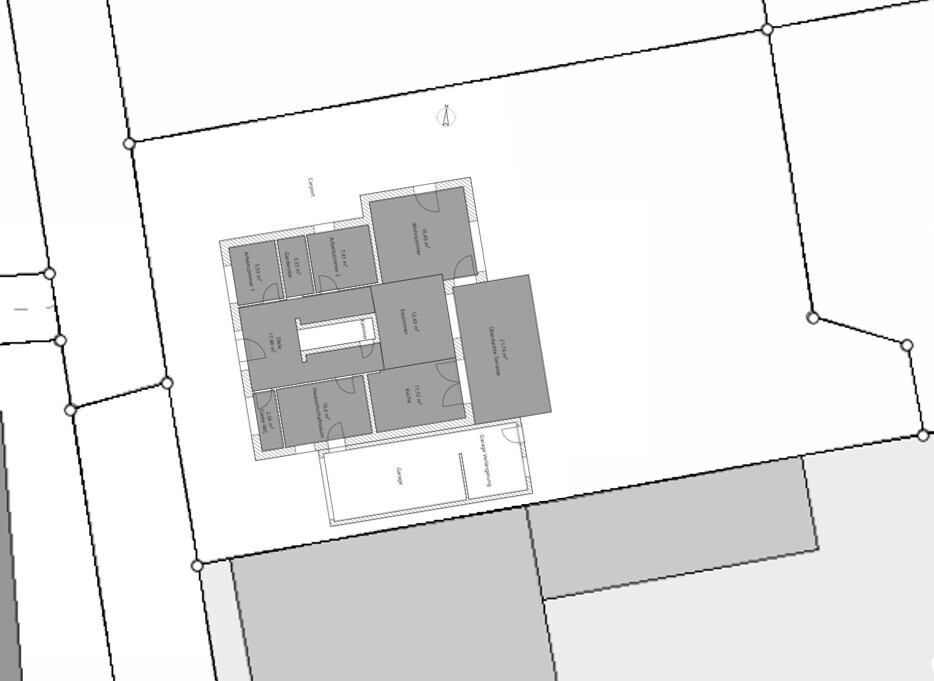
Plot size: 566 square meters (approx. 19 x 29 m (62 x 95 ft), see attachment)
The development plan follows § 34 of the Building Code.
The boundary building regulations follow common standards (i.e., a maximum of 9 m (30 ft) on one boundary and no more than 15 m (49 ft) in total on all boundaries).
A 9 m (30 ft) long garage is planned on the right side to conceal a commercial hall.
On the left side, a masonry carport with a canopy extending to the front door will be built.
Currently, we prefer the town villa architectural style but could also consider Bauhaus.
The plot mainly faces east.
Requirements of the homeowners
The project is intended for two adults and two children.
Two full stories are planned without a basement.
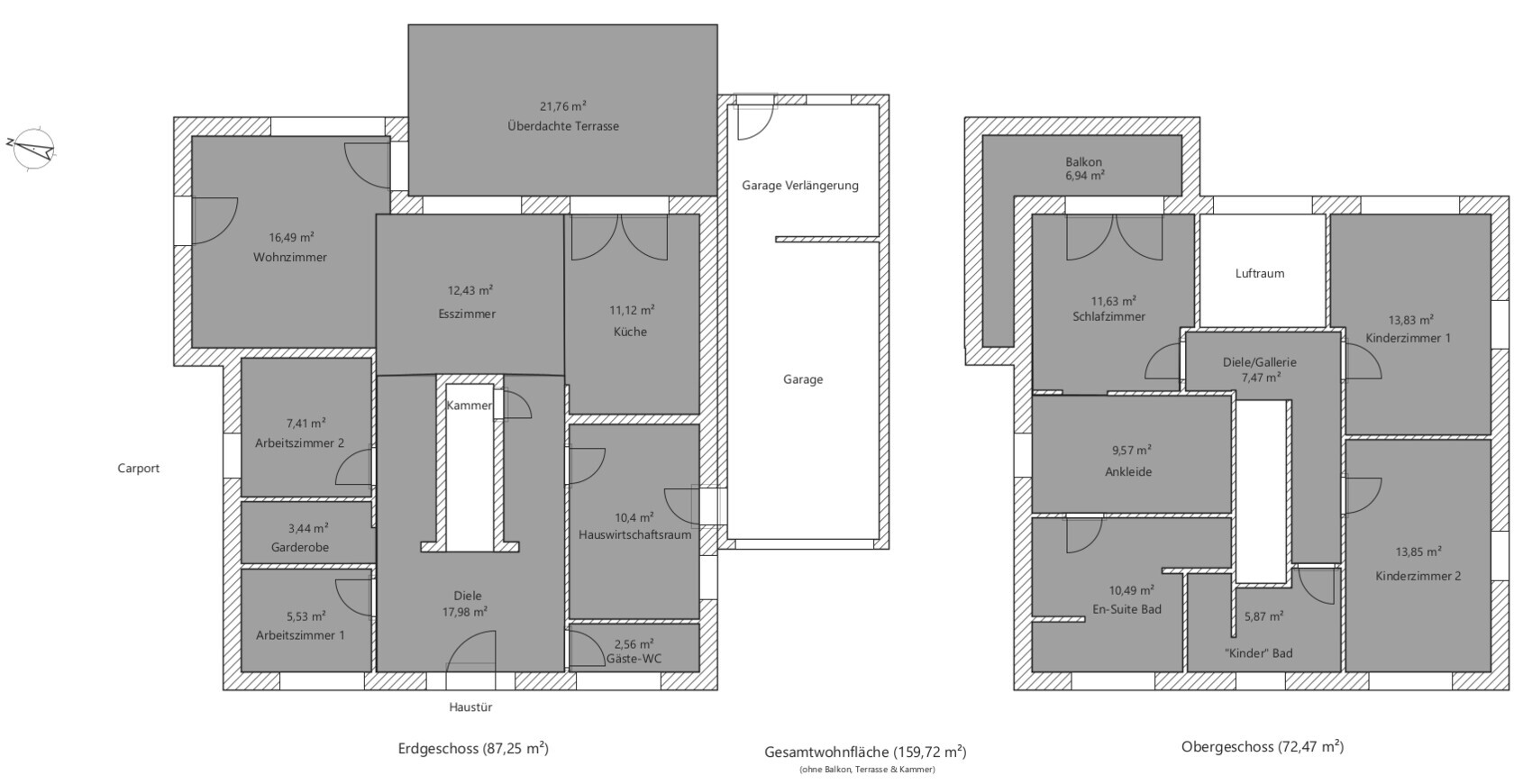
Space requirements on the ground floor: open living/dining/kitchen area; two small offices for working from home; utility room including heating/technical equipment; guest WC; cloakroom
Space requirements on the upper floor: two children’s rooms, a small bathroom, bedroom, walk-in closet, en-suite bathroom
Above the dining area, we would like to create an open void/gallery. We prefer an open, modern design.
The kitchen should be open and feature a cooking island with a stove.
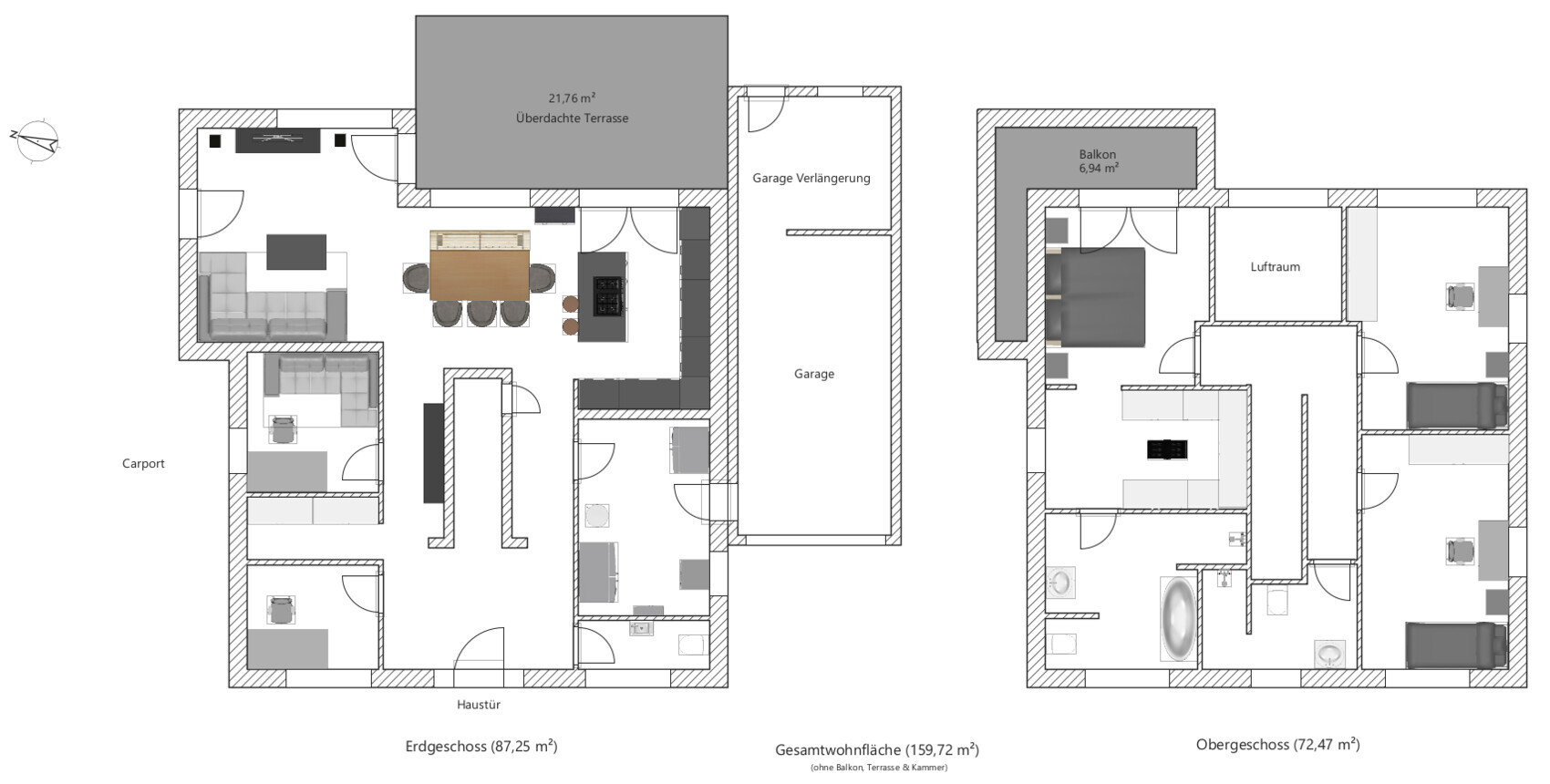
The sofa in the living room should be oriented to face the open living/dining/kitchen area as well as the garden.
A small balcony accessible from the bedroom is planned above the offset living room.
House Design
As a basis for planning, we used a sample floor plan from a construction company and adapted it to our preferences.
What do we especially like? Why? The open layout combining living, dining, and kitchen areas, oriented toward the garden. We are aware that this open design with an entrance hall and open void involves some sound transmission.
What do we not like? Why? The bedroom is planned relatively small but includes an adjacent walk-in closet. Laundry must be done on the ground floor in the utility room, although the wardrobes are on the upper floor.
Preferred heating system: geothermal or air-source heat pump
If you had to give up something, which details/structures
- Could you give up: balcony; passage from utility room to garage; cloakroom (if integrated into the hallway)
- Could not give up: offset living room (to avoid a simple rectangular box), open void
We are especially interested in your absolute no-gos or critical points where you think we might strongly regret something later. If you need any additional information, please let us know.
Many thanks in advance!
Best regards,
BetaVersion
Floor plan on plot:
Floor plan:
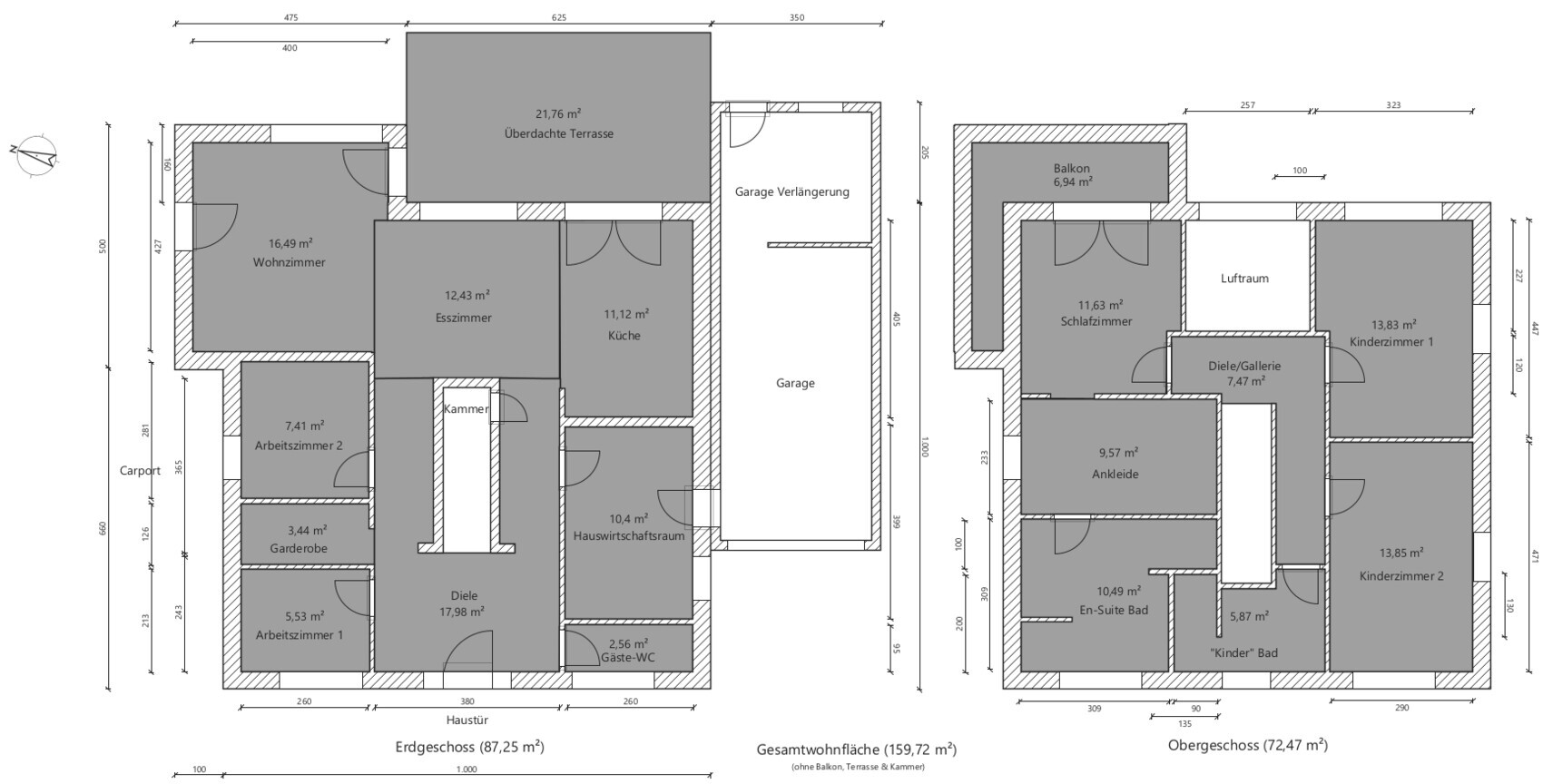
Floor plan with dimensions:
Floor plan with furniture:
We are still at the beginning of our building project but are already working on a possible floor plan to clarify our ideas. We would, of course, be interested in your feedback and suggestions for improvement. Below you will find the questionnaire completed to the best of our knowledge and attached are our drafts.
Development Plan / Restrictions
Plot size: 566 square meters (approx. 19 x 29 m (62 x 95 ft), see attachment)
The development plan follows § 34 of the Building Code.
The boundary building regulations follow common standards (i.e., a maximum of 9 m (30 ft) on one boundary and no more than 15 m (49 ft) in total on all boundaries).
A 9 m (30 ft) long garage is planned on the right side to conceal a commercial hall.
On the left side, a masonry carport with a canopy extending to the front door will be built.
Currently, we prefer the town villa architectural style but could also consider Bauhaus.
The plot mainly faces east.
Requirements of the homeowners
The project is intended for two adults and two children.
Two full stories are planned without a basement.
Space requirements on the ground floor: open living/dining/kitchen area; two small offices for working from home; utility room including heating/technical equipment; guest WC; cloakroom
Space requirements on the upper floor: two children’s rooms, a small bathroom, bedroom, walk-in closet, en-suite bathroom
Above the dining area, we would like to create an open void/gallery. We prefer an open, modern design.
The kitchen should be open and feature a cooking island with a stove.
The sofa in the living room should be oriented to face the open living/dining/kitchen area as well as the garden.
A small balcony accessible from the bedroom is planned above the offset living room.
House Design
As a basis for planning, we used a sample floor plan from a construction company and adapted it to our preferences.
What do we especially like? Why? The open layout combining living, dining, and kitchen areas, oriented toward the garden. We are aware that this open design with an entrance hall and open void involves some sound transmission.
What do we not like? Why? The bedroom is planned relatively small but includes an adjacent walk-in closet. Laundry must be done on the ground floor in the utility room, although the wardrobes are on the upper floor.
Preferred heating system: geothermal or air-source heat pump
If you had to give up something, which details/structures
- Could you give up: balcony; passage from utility room to garage; cloakroom (if integrated into the hallway)
- Could not give up: offset living room (to avoid a simple rectangular box), open void
We are especially interested in your absolute no-gos or critical points where you think we might strongly regret something later. If you need any additional information, please let us know.
Many thanks in advance!
Best regards,
BetaVersion
Floor plan on plot:
Floor plan:
Floor plan with dimensions:
Floor plan with furniture:
Good evening, to ease some of the sharpness of the criticism:
I assume that you have only briefly dealt with the topic of house construction and floor plans. Many of the issues mentioned were likely unintentional or not fully considered yet.
Keep in mind roughly that every built square meter costs you about 3000€ (about $3200) in standard construction.
A bay window is not standard and, in my estimation, would add rather 5,000–10,000 € (about $5,300–10,600) extra (so 7 sqm (75 sq ft) at 21,000€ (about $22,500) plus 5,000–10,000€ extra (about $5,300–10,600) -> nearly 30,000€ (about $32,000)).
In short: The house should be designed according to your habits and the plot of land. This should be your starting point:
-> For example, do you prefer morning or evening sun (but do not block the sunlight completely!)? What are your routines and routes within the house (it usually makes more sense to go through the dressing room to the bedroom rather than the other way around)? Consider whether you might be convincing yourself it's nice because it looks good but isn’t very practical, or if you will actually use it (en suite bathroom – possible, maybe nice, but 3 toilets, 3 sinks, … have to be cleaned whether used or not, not to mention the costs) … and much more.
In fact, there are a lot of problems, shortcomings, etc. here.
I would recommend either spending significantly more time dealing with the subject (and later approaching an independent architect), or going directly to a INDEPENDENT architect and focusing on your wishes and ideas.
Try not to fixate too much on the building style and details initially, but focus first on the essentials.
I assume that you have only briefly dealt with the topic of house construction and floor plans. Many of the issues mentioned were likely unintentional or not fully considered yet.
Keep in mind roughly that every built square meter costs you about 3000€ (about $3200) in standard construction.
A bay window is not standard and, in my estimation, would add rather 5,000–10,000 € (about $5,300–10,600) extra (so 7 sqm (75 sq ft) at 21,000€ (about $22,500) plus 5,000–10,000€ extra (about $5,300–10,600) -> nearly 30,000€ (about $32,000)).
In short: The house should be designed according to your habits and the plot of land. This should be your starting point:
-> For example, do you prefer morning or evening sun (but do not block the sunlight completely!)? What are your routines and routes within the house (it usually makes more sense to go through the dressing room to the bedroom rather than the other way around)? Consider whether you might be convincing yourself it's nice because it looks good but isn’t very practical, or if you will actually use it (en suite bathroom – possible, maybe nice, but 3 toilets, 3 sinks, … have to be cleaned whether used or not, not to mention the costs) … and much more.
In fact, there are a lot of problems, shortcomings, etc. here.
I would recommend either spending significantly more time dealing with the subject (and later approaching an independent architect), or going directly to a INDEPENDENT architect and focusing on your wishes and ideas.
Try not to fixate too much on the building style and details initially, but focus first on the essentials.
H
HuppelHuppel27 May 2025 22:27Sahitaz schrieb:
Just keep in mind roughly that every square meter built costs you 3000€ (approximately $3200) at standard quality.
No. Assuming his planned 160 square meters (approximately 1720 square feet) cost 450,000€, neither 150 square meters (approximately 1615 square feet) would cost 420,000€, nor 170 square meters (approximately 1830 square feet) 480,000€.
As already explained, the bay windows can simply be filled in, and the costs remain limited.
There isn’t much more to add here @Sahitaz
But whether it’s sharp or not: both mean the same thing.
It doesn’t work to draw it differently just to have to explain later that it is otherwise. Your software can show a staircase in a reasonable and correct position with the right length. Please show what you mean. Show it as it should be. Then show the problem.
Here again, unfortunately. I had already predicted the carelessness. No problem, everyone makes mistakes. But what exactly do you want to be “of course” like, and what is shown incorrectly?
The question that always arises: what does “of course” mean?
Everything should be open. You have drawn in more walls than necessary. Walls separate; they do not create openness.
On the contrary, it often looks more open when you close something off with a door than when looking into a narrow hallway or corridor. These airlocks, however short or long, are unnecessary and expensive here.
Take your time, read up, look at other floor plan threads, including those from last year, and start fresh.
And:
It’s quite common for a home office space to double as the family computer spot.
But plan a room for your children where they can have a desk, enough closet space, and enough room to sulk or celebrate. That is their privacy, their living space, which they need for their development. No one needs to collect their things and places all around the house. They will grow up, just like you.
What “of course” means to me is:
- don’t set things in stone
- don’t reject anything outright or see anything as fixed at first
- let in light so you feel comfortable inside all year round, including winter
- a wardrobe room where three people can move in front of the closet at the same time
- bedrooms shouldn’t be through-rooms
- proportions of rooms must be right—kids aren’t grateful just for a kids’ bathroom, nor even if they are allowed to use a bathroom at night. Try explaining that to them.
But whether it’s sharp or not: both mean the same thing.
BetaVersion schrieb:
By the way, the first three steps of the staircase on the ground floor extend into the hallway
It doesn’t work to draw it differently just to have to explain later that it is otherwise. Your software can show a staircase in a reasonable and correct position with the right length. Please show what you mean. Show it as it should be. Then show the problem.
BetaVersion schrieb:
Sorry, that was unclear. The open space to the gallery should of course be open or only separated by a railing, and the right wall of the staircase on the upper floor should only be half-height—similar to the original floor plan.
Here again, unfortunately. I had already predicted the carelessness. No problem, everyone makes mistakes. But what exactly do you want to be “of course” like, and what is shown incorrectly?
The question that always arises: what does “of course” mean?
BetaVersion schrieb:
should of course be open
Everything should be open. You have drawn in more walls than necessary. Walls separate; they do not create openness.
BetaVersion schrieb:
We thought that by opening the two “tubes” on the ground floor, they would at least be brighter than in the original floor plan, where the entrance area is separated by two doors.
On the contrary, it often looks more open when you close something off with a door than when looking into a narrow hallway or corridor. These airlocks, however short or long, are unnecessary and expensive here.
BetaVersion schrieb:
Does anyone have an idea here,
Take your time, read up, look at other floor plan threads, including those from last year, and start fresh.
And:
BetaVersion schrieb:
After all, children’s clothes would also be stored in the walk-in closet
It’s quite common for a home office space to double as the family computer spot.
But plan a room for your children where they can have a desk, enough closet space, and enough room to sulk or celebrate. That is their privacy, their living space, which they need for their development. No one needs to collect their things and places all around the house. They will grow up, just like you.
What “of course” means to me is:
- don’t set things in stone
- don’t reject anything outright or see anything as fixed at first
- let in light so you feel comfortable inside all year round, including winter
- a wardrobe room where three people can move in front of the closet at the same time
- bedrooms shouldn’t be through-rooms
- proportions of rooms must be right—kids aren’t grateful just for a kids’ bathroom, nor even if they are allowed to use a bathroom at night. Try explaining that to them.

BetaVersion schrieb:
@11ant What exactly do you mean by your "note on the justified suspicion of transferred setback distances"?The hall on the neighboring property is located directly on the boundary and triggers setback requirements in almost all cases, which can alternatively be fulfilled on your property. This is called a transfer of setback distances. Depending on the federal state, this is recorded in the land register or in a separate register of building encumbrances to show whether your predecessor carried out such a transfer. The boundary line to the neighbor at the rear indicates the need to take this into account. Even transferred setback distances must be kept free of any construction, which can also affect outbuildings like your garage that would otherwise benefit from a boundary privilege.
https://www.instagram.com/11antgmxde/
https://www.linkedin.com/company/bauen-jetzt/
@BetaVersion Having a second shower for four people is definitely convenient. Occasionally, there are bottlenecks. However, most of us grew up with just one shower for four or more people. That’s why most common floor plans add a shower to the ground floor bathrooms.
A different staircase layout and many other changes improve things — including the openness. Openness requires light to have an effect. YPG has already shared quite a bit about that.
Have you ever visited a prefabricated house exhibition?
A staircase with two hallways feels grand in castles — but they have more space and budget than we do.
The winter clothes you can sort out from children and store in the walk-in closet (storage room) are usually limited in quantity. Most of the time, they won’t fit again the following year anyway. We store ski clothing in the attic during spring, and take down the cycling and riding gear.
A different staircase layout and many other changes improve things — including the openness. Openness requires light to have an effect. YPG has already shared quite a bit about that.
Have you ever visited a prefabricated house exhibition?
A staircase with two hallways feels grand in castles — but they have more space and budget than we do.
The winter clothes you can sort out from children and store in the walk-in closet (storage room) are usually limited in quantity. Most of the time, they won’t fit again the following year anyway. We store ski clothing in the attic during spring, and take down the cycling and riding gear.
B
BetaVersion7 Sep 2025 14:00Hello everyone,
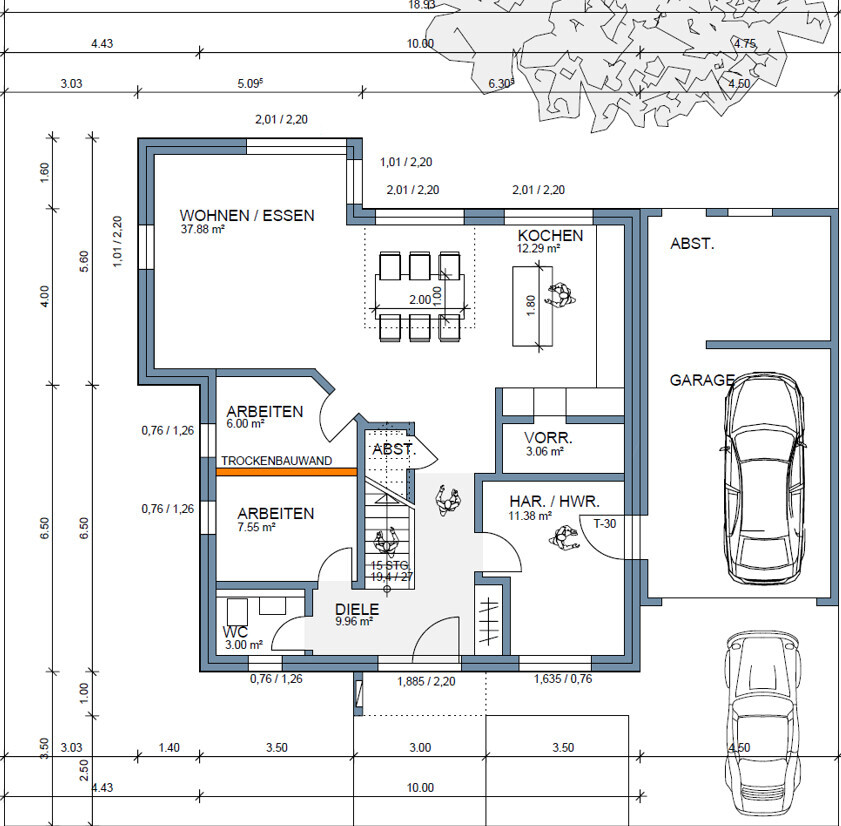
I thought I’d share our current progress update for those who are interested. We decided to move away from the central staircase with two passageways in the hallway. As a result, the entrance area should no longer feel so narrow and corridor-like. The guest toilet and the children’s rooms have also become a bit more spacious. The garage no longer extends over the terrace, and an additional carport is currently not planned. We are also aiming for an urban villa style to have extra storage space in the attic.
Wishing you all a great Sunday!
Ground floor:
Upper floor:
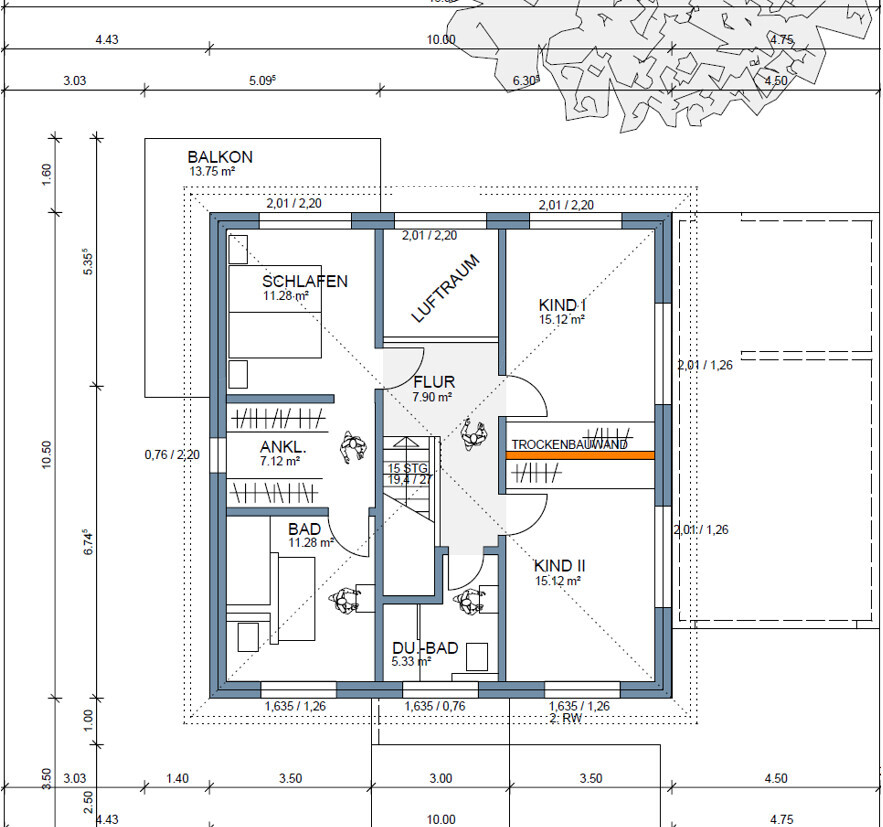
I thought I’d share our current progress update for those who are interested. We decided to move away from the central staircase with two passageways in the hallway. As a result, the entrance area should no longer feel so narrow and corridor-like. The guest toilet and the children’s rooms have also become a bit more spacious. The garage no longer extends over the terrace, and an additional carport is currently not planned. We are also aiming for an urban villa style to have extra storage space in the attic.
Wishing you all a great Sunday!
Ground floor:
Upper floor:
Similar topics