
ᐅ Prefabricated house: should you start with an architect’s design and then choose a prefab provider, or the other way around?
Created on: 13 Aug 2025 22:38
G
Gänseblümchen7G
Gänseblümchen713 Aug 2025 22:38We are currently planning a single-family house. The plot is already secured, and the development plan is straightforward (large building area; we are allowed two full stories with a pitched roof…).
We have spoken with several prefabricated house suppliers and gone through the preliminary model selection process. We were actually ready to make a decision soon. We are basically laypeople but have continuously gathered information. I noticed that in one of the offered floor plans, the utility room does not have an exterior wall (which seems problematic for a heat pump, right?).
It is generally said that the “detailed planning” will be done with the architect later. I’m starting to wonder if it might be smarter to first have the planning done with an architect we pay ourselves, and then request offers from prefabricated house manufacturers to implement it?
Currently, we are considering Schwörerhaus, Weberhaus, and Fingerhaus. We are not completely satisfied with any of their floor plans. With Weberhaus, we could stay within one building series, which theoretically could improve the price, but is that really true?
What are your opinions?
We have spoken with several prefabricated house suppliers and gone through the preliminary model selection process. We were actually ready to make a decision soon. We are basically laypeople but have continuously gathered information. I noticed that in one of the offered floor plans, the utility room does not have an exterior wall (which seems problematic for a heat pump, right?).
It is generally said that the “detailed planning” will be done with the architect later. I’m starting to wonder if it might be smarter to first have the planning done with an architect we pay ourselves, and then request offers from prefabricated house manufacturers to implement it?
Currently, we are considering Schwörerhaus, Weberhaus, and Fingerhaus. We are not completely satisfied with any of their floor plans. With Weberhaus, we could stay within one building series, which theoretically could improve the price, but is that really true?
What are your opinions?
Gänseblümchen7 schrieb:
The technical room has no exterior wall (unfavorable because of the heat pump, right?). I recently read that the piping can span 15 meters (50 feet).
Gänseblümchen7 schrieb:
But is that really correct? Good question. The problem is that many here don’t contribute to this topic, so most readers in the forum are not up to date.
Gänseblümchen7 schrieb:
We’re not completely satisfied with any of the floor plans. Yes, I would also find fault with each one, but many house designs are quite nice and allow you to imagine your own wishes within them. You can’t fit everything you want in terms of details anyway.
That is true even at the stage of modifications, the so-called “fine planning.”
Gänseblümchen7 schrieb:
It’s generally said that the “fine planning” is done later with the architect. I’m starting to wonder if it might be smarter to first have the planning done by an architect we pay ourselves, and then request quotes from prefabricated house manufacturers to execute it? That depends on whether your fine tuning moves into the scope of full architectural planning.
You have to decide for yourselves if you can accept a standard house design or if you want to make so many changes that it takes a different direction. There is not enough information for that here.
In my opinion, if you have no major restrictions from the local zoning regulations (building permit/planning permission) and intend to do a lot of work by yourselves (for example, if relatives can do electrical work and plumbing), and if you feel well cared for by a general contractor who also provides a comprehensive scope of work, then staying with the general contractor is fine.
However, if you need to add special features here and there right from the start, or if you plan something unusual in your build, I recommend going with an architect. Especially if it’s a sloped/uneven plot.

Gänseblümchen7 schrieb:
We have similar conditions and so far approached it the other way around – we had standard house designs suggested to us and then adapted them. By now, I’m wondering if it wouldn’t be better to start with an architect instead... What conditions do you have exactly? It’s always helpful to provide details about yourself and your plot on page 1 of your thread using the completed questionnaire https://www.hausbau-forum.de/threads/grundriss-planung-unbedingt-vor-beitrag-erstellung-lesen.11714/. This is essentially the foundation for project discussions. Good representations of the plot are cadastral maps with contour lines or elevation points, and aerial photos showing around 100 m (330 feet) diagonal of the surrounding area. It’s best to also mention the local zoning plan (without linking!).
Gänseblümchen7 schrieb:
We have talked to several prefabricated house manufacturers. Why prefabricated house manufacturers? Because of the promises of faster construction or more predictable final costs?
Gänseblümchen7 schrieb:
I’m slowly wondering whether it would be smarter to first do the planning with an architect that we pay ourselves, and then request offers from prefabricated house builders to realize it? Absolutely yes. Service phases 1 and 2 are always necessary, cost little, and are payable regardless of whether they are itemized separately. In my “House Building Roadmap, also for you: the HOAI phase model!” (search for the phrase in quotation marks on “Bauen jetzt” or now also via my signature), I bundle these as “Module A” and recommend a > resting phase with > decision-making afterwards. The resting phase is a period of “time off” from nightmares about floor plans and such, and during the decision-making, you find out whether, in your specific case, a wooden or masonry construction method is the better path to your home.
I usually request offers from a total of five providers (mixed wood and masonry), but also explain how to do it yourself. Question 1 always concerns the house designed by the independent architect as a preliminary draft, and question 2 centers on a construction proposal from the supplier that they have implemented several times (whether it’s called a standard house, catalogue house, or promotional house is secondary). An individual design is not inherently more valuable; a typical family with a flat plot (there are hardly any standard houses for sloped plots) usually does not necessarily need it. The tested, series-mature model offers these advantages.
Gänseblümchen7 schrieb:
We are not completely satisfied with any of the floor plans. That is most often because you are not a typical family (e.g., you have a third child or need a second home office) or have a sloped plot and the basement is poorly integrated into the plan.
Gänseblümchen7 schrieb:
In one floor plan offered, the technical room doesn’t have an exterior wall (unfavorable for a heat pump, right?). ypg schrieb:
I recently read that the piping can span 15 meters (50 feet). The bigger issue is the overbuilding of the house connections. And yes, some utility providers do not necessarily limit the total length of the branch line, but rather the distance from the plot boundary to the shut-off device or service opening. A technical room in a central position is, however, extremely rare in standard houses.
Gänseblümchen7 schrieb:
With Weberhaus, we can stay within one building series, which theoretically improves the price, but is that really true? I have now read that sentence four times (slowly) and have not understood it even once (?)
https://www.instagram.com/11antgmxde/
https://www.linkedin.com/company/bauen-jetzt/
G
Gänseblümchen714 Aug 2025 11:36Thank you for the note about the questionnaire. Filled out here.
We have plot 5709 (Google Maps: between "Im Sand 36" and "Im Sand 42" in 67376 Harthausen)
Development Plan / Restrictions
Plot size – 555 m² (6000 sq ft)
Slope – Slightly slopes downwards from the street towards the back (approx. 50 cm (20 inches) from street to rear boundary)
Floor space index (FSI) / Plot ratio – 0.4
Floor area ratio (FAR) – 0.8
Building envelope, building line, and boundary – approx. 10 x 16 m (33 x 52 ft); see development plan
Edge development – Garage to border the neighboring plot (slightly larger than shown in the development plan and directly adjoining the house)
Number of parking spaces – 2 in front of garage
Number of floors – 2
Roof type – Gable roof, 33° pitch (as specified in the development plan)
Style – What does this refer to?
Orientation – South azimuth approx. -20° (as in the development plan)
Maximum height/limits – max. 6.60 m (21 ft 8 in) eaves height
Owners’ Requirements
Style, roof type, building type – Detached single-family house with gable roof
Basement, floors – No basement, 2 full floors
Number of occupants, age – 4 (2 adults, 2 children)
Space requirements on ground floor and upper floor – Living/dining/kitchen; utility room, shower WC on ground floor; family bathroom on upper floor; master bedroom with walk-in closet; 2 offices; 2 children’s bedrooms
Office: family use or home office? One office is for home office use, the other is a sewing room.
Number of guest stays per year – Mother of the owner about 4 times a year; plan is to place a sofa bed in one of the offices.
Open or closed architecture – Open plan living/dining area, ideally with a kitchen that can be separated. Other rooms separate.
Traditional or modern building method – What is meant here?
Open kitchen, cooking island – Unclear
Number of dining seats – 8 (dining table approx. 2.40 x 1.10 m (7 ft 10 in x 3 ft 7 in))
Fireplace – No
Music/sound wall – No
Balcony, roof terrace – No
Garage, carport – Yes, double garage + garden shed directly adjoining the house
Utility garden, greenhouse – Possibly a small vegetable/herb bed. Otherwise terrace + lawn, possibly additional play areas later
Other wishes / special features / daily routine, including reasons why certain things are preferred or excluded
House Design
Who created the design:
- Based on a standard catalog house, refined by us to the current plan
What do you particularly like? Why?
- Size of ground floor office, sleeping area + walk-in closet
- Very comfortable size
What do you dislike? Why?
- Children’s rooms could be smaller
- Bathroom upstairs definitely too large
- Entrance hall (ground floor) very big (wasted space?)
- Closets in the hall towards the garage are currently planned as a "pantry." Does this make sense?
Price estimate from the general contractor: ~470,000 € (price already deducts owner’s contributions: interior doors, sanitary fixtures except showers and bathtubs, floor coverings except bathrooms and shower WCs, plastering, painting)
Personal price limit for house including fittings: ~550,000 €
Preferred heating technology: We are still undecided between air-to-air heat pump (Proxon by WeberHaus) or air-to-water heat pump (Tecalor). Currently leaning towards air-to-water heat pump. The price above already includes the air-to-water heat pump (approx. €13,000 (USD 14,000) extra compared to air-to-air heat pump)
If you have to give up something, which details/expansions
- Can give up: partly on room size
- Cannot give up: number of rooms
Why is the design as it is now?
Standard design from the planner? Started from a WeberHaus Balance 300 and then modified.
Which wishes were implemented by the architect? Not yet seen an architect.
We are currently at about 180 m² (1,940 sq ft). We believe that 160 – 170 m² (1,720 – 1,830 sq ft) should also be sufficient and hope for ideas on how to save space.
Are there any fundamental problems we may have overlooked so far?
Attachment: Ground floor / upper floor plans from WeberHaus.
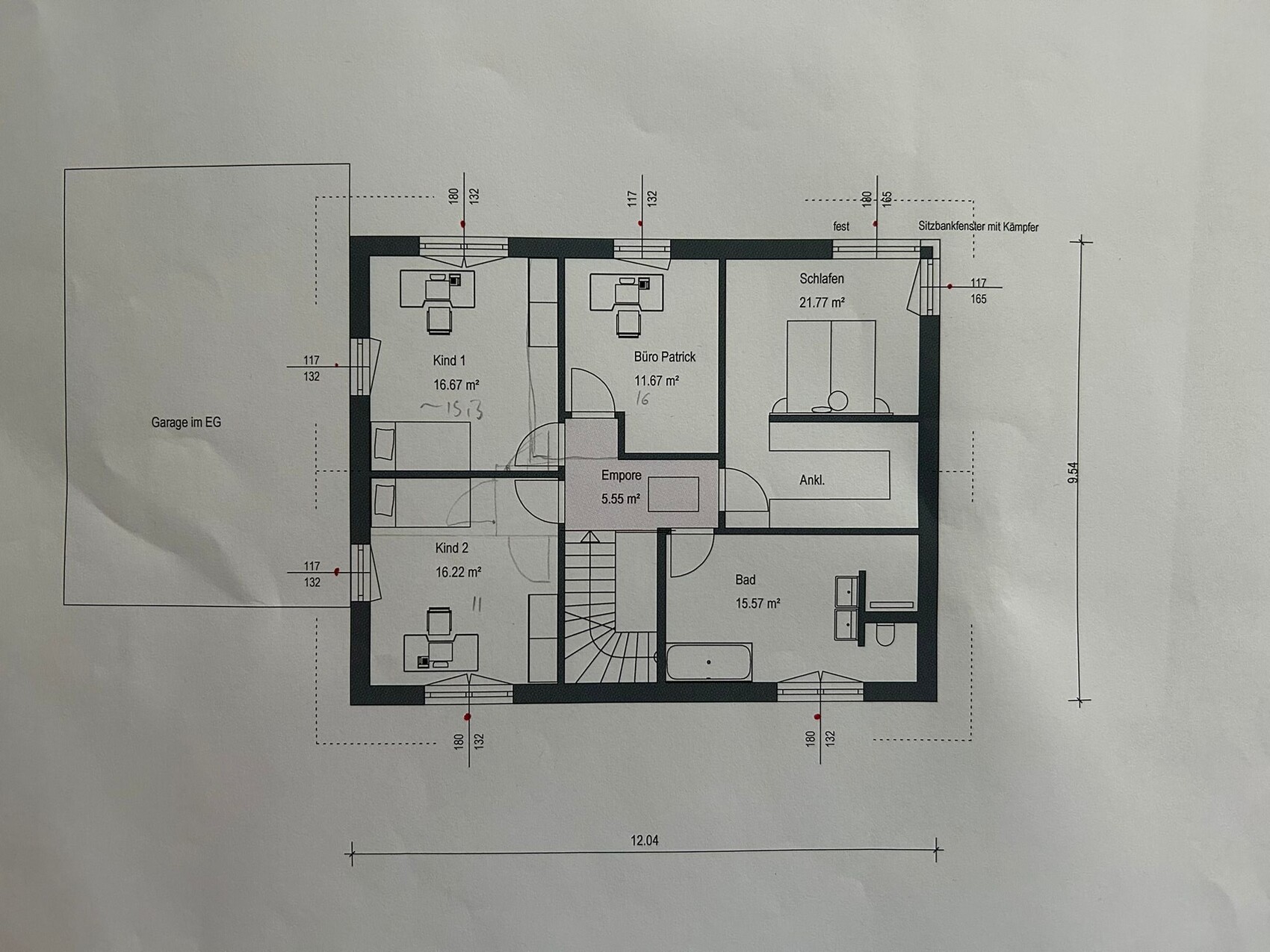
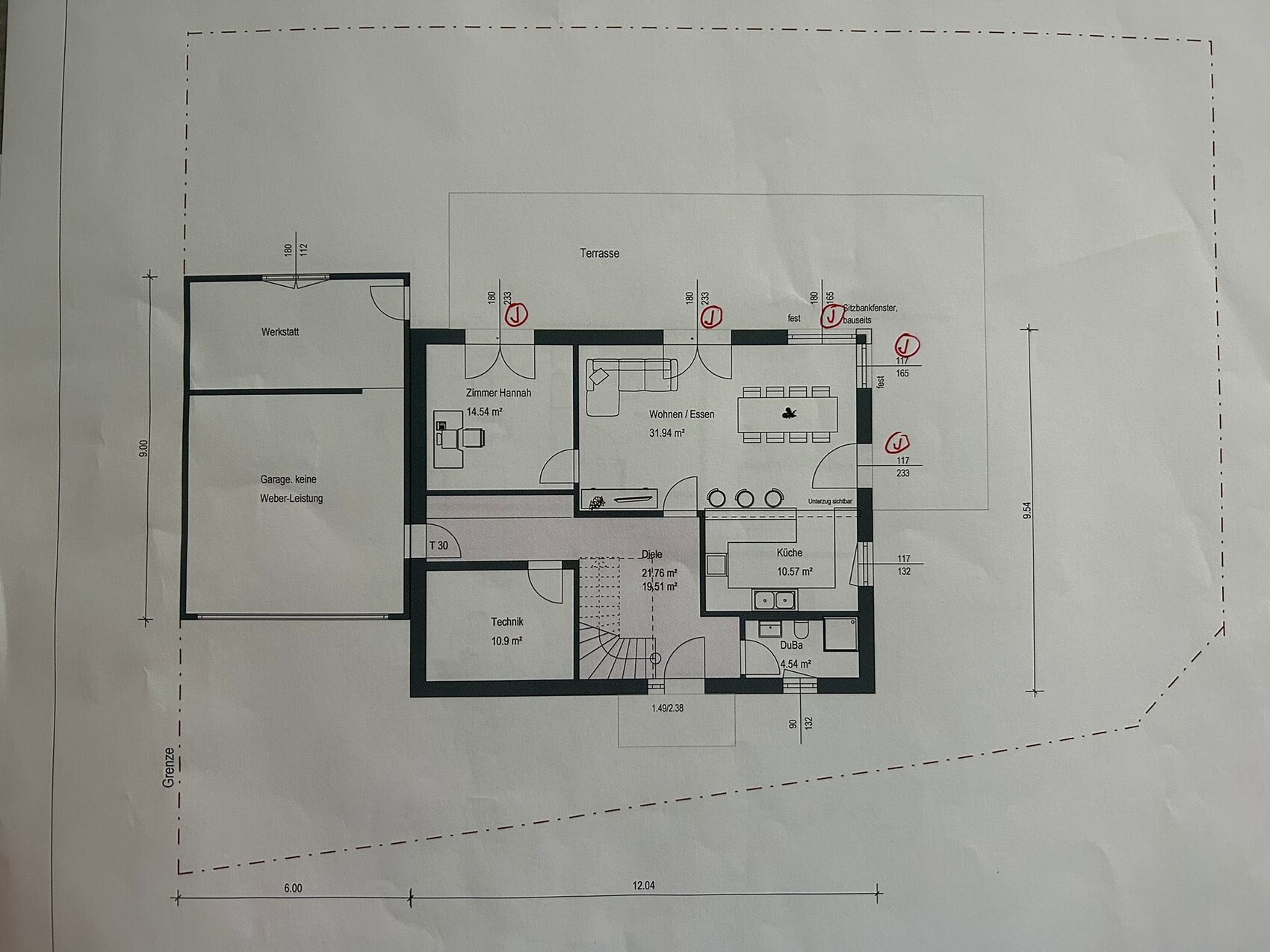
We have plot 5709 (Google Maps: between "Im Sand 36" and "Im Sand 42" in 67376 Harthausen)
Development Plan / Restrictions
Plot size – 555 m² (6000 sq ft)
Slope – Slightly slopes downwards from the street towards the back (approx. 50 cm (20 inches) from street to rear boundary)
Floor space index (FSI) / Plot ratio – 0.4
Floor area ratio (FAR) – 0.8
Building envelope, building line, and boundary – approx. 10 x 16 m (33 x 52 ft); see development plan
Edge development – Garage to border the neighboring plot (slightly larger than shown in the development plan and directly adjoining the house)
Number of parking spaces – 2 in front of garage
Number of floors – 2
Roof type – Gable roof, 33° pitch (as specified in the development plan)
Style – What does this refer to?
Orientation – South azimuth approx. -20° (as in the development plan)
Maximum height/limits – max. 6.60 m (21 ft 8 in) eaves height
Owners’ Requirements
Style, roof type, building type – Detached single-family house with gable roof
Basement, floors – No basement, 2 full floors
Number of occupants, age – 4 (2 adults, 2 children)
Space requirements on ground floor and upper floor – Living/dining/kitchen; utility room, shower WC on ground floor; family bathroom on upper floor; master bedroom with walk-in closet; 2 offices; 2 children’s bedrooms
Office: family use or home office? One office is for home office use, the other is a sewing room.
Number of guest stays per year – Mother of the owner about 4 times a year; plan is to place a sofa bed in one of the offices.
Open or closed architecture – Open plan living/dining area, ideally with a kitchen that can be separated. Other rooms separate.
Traditional or modern building method – What is meant here?
Open kitchen, cooking island – Unclear
Number of dining seats – 8 (dining table approx. 2.40 x 1.10 m (7 ft 10 in x 3 ft 7 in))
Fireplace – No
Music/sound wall – No
Balcony, roof terrace – No
Garage, carport – Yes, double garage + garden shed directly adjoining the house
Utility garden, greenhouse – Possibly a small vegetable/herb bed. Otherwise terrace + lawn, possibly additional play areas later
Other wishes / special features / daily routine, including reasons why certain things are preferred or excluded
House Design
Who created the design:
- Based on a standard catalog house, refined by us to the current plan
What do you particularly like? Why?
- Size of ground floor office, sleeping area + walk-in closet
- Very comfortable size
What do you dislike? Why?
- Children’s rooms could be smaller
- Bathroom upstairs definitely too large
- Entrance hall (ground floor) very big (wasted space?)
- Closets in the hall towards the garage are currently planned as a "pantry." Does this make sense?
Price estimate from the general contractor: ~470,000 € (price already deducts owner’s contributions: interior doors, sanitary fixtures except showers and bathtubs, floor coverings except bathrooms and shower WCs, plastering, painting)
Personal price limit for house including fittings: ~550,000 €
Preferred heating technology: We are still undecided between air-to-air heat pump (Proxon by WeberHaus) or air-to-water heat pump (Tecalor). Currently leaning towards air-to-water heat pump. The price above already includes the air-to-water heat pump (approx. €13,000 (USD 14,000) extra compared to air-to-air heat pump)
If you have to give up something, which details/expansions
- Can give up: partly on room size
- Cannot give up: number of rooms
Why is the design as it is now?
Standard design from the planner? Started from a WeberHaus Balance 300 and then modified.
Which wishes were implemented by the architect? Not yet seen an architect.
We are currently at about 180 m² (1,940 sq ft). We believe that 160 – 170 m² (1,720 – 1,830 sq ft) should also be sufficient and hope for ideas on how to save space.
Are there any fundamental problems we may have overlooked so far?
Attachment: Ground floor / upper floor plans from WeberHaus.
H
HuppelHuppel14 Aug 2025 11:40One might consider reducing the width slightly, but would that really make a significant difference? As a layperson, I find the design quite nice.
G
Gänseblümchen714 Aug 2025 11:40Why choose a prefabricated house? We currently live about 110 km (68 miles) from the building site and hope this will result in fewer on-site inspection appointments.
"With WeberHaus, we can stay within one product line, which theoretically improves the price, but is that really true?"
I will try to explain in more detail:
--> Our floor plan above is based on a WeberHaus product line (Balance 300). This means that the exterior walls and stair placement are fixed. The rest is flexible and has been adjusted by us accordingly. We hope that building within the product line will be cheaper than choosing a fully custom-designed house. However, we do not know if it actually is cheaper.
"With WeberHaus, we can stay within one product line, which theoretically improves the price, but is that really true?"
I will try to explain in more detail:
--> Our floor plan above is based on a WeberHaus product line (Balance 300). This means that the exterior walls and stair placement are fixed. The rest is flexible and has been adjusted by us accordingly. We hope that building within the product line will be cheaper than choosing a fully custom-designed house. However, we do not know if it actually is cheaper.
Similar topics