
ᐅ Plaster Damage on Exterior Wall – Is the Builder’s Response Adequate?
Created on: 13 Aug 2025 13:53
B
Blaexe90
Hello everyone,
I am reaching out to you as a community of experienced construction professionals and homeowners because we, as a condominium owners’ association (HOA), are currently a bit uncertain.
The situation: On our new building (approximately 4.5 years old), the plaster on the facade is crumbling around two pipe penetrations (common ventilation pipes) (see photo). A third, identical penetration still looks fine. We discovered and reported the damage in January. The end of the 5-year warranty period is approaching, so we want to make sure this issue is properly resolved.
The developer has already identified the cause (albeit remotely diagnosed: missing separation between the plastic pipe and the plaster) and has responded in writing to our questions about the repair. However, their answers seem somewhat vague to us.
Our question:
How exactly will the repair process proceed?
Developer’s answer:
The damaged plaster will be removed, and I will carefully inspect the situation on-site. Then, together with the contractor, I will determine the necessary steps. At this point, I expect that the missing separation will be installed, the plaster reapplied, and the damaged areas repaired. This will also include blending the new plaster with the old. Any color difference between old and new plaster will quickly even out due to weathering.
Our question:
Will any resulting damage such as moisture be investigated?
Developer’s answer:
When I am on site, I will inspect the entire building and check for any secondary damage and address it if necessary. However, I expect that there will be no further damage. Usually, only a few drops of water seep behind the system, which then diffuse over time since our system is vapor-permeable.
Our question:
Will the third, still intact pipe penetration be repaired preventively?
Developer’s answer:
I will also check that and initiate further measures if needed.
Thank you very much in advance and best regards
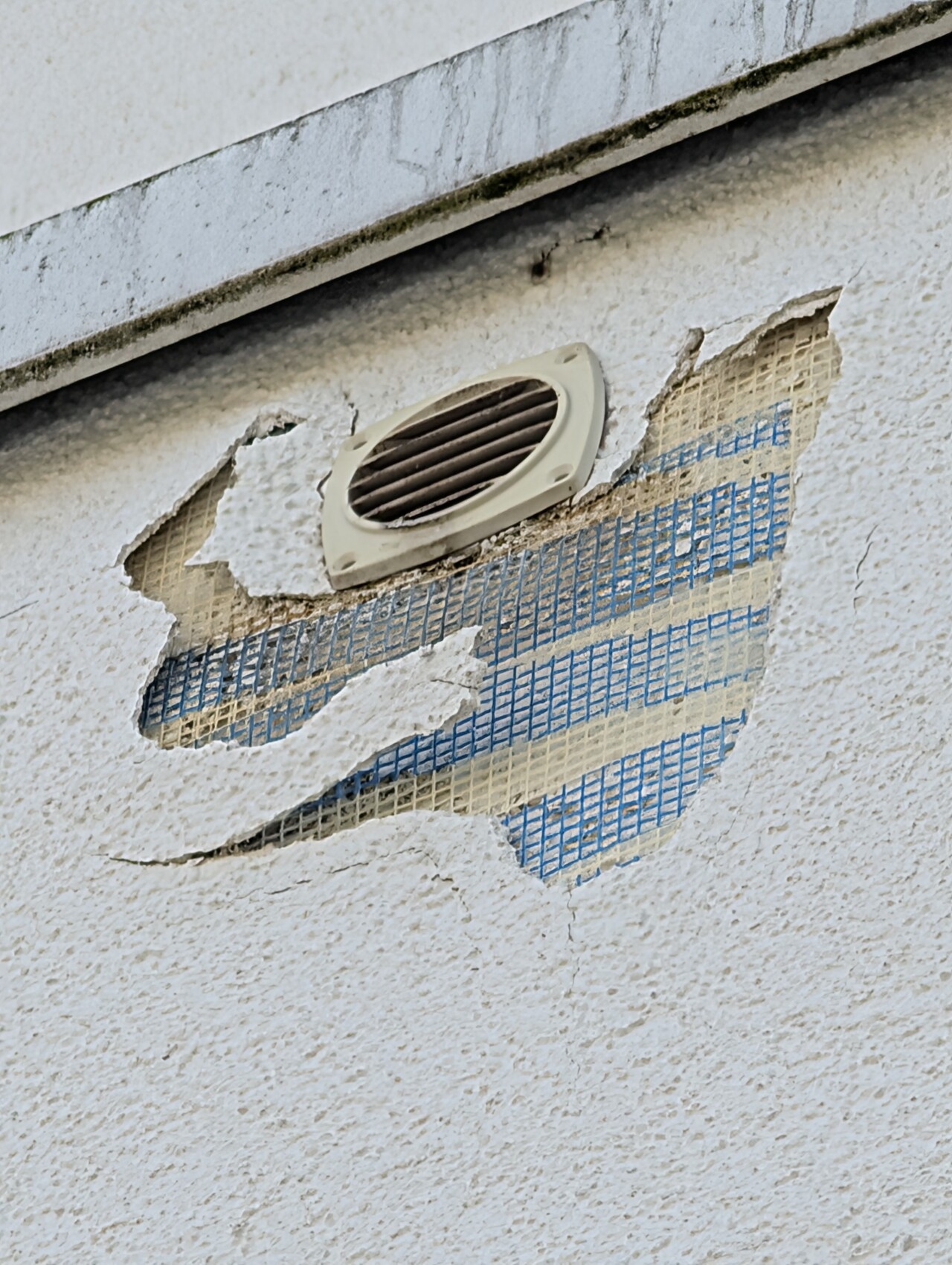
I am reaching out to you as a community of experienced construction professionals and homeowners because we, as a condominium owners’ association (HOA), are currently a bit uncertain.
The situation: On our new building (approximately 4.5 years old), the plaster on the facade is crumbling around two pipe penetrations (common ventilation pipes) (see photo). A third, identical penetration still looks fine. We discovered and reported the damage in January. The end of the 5-year warranty period is approaching, so we want to make sure this issue is properly resolved.
The developer has already identified the cause (albeit remotely diagnosed: missing separation between the plastic pipe and the plaster) and has responded in writing to our questions about the repair. However, their answers seem somewhat vague to us.
Our question:
How exactly will the repair process proceed?
Developer’s answer:
The damaged plaster will be removed, and I will carefully inspect the situation on-site. Then, together with the contractor, I will determine the necessary steps. At this point, I expect that the missing separation will be installed, the plaster reapplied, and the damaged areas repaired. This will also include blending the new plaster with the old. Any color difference between old and new plaster will quickly even out due to weathering.
Our question:
Will any resulting damage such as moisture be investigated?
Developer’s answer:
When I am on site, I will inspect the entire building and check for any secondary damage and address it if necessary. However, I expect that there will be no further damage. Usually, only a few drops of water seep behind the system, which then diffuse over time since our system is vapor-permeable.
Our question:
Will the third, still intact pipe penetration be repaired preventively?
Developer’s answer:
I will also check that and initiate further measures if needed.
- What do you think of these answers? Is this a solid basis for a repair, or are these just vague responses designed to avoid commitment?
- I’m especially skeptical about the statement regarding moisture (“only a few drops,” “diffuse out again”). The areas have been open since winter, and there has been heavy rain frequently. Is this statement realistic?
- What would a truly professional repair look like to you? What should we pay attention to when the contractors come?
- What about the third area? We don’t want to just rely on “check and if necessary.” Is it common to do preventive repairs in cases where the defect is systemic?
Thank you very much in advance and best regards
Blaexe90 schrieb:
a standard complaint within the scope of the warranty What differentiates a standard complaint from a formal one?
As mentioned before: it is the start of a procedure, and if no deadline was actually set, then you should definitely contact a lawyer.
Because if the complaint was indeed not formally submitted with a deadline, you don’t have much time left.
@11ant
I’m wondering how you even came to the conclusion that I would make any decisions for the homeowners’ association? We, as owners, are in contact and can only decide on something through a resolution anyway.
Your post is somewhat off-topic. I asked for professional assessments so that we can jointly make the most informed decision possible.
I’m wondering how you even came to the conclusion that I would make any decisions for the homeowners’ association? We, as owners, are in contact and can only decide on something through a resolution anyway.
Your post is somewhat off-topic. I asked for professional assessments so that we can jointly make the most informed decision possible.

Blaexe90 schrieb:
I wonder how you even come to the conclusion that I would make any decisions for the homeowners’ association? We owners are in contact and can only decide on something through a formal resolution anyway. I’m not concluding, but rather fearing that you belong to the "Team Galama," and so far you haven’t taken any position on your role. Now here’s someone from Codos Sternenmitte, formally no more responsible than the others. That’s what I figured and advised you to protect yourself by consulting a professional (for legal matters, because you need that here).
Blaexe90 schrieb:
Your post is somewhat off topic right now. I asked for expert assessments so that we can jointly make the most informed decision possible. Once again: this is not a matter of plastering technique expertise, but of legally correcting the situation, and for good reason the legal advice act does not leave that to phone amateurs.
https://www.instagram.com/11antgmxde/
https://www.linkedin.com/company/bauen-jetzt/
I honestly have no idea what you mean by "Team Galama" and so on. You also don’t need to have any concerns. And why you repeatedly advise me to "consult a professional" is unclear to me. I am not capable of doing that. Apparently, you are not aware of how a condominium owners association (or homeowners association) works.
Not that I need to justify myself here, but I am the one responsible for hiring a lawyer. The other owners are not necessarily on board. Accordingly, I need professional arguments to convince them why the developer’s statement is not sufficient. Because the developer basically wants to carry out repairs.
Either you can contribute something technically relevant or not. If not, I kindly ask you to refrain from further suggestions of this kind. Thank you.
Not that I need to justify myself here, but I am the one responsible for hiring a lawyer. The other owners are not necessarily on board. Accordingly, I need professional arguments to convince them why the developer’s statement is not sufficient. Because the developer basically wants to carry out repairs.
Either you can contribute something technically relevant or not. If not, I kindly ask you to refrain from further suggestions of this kind. Thank you.
Blaexe90 schrieb:
Accordingly, I need professional arguments to convince themActually, these have already been mentioned several times in the two posts.Obviously, something must have impregnated the reinforcement mesh, preventing the plaster from bonding with it. As a result, the plaster has remained a separate layer, apparently only as thick as the film.
This is the only technical statement made so far in this discussion. The rest were mostly personal assumptions and condescending, provocative remarks, which could have been easily avoided.
This is the only technical statement made so far in this discussion. The rest were mostly personal assumptions and condescending, provocative remarks, which could have been easily avoided.
Similar topics