
Hello,
We have been required by the water authority to ensure that the driveway drains through permeable ground.
I have attached a simple sketch.
Originally, we wanted to pave the hatched area, but since this is a drinking water protection zone, this is not allowed.
Do you have any ideas? The only solution I have come up with (which the water authority’s geologist also agreed with over the phone) is to build the driveway itself on permeable ground and then install some kind of grass grid or similar (e.g., plastic).
On the other hand, it seems like it would still sink over time, even though the grid manufacturer claims the load is evenly distributed.
According to online sources, permeable ground requires 30cm (12 inches) of soil before any subbase can start.
We don’t want to end up with waterlogged ground either, but for a narrow walkway (say 60cm (24 inches) wide), the 3m (10 feet) driveway is already almost too narrow.
If we install the walkway and then start the grass grids beside it, the car will very likely drive over the edge between the two surfaces, which might cause settling there.
Do you have any good suggestions on how we could handle this?
Best regards!
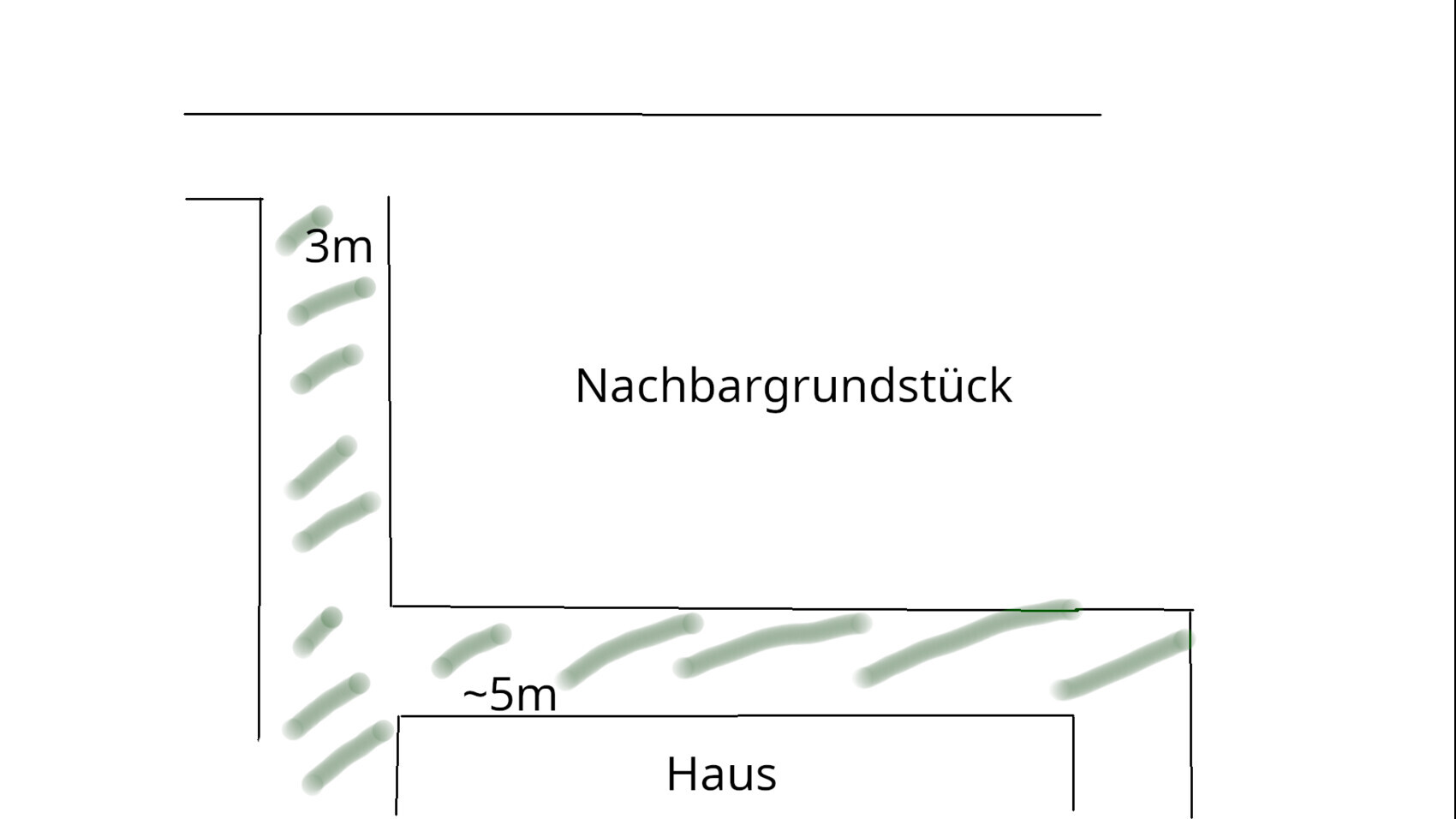
We have been required by the water authority to ensure that the driveway drains through permeable ground.
I have attached a simple sketch.
Originally, we wanted to pave the hatched area, but since this is a drinking water protection zone, this is not allowed.
Do you have any ideas? The only solution I have come up with (which the water authority’s geologist also agreed with over the phone) is to build the driveway itself on permeable ground and then install some kind of grass grid or similar (e.g., plastic).
On the other hand, it seems like it would still sink over time, even though the grid manufacturer claims the load is evenly distributed.
According to online sources, permeable ground requires 30cm (12 inches) of soil before any subbase can start.
We don’t want to end up with waterlogged ground either, but for a narrow walkway (say 60cm (24 inches) wide), the 3m (10 feet) driveway is already almost too narrow.
If we install the walkway and then start the grass grids beside it, the car will very likely drive over the edge between the two surfaces, which might cause settling there.
Do you have any good suggestions on how we could handle this?
Best regards!
BauFuxx schrieb:
that we have to allow infiltration on the driveway through permeable ground.The driveway should allow infiltration?? Or do you mean the driveway should be “permeable,” basically unsealed?
So that it allows water to infiltrate?!
What does “permeable” mean in your context? Did you ask? When I look it up, “permeable” usually refers to high traffic frequency.
BauFuxx schrieb:
On the other hand, it will settle, though,If you have a proper construction, nothing should settle. Where exactly should it settle if the edges are properly secured? BauFuxx schrieb:
We don’t want to get wet feet,Why would you get wet feet? There are surface options like creeping thyme, gravel turf, or grass pavers. You can also combine several types; it doesn’t all have to be uniform or static. In our area, for example, there are modern grass pavers that don’t settle at all. And if the grass gets too long, you can just mow it.
We use gravel ourselves, which is considered unsealed by us. Whether gravel belongs to permeable surfaces or not, I don’t know.
The infiltration of water from the roof, etc., is supposed to be done through a pipe trench (pipe soakaway).
The wording from the water authority is:
"Rainwater from traffic areas (e.g., driveway) may only infiltrate through the active soil zone."
This means that I am not allowed to simply install a drainage system or soakaway under a "plain paved" driveway; instead, the water from the driveway must somehow infiltrate through the active soil zone.
Since there is no space on the left or right, I believe the only option is for the driveway itself to be the "active soil zone." This is what the geologist also said.
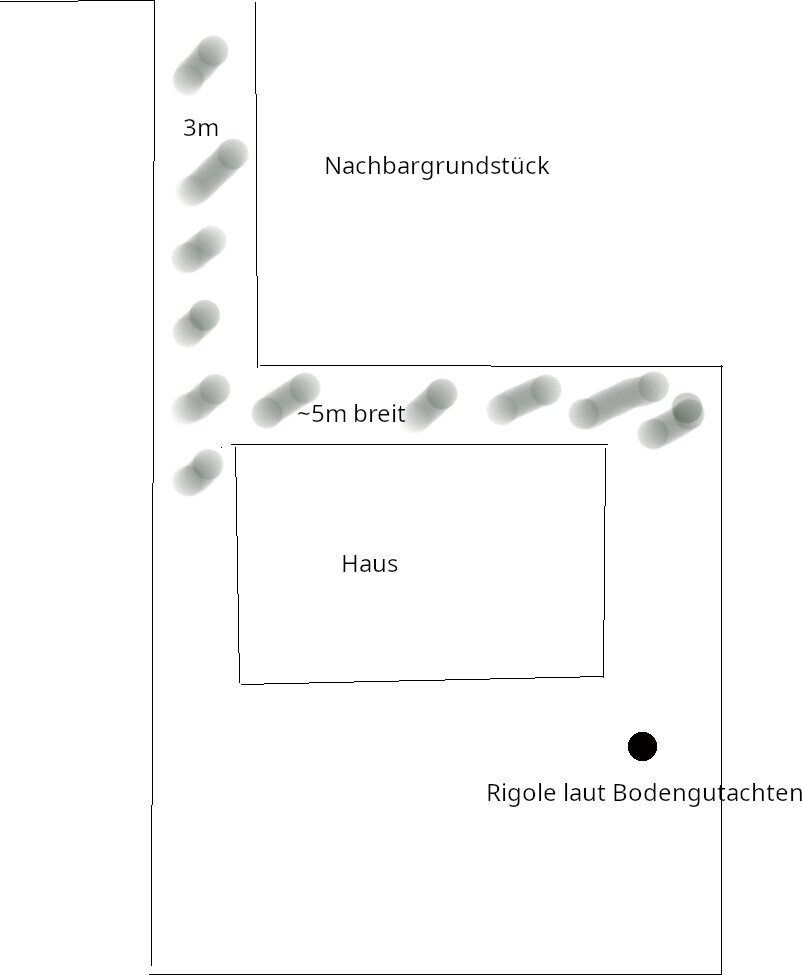
I created a second drawing; the pipe trench (besides being far away from the driveway) is also not approved by the water authority for infiltrating the water from the driveway.
The wording from the water authority is:
"Rainwater from traffic areas (e.g., driveway) may only infiltrate through the active soil zone."
This means that I am not allowed to simply install a drainage system or soakaway under a "plain paved" driveway; instead, the water from the driveway must somehow infiltrate through the active soil zone.
Since there is no space on the left or right, I believe the only option is for the driveway itself to be the "active soil zone." This is what the geologist also said.
I created a second drawing; the pipe trench (besides being far away from the driveway) is also not approved by the water authority for infiltrating the water from the driveway.
BauFuxx schrieb:
“Stormwater from traffic areas (e.g., driveway) may only be infiltrated through the active soil zone.” Oh, that makes a difference.
Stormwater must be drained on one's own property. This is the usual case in most situations.
I don’t know of any property where it’s different or where other methods are allowed.
Infiltration can be done via a soakaway, chamber, or swale. Whether the term “active soil zone” means only a swale is possible, I am not sure.
W
wiltshire1 Aug 2025 22:53If you are concerned about ruts forming, you can have a sub-base layer constructed. This would include geogrid and coarse gravel, about 30-40cm (12-16 inches) thick. On top of that, the base layer made of frost protection material, for example 0-32mm (0-1.25 inches) gravel, again 30-40cm (12-16 inches), compacted in layers. Above that, a bedding layer of approximately 5 cm (2 inches) made from a gravel-chip mix. Finally, a turf reinforcement system can be installed on top.
It is also possible without a sub-base layer if your soil is not heavy clay that doesn’t drain at all.
It is also possible without a sub-base layer if your soil is not heavy clay that doesn’t drain at all.
BauFuxx schrieb:You solve this, as @ypg explains, with an appropriately designed edging. And: turf pavers do not cause wetter feet than regular paving. The “vegetation” does not have to grow very high.
When we build the footpath and start the turf reinforcement grids next to it, it is very likely that cars will drive right over that joint, which could cause it to settle even more.
Similar topics