
ᐅ Floor Plan Feedback Single-Family Home 140 sqm Two Full Stories
Created on: 4 Jul 2025 16:06
M
Milka0105
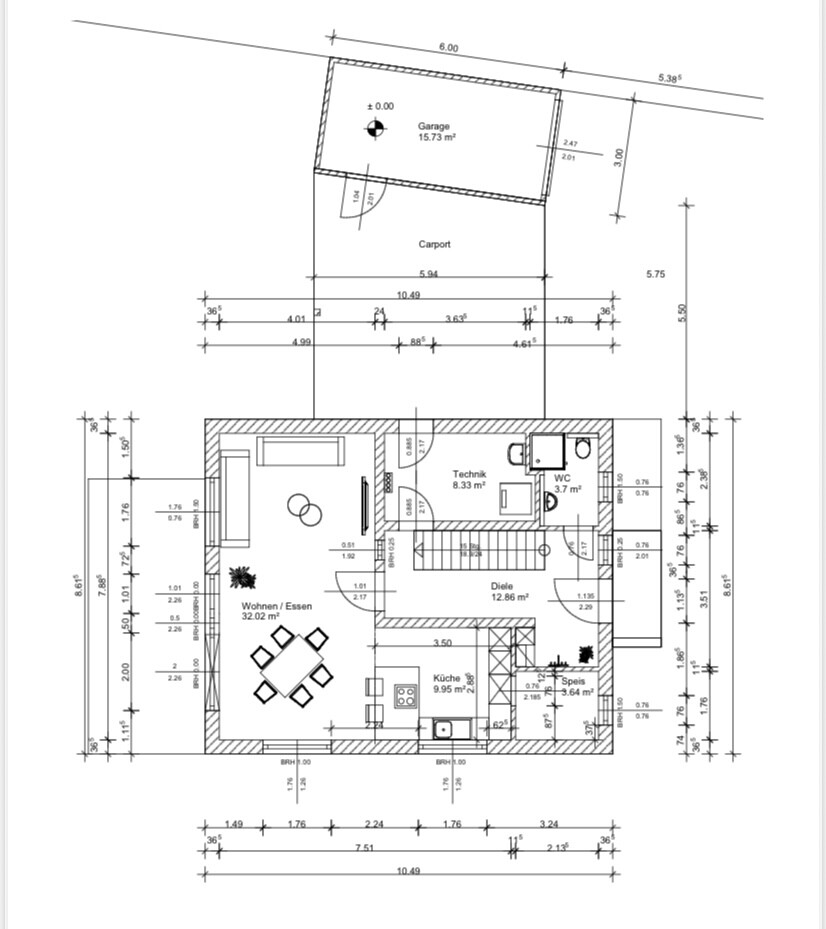
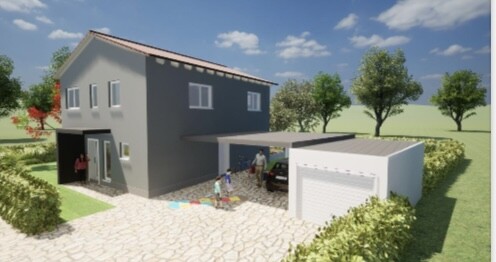
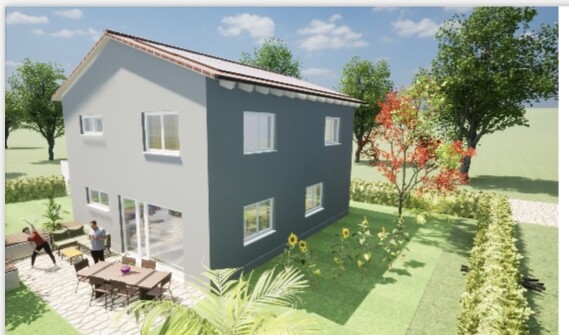
Hello everyone, following my last post about costs and so on, Ant11 suggested that I start with a floor plan here for evaluation. This plan has now existed for quite some time with a few minor adjustments, so the ideas have not changed. I’m looking forward to some feedback.
Development Plan / Restrictions
Plot size 654 sqm (7040 sq ft)
Slope no
Site occupancy index 0.4
Floor area ratio 0.8
Building setback, building line and boundary 3 m (10 ft)
Edge development only garages or carport
Number of parking spaces 2
Number of floors max 2
Roof pitch 0–48 degrees
Style single-family house
Orientation any
Maximum heights / limits 6 m (20 ft) wall and 9 m (30 ft) total
Other requirements cistern
Client Requirements
Style, roof type, building type gable roof
Basement, floors 2
Number of people, age 2 adults and potentially 2 children, currently 1
Space requirements ground floor, upper floor
Office: family use or home office? Both
Guest sleeping per year, if so guests sleep in the children’s rooms
Open kitchen, kitchen island open kitchen
Number of dining seats 1
Fireplace no
Music / stereo wall no
Balcony, roof terrace no
Garage, carport yes
Utility garden, greenhouse possible
Other wishes / special features / daily routine, also reasons why this or that should or should not be included
House Design
Who designed it:
- Initial draft by architect then adjustments with builder/architect
What do you particularly like? Why? Utility room with separate door (mudroom), large pantry
What do you dislike? Why?
Price estimate according to architect/planner: 433k
Personal price limit for the house, including fixtures: 500k
Preferred heating technology: air heat pump and central ventilation system
If you had to give up, which details / extensions
- Could you give up: if push comes to shove, the separate door for the utility room or the pantry could be omitted
- Could you not give up: guest WC with shower
Why did the design turn out the way it did? For example:
Build as small as possible but as large as necessary. The plot becomes wider toward the back.
So, this is a draft after a consultation appointment with the architect. It was then revised again with the builder.
We want a functional home that works for 2 adults and potentially 2 children (1 currently). In addition, we have a dog, but that obviously adapts too (the mudroom is also designed for this).
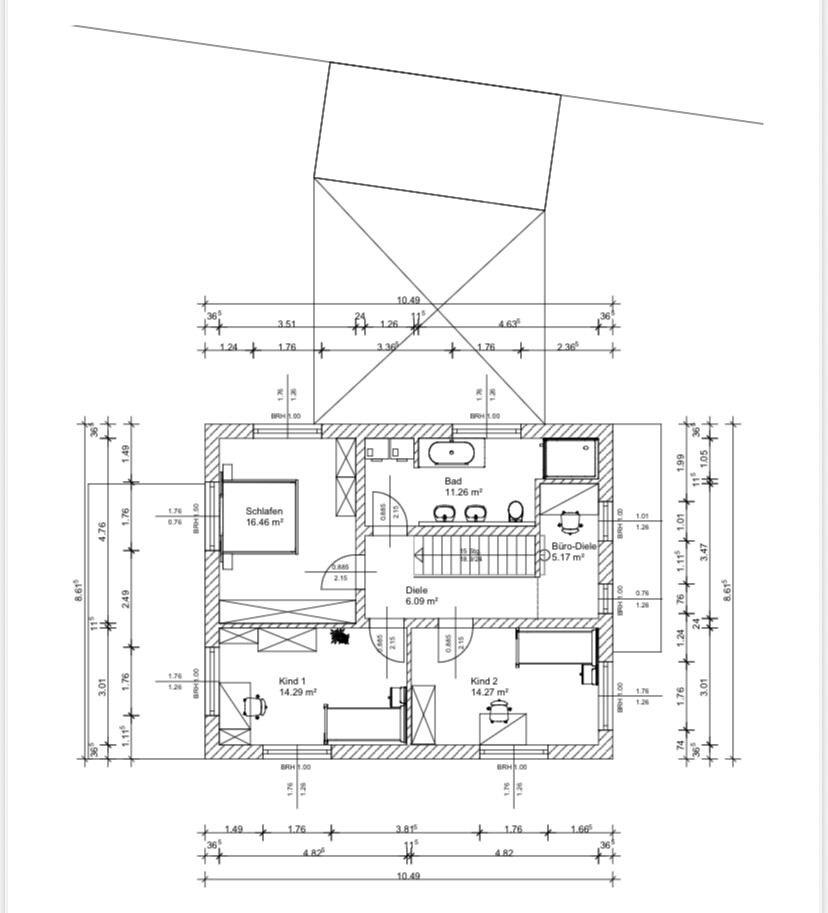
Home office is generally possible and planned. First, we have one child’s room reserved and intended for this purpose. Afterwards, the office niche or the bedroom upstairs. We don’t need much except a quiet place to work.
If all else fails, the pantry will become the office (possibly then accessible from the hallway).
The upstairs bathroom is somewhat elongated due to the narrow building footprint and straight staircase. The washing machine and dryer are shown upstairs and are planned to be there. There are also connections in the utility room. Otherwise, the space upstairs or downstairs will be used for storage.
I look forward to your opinions.
Development Plan / Restrictions
Plot size 654 sqm (7040 sq ft)
Slope no
Site occupancy index 0.4
Floor area ratio 0.8
Building setback, building line and boundary 3 m (10 ft)
Edge development only garages or carport
Number of parking spaces 2
Number of floors max 2
Roof pitch 0–48 degrees
Style single-family house
Orientation any
Maximum heights / limits 6 m (20 ft) wall and 9 m (30 ft) total
Other requirements cistern
Client Requirements
Style, roof type, building type gable roof
Basement, floors 2
Number of people, age 2 adults and potentially 2 children, currently 1
Space requirements ground floor, upper floor
Office: family use or home office? Both
Guest sleeping per year, if so guests sleep in the children’s rooms
Open kitchen, kitchen island open kitchen
Number of dining seats 1
Fireplace no
Music / stereo wall no
Balcony, roof terrace no
Garage, carport yes
Utility garden, greenhouse possible
Other wishes / special features / daily routine, also reasons why this or that should or should not be included
House Design
Who designed it:
- Initial draft by architect then adjustments with builder/architect
What do you particularly like? Why? Utility room with separate door (mudroom), large pantry
What do you dislike? Why?
Price estimate according to architect/planner: 433k
Personal price limit for the house, including fixtures: 500k
Preferred heating technology: air heat pump and central ventilation system
If you had to give up, which details / extensions
- Could you give up: if push comes to shove, the separate door for the utility room or the pantry could be omitted
- Could you not give up: guest WC with shower
Why did the design turn out the way it did? For example:
Build as small as possible but as large as necessary. The plot becomes wider toward the back.
So, this is a draft after a consultation appointment with the architect. It was then revised again with the builder.
We want a functional home that works for 2 adults and potentially 2 children (1 currently). In addition, we have a dog, but that obviously adapts too (the mudroom is also designed for this).
Home office is generally possible and planned. First, we have one child’s room reserved and intended for this purpose. Afterwards, the office niche or the bedroom upstairs. We don’t need much except a quiet place to work.
If all else fails, the pantry will become the office (possibly then accessible from the hallway).
The upstairs bathroom is somewhat elongated due to the narrow building footprint and straight staircase. The washing machine and dryer are shown upstairs and are planned to be there. There are also connections in the utility room. Otherwise, the space upstairs or downstairs will be used for storage.
I look forward to your opinions.
W
wiltshire6 Jul 2025 11:10Milka0105 schrieb:
However, this is a floor plan that we like in the overall context.That is important. It is for me as well, although a few wishes remain unfulfilled.Milka0105 schrieb:
Winter coats are stored in the closet after winter and switched with summer coats in summer. The same goes for winter shoes and summer shoes.Where exactly are these closets located?Milka0105 schrieb:
I just based it on my current living situation and I also grew up in apartments, not in a detached house.Experience is important but should not be taken as guidance. The only real guidance is to consider how you want to live in your house with your family.Milka0105 schrieb:
Honestly, I don’t want to spend thousands of euros again. I see how my floor plan apparently causes problems.If the floor plan causes you problems, go back—that is money well spent. If after careful reconsideration and taking feedback into account the floor plan still doesn’t cause problems for you, then go for it.I want to defend the design here once again—even if much is different from how “one” would normally do things. For me, the reasons are completely understandable, and the balance of priorities relative to the budget also makes sense. In the end, it does not matter whether “one” needs a certain distance to the TV, or “one” prefers entering the garden through the kitchen, or “one” doesn’t like having to go into the pantry to get something. “One” does not live in this house—you and your family do. (“One” has bedrooms. We do not. The so-called multi-purpose room has an extended meaning. We still like it after 6 years. That some people shake their heads about this is irrelevant.)
Office: “Home office” is a broad topic, and the need for quiet and space varies greatly. Therefore, the space requirements differ as well. If this size is sufficient, then it is sufficient. That small rooms can be cleverly and well designed is beyond doubt. Many have expressed that for them it might be too small or too noisy, which @Milka0105 can take into account and assess. If the size remains as planned, it is not a wrong decision.
Kitchen / Pantry: Of course, a kitchen of this size works. Thousands of terraced houses designed for families in recent decades have kitchens of this scale. It gets tight when multiple people want to move around the kitchen simultaneously. Those who see cooking and baking together as an important part of life will set different priorities when building their own home. Everything that is not used often can be stored in the pantry. This creates “traffic routes,” but not for daily occasions. Storing things in the pantry saves money if the storage furniture there can be “simple.” Not every pot, pan, or plate needs to be within arm’s reach at all times. With some thought, I believe the current layout can accommodate a kitchen that looks good and is enjoyable to use. The planning challenge is the clear prioritization by the clients. The design is unusual but not a “mistake.” Still: try thinking through what you want to happen in your kitchen and what you need for that. The description by @ypg is very helpful in that respect. What would annoy me over time is the route groceries have to take from delivery to pantry, which feels like it crosses the whole house.
Space requirements for the staircase: Straight staircases in small houses are often criticized here. If you want a straight staircase, you should build one. In a cost-optimized space, this is a luxury. Recognizing this for yourself and acting accordingly does not mean you are resistant to advice, but that you are in control of your preferences. By the way, a straight staircase without a hallway—that is, located in the so-called “multi-purpose room”—is very space-saving. You have to want that—we wanted it, and it fits very well.
Narrow hallway: A hallway is only too narrow when people and items no longer fit through it to reach the adjoining rooms. Choosing a narrow hallway may not align with common standards regarding the alleged “wasted space” around the staircase. If no change is made here, that is not a “mistake.”
M
Milka01056 Jul 2025 11:35It's not as if we haven't separately considered another proposal because of the straight staircase and the narrow bathroom upstairs.
We also had the idea of a spiral staircase planned. I've attached it as well. We decided against it because the kitchen space is actually limited there, and there is no pantry or additional storage with kitchen cabinets.
Also, the fact that the access goes through the kitchen didn’t fully appeal to us. It wasn't an absolute dealbreaker, but overall it was a concern. Maybe you have some ideas for this floor plan so I can reconsider all these points.
As I said, I’m very grateful for any opinions and would like to build everything as optimally as possible. But in the end, the total area should not exceed 140 square meters (1,507 square feet).
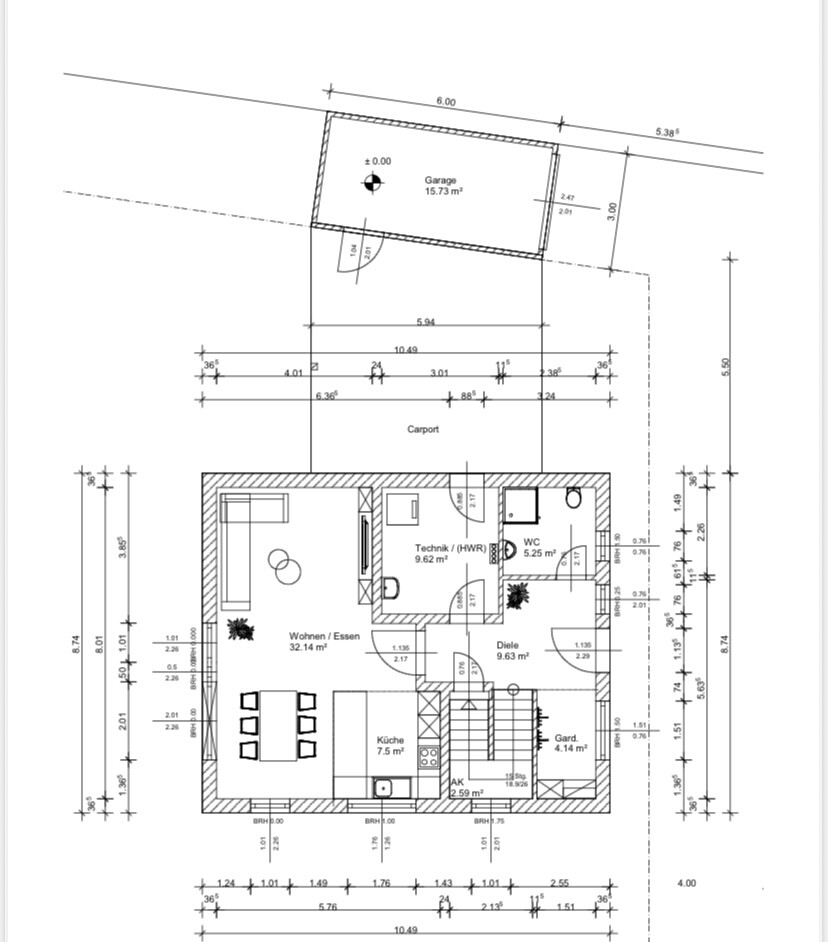
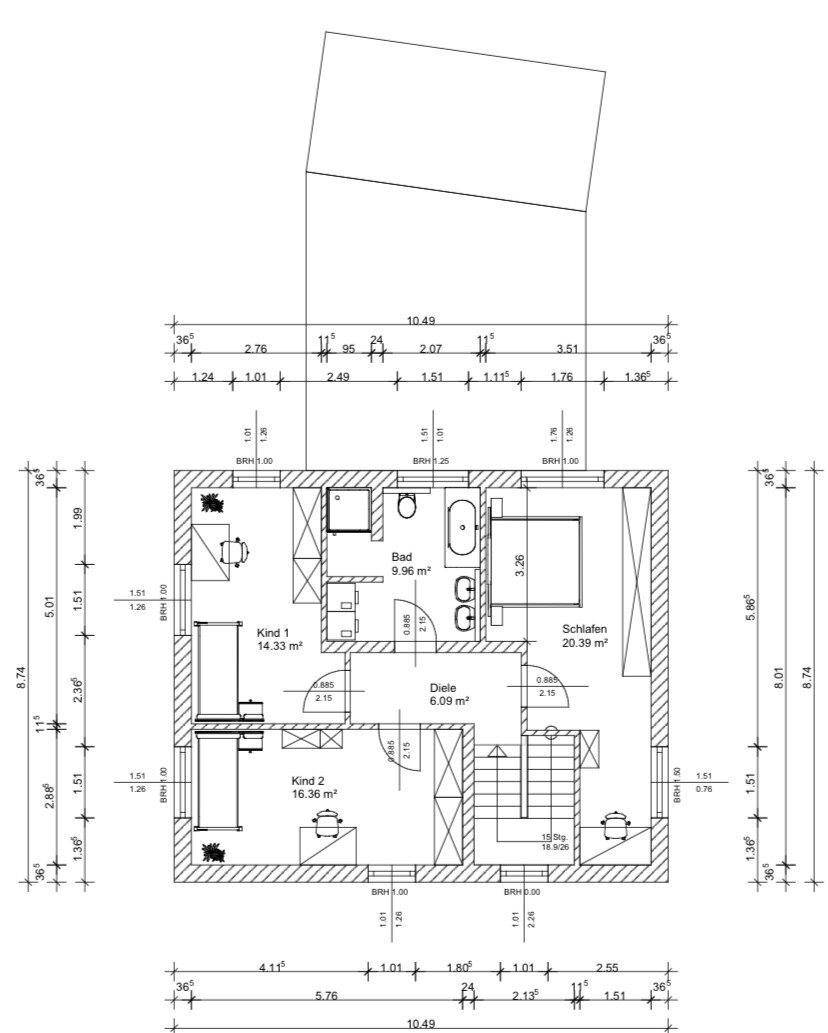
We also had the idea of a spiral staircase planned. I've attached it as well. We decided against it because the kitchen space is actually limited there, and there is no pantry or additional storage with kitchen cabinets.
Also, the fact that the access goes through the kitchen didn’t fully appeal to us. It wasn't an absolute dealbreaker, but overall it was a concern. Maybe you have some ideas for this floor plan so I can reconsider all these points.
As I said, I’m very grateful for any opinions and would like to build everything as optimally as possible. But in the end, the total area should not exceed 140 square meters (1,507 square feet).
M
Milka01056 Jul 2025 11:41wiltshire schrieb:
This is important. It is for me as well, although some wishes remain unfulfilled.
Where exactly are these cabinets located?
Experience is important but not a reliable guide. The only real guidance comes from considering how you want to live with your family in your home.
If the floor plan causes you problems, go back. That's money well spent. If, after careful review and considering all input, the floor plan still doesn’t cause any issues – go for it.
I want to defend the design here once more – even though many things differ from common approaches. The reasons behind it are completely understandable to me and the balance of priorities relative to the budget makes sense. In the end, it doesn’t matter whether you “need” a certain distance to the TV or whether you prefer to enter the garden through the kitchen or dislike having to run through a pantry to get something. It’s not “one” who lives in this house but you and your family. (“One” has bedrooms. We don’t. The so-called open-plan room has an extended meaning. We still like that after six years. That some people shake their heads is irrelevant.)
Study / Home Office: “Home office” covers a wide range of needs, and the demand for quiet and space varies greatly. Consequently, space requirements differ. If this size suffices, then it is sufficient. There should be no doubt that even small rooms can be cleverly and well designed. Many have expressed that it would be too small or noisy for their purposes; this feedback can be received and considered by @Milka0105. If this layout is kept, it is not a wrong decision.
Kitchen / Pantry: Of course, a kitchen of this size works. Thousands of terraced houses built for families over recent decades have kitchens in this range. It becomes tight as soon as multiple people want to move around the kitchen simultaneously. Those who see cooking and baking together as an important part of life will set different priorities when building their own home. Everything not used frequently can be stored in the pantry. This does create “traffic routes,” but not for everyday occasions. Using the pantry saves money if the storage furniture there can be “simple.” Not every pot, pan, or plate needs to be within arm’s reach. With some clever planning, I believe that the existing layout can accommodate a kitchen that looks good and is enjoyable to use. The design challenge lies in clearly prioritizing the client’s requirements. The plan is unusual but not a “mistake.”
Still: Run through what you want to do in your kitchen and what you need for it. The description provided by @ypg is very helpful. What would annoy me over time is the route groceries must take from shopping right through the house to reach the pantry.
Staircase space requirements: Straight stairs in small houses are often criticized here. If you want a straight staircase, you should build one. In a cost-optimized space, it is a luxury. Those who accept and act on this are not ignoring advice but are masters of their own preferences. By the way, a straight staircase without a hallway—i.e., located in the so-called open-plan room—is very space-saving. You have to want this – we did, and it fits very well.
Narrow hallway: The hallway is only too narrow if people and things cannot pass through to the adjacent rooms. Choosing a narrow hallway may not align with usual standards that consider the staircase area as “wasted space.” If no changes were made here, it is not a “mistake.” Thank you for your input. I will review the points again as I have done with the other comments and then decide if this works for us as a family. Thanks again!
Even more than the kitchen, the narrow bathroom upstairs is a bit concerning. A 1–1.15m (3 ft 3 in–3 ft 9 in) passage between the bathtub and the washbasin could feel tight. What is your opinion on this?
W
wiltshire6 Jul 2025 11:55Milka0105 schrieb:
We also had the idea of a spiral staircase planned. I’ve attached it as well. Thanks!
You can see from the room dimensions that the spiral staircase really saves space and allows more room to move in the hallways. This design is much more practical.
Still, I would prefer the one with the straight staircase. I find it much more aesthetically pleasing.
Milka0105 schrieb:
It might feel tight; what’s your opinion on that? With the 1.15m (3 ft 9 in), it often happens in daily family life that someone needs to step aside. I don’t see that as a problem. The few kid quarrels caused by this happen elsewhere anyway. “Tight” isn’t really my concern; it’s more about how I would furnish the room so that I’d enjoy being there. Probably, it would be enough for me to place a half-height wall next to the toilet and instead of two separate sinks, use a vanity with a shallow, wide basin where two people can stand side by side. There are models that allow a bit more space for passing through.
wiltshire schrieb:
Study: "Home office" is a broad concept, and the need for quiet and space varies greatly. Consequently, the space requirements differ as well. If the size is sufficient, then it works. There’s no doubt that even small rooms can be designed cleverly and effectively. This is an open area in the hallway outside the children’s rooms. I can’t really see it as ideal if you are doing proper home office work.
------------
Regarding the other plan... that is a landing staircase, not a spiral staircase.
I also find the kitchen too small there, especially since the dimensions towards the dining table are not clearly drawn and really crowd the dining area.
There is now a home office corner in the master bedroom. But I wouldn’t consider that the ideal location either, since bedrooms are usually kept at cooler temperatures between 15 and 20°C (59 and 68°F), whereas in winter you would probably prefer 21 or 22°C (70 or 72°F) when working at the home office. That’s something to keep in mind.
In general, I notice the sofa is always positioned so you can definitely see the kitchen 😉.
And clearly, you always have to weigh your own preferences against the shared experiences, and maybe think a little further.
For example, I like the approach that I think @11ant mentioned. Take your current apartment or house plan and first mark everything you no longer want in the future. That’s how I approached the floor plan of my "new" apartment, which I was able to help design quite freely. What I wanted to avoid:
- Washing machine ideally neither in the kitchen (an absolute no-go) nor in the bathroom if possible.
- Washing machine positioned so that small items can also be dried nearby right after washing.
- Vacuum cleaner/mop etc. no longer stored in the niche behind the bedroom. With two floors, having one vacuum cleaner per floor is a must.
- Home office space that allows closing the door, with enough room for two large monitors, a printer, business documents, and all my personal files. Important: be able to hold video conferences undisturbed.
- Storage space for supplies (eventually a combined utility room for washing machine, vacuum, and supplies).
- Sufficient closet space to avoid stacking everything and struggling to reach T-shirts and similar at the bottom. For me, only underwear, socks, and sweaters are folded; everything else is hung.
- Space to store off-season jackets, scarves, and hats so they do not clutter the coat area.
- Appliances such as a food processor, fully automatic coffee machine, ice cream maker — all used frequently — to be stored in the kitchen so they can be used immediately without having to move them first.
- Kitchen close to the terrace, simply a short path in summer.
- Etc... just create a personal list.
-------------------
Regarding the bathroom question:
The rough structural dimension is 238 cm (94 inches), so let’s assume 235 cm (93 inches).
I think you will need a small half-wall against the stairwell on the lower side of the plan. The half-wall plus the vanity will be about 60 to 65 cm (24 to 26 inches).
The bathtub, if nicely installed, I’d estimate to be about 75 to 80 cm (30 to 31 inches).
That’s a total of approximately 145 cm (57 inches) in an extreme case, leaving a passage of 90 cm (35 inches). That should be sufficient; doorways are generally not wider either.
However, I don’t like the tube-like layout. And I always prefer side lighting at the vanity.
kbt09 schrieb:
but also without cabinets etc., so that the full width of 120cm (47 inches) is available. I still find that too narrow. A front door has installation dimensions of about 111cm (44 inches). This narrow entrance area feels wasted to me because a console table or cabinet also needs clearance space in front, which you then have to create again somewhere else in the house. I really don’t like that at all. As a family or in everyday use, do you then have to repair those worn walls every year? But that’s just my taste; I’m only speaking from a neutral perspective.
kbt09 schrieb:
Unfortunately, your floor plan does not have a north arrow, and the exact plot dimensions and boundaries are also not shown. I would have liked to see the entire plot too, @Milka0105. It’s difficult to be constructive when key data is missing.
wiltshire schrieb:
Kitchen / pantry: Of course, a kitchen this size works. Thousands of townhouses built for families over the past decades have kitchens of this scale. I also had a functional townhouse kitchen, but here we are not planning a townhouse kitchen. Instead, a single-family house kitchen is squeezed into townhouse size by leaving out one row of cabinets.
Milka0105 schrieb:
Narrow bathroom upstairs gives me a headache. A 1 to 1.15m (3'3" to 3'9") passage between bathtub and washbasin could feel cramped. I already commented on that at the beginning.
I question the whole concept: if there is supposed to be such a large covered area between garage and house, then that would also be an excellent place for an entrance!
The optimal access is from the long side so the hallway doesn’t need to be so long. Then a typical quarter-turn staircase upstairs, which is well positioned to save space. Here is an example that can of course be modified without the study room, according to needs. So it’s (almost) only a matter of the staircase.
Or here, a staircase arrangement for narrow houses (note, this example has only 126sqm (1,356 sq ft) of living space, so there is even more potential).
wiltshire schrieb:
That the spiral staircase really saves space. I just can’t understand how in 140sqm (1,507 sq ft) for a family, a hallway is needed but the staircase is drawn in with the ones that take most space. A landing staircase consumes unnecessary space and again forces approximately 3 meters (10 feet) sideways. Only here is a nice coat area drawn.
Similar topics