
Hello,
I have been reading along for some time now and finally dare to share a floor plan here.
First, here is the list of questions:
Zoning Plan / Restrictions
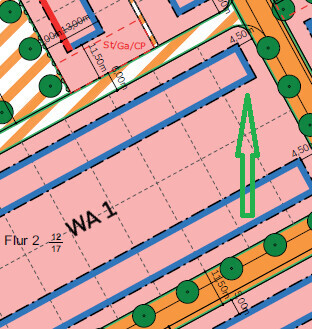
Plot size: 576 sqm (6,200 sq ft)
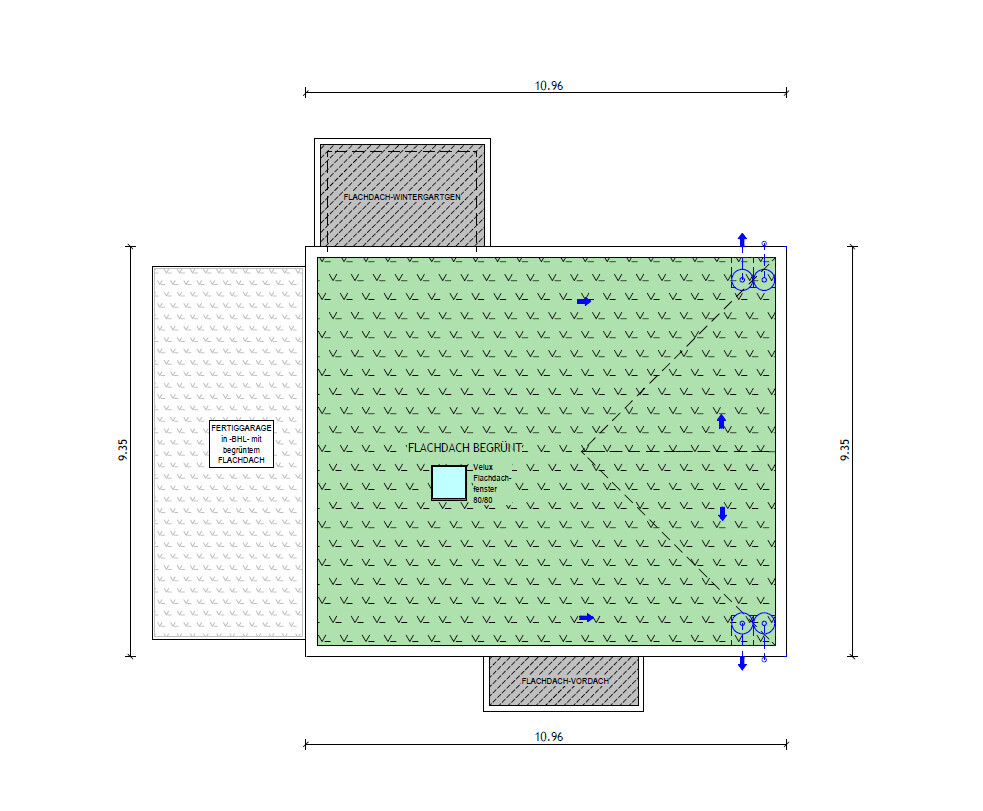
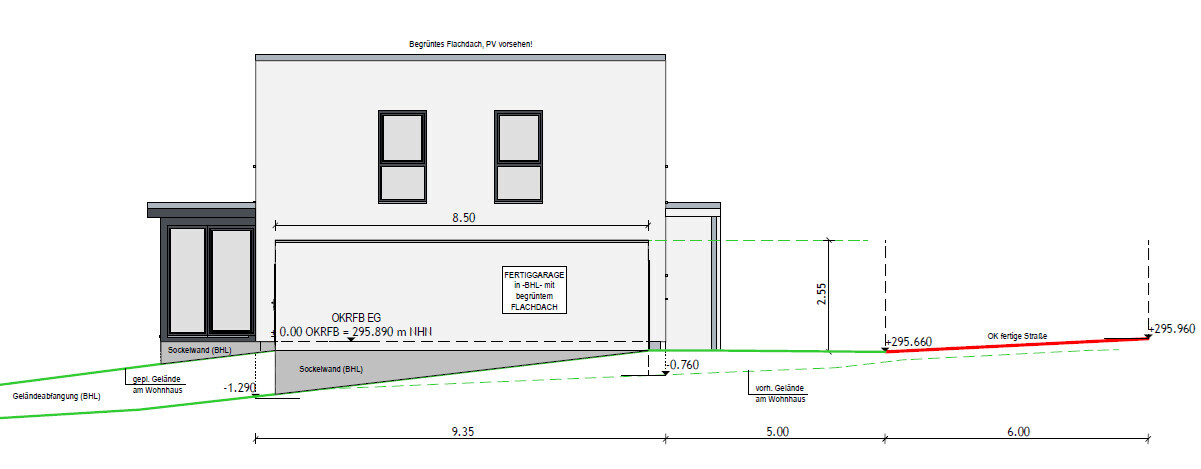
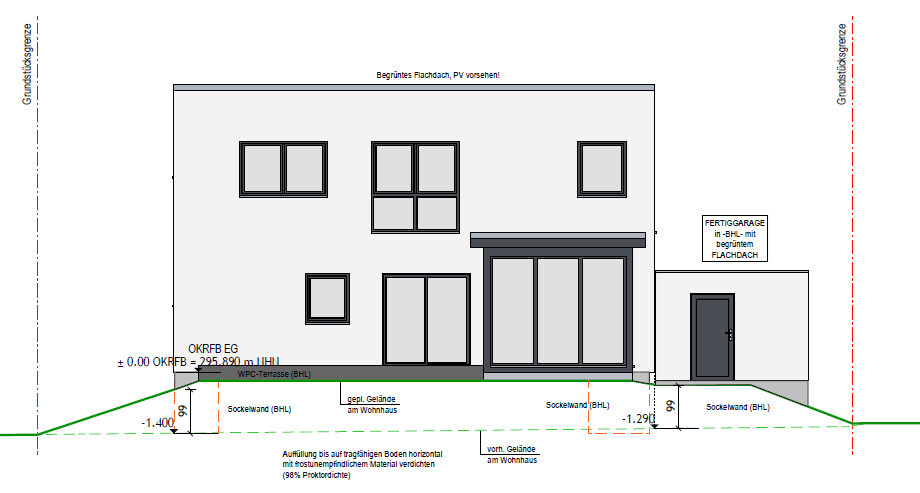
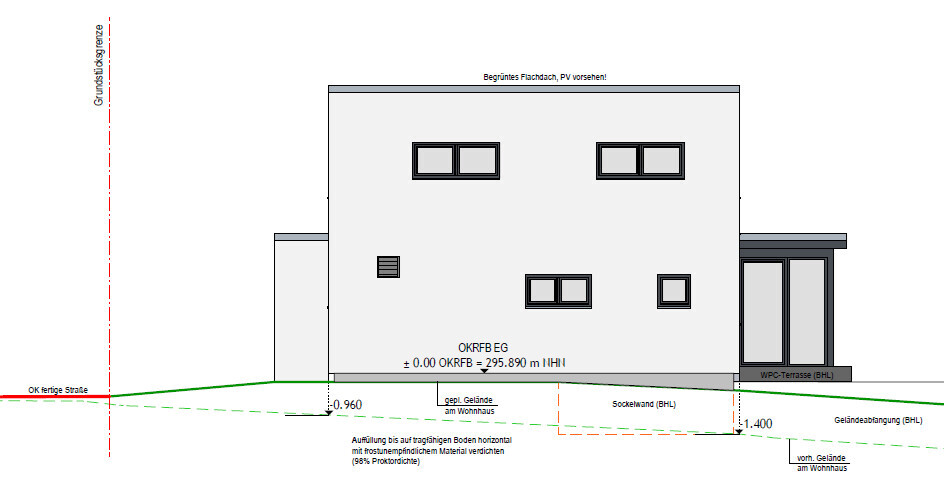
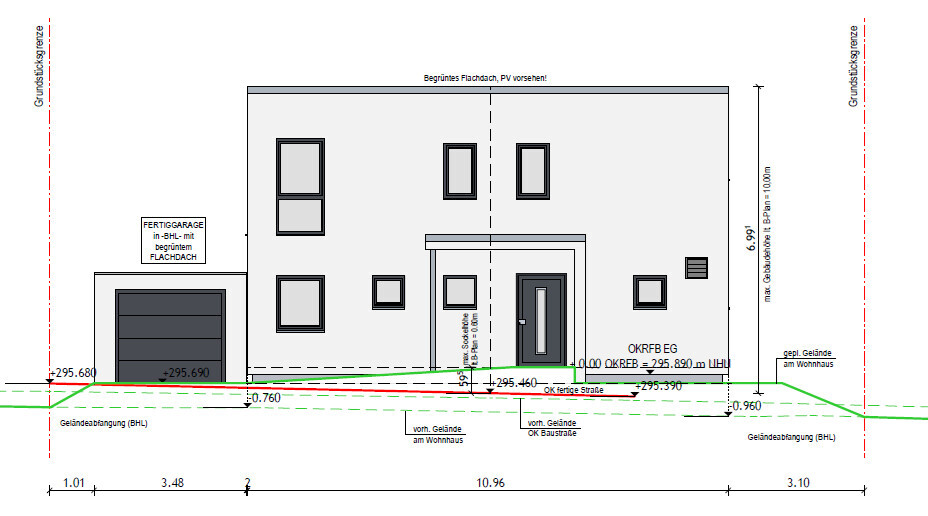
Slope: Yes, slight. According to the site plan, the top "right" corner is at 295.4 meters (970 feet), lower at 293.88 meters (964 feet), left side goes from 295.17 meters (968 feet) to 293.43 meters (963 feet)
Floor area ratio: 0.3
Building envelope, building line and boundary: Applies to house number 16
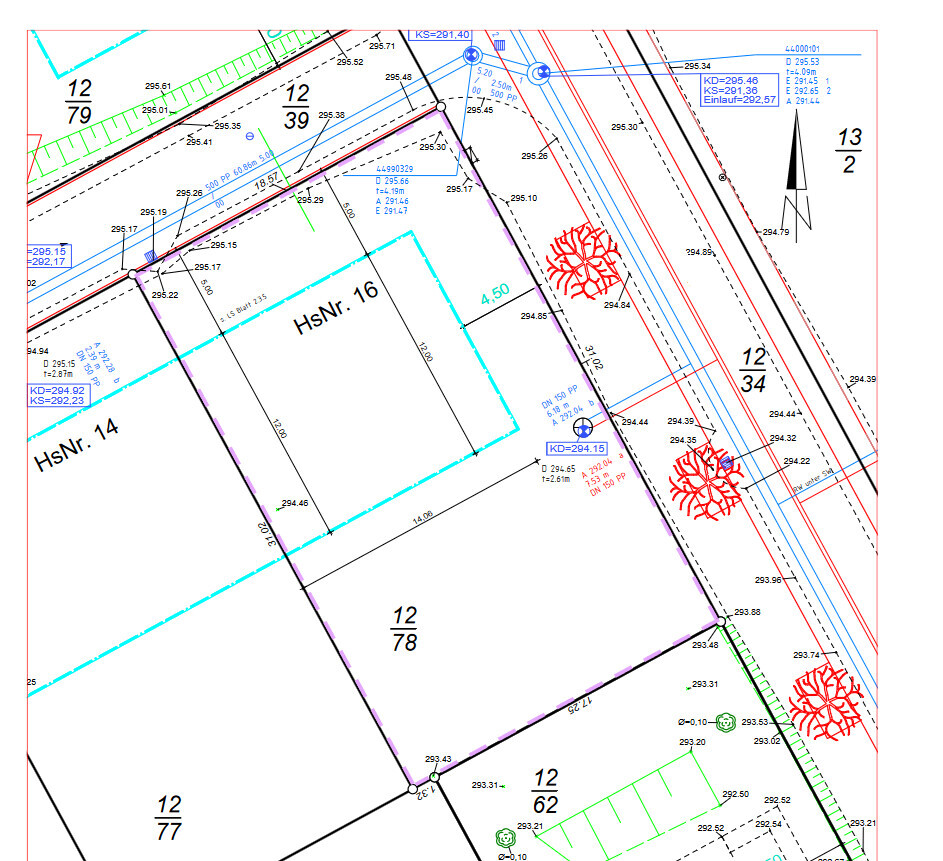
Surrounding buildings
Number of parking spaces: 2
Number of stories: 2 full floors required, plus optional recessed floor (setback floor)
Roof type: Flat roof, max. 5° pitch
Maximum height/limits: Max. 10 m (33 ft) high
Additional requirements: Equipment (heat pump) must be integrated, not external. Maximum of 2 residential units. Specific exterior colors required, rainwater should infiltrate (soil report says this is unlikely). Roofs must be greened. No oil or gas heating allowed.
Client requirements
Style, roof type, building type: Actually, none specified.
Basement, floors: No basement, 2 floors.
Number of occupants, ages: 4 people — 2 adults, 2 children
Ground floor space needs: Daily life (living, kitchen, dining, technical room, guest room)
Upper floor: Family (2 children's rooms, master bedroom, separate bathrooms), home office
Office: Home office, second workspace for occasional use such as a work window sill for example in the bedroom
Guests per year: Currently few.
Open or closed architecture, conservative or modern style: Either is fine.
Open kitchen, kitchen island: We are still considering. Initial wish was separate pantry like in the floor plan. An island would be nice if space allows.
Number of dining seats: Normally 4, rarely up to 8.
Fireplace: None.
Music/stereo wall: Multi-room audio with central unit in technical room.
Balcony, roof terrace: Neither.
Garage, carport: 1 garage
Other wishes: Central vacuum system, laundry chute, smart home (KNX) (I am mostly doing this myself, yes, I am a certified electrician, can program, but will also get additional help)
House design
Who designed the plan:
- Planner from a construction company: Correct, with some input from us. Based on an existing plan.
Price estimate by architect/planner: approx. 485,000 € (euros) for the house, approx. 210,000 € for the plot including basic services (survey, soil report, etc.)
Personal price limit for the house including features: approx. 800,000–850,000 € (including land)
Preferred heating technology: Heat pump
If you had to give up, which details/extra features could you skip:
- Could skip:
- Cannot skip:
Why is the design like it is now? For example:
Standard design by the planner? Yes, with minor wishes from us (wall between study and child’s room 2, T-walls in bathrooms, porch roof, conservatory, pantry)
What do you find especially good or bad about it? So far it seems to fit; apart from possibly the pantry/dining room, we don’t see major issues yet. But that’s why I’m here now.
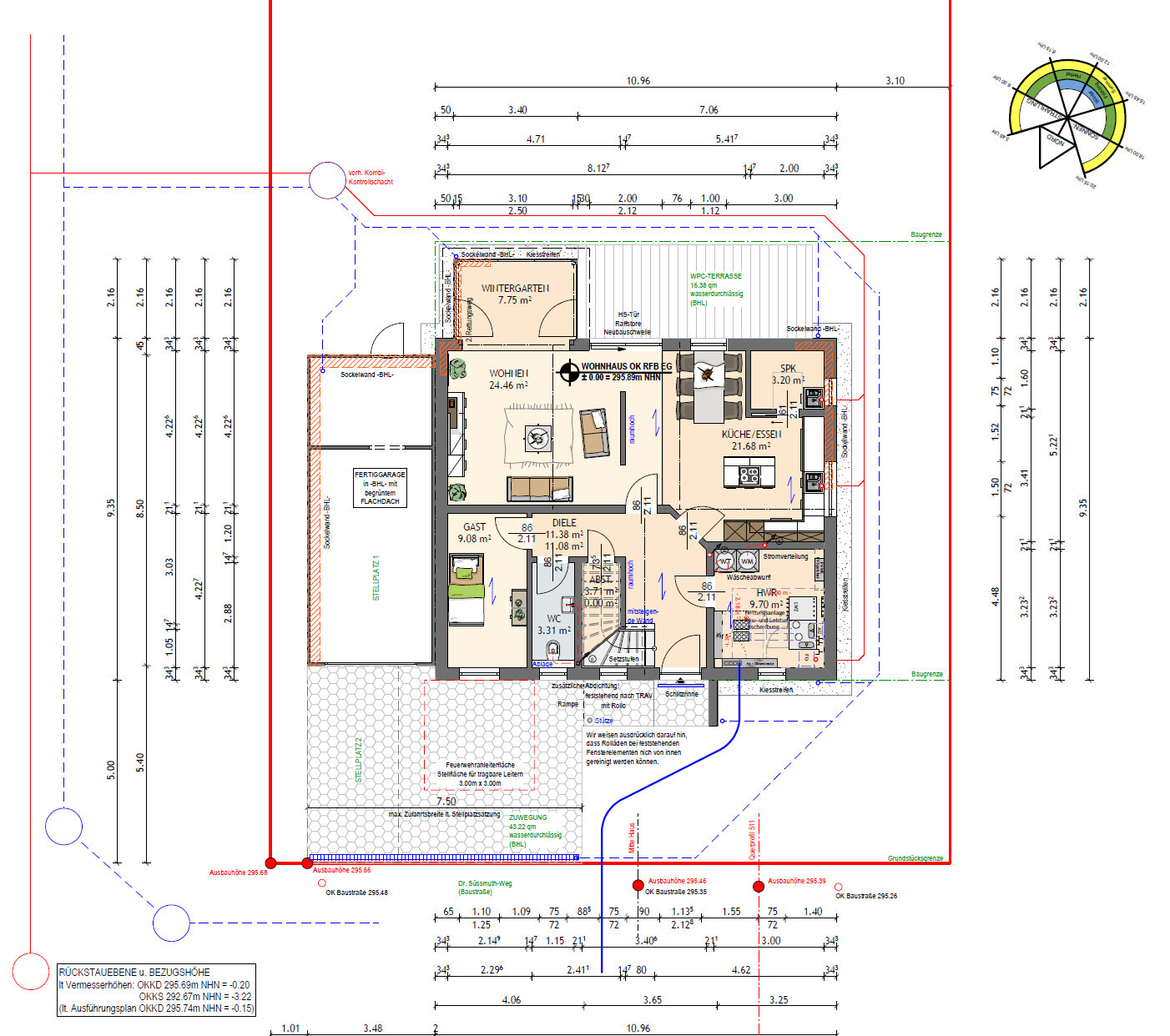
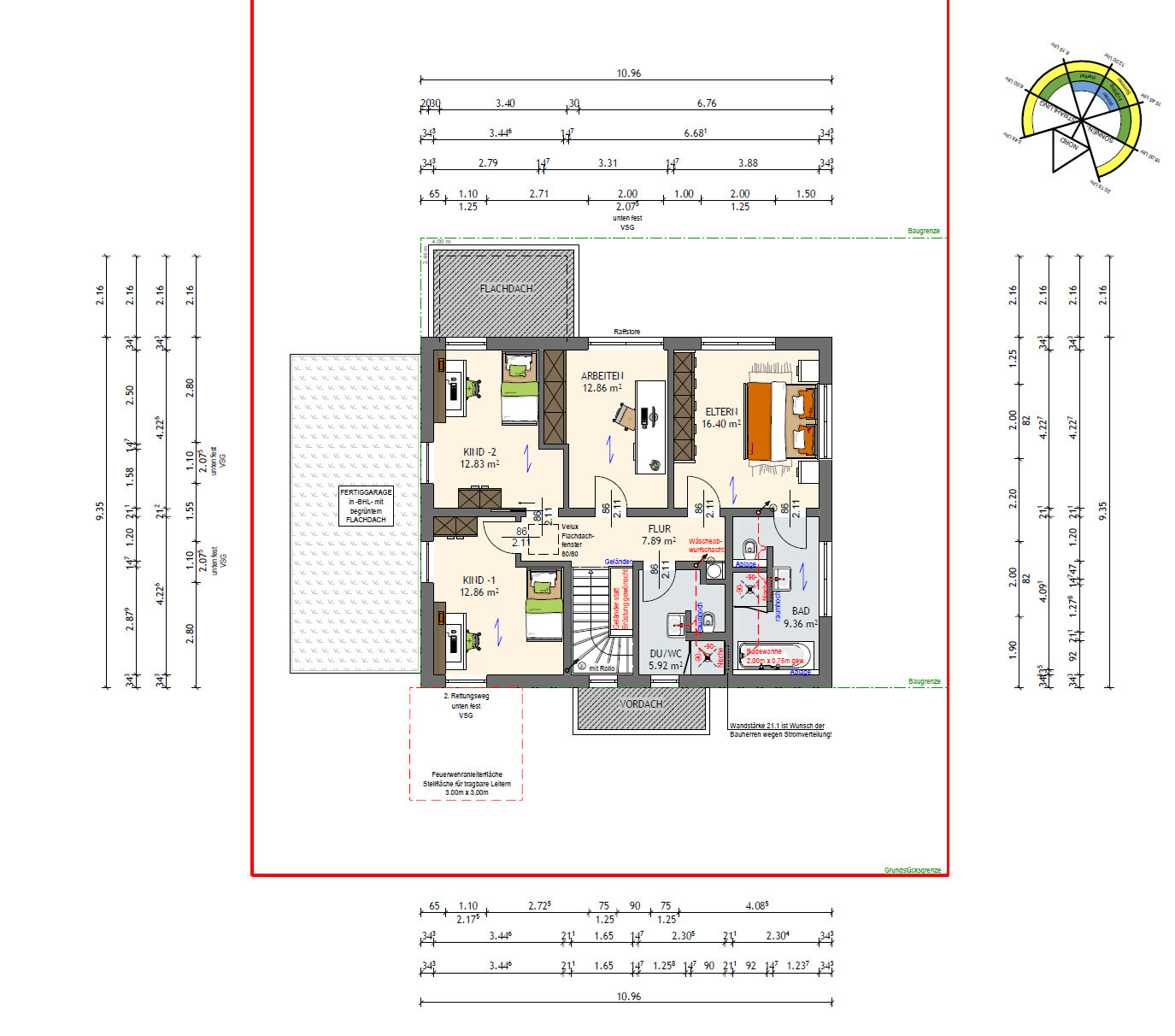
Edit: The furniture shown in the floor plans can be safely ignored. Planners seem to like adding these.
Best regards
Ganneff
I have been reading along for some time now and finally dare to share a floor plan here.
First, here is the list of questions:
Zoning Plan / Restrictions
Plot size: 576 sqm (6,200 sq ft)
Slope: Yes, slight. According to the site plan, the top "right" corner is at 295.4 meters (970 feet), lower at 293.88 meters (964 feet), left side goes from 295.17 meters (968 feet) to 293.43 meters (963 feet)
Floor area ratio: 0.3
Building envelope, building line and boundary: Applies to house number 16
Surrounding buildings
Number of parking spaces: 2
Number of stories: 2 full floors required, plus optional recessed floor (setback floor)
Roof type: Flat roof, max. 5° pitch
Maximum height/limits: Max. 10 m (33 ft) high
Additional requirements: Equipment (heat pump) must be integrated, not external. Maximum of 2 residential units. Specific exterior colors required, rainwater should infiltrate (soil report says this is unlikely). Roofs must be greened. No oil or gas heating allowed.
Client requirements
Style, roof type, building type: Actually, none specified.
Basement, floors: No basement, 2 floors.
Number of occupants, ages: 4 people — 2 adults, 2 children
Ground floor space needs: Daily life (living, kitchen, dining, technical room, guest room)
Upper floor: Family (2 children's rooms, master bedroom, separate bathrooms), home office
Office: Home office, second workspace for occasional use such as a work window sill for example in the bedroom
Guests per year: Currently few.
Open or closed architecture, conservative or modern style: Either is fine.
Open kitchen, kitchen island: We are still considering. Initial wish was separate pantry like in the floor plan. An island would be nice if space allows.
Number of dining seats: Normally 4, rarely up to 8.
Fireplace: None.
Music/stereo wall: Multi-room audio with central unit in technical room.
Balcony, roof terrace: Neither.
Garage, carport: 1 garage
Other wishes: Central vacuum system, laundry chute, smart home (KNX) (I am mostly doing this myself, yes, I am a certified electrician, can program, but will also get additional help)
House design
Who designed the plan:
- Planner from a construction company: Correct, with some input from us. Based on an existing plan.
Price estimate by architect/planner: approx. 485,000 € (euros) for the house, approx. 210,000 € for the plot including basic services (survey, soil report, etc.)
Personal price limit for the house including features: approx. 800,000–850,000 € (including land)
Preferred heating technology: Heat pump
If you had to give up, which details/extra features could you skip:
- Could skip:
- Cannot skip:
Why is the design like it is now? For example:
Standard design by the planner? Yes, with minor wishes from us (wall between study and child’s room 2, T-walls in bathrooms, porch roof, conservatory, pantry)
What do you find especially good or bad about it? So far it seems to fit; apart from possibly the pantry/dining room, we don’t see major issues yet. But that’s why I’m here now.
Edit: The furniture shown in the floor plans can be safely ignored. Planners seem to like adding these.
Best regards
Ganneff
Arauki11 schrieb:
There are always little critters, cobwebs, etc., in any garage (non-living space), which you don’t really want to be in constant contact with. But you do get spiders in basements as well.
Arauki11 schrieb:
A garage tends to smell like oil/gasoline and can get dusty as well. Yay, electric only, no combustion engine will ever come into the garage. That old technology just isn’t fun to drive anymore.
ypg schrieb:
This is about suitcases for holidays, for example. But I admit: the alternative is no holiday at all. Hey, we’re building a house. Holiday? What’s that supposed to mean?
(Okay, okay, kids’ school trips, club stuff, and things like that, I know).
In terms of space, we (initially) have the advantage that we’re moving from an apartment including a cellar room that is only about half the size of the new house. Since we’ve already marked quite a few things as “to be disposed of” (by whatever means) and otherwise make sure that the (limited, yes, compared to, for example, a large cellar) storage space roughly matches what we had before, the start of storing our stuff should work out.
Actually, I planned to keep suitcases in the garage space regardless of which car is parked there — they will simply go into a large plastic bag for protection, so I don’t really mind the critters in that case.
Ganneff schrieb:
You do get spiders in basements as well.Will you have a basement? Also, there is a difference between inside the house and outside.
I personally also prefer not to accumulate and rarely buy things; my advice was solely meant to honestly address personal preferences.
Ganneff schrieb:
Yay, electric only, there will never be a combustion engine in the garage. That old technology really isn’t fun to drive anymore.We don’t have one either, yet the smell in a garage is always different than inside the living area (at least it should be). Outside there are shovels with soil, used buckets, open bags with various contents, and much more. No one here is trying to convert you—if everything is clear to you, then that’s fine. I just thought that mentioning these things might be helpful before someone else forgets about them and wishes they had been reminded earlier. When I was building my house, I always checked what I might need from such tips or what I might have overlooked or underestimated.
Ganneff schrieb:
I know)...you can tell, lucky you.W
wiltshire29 Jun 2025 13:16@Ganneff: Don’t worry about having little storage space. You seem confident (based on your electrical planning) and ready to accept the consequences of your decision. We manage very well with very little storage. Of course, our lifestyles are not directly comparable, but I can assure you that we don’t live “sparsely.”
Then why do you call it “stuff”?
Regarding “suitcases” – that depends on the type of vacation, number of people, and travel frequency. Personally, I wouldn’t dedicate a single square meter for several thousand euros just to store suitcases. Not even traveling without suitcases is our main reason – you can easily rent or borrow suitcases, or use space-saving travel bags instead. There are also suitcase systems designed to nest inside each other, saving lots of space.
When we moved into the new house, we gave away all but one suitcase in IATA size for my business trips. We haven’t missed them a single day in six years.
That was how it was for us when moving from an apartment to our first house. We simply took a lot with us because there was so much more space. Sorting things out felt like a major task, yet there were boxes that weren’t unpacked for the entire following 18 years. When we moved again, I disposed of those boxes unopened.
ypg schrieb:
This is about suitcases, for example for vacations. But I admit: the alternative is no vacation 😉
Then why do you call it “stuff”?
Regarding “suitcases” – that depends on the type of vacation, number of people, and travel frequency. Personally, I wouldn’t dedicate a single square meter for several thousand euros just to store suitcases. Not even traveling without suitcases is our main reason – you can easily rent or borrow suitcases, or use space-saving travel bags instead. There are also suitcase systems designed to nest inside each other, saving lots of space.
When we moved into the new house, we gave away all but one suitcase in IATA size for my business trips. We haven’t missed them a single day in six years.
chand1986 schrieb:
Nowadays, I can only guess what was left unpacked.
That was how it was for us when moving from an apartment to our first house. We simply took a lot with us because there was so much more space. Sorting things out felt like a major task, yet there were boxes that weren’t unpacked for the entire following 18 years. When we moved again, I disposed of those boxes unopened.
Arauki11 schrieb:
Are you going to have a basement? It doesn’t look likely at the moment. I did ask for an estimate (from those who will be doing my foundation and base walls anyway, so they know the conditions well enough to give a rough figure), but from everything I know so far, it’s probably not within the budget. Even if I made the house a bit smaller to accommodate it.
Arauki11 schrieb:
We don’t have one either, but the air in a garage always smells different than inside the living area (at least it should). Outside, there are wheelbarrows with soil, used buckets, open bags with various contents and much more. Yes, of course.
Arauki11 schrieb:
No one here wants to preach to you. If you understand everything already, then that’s fine. On the contrary: I appreciate all the input here. There are plenty of things that you might not have considered beforehand, and quite a few are already in my notes for selection, inspection, and other upcoming stages. (Not just from this thread alone.)
Arauki11 schrieb:
...you can tell, lucky you. ?

Ganneff schrieb:
It doesn’t look likely at the moment. I did ask for a rough estimate once (from those who will be doing my foundation/the base walls anyway, so they know the conditions and could quickly give a guideline), but based on everything I know so far, it’s probably not within budget. Even if I were to make the house a bit smaller for that. A basement is economically either necessary or not, according to the 11ant basement rule (a result of my experience, not an opinion), which indicates the balance between what is sensible and what is a luxury in each specific case. Making the house smaller to fit the budget would be complete nonsense. The part that can be reduced – and only to cover the needs already satisfied by the basement level – is the “above-ground portion” of the house. If the site-related measures for underpinning the ground floor are limited to the corner jack posts shown, I see no economically justified or required basement here. Is the rule still so widely misunderstood that I have to keep explaining it?
The basement question must fundamentally be answered first before translating the spatial requirements into a building design in design phase 2!
https://www.instagram.com/11antgmxde/
https://www.linkedin.com/company/bauen-jetzt/
[A cellar is economically either necessary or not, based on the “11ant cellar rule” (a result of my experience, not an opinion), which helps determine the specific mix of essential and luxury features in each individual case. Making a house smaller just to fit a budget would be completely illogical. What you reduce— and even then only to cover needs already met in the basement— is the “above-ground part” of the house. If the terrain-related measures for underpinning the ground floor are limited to the corner raisings shown, I see no economically justified or even necessary reason for a cellar here. Is the rule still so widely misunderstood that I have to keep explaining it?
The cellar question fundamentally needs to be answered before, in design phase 2, the space requirements are translated into a building form!]
Among other reasons, due to this rule (yes, I know it), I am fairly certain there will be no cellar because it would be comparatively too expensive. But since the foundation walls were added and *I* do not even remotely know the price lists, I asked what the costs for the cellar would be (previous figures were very rough estimates not provided by the cellar builder) to make sure it would still come out as “too expensive.” Otherwise, I would regret for years not having asked.
And I am not talking about “fitting the budget” here, but purely that what moves from top to bottom (all the technical installations, possibly a home office, etc.) can then be omitted from above, making the above-ground part smaller and thereby reducing the gross floor area somewhat, yet maintaining the same functional utility.
The cellar question fundamentally needs to be answered before, in design phase 2, the space requirements are translated into a building form!]
Among other reasons, due to this rule (yes, I know it), I am fairly certain there will be no cellar because it would be comparatively too expensive. But since the foundation walls were added and *I* do not even remotely know the price lists, I asked what the costs for the cellar would be (previous figures were very rough estimates not provided by the cellar builder) to make sure it would still come out as “too expensive.” Otherwise, I would regret for years not having asked.
And I am not talking about “fitting the budget” here, but purely that what moves from top to bottom (all the technical installations, possibly a home office, etc.) can then be omitted from above, making the above-ground part smaller and thereby reducing the gross floor area somewhat, yet maintaining the same functional utility.
Similar topics