
Hello,
I have been reading along for some time now and finally dare to share a floor plan here.
First, here is the list of questions:
Zoning Plan / Restrictions
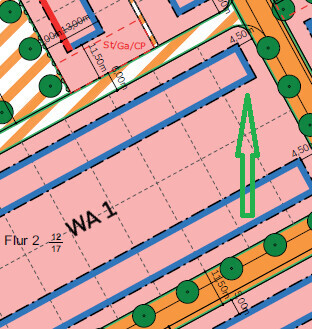
Plot size: 576 sqm (6,200 sq ft)
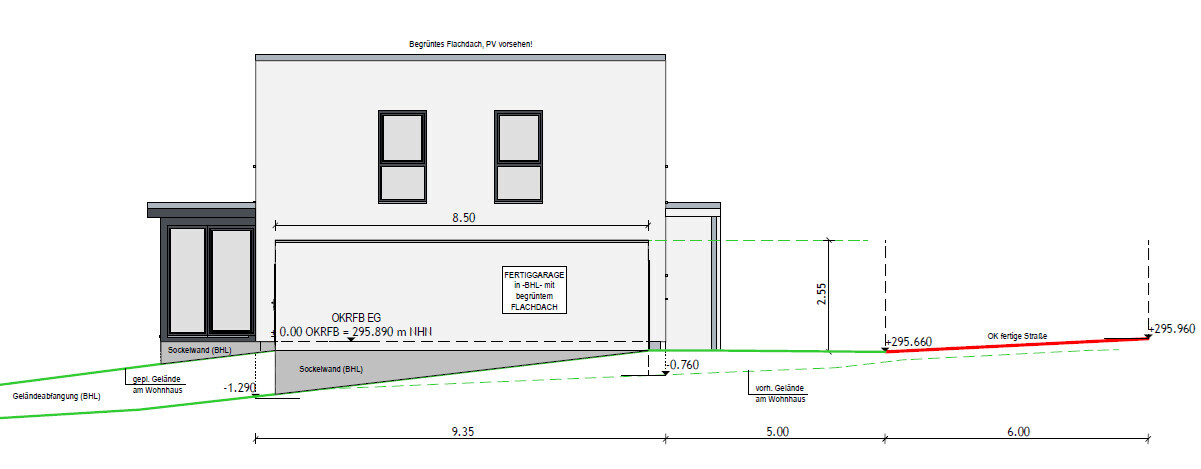
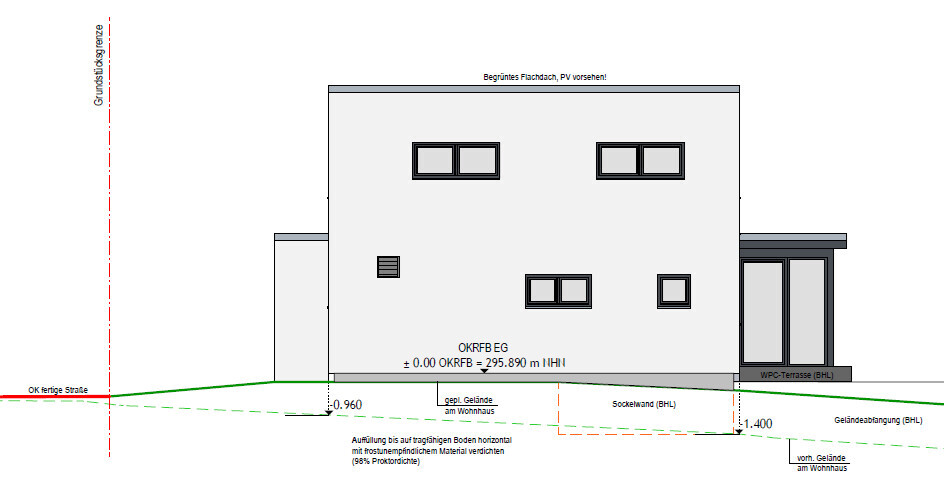
Slope: Yes, slight. According to the site plan, the top "right" corner is at 295.4 meters (970 feet), lower at 293.88 meters (964 feet), left side goes from 295.17 meters (968 feet) to 293.43 meters (963 feet)
Floor area ratio: 0.3
Building envelope, building line and boundary: Applies to house number 16
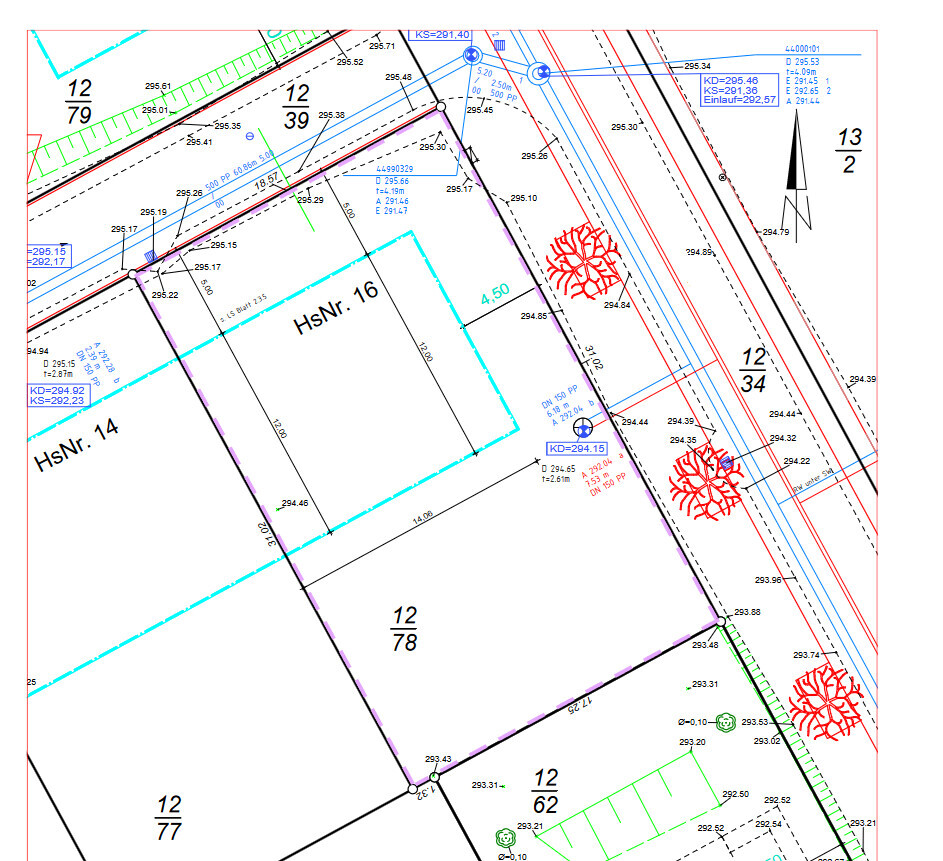
Surrounding buildings
Number of parking spaces: 2
Number of stories: 2 full floors required, plus optional recessed floor (setback floor)
Roof type: Flat roof, max. 5° pitch
Maximum height/limits: Max. 10 m (33 ft) high
Additional requirements: Equipment (heat pump) must be integrated, not external. Maximum of 2 residential units. Specific exterior colors required, rainwater should infiltrate (soil report says this is unlikely). Roofs must be greened. No oil or gas heating allowed.
Client requirements
Style, roof type, building type: Actually, none specified.
Basement, floors: No basement, 2 floors.
Number of occupants, ages: 4 people — 2 adults, 2 children
Ground floor space needs: Daily life (living, kitchen, dining, technical room, guest room)
Upper floor: Family (2 children's rooms, master bedroom, separate bathrooms), home office
Office: Home office, second workspace for occasional use such as a work window sill for example in the bedroom
Guests per year: Currently few.
Open or closed architecture, conservative or modern style: Either is fine.
Open kitchen, kitchen island: We are still considering. Initial wish was separate pantry like in the floor plan. An island would be nice if space allows.
Number of dining seats: Normally 4, rarely up to 8.
Fireplace: None.
Music/stereo wall: Multi-room audio with central unit in technical room.
Balcony, roof terrace: Neither.
Garage, carport: 1 garage
Other wishes: Central vacuum system, laundry chute, smart home (KNX) (I am mostly doing this myself, yes, I am a certified electrician, can program, but will also get additional help)
House design
Who designed the plan:
- Planner from a construction company: Correct, with some input from us. Based on an existing plan.
Price estimate by architect/planner: approx. 485,000 € (euros) for the house, approx. 210,000 € for the plot including basic services (survey, soil report, etc.)
Personal price limit for the house including features: approx. 800,000–850,000 € (including land)
Preferred heating technology: Heat pump
If you had to give up, which details/extra features could you skip:
- Could skip:
- Cannot skip:
Why is the design like it is now? For example:
Standard design by the planner? Yes, with minor wishes from us (wall between study and child’s room 2, T-walls in bathrooms, porch roof, conservatory, pantry)
What do you find especially good or bad about it? So far it seems to fit; apart from possibly the pantry/dining room, we don’t see major issues yet. But that’s why I’m here now.
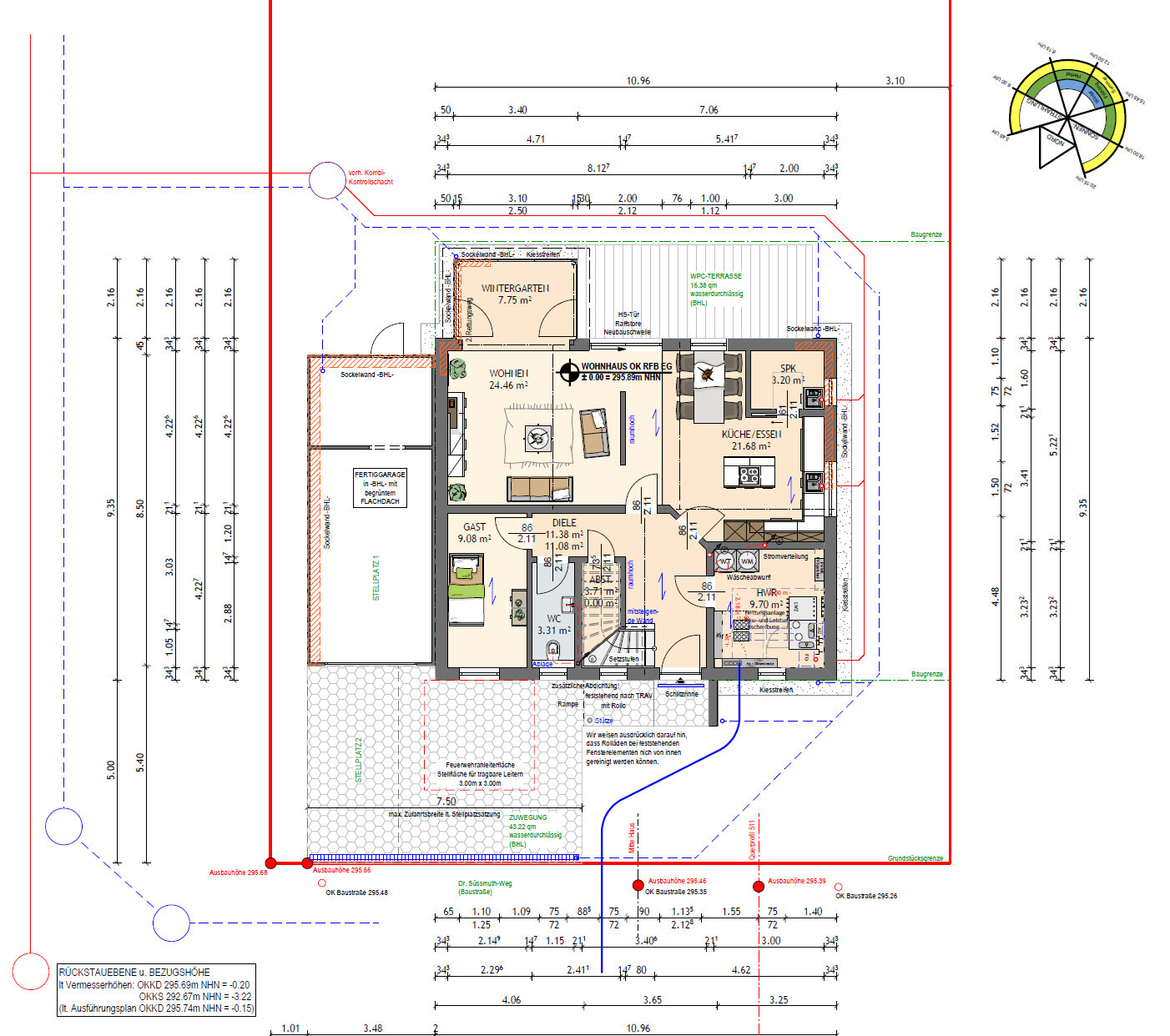
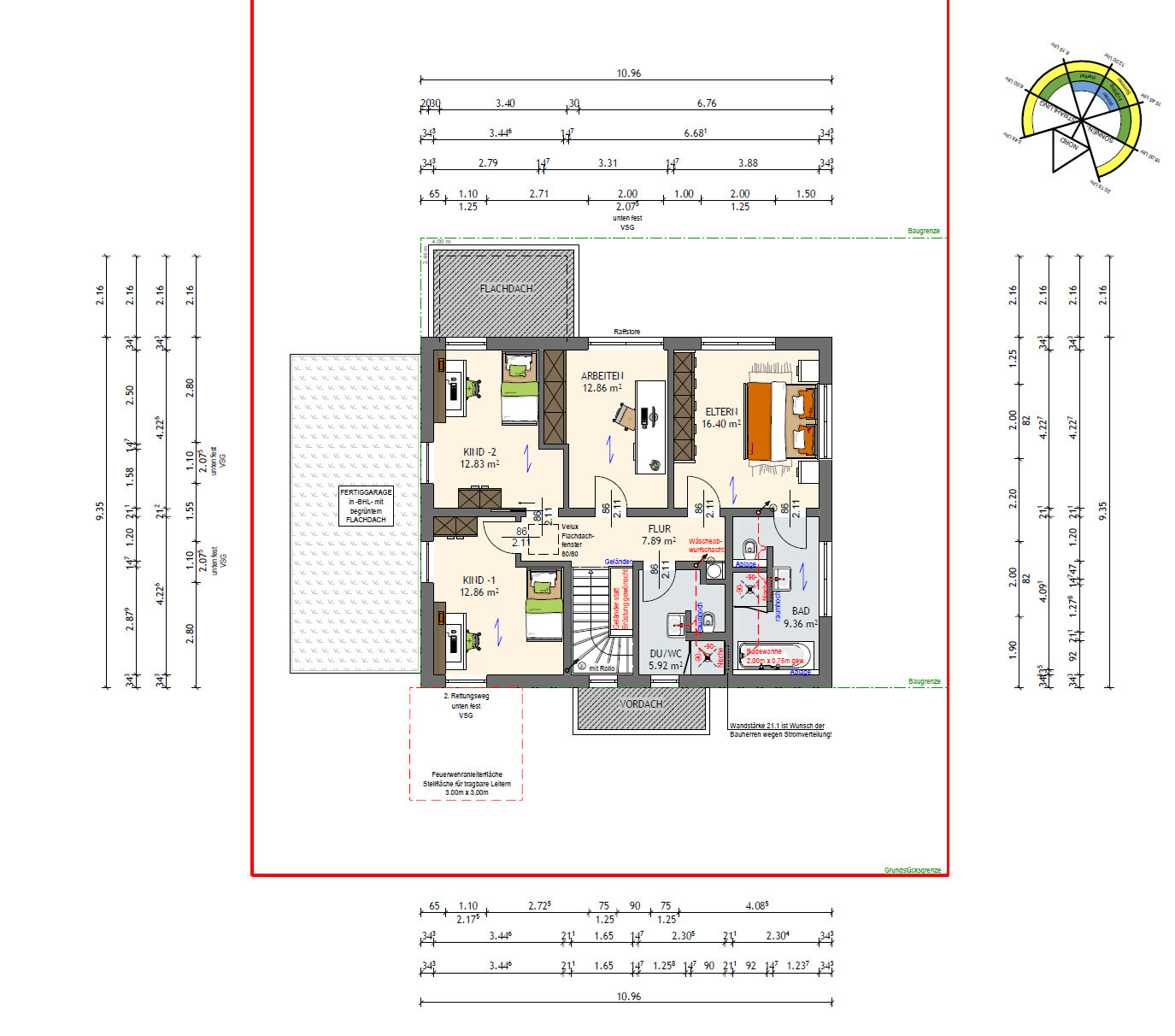
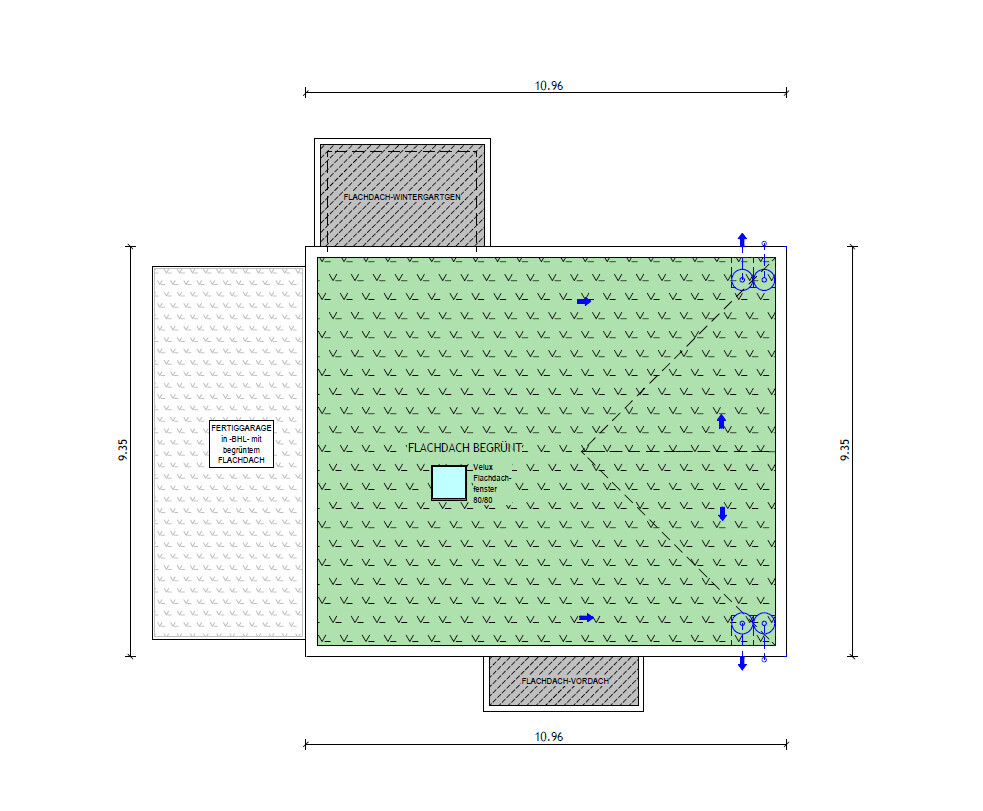
Edit: The furniture shown in the floor plans can be safely ignored. Planners seem to like adding these.
Best regards
Ganneff
I have been reading along for some time now and finally dare to share a floor plan here.
First, here is the list of questions:
Zoning Plan / Restrictions
Plot size: 576 sqm (6,200 sq ft)
Slope: Yes, slight. According to the site plan, the top "right" corner is at 295.4 meters (970 feet), lower at 293.88 meters (964 feet), left side goes from 295.17 meters (968 feet) to 293.43 meters (963 feet)
Floor area ratio: 0.3
Building envelope, building line and boundary: Applies to house number 16
Surrounding buildings
Number of parking spaces: 2
Number of stories: 2 full floors required, plus optional recessed floor (setback floor)
Roof type: Flat roof, max. 5° pitch
Maximum height/limits: Max. 10 m (33 ft) high
Additional requirements: Equipment (heat pump) must be integrated, not external. Maximum of 2 residential units. Specific exterior colors required, rainwater should infiltrate (soil report says this is unlikely). Roofs must be greened. No oil or gas heating allowed.
Client requirements
Style, roof type, building type: Actually, none specified.
Basement, floors: No basement, 2 floors.
Number of occupants, ages: 4 people — 2 adults, 2 children
Ground floor space needs: Daily life (living, kitchen, dining, technical room, guest room)
Upper floor: Family (2 children's rooms, master bedroom, separate bathrooms), home office
Office: Home office, second workspace for occasional use such as a work window sill for example in the bedroom
Guests per year: Currently few.
Open or closed architecture, conservative or modern style: Either is fine.
Open kitchen, kitchen island: We are still considering. Initial wish was separate pantry like in the floor plan. An island would be nice if space allows.
Number of dining seats: Normally 4, rarely up to 8.
Fireplace: None.
Music/stereo wall: Multi-room audio with central unit in technical room.
Balcony, roof terrace: Neither.
Garage, carport: 1 garage
Other wishes: Central vacuum system, laundry chute, smart home (KNX) (I am mostly doing this myself, yes, I am a certified electrician, can program, but will also get additional help)
House design
Who designed the plan:
- Planner from a construction company: Correct, with some input from us. Based on an existing plan.
Price estimate by architect/planner: approx. 485,000 € (euros) for the house, approx. 210,000 € for the plot including basic services (survey, soil report, etc.)
Personal price limit for the house including features: approx. 800,000–850,000 € (including land)
Preferred heating technology: Heat pump
If you had to give up, which details/extra features could you skip:
- Could skip:
- Cannot skip:
Why is the design like it is now? For example:
Standard design by the planner? Yes, with minor wishes from us (wall between study and child’s room 2, T-walls in bathrooms, porch roof, conservatory, pantry)
What do you find especially good or bad about it? So far it seems to fit; apart from possibly the pantry/dining room, we don’t see major issues yet. But that’s why I’m here now.
Edit: The furniture shown in the floor plans can be safely ignored. Planners seem to like adding these.
Best regards
Ganneff
M
motorradsilke27 Jun 2025 23:06You have the exit to the terrace right next to the sunroom. I wouldn’t consider placing it inside the sunroom or bay window important.
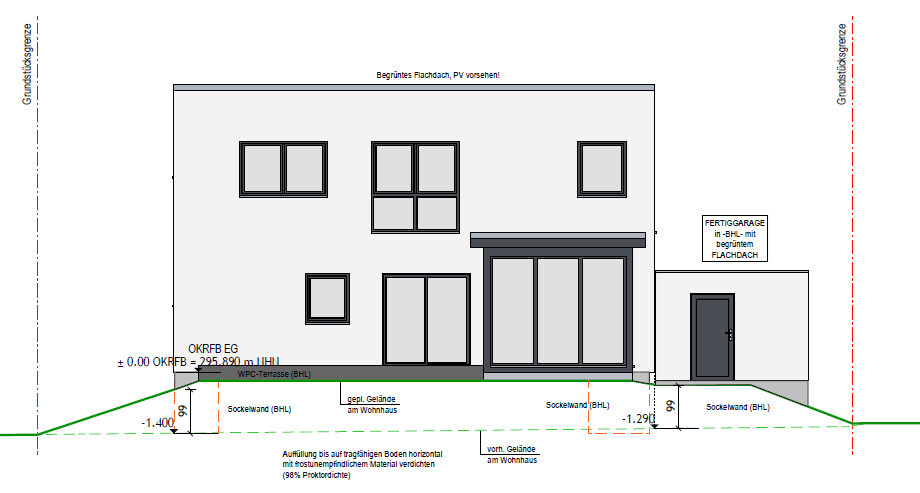
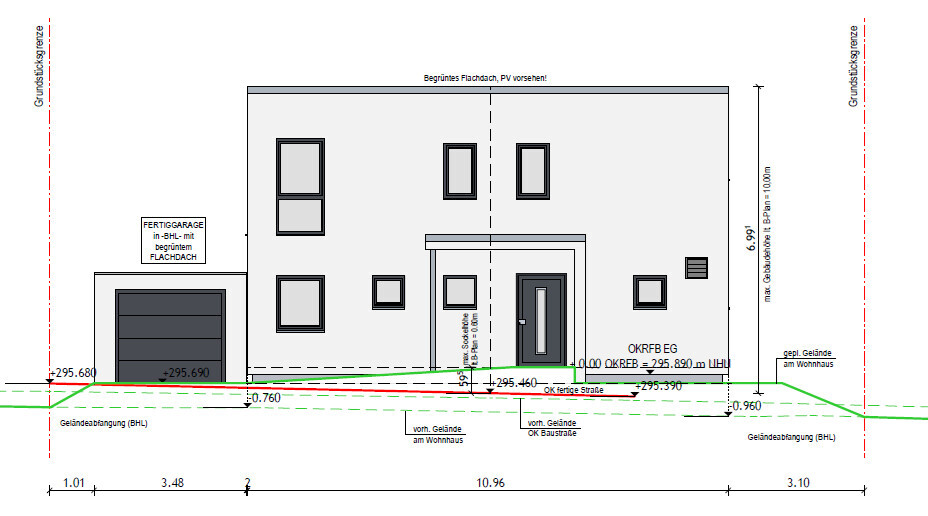
I’m not a big fan of floor-to-ceiling windows on the upper floor. If you put anything in front of them, it blocks the light again. Better to have windows oriented horizontally, so you have space underneath for sideboards, a desk, etc.
On the ground floor, I love our floor-to-ceiling windows. They bring in light and create a sense of openness. We also don’t have any pleated blinds installed there.
We also have a fixed window with a roller shutter. After 4 years, it hasn’t bothered me, and I haven’t felt the need to clean it yet. But those are only on the lower part, when I’m sleeping.
I’m not a big fan of floor-to-ceiling windows on the upper floor. If you put anything in front of them, it blocks the light again. Better to have windows oriented horizontally, so you have space underneath for sideboards, a desk, etc.
On the ground floor, I love our floor-to-ceiling windows. They bring in light and create a sense of openness. We also don’t have any pleated blinds installed there.
We also have a fixed window with a roller shutter. After 4 years, it hasn’t bothered me, and I haven’t felt the need to clean it yet. But those are only on the lower part, when I’m sleeping.
motorradsilke schrieb:
I’m not a big fan of floor-to-ceiling windows on the upper floor. If you place something in front of them, you end up blocking the light. It’s better to have horizontal windows so you have space underneath for sideboards, a desk, etc.But then, for example in the children’s rooms, only one of those facing east should be twice as wide, otherwise we’ll hardly have any wall space left. Should the others remain floor-to-ceiling or be “regular height”? Ah. Meh. Always this thinking and weighing options. Yuck, no thanks. 🙂
In the home office, I’m planning to place the desk in front of the window, which is both twice as wide and floor-to-ceiling. But I think/hope that should work well – since I usually have the desk surface raised (to 126cm (50 inches), about 80% of the day) and both the desk and I will be clearly visible even with regular-height windows.
My opinion: eliminate the laundry chute; it is definitely unnecessary in a compact design spanning one floor. If someone really wants to throw laundry down, they can use the stairs.
I wouldn’t build a conservatory in the literal sense either – my intention was to have a bay window, which I prefer here.
Not only because of the construction method but also due to the clean room opening. The amount of natural light can hardly be increased beyond what is already there; a well-designed window plan is sufficient. I believe the window arrangement here has gotten completely out of hand. Floor windows on the upper floor disrupt the overall look, there are auxiliary windows on the west side even though that light is the most beautiful. Due to the window in the upstairs office, you can’t even place a wardrobe in the niche. And a wardrobe in the bedroom is also problematic because of the door. Windows above the bed are unnecessary and rather distracting, and there is absolutely no reason why the master bathroom can’t be accessed from the hallway. This current setup is disadvantageous. The children’s bathroom should still have the toilet and shower swapped.
Make sure there is a clear sightline from the entrance to the garden, at least through the living area. This enhances the appeal of any house! Also, at minimum, widen the door and expand the “WiGa,” the bay window, to the left on the plan.
I wouldn’t build a conservatory in the literal sense either – my intention was to have a bay window, which I prefer here.
Not only because of the construction method but also due to the clean room opening. The amount of natural light can hardly be increased beyond what is already there; a well-designed window plan is sufficient. I believe the window arrangement here has gotten completely out of hand. Floor windows on the upper floor disrupt the overall look, there are auxiliary windows on the west side even though that light is the most beautiful. Due to the window in the upstairs office, you can’t even place a wardrobe in the niche. And a wardrobe in the bedroom is also problematic because of the door. Windows above the bed are unnecessary and rather distracting, and there is absolutely no reason why the master bathroom can’t be accessed from the hallway. This current setup is disadvantageous. The children’s bathroom should still have the toilet and shower swapped.
Make sure there is a clear sightline from the entrance to the garden, at least through the living area. This enhances the appeal of any house! Also, at minimum, widen the door and expand the “WiGa,” the bay window, to the left on the plan.
 Papierturm28 Jun 2025 10:39
Ganneff schrieb:
The alternative is a bay window. Slightly more cost-effective, but then "only" a set of windows and no door. Although that could also be nice if you put three windows along the long side and the middle one is one with a deep window seat—that sounds good to me as well. If we stick with a depth of 1.25m (4 feet), there wouldn’t be any side doors. I’m not sure if that’s a big issue—I can imagine that having at least one door leading directly to the terrace there would be nice. But then you might make it about 1.50m (5 feet) deep. I already see two other doors right next to it on the plan? I don’t think so many doors are necessary here.
But – this is meant as a room for occasional sleeping and otherwise "when you need some privacy" or "a place to relax for a hobby/to read/etc.," but unlike a child’s room or study, it’s not used permanently. That should be sufficient. I would have planned it the same way, based on everything I have read (keyword: tax deductions for a home office).
My point was something different: windows also take up space. And beyond a certain size, windows become oversized for rooms. Whether this is the case here, I can’t say directly. For this small room, a 200x125cm (79x49 inches) window already seems very generous to me. It will be well lit even with a smaller window.
Floor-to-ceiling windows are a way to get more light ... yes and no. A bit on the physics of light:
1. Window areas have diminishing returns! If you increase a single window from 85x125cm (33x49 inches) to 95x125cm (37x49 inches), the room noticeably gets brighter. But going from 250x125cm (98x49 inches) to 260x125cm (102x49 inches), you hardly notice the difference.
2. Floor-level window areas provide very little additional room illumination. You can test this in several ways: In display home parks with many floor-to-ceiling windows, close all shutters down to about 90cm (35 inches) above the floor. Or in a pitch-dark room, shine a flashlight diagonally downward and move it closer to the floor. Or find a house with a high knee wall that only has small fixed glass bands near the floor. (The darker the floor covering, the more pronounced this effect.)
3. The less square or circular a window area is, the less effective it is at lighting the room. (A 50x50cm (20x20 inches) glass area lets in more light than a 10x250cm (4x98 inches) glass area, even though the total square meters are the same.) For typical window formats, this usually isn’t noticeable. But comparing a large window to a single-leaf patio door (e.g. 175x140cm (69x55 inches) vs. 113x221cm (44x87 inches)), the difference becomes clear.
(4. Windows on multiple walls are often much better for lighting than windows on only one wall. But as far as I remember, this was well implemented everywhere.)
For openness, views, and spatial effect, floor-to-ceiling elements are definitely very good. For pure lighting, however, their effectiveness is often overestimated due to the reasons above.
And in children’s rooms they can be really impractical because they dominate the space. You can put a desk or a dresser under a standard window, or whatever else. A normal window allows flexible furniture layout. A floor-to-ceiling element does not.
ypg schrieb:
In my opinion: forget about a laundry chute; in a compact design over one floor, it’s definitely not necessary. If someone really wants to throw laundry down, they can use the stairs. A laundry chute is already on my removal list; it worked well in the old draft but not anymore in the new one.
But throwing laundry down the stairs? That’s a bit heavy—I’d rather skip that.
ypg schrieb:
I wouldn’t build a conservatory in the literal sense either—my intention was a bay window, which I prefer here, not just because of the building method but also for a clean room opening. Papierturm schrieb:
I already see two other doors right next to that on the plan? I don’t think so many doors are needed here. Yes, those wall sections that jut in there are annoying. For the bay window, I would plan a 125cm (50 inches) high window on the long wall on both left and right sides and one with a seating window sill in the center. That one could also be a bit higher (the window sill has to be lower). Let’s see what options they offer.
I’m considering whether to add windows to the small wall sections on the left and right or not. For that, the wall depth would probably need to be more like 150cm (60 inches) instead of 125cm (50 inches). The advantage would be more light and (on the left) a view of the terrace. But if I skip this, I could attach or place something in front of the wall.
Or maybe only one window on the left toward the terrace, and on the right a wall towards the neighbor.
ypg schrieb:
Due to the window in the upstairs office, you can’t even place a closet in the niche. That was my initial plan, yes. But currently, I also find the idea of a desk on the left and a closet or shelving on the right in that room not bad.
ypg schrieb:
Make sure there is a clear line of sight from the entrance to the garden, at least to the main living area. That enhances any house! Also, widen the door at least and extend the “WiGa,” meaning the bay window, to the left side as planned. Oh, I have someone at home who holds an opposing view on this—having a completely open, straight line of sight is not a favorite.
Papierturm schrieb:
I would have planned it that way too, based on everything I read (keyword: tax deductibility of a home office). Yes, the home office must simply be separate.
Papierturm schrieb:
I meant something different: windows also require space. And beyond a certain point, windows in rooms become oversized. Whether this applies here, I can’t say directly. For the small room, a 200x125cm (79x50 inches) window would seem very generous to me. It will also be sufficiently illuminated by a smaller window. I think it will be a standard window, not double width, but 125cm (50 inches) high. That should work. Right now, it’s just set symmetrically, but everyone here agrees that a window band that high in the guest room looks odd. A normal single window should be sufficient.
Papierturm schrieb:
.. well, yes and no. A little on light physics: Thanks for that.
Papierturm schrieb:
And in the children’s rooms, they become really impractical because they dominate the space. Under a normal window you can place a desk. Or a dresser. Or whatever. A normal window leaves room for design options. A floor-to-ceiling element does not. Noted, we’ll reconsider that, thank you.
Ganneff schrieb:
Oh, I have someone at home who holds an opposing view—fully transparent glass is definitely not a favorite. Then no upgrade it is.
Regarding the windows: start with the basics, meaning the room layout. Then install the windows—all at once. It doesn’t help to decide on one window or another now. Consider the fundamental physics and usable space; then you can confidently place the windows.
If the room layout is correct (including structural aspects), the window positions will almost naturally fall into place, resulting in a balanced appearance on the exterior as well.
Similar topics