
Hello,
I have been reading along for some time now and finally dare to share a floor plan here.
First, here is the list of questions:
Zoning Plan / Restrictions
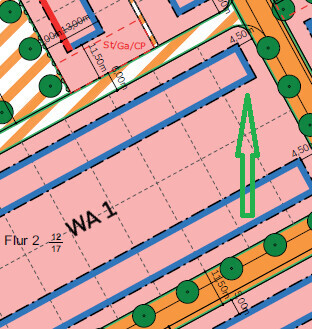
Plot size: 576 sqm (6,200 sq ft)
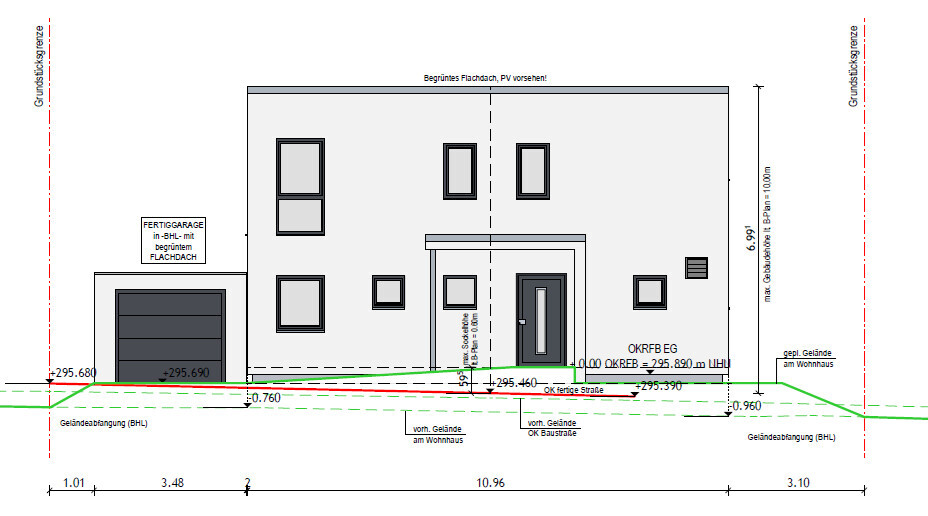
Slope: Yes, slight. According to the site plan, the top "right" corner is at 295.4 meters (970 feet), lower at 293.88 meters (964 feet), left side goes from 295.17 meters (968 feet) to 293.43 meters (963 feet)
Floor area ratio: 0.3
Building envelope, building line and boundary: Applies to house number 16
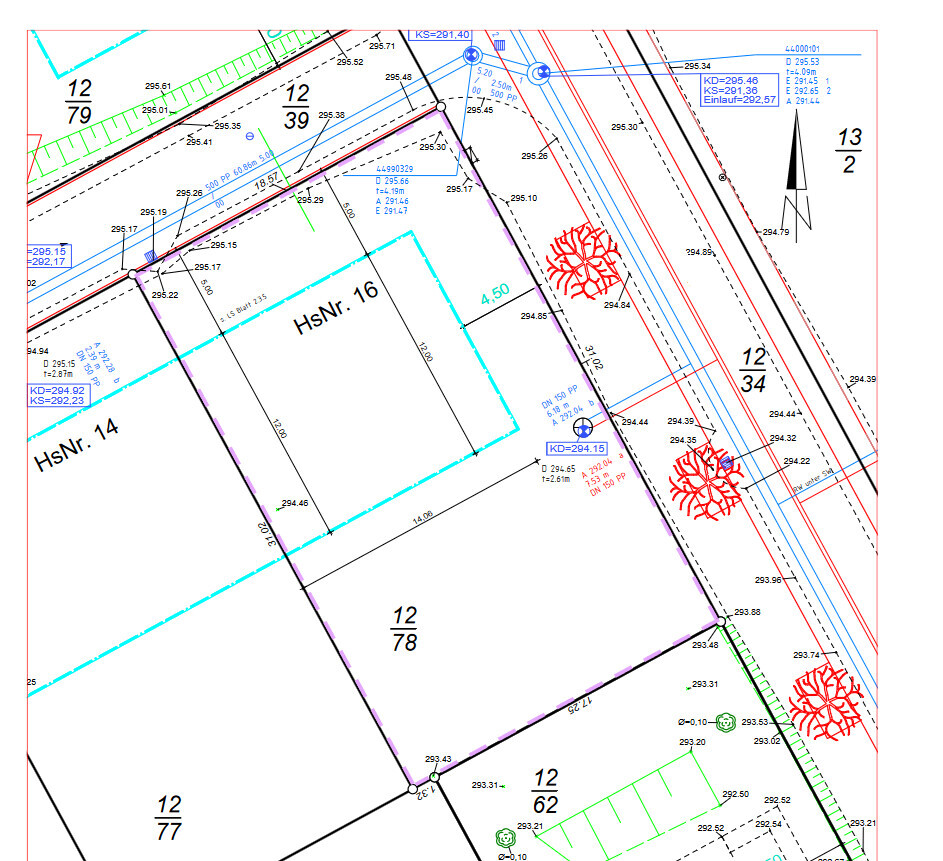
Surrounding buildings
Number of parking spaces: 2
Number of stories: 2 full floors required, plus optional recessed floor (setback floor)
Roof type: Flat roof, max. 5° pitch
Maximum height/limits: Max. 10 m (33 ft) high
Additional requirements: Equipment (heat pump) must be integrated, not external. Maximum of 2 residential units. Specific exterior colors required, rainwater should infiltrate (soil report says this is unlikely). Roofs must be greened. No oil or gas heating allowed.
Client requirements
Style, roof type, building type: Actually, none specified.
Basement, floors: No basement, 2 floors.
Number of occupants, ages: 4 people — 2 adults, 2 children
Ground floor space needs: Daily life (living, kitchen, dining, technical room, guest room)
Upper floor: Family (2 children's rooms, master bedroom, separate bathrooms), home office
Office: Home office, second workspace for occasional use such as a work window sill for example in the bedroom
Guests per year: Currently few.
Open or closed architecture, conservative or modern style: Either is fine.
Open kitchen, kitchen island: We are still considering. Initial wish was separate pantry like in the floor plan. An island would be nice if space allows.
Number of dining seats: Normally 4, rarely up to 8.
Fireplace: None.
Music/stereo wall: Multi-room audio with central unit in technical room.
Balcony, roof terrace: Neither.
Garage, carport: 1 garage
Other wishes: Central vacuum system, laundry chute, smart home (KNX) (I am mostly doing this myself, yes, I am a certified electrician, can program, but will also get additional help)
House design
Who designed the plan:
- Planner from a construction company: Correct, with some input from us. Based on an existing plan.
Price estimate by architect/planner: approx. 485,000 € (euros) for the house, approx. 210,000 € for the plot including basic services (survey, soil report, etc.)
Personal price limit for the house including features: approx. 800,000–850,000 € (including land)
Preferred heating technology: Heat pump
If you had to give up, which details/extra features could you skip:
- Could skip:
- Cannot skip:
Why is the design like it is now? For example:
Standard design by the planner? Yes, with minor wishes from us (wall between study and child’s room 2, T-walls in bathrooms, porch roof, conservatory, pantry)
What do you find especially good or bad about it? So far it seems to fit; apart from possibly the pantry/dining room, we don’t see major issues yet. But that’s why I’m here now.
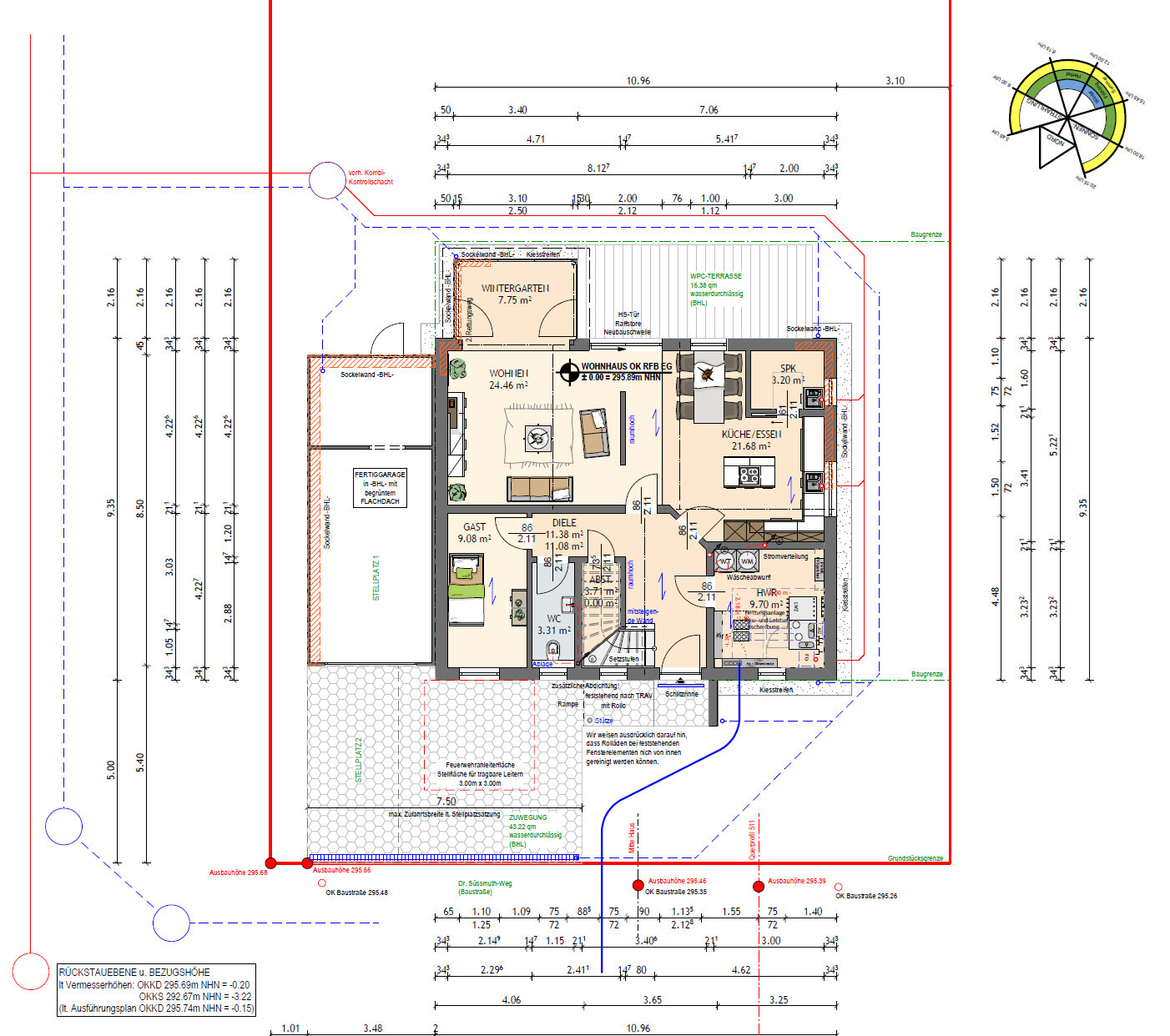
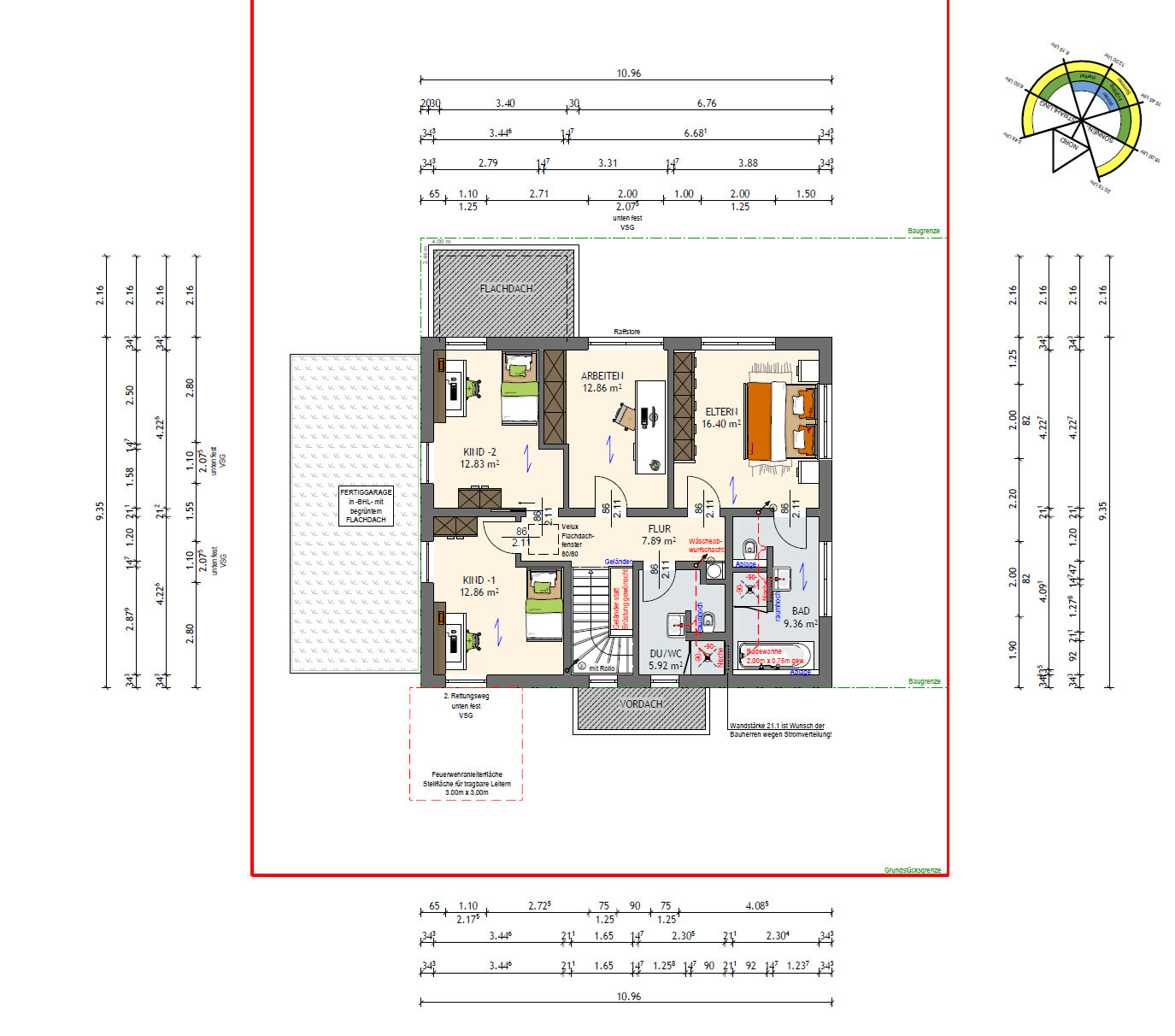
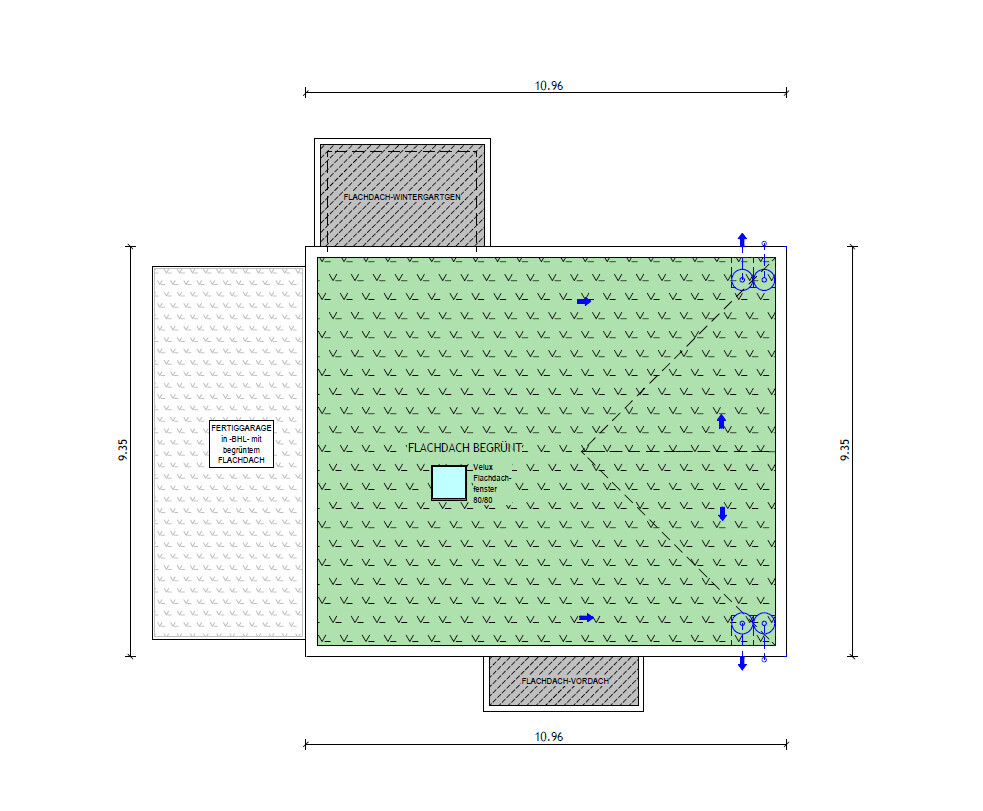
Edit: The furniture shown in the floor plans can be safely ignored. Planners seem to like adding these.
Best regards
Ganneff
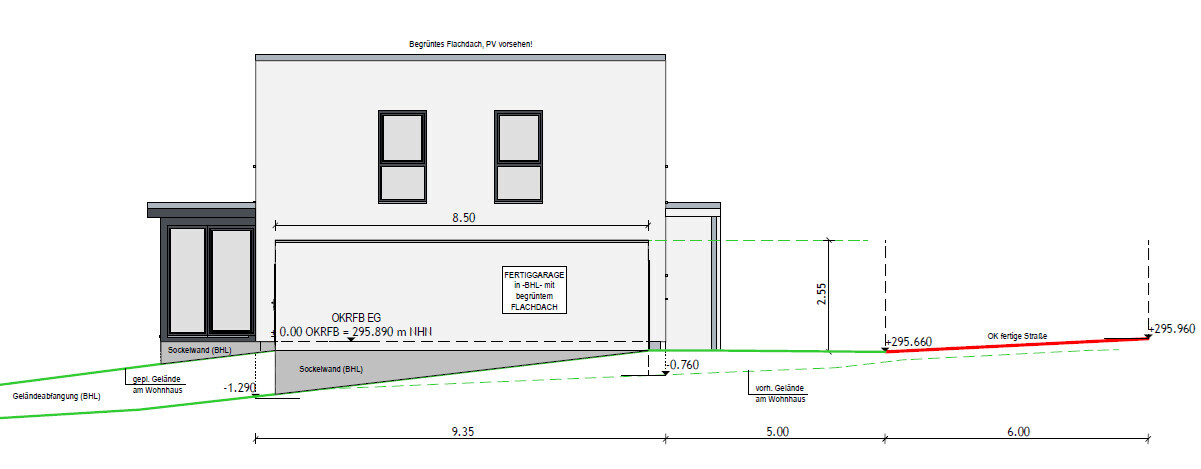
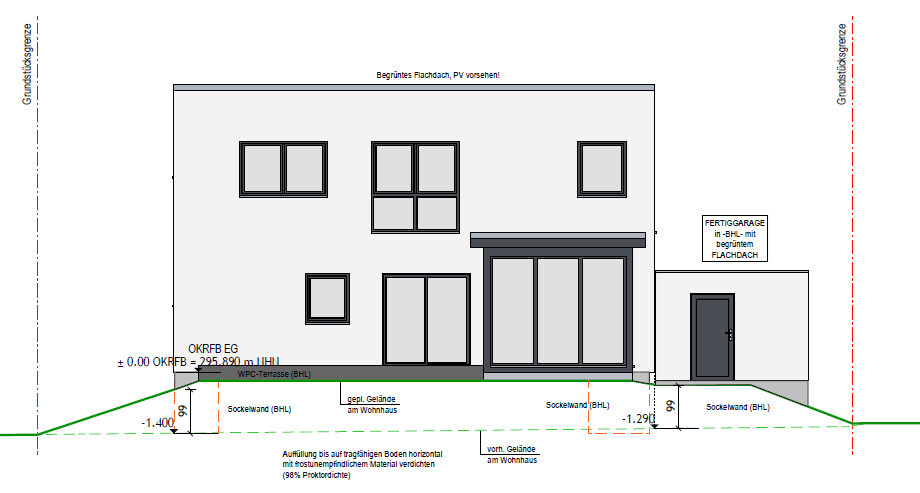
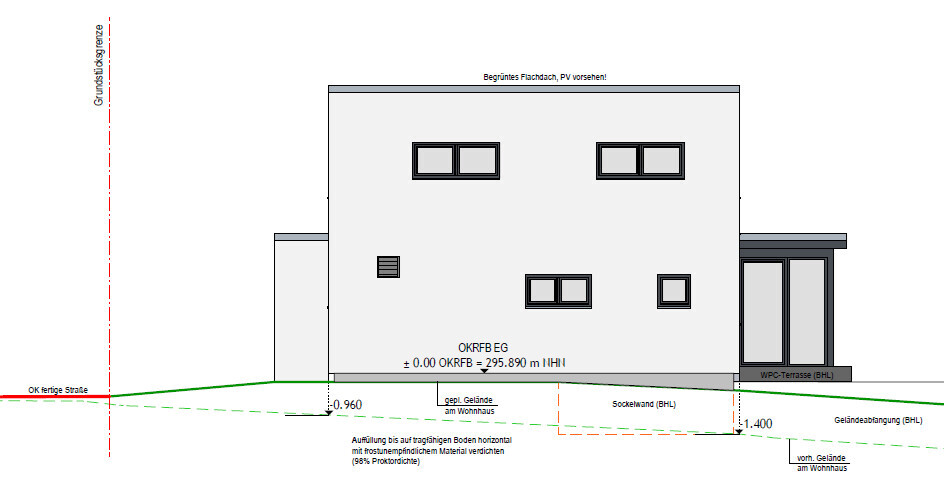
I have been reading along for some time now and finally dare to share a floor plan here.
First, here is the list of questions:
Zoning Plan / Restrictions
Plot size: 576 sqm (6,200 sq ft)
Slope: Yes, slight. According to the site plan, the top "right" corner is at 295.4 meters (970 feet), lower at 293.88 meters (964 feet), left side goes from 295.17 meters (968 feet) to 293.43 meters (963 feet)
Floor area ratio: 0.3
Building envelope, building line and boundary: Applies to house number 16
Surrounding buildings
Number of parking spaces: 2
Number of stories: 2 full floors required, plus optional recessed floor (setback floor)
Roof type: Flat roof, max. 5° pitch
Maximum height/limits: Max. 10 m (33 ft) high
Additional requirements: Equipment (heat pump) must be integrated, not external. Maximum of 2 residential units. Specific exterior colors required, rainwater should infiltrate (soil report says this is unlikely). Roofs must be greened. No oil or gas heating allowed.
Client requirements
Style, roof type, building type: Actually, none specified.
Basement, floors: No basement, 2 floors.
Number of occupants, ages: 4 people — 2 adults, 2 children
Ground floor space needs: Daily life (living, kitchen, dining, technical room, guest room)
Upper floor: Family (2 children's rooms, master bedroom, separate bathrooms), home office
Office: Home office, second workspace for occasional use such as a work window sill for example in the bedroom
Guests per year: Currently few.
Open or closed architecture, conservative or modern style: Either is fine.
Open kitchen, kitchen island: We are still considering. Initial wish was separate pantry like in the floor plan. An island would be nice if space allows.
Number of dining seats: Normally 4, rarely up to 8.
Fireplace: None.
Music/stereo wall: Multi-room audio with central unit in technical room.
Balcony, roof terrace: Neither.
Garage, carport: 1 garage
Other wishes: Central vacuum system, laundry chute, smart home (KNX) (I am mostly doing this myself, yes, I am a certified electrician, can program, but will also get additional help)
House design
Who designed the plan:
- Planner from a construction company: Correct, with some input from us. Based on an existing plan.
Price estimate by architect/planner: approx. 485,000 € (euros) for the house, approx. 210,000 € for the plot including basic services (survey, soil report, etc.)
Personal price limit for the house including features: approx. 800,000–850,000 € (including land)
Preferred heating technology: Heat pump
If you had to give up, which details/extra features could you skip:
- Could skip:
- Cannot skip:
Why is the design like it is now? For example:
Standard design by the planner? Yes, with minor wishes from us (wall between study and child’s room 2, T-walls in bathrooms, porch roof, conservatory, pantry)
What do you find especially good or bad about it? So far it seems to fit; apart from possibly the pantry/dining room, we don’t see major issues yet. But that’s why I’m here now.
Edit: The furniture shown in the floor plans can be safely ignored. Planners seem to like adding these.
Best regards
Ganneff

Ganneff schrieb:
One wing is the goal—and it’s quite feasible space-wise.Then don’t choose a door that is flush with the wall, or else accidents will happen in the hallway when the door silently swings fully outward. Recess the door into the room.
wiltshire schrieb:
In small companies, the business owner shapes the product range, scope of services, prices, and the willingness to engage with some clients but not others. Naturally, this creates the strongest impression of expertise. The technically most skilled people often have less customer contact and are utilized differently. A good entrepreneur gladly hires people who surpass them technically. Oh, of course, the owner decides what and how to offer. But if I have someone who basically just repeats what I can read 1:1 on the manufacturer’s website and struggles to answer follow-up questions, that leaves a very different impression than someone who clearly speaks from experience. And, of course, word of mouth within your circle of friends and acquaintances helps a lot (this is a local tradesman company).
ypg schrieb:
And before worrying about the hinge of a swing door, there are more fundamental questions to address here. You’re putting the cart before the horse. No walls are up yet! And that’s a good thing.
Tip: I would seriously consider what you expect from a general contractor who offers everything from a single source. Well, at the moment I’m waiting for answers to my questions there. Until then, I can let a few horses out to pasture.
11ant schrieb:
As far as possible, don’t choose anything beyond walking distance from the standard scope of work description; otherwise, you might share the fate of @R.Hotzenplotz. Well, what I expect is that it turns out perfect and wonderful, that all my wishes are fully realized (and ideally cost-neutral), and a big thank you in the end for letting them build my house—obviously.
Joking aside: I have friends who built with this company and are happy. Several. There is still quite a lot of positive feedback and very little negative feedback online. That’s either a good sign or a good legal department—but looking at my friends, I tend to lean toward the former. So all I can do is hope and check repeatedly as best I can what is going on or have experts review what I can’t handle myself.
Arauki11 schrieb:
Maybe you should base some decisions on what you can more easily do yourself, for example, opting for wood flooring instead of tiles, etc. I don’t know what my spinal implant will think when I’m completely done with the flooring. 😕 (Probably a big “Ouch, you idiot.”)
Aside from that, I can handle some DIY, but I also know when it’s better to talk to the companies and have them let me do some support work under their supervision to save a bit of money, rather than tackling everything on my own. That way, the likelihood that it turns out well is higher—or at least I have someone officially responsible if it goes wrong.
11ant schrieb:
I think about this kind of thing when I see photovoltaics mentioned just as a single line of text on the parapet in the house renderings. In my mind, that’s the laundry balcony door threshold of the rogue builder. Well, I removed the photovoltaics from the plan because I didn’t like the idea that they want to slap on modules whose manufacturer thinks it’s good if they chatter with cloud nonsense and demand a subscription to access detailed data. Yuck.
I work in IT. My house should not be “calling home”—none of that, unless I explicitly say so. Everything has to run purely locally.
And about that rogue builder, I’ll have to read through some histories here; it sounds interesting. (Although one thread has over 1,400 posts, yikes.)
Ganneff schrieb:
I don’t know what my spinal disc implant will tell me once I’m completely done with the floor. Well, that’s an important realization—that heavy DIY work simply won’t be possible. That’s not a big problem; it just needs to be properly taken into account in the planning and budgeting.
Ganneff schrieb:
I have friends who built with this company and are happy. Several of them. There is quite a bit of positive feedback online and very little negative. It wasn’t as if the builder had a bad reputation. He’s just a general contractor (GC) who can deliver a standard build. But the client wanted no standard work anywhere and instead wanted extra custom features everywhere. The GC said it was possible and had dollar signs in his eyes. The subcontractors (subs) were overwhelmed by the requests. The client should have gone to an architect and managed the project with separate contracts.
R.Hotzenplotz schrieb:
The site manager has been on sick leave about five times since construction started. The drywall installer doesn’t know when to install the gypsum board ceiling, and the roofer says the Velux ceiling spots should not have been installed until after the drywall ceiling was in place, but they are already installed. One of the spots is positioned so that it is blocked by a rafter and cannot be connected to a duct. He’s unsure what to do. Pure chaos! And they are paid a five-figure sum for this kind of site management. Simply frustrating!
At least the plasterers carefully reworked every section of plaster that the site manager had approved. So purely goodwill, not because everything was okay.
After the bumpy blower door test, the drywall installer has reportedly already had to dismantle the enclosures in the bathrooms three times because sealing still had to be redone or documented by photo.
The base plaster is being applied now. In 10 days, the finishing plaster is scheduled for the exterior. The scaffolding should be removed in three weeks.
The screed is being heated. However, several pipes in the heating circuit distributors are cold. I don’t understand that but can’t ask anyone right now. The exposed pipes in the recessed screed areas of the showers also seem not to be carrying water. Still, the house is moderately warm inside. Traumfaenger schrieb:
The client has been living with his family in the new house for about two months after a significant delay in completion. Still, many things are going wrong, both inside and outside. Some trades are working quite sloppily: cables for various electrical installations were forgotten and had to be chased into finished ceilings and walls after moving in; the expensive GIRA doorbell system was plastered over and damaged, etc. Lots of conflicts and disputes, but at least the house is standing and occupied. I cannot share pictures here because of copyright issues, but some of the workmanship would leave you speechless. And the prices were definitely not cheap. He sends his regards but no longer visits the forum after unsubscribing due to some posts he felt were no longer constructive for him. So that’s the current status of the client. 
Ganneff schrieb:
Well, I removed the photovoltaic system because I didn’t like that they want to just slap the modules on, the manufacturer thinks it’s fine for the system to communicate with some cloud service, and there’s a mandatory subscription if you want to access detailed data. So the house builder has a deal with the module manufacturer where they control your photovoltaic output, and if you want a statement for that, you have to pay for it—and as a subscription at that?
https://www.instagram.com/11antgmxde/
https://www.linkedin.com/company/bauen-jetzt/
11ant schrieb:
So the house manufacturer has an agreement with the module manufacturer to handle your photovoltaic energy production, and if you want a statement for it, you have to pay for it, and even as a subscription?No. They simply install modules from a manufacturer whose systems cannot be monitored locally, for example via Modbus, but require access to the manufacturer’s cloud. And that manufacturer charges for this access.
There is something like what you describe, but it is completely optional. It is called, for example, "Zero Bills" by an energy provider and is aimed at new-build homes. The provider installs the photovoltaic system on your roof and a battery storage unit in the utility room, handles marketing of the electricity, and you get a free electricity allowance that “covers the typical needs of a household.” You pay for any consumption beyond that.
For someone who does not want to deal with the details, this can be an option. Not for me, but as said, it is fully optional. In this case, you probably wouldn’t have direct access to the data yourself, as the provider manages everything on your behalf.
Similar topics