
Hello,
I have been reading along for some time now and finally dare to share a floor plan here.
First, here is the list of questions:
Zoning Plan / Restrictions
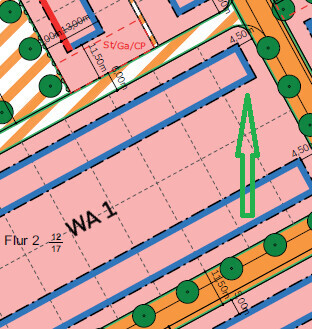
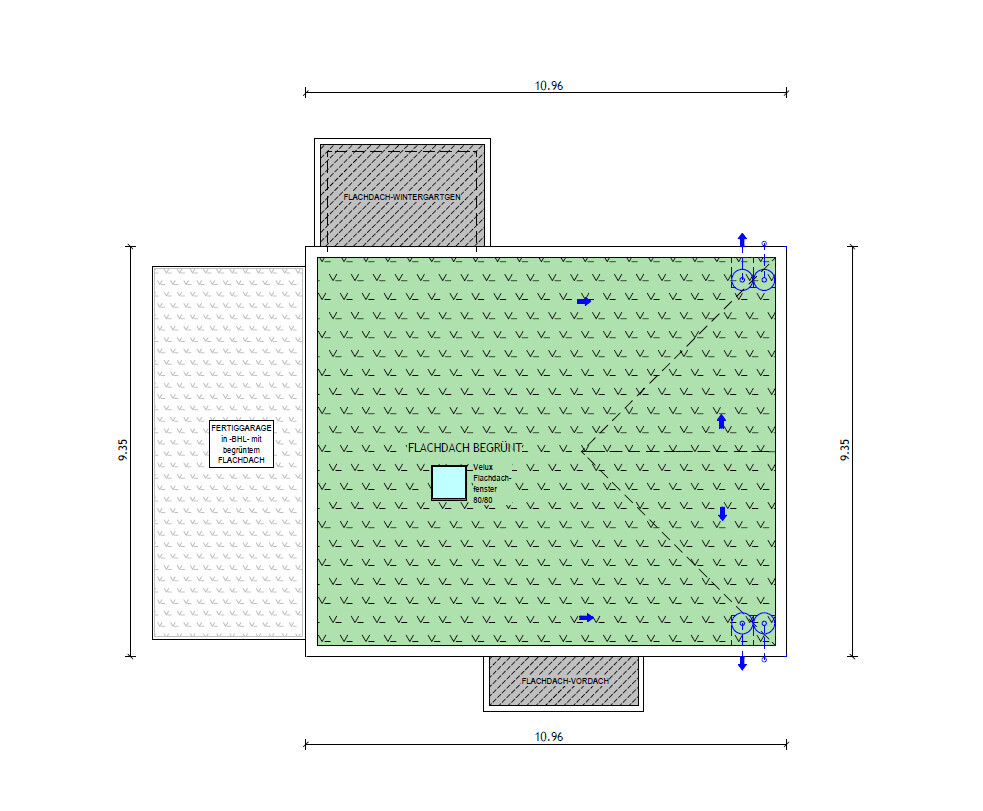
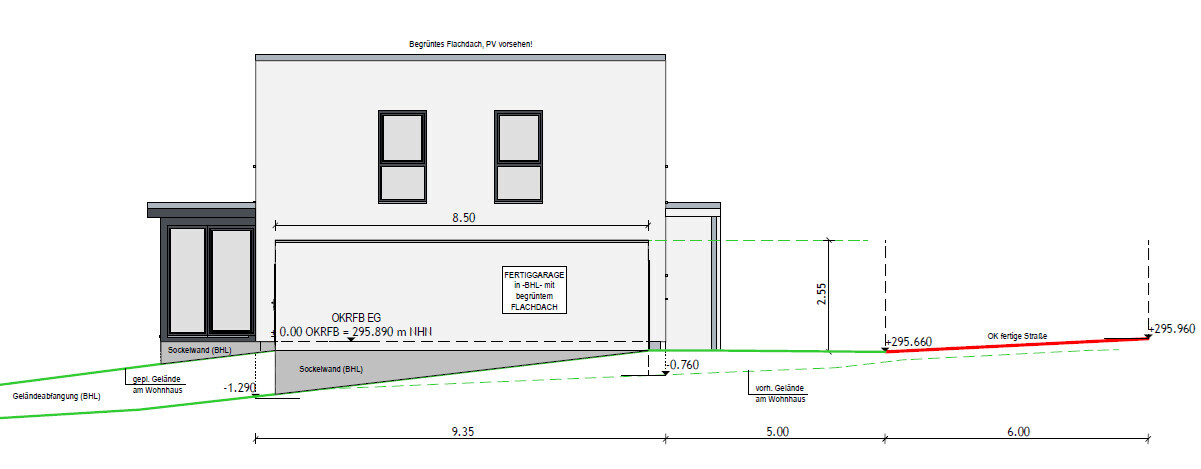
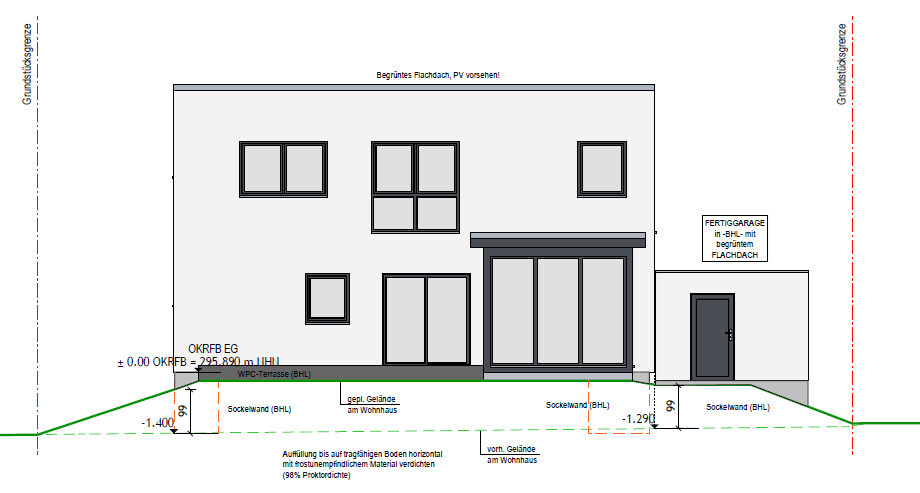
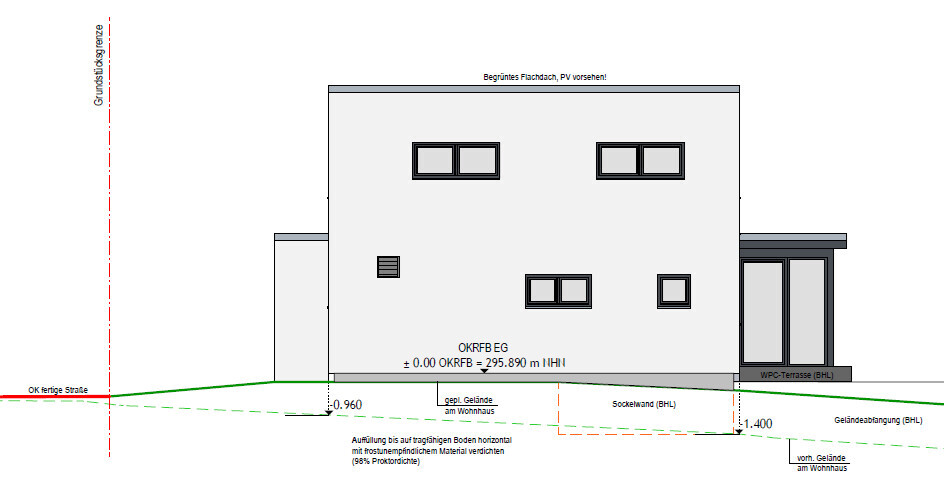
Plot size: 576 sqm (6,200 sq ft)
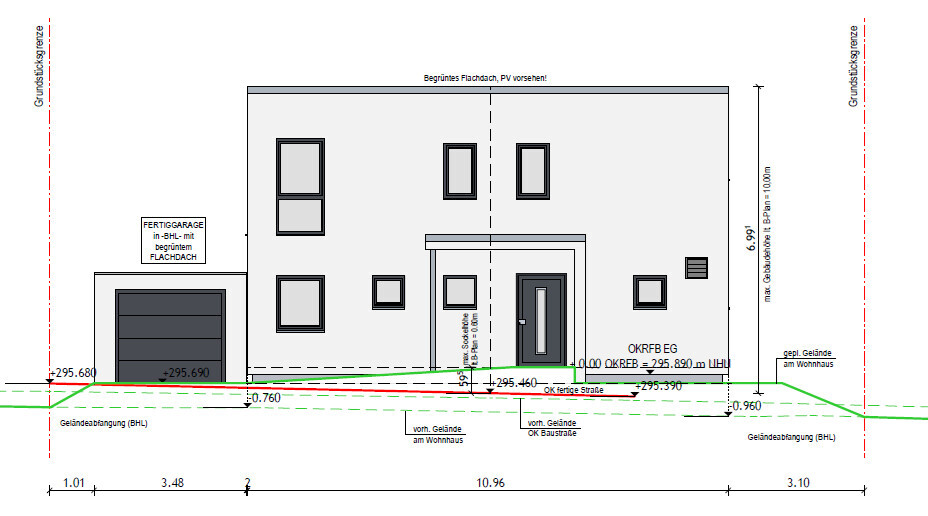
Slope: Yes, slight. According to the site plan, the top "right" corner is at 295.4 meters (970 feet), lower at 293.88 meters (964 feet), left side goes from 295.17 meters (968 feet) to 293.43 meters (963 feet)
Floor area ratio: 0.3
Building envelope, building line and boundary: Applies to house number 16
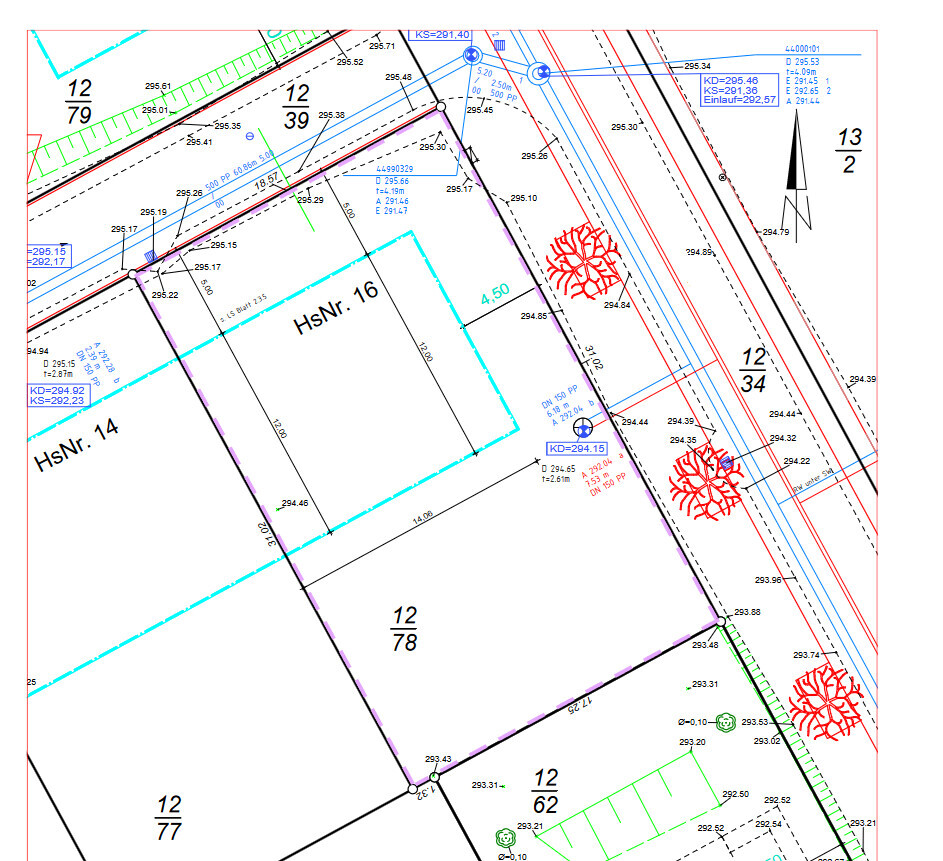
Surrounding buildings
Number of parking spaces: 2
Number of stories: 2 full floors required, plus optional recessed floor (setback floor)
Roof type: Flat roof, max. 5° pitch
Maximum height/limits: Max. 10 m (33 ft) high
Additional requirements: Equipment (heat pump) must be integrated, not external. Maximum of 2 residential units. Specific exterior colors required, rainwater should infiltrate (soil report says this is unlikely). Roofs must be greened. No oil or gas heating allowed.
Client requirements
Style, roof type, building type: Actually, none specified.
Basement, floors: No basement, 2 floors.
Number of occupants, ages: 4 people — 2 adults, 2 children
Ground floor space needs: Daily life (living, kitchen, dining, technical room, guest room)
Upper floor: Family (2 children's rooms, master bedroom, separate bathrooms), home office
Office: Home office, second workspace for occasional use such as a work window sill for example in the bedroom
Guests per year: Currently few.
Open or closed architecture, conservative or modern style: Either is fine.
Open kitchen, kitchen island: We are still considering. Initial wish was separate pantry like in the floor plan. An island would be nice if space allows.
Number of dining seats: Normally 4, rarely up to 8.
Fireplace: None.
Music/stereo wall: Multi-room audio with central unit in technical room.
Balcony, roof terrace: Neither.
Garage, carport: 1 garage
Other wishes: Central vacuum system, laundry chute, smart home (KNX) (I am mostly doing this myself, yes, I am a certified electrician, can program, but will also get additional help)
House design
Who designed the plan:
- Planner from a construction company: Correct, with some input from us. Based on an existing plan.
Price estimate by architect/planner: approx. 485,000 € (euros) for the house, approx. 210,000 € for the plot including basic services (survey, soil report, etc.)
Personal price limit for the house including features: approx. 800,000–850,000 € (including land)
Preferred heating technology: Heat pump
If you had to give up, which details/extra features could you skip:
- Could skip:
- Cannot skip:
Why is the design like it is now? For example:
Standard design by the planner? Yes, with minor wishes from us (wall between study and child’s room 2, T-walls in bathrooms, porch roof, conservatory, pantry)
What do you find especially good or bad about it? So far it seems to fit; apart from possibly the pantry/dining room, we don’t see major issues yet. But that’s why I’m here now.
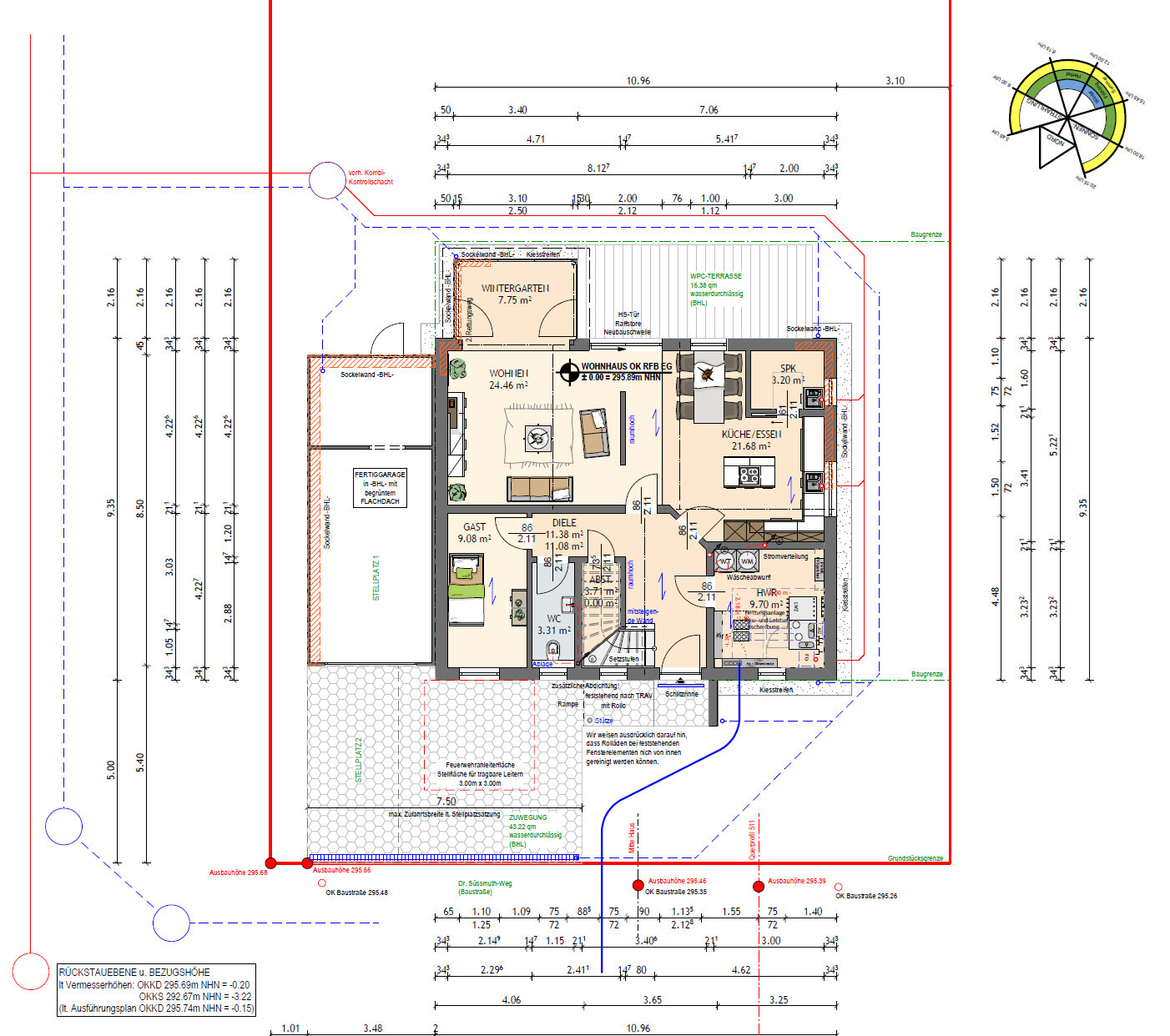
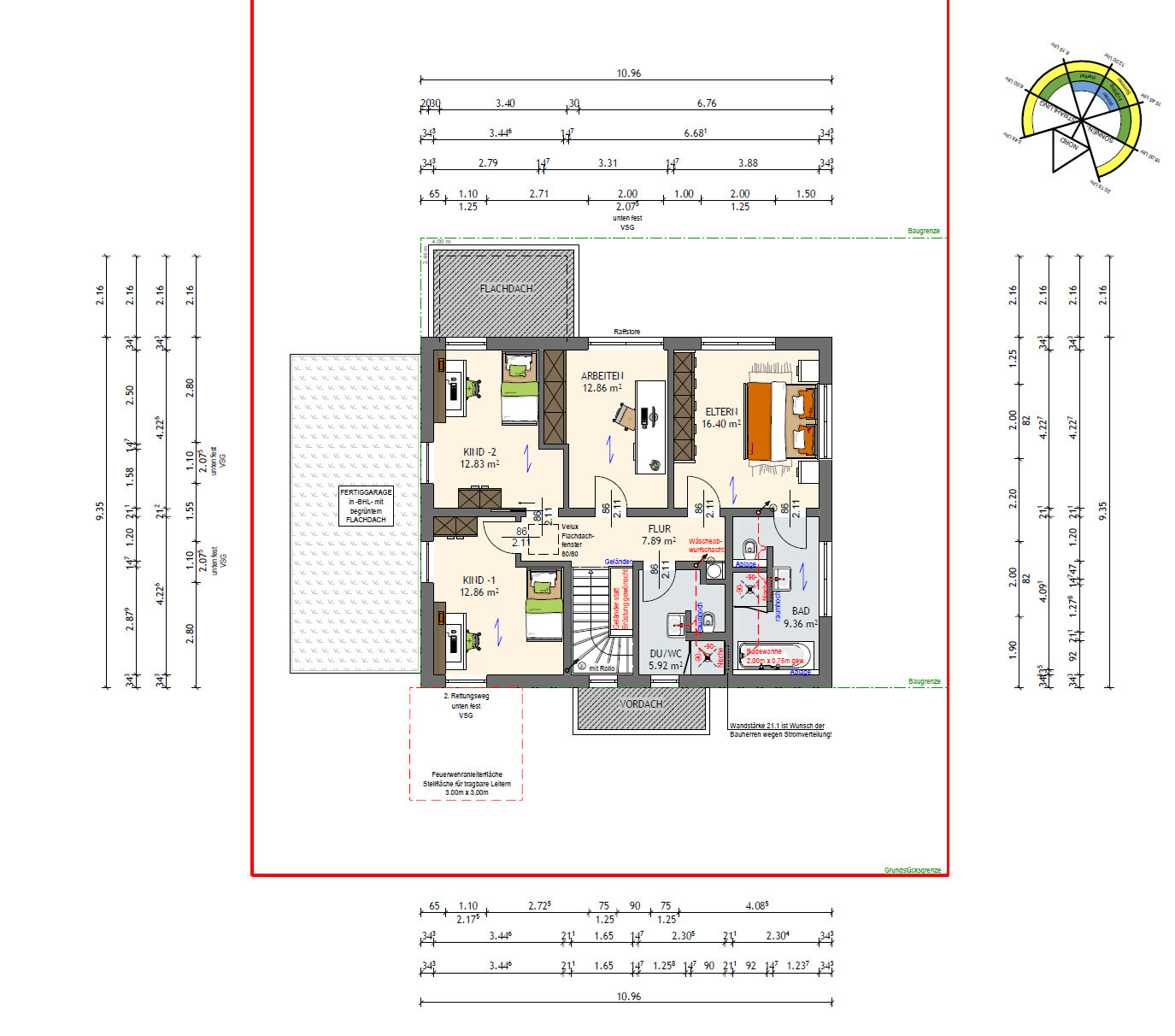
Edit: The furniture shown in the floor plans can be safely ignored. Planners seem to like adding these.
Best regards
Ganneff
I have been reading along for some time now and finally dare to share a floor plan here.
First, here is the list of questions:
Zoning Plan / Restrictions
Plot size: 576 sqm (6,200 sq ft)
Slope: Yes, slight. According to the site plan, the top "right" corner is at 295.4 meters (970 feet), lower at 293.88 meters (964 feet), left side goes from 295.17 meters (968 feet) to 293.43 meters (963 feet)
Floor area ratio: 0.3
Building envelope, building line and boundary: Applies to house number 16
Surrounding buildings
Number of parking spaces: 2
Number of stories: 2 full floors required, plus optional recessed floor (setback floor)
Roof type: Flat roof, max. 5° pitch
Maximum height/limits: Max. 10 m (33 ft) high
Additional requirements: Equipment (heat pump) must be integrated, not external. Maximum of 2 residential units. Specific exterior colors required, rainwater should infiltrate (soil report says this is unlikely). Roofs must be greened. No oil or gas heating allowed.
Client requirements
Style, roof type, building type: Actually, none specified.
Basement, floors: No basement, 2 floors.
Number of occupants, ages: 4 people — 2 adults, 2 children
Ground floor space needs: Daily life (living, kitchen, dining, technical room, guest room)
Upper floor: Family (2 children's rooms, master bedroom, separate bathrooms), home office
Office: Home office, second workspace for occasional use such as a work window sill for example in the bedroom
Guests per year: Currently few.
Open or closed architecture, conservative or modern style: Either is fine.
Open kitchen, kitchen island: We are still considering. Initial wish was separate pantry like in the floor plan. An island would be nice if space allows.
Number of dining seats: Normally 4, rarely up to 8.
Fireplace: None.
Music/stereo wall: Multi-room audio with central unit in technical room.
Balcony, roof terrace: Neither.
Garage, carport: 1 garage
Other wishes: Central vacuum system, laundry chute, smart home (KNX) (I am mostly doing this myself, yes, I am a certified electrician, can program, but will also get additional help)
House design
Who designed the plan:
- Planner from a construction company: Correct, with some input from us. Based on an existing plan.
Price estimate by architect/planner: approx. 485,000 € (euros) for the house, approx. 210,000 € for the plot including basic services (survey, soil report, etc.)
Personal price limit for the house including features: approx. 800,000–850,000 € (including land)
Preferred heating technology: Heat pump
If you had to give up, which details/extra features could you skip:
- Could skip:
- Cannot skip:
Why is the design like it is now? For example:
Standard design by the planner? Yes, with minor wishes from us (wall between study and child’s room 2, T-walls in bathrooms, porch roof, conservatory, pantry)
What do you find especially good or bad about it? So far it seems to fit; apart from possibly the pantry/dining room, we don’t see major issues yet. But that’s why I’m here now.
Edit: The furniture shown in the floor plans can be safely ignored. Planners seem to like adding these.
Best regards
Ganneff
Arauki11 schrieb:
I understand you come from a technical background. I don’t have much experience in this area and haven’t had great results with too much “automation” when it comes to practical everyday life.
First, personal preference can’t be controlled by time, because sometimes I like it bright, sometimes the opposite. How should the system know that? Also, I’d feel overly controlled by too much automation, and just saving the effort of operating a switch doesn’t really make sense in daily life. I used to have an expensive wind-sun automatic control, but it was switched off after just one summer.
My main question, however, is how well you want to insulate, including window properties. Will you use external blinds (e.g. venetian blinds or roller shutters) and is there an overhang on the roof?
We have a southeast orientation with lots of glass, but we have external blinds, air conditioning, and KfW 40 standard.
I simply mean that you really need to look closely at this and honestly assess your own feelings.
So, be sure before committing... many things sound good on paper. Yes, I have a journeyman electrician certificate somewhere and have been programming for decades. I’m currently learning the KNX part.
So far, I have implemented quite a bit of automation (within the limits an apartment rental allows), so this is more about adjusting the system rather than something entirely new. Regarding “how should the system know”: well, that depends on how you set it up. If I manually adjust something, the automation switches off. For a certain period or until another event, it’s a matter of configuration.
For various reasons, I’m not KfW-bound, but “the more insulation, the better.” There is already quite a bit included. And yes, continuing to explore and deepen this is definitely on my list.
haydee schrieb:
@Ganneff, only partially do you see it with chairs. Chairs don’t represent the space needed for someone to squeeze past behind them. Correct, I first need to get to the chair. I have (hopefully sufficiently) taken that into account.
Ganneff schrieb:
Yes, I have an electrician’s journeyman certificate somewhere and have been programming for decades. I’m currently learning the KNX part.
I’ve already done quite a bit of automation (within the limits imposed by living in a rented apartment), so it’s more about adapting the system than starting something entirely new. The question “How is the automation supposed to know that?” well, that’s part of how you set it up. If I adjust something manually, the automation turns off. For a certain time or until another event occurs, it’s then a matter of settings. Although this topic is unfamiliar to me and not necessarily my area of interest, I understand that everyone has different priorities and hobbies. I just want to point out that written terms like “cooling,” “conservatory,” “shading,” etc., while initially sounding reasonable, should be examined carefully in detail regarding their actual effect. Of course, there is always some residual risk with any plan, but I would like to keep that risk as minimal as possible, especially concerning such fundamental matters. I speak from my own “experience” with myself, but of course, that may not apply to you; you have to decide that yourself.
I realize many things can be programmed, and that can be enjoyable, but for example, with wind and sun automation, there will always be a residual risk or a personal feeling that goes against the setting. My sunshade could stay open much longer according to the datasheet, but I often feel uncomfortable when it’s windy. Although there are many reasons and advantages to sophisticated automation, I personally have found that for reasons often unknown even to me, sometimes I prefer one thing and sometimes another, even under the same conditions. My thinking is also more toward comfort: I would rather have manual venetian blinds than automatic roller shutters, or prefer air conditioning over some other solution. Everyone has different priorities, of course, but I would first focus on improving the quality and function of the necessarily installed products and only then look at where to add “extras” (quality flooring, venetian blinds, stairs, seating, etc.). Around me, I often see the opposite order—for example, plastic flooring with elaborate lighting and plenty of technical “gimmicks,” but less overall living quality; that’s what I mean.
In my neighborhood, I currently see only fully darkened living rooms—that would be a nightmare for me, which I would solve with air conditioning and/or venetian blinds or something similar. Although this is widespread, I find it rather unpleasant.
Ganneff schrieb:
For various reasons, I am not tied to KfW, but the principle of “the more insulation, the better” applies. There’s quite a bit in there already. And yes, further exploring this is definitely on my list. I don’t mean the funding program itself, but rather the truly tangible benefit of optimal insulation, ventilation, and shading. This certainly costs a significant amount of money, but it seems to me to be a very worthwhile investment. I built a house in 1990 and again in 2021, so I recognize the difference, even if I would build my next house quite differently again.
It’s fun to have this open discussion, and you will receive a wide range of helpful support here in many areas. No rush……
W
wiltshire23 Jun 2025 17:20About the swing door:
The frame is basically just a board – it must not have a rebate. Very easy to build. The hinges operate either with a spring mechanism or, more elegantly, with gravity. Should the door have one or two panels?
Sealing for soundproofing is a challenge – your son should consider this. These doors never close fully airtight if they are to remain within a reasonably affordable price range. This also applies to drafts and light. Nonetheless, I think it’s a nice idea.
About KNX:
As soon as you mentioned home automation, you seem to be entering familiar territory. If you enjoy it, then definitely build it according to your preferences. My own view is quite similar to that of @Arauki11. What impressed me personally: my father and both parents-in-law developed dementia and increasingly had problems operating electrical devices. My father soon no longer understood the touch switch for dimming in the conservatory, which he had used without issue for 20 years before.
About space around the chairs:
A bench creates space – especially if it has a backrest. In our kitchen, we have a peninsula about 3m (10 feet) long (referred to in our household as the "Spain") with access to storage from both sides. The dining table sits parallel to the long side of the peninsula. In front of four inconspicuous doors, there is a 2m (6½ feet) long bench, and right in front of that is the table. We chose this arrangement because only rarely used items are stored in this part of the kitchen island (vacuum sealer, spice mill, fondue set, less common glasses, manuals, etc.). When something is needed, the bench is simply moved. It has not been inconvenient so far, and the sense of space is great.
I can understand prioritizing quality flooring. Unfortunately, good quality is always quite expensive here. It would look somehow strange if the Eames Lounge Chair stood on laminate.
For stairs, there are very good and not overly expensive solutions if you look beyond standard local products. The same applies to railings. It’s worth asking a locksmith – and if it doesn’t have to be fully compliant with regulations just to look nice, you can order a pre-assembled kit from the locksmith and then leave it as is. This way, the locksmith is not liable, and you get what you want.
External venetian blinds admittedly are an effective shading element – I wouldn’t even have installed them if I had been paid for it.
The frame is basically just a board – it must not have a rebate. Very easy to build. The hinges operate either with a spring mechanism or, more elegantly, with gravity. Should the door have one or two panels?
Sealing for soundproofing is a challenge – your son should consider this. These doors never close fully airtight if they are to remain within a reasonably affordable price range. This also applies to drafts and light. Nonetheless, I think it’s a nice idea.
About KNX:
As soon as you mentioned home automation, you seem to be entering familiar territory. If you enjoy it, then definitely build it according to your preferences. My own view is quite similar to that of @Arauki11. What impressed me personally: my father and both parents-in-law developed dementia and increasingly had problems operating electrical devices. My father soon no longer understood the touch switch for dimming in the conservatory, which he had used without issue for 20 years before.
About space around the chairs:
A bench creates space – especially if it has a backrest. In our kitchen, we have a peninsula about 3m (10 feet) long (referred to in our household as the "Spain") with access to storage from both sides. The dining table sits parallel to the long side of the peninsula. In front of four inconspicuous doors, there is a 2m (6½ feet) long bench, and right in front of that is the table. We chose this arrangement because only rarely used items are stored in this part of the kitchen island (vacuum sealer, spice mill, fondue set, less common glasses, manuals, etc.). When something is needed, the bench is simply moved. It has not been inconvenient so far, and the sense of space is great.
Arauki11 schrieb:
Of course, everyone has different priorities, but I would first increase the quality/functionality of the necessarily installed products and only then look at where to add “extras” (quality flooring, external venetian blinds, stairs, seating furniture, etc.). In my environment, I often see the opposite sequence, for example when walking on plastic floors that are elaborately illuminated.
I can understand prioritizing quality flooring. Unfortunately, good quality is always quite expensive here. It would look somehow strange if the Eames Lounge Chair stood on laminate.
For stairs, there are very good and not overly expensive solutions if you look beyond standard local products. The same applies to railings. It’s worth asking a locksmith – and if it doesn’t have to be fully compliant with regulations just to look nice, you can order a pre-assembled kit from the locksmith and then leave it as is. This way, the locksmith is not liable, and you get what you want.
External venetian blinds admittedly are an effective shading element – I wouldn’t even have installed them if I had been paid for it.
wiltshire schrieb:
About the swing door:
The frame is really just a simple board – it should have no rebate. Very easy to build. The hinges either work with a spring mechanism or, more elegantly, with gravity. Do you want the door to have one or two leaves?
Sealing in terms of soundproofing is a challenge – your son should keep that in mind. These doors never seal completely if they are to stay within a reasonable price range. This also applies to drafts and light. Still, I think it’s a nice idea. One leaf is preferred – and it is quite feasible space-wise. Regarding sealing: I was thinking about a sealing tape for doors/windows, something like a 0.5cm (0.2 inch) self-adhesive strip or so. The door will have to have a small gap between itself and the frame. Applying the tape either to the door leaf or to the frame should at least keep light out. Maybe reduce some sound as well. It would just need to be replaced every two or three years. How much draft needs to be reduced – well, the house has a central ventilation system. So some air movement must be present anyway.
wiltshire schrieb:
About KNX:
As soon as you mentioned home automation, it seems you’re entering familiar territory. If you enjoy it, then definitely build it according to your wishes. My own view is quite similar to @Arauki11. What struck me personally was this: my father and both parents-in-law developed dementia and had increasing difficulties operating electrical devices. My father soon no longer understood the touch switch for dimming in the conservatory, although he had easily used it for 20 years before. Well. I’m a trained electrician and have long worked as a sysadmin/programmer, so this is my area. It’ll be fine. There are some differences from what I normally do, but it’s learnable. I already have a corresponding test board here.
wiltshire schrieb:
About space for chairs:
A bench saves space – especially if it has a wall at the back. In our kitchen, we have a roughly 3m (10 feet) long peninsula (locally nicknamed “Spain”) with storage access from both sides. The dining table runs parallel to the long side of the peninsula. In front of four discreet doors, there is a 2m (6.5 feet) long bench, and the table is placed right there. We chose this deliberately since this part of the kitchen island only contains rarely used items (vacuum sealer, spice grinder, fondue set, less common glassware, manuals...). When something is needed, the bench is simply moved. So far, it has not caused any inconvenience. And the sense of space is great. Yes. I originally had a bench at the wall in the pantry design. If it turns out a bench (whether fixed to the wall or movable) works better here, that is certainly an option.
wiltshire schrieb:
I understand the idea of installing high-quality flooring first. Good quality is unfortunately quite expensive here. It would look somehow odd if the Eames Lounge Chair stood on laminate flooring.
For stairs, there are very good and not too expensive solutions if you look beyond the usual standard German products. The same applies to railings. Consulting a metalworker is worthwhile – and if it doesn’t have to be strictly compliant with all standards to look good, you can order a pre-assembled kit (from the metalworker) and then do no further work on it. This way, the metalworker is no longer liable and you get exactly what you want.
Venetian blinds are admittedly an effective shading element – but I wouldn’t have installed them even if I was paid to do so. Ah, we just had a HausBau Plus fair recently here. Many were there, and we had quite a few discussions – and as so often, the smaller companies where the owner was personally at the stand conducting conversations came across as the most competent.
W
wiltshire23 Jun 2025 18:05Ganneff schrieb:
The smaller companies where the owner was personally on site and conducted the discussions came across as the most competent.In small companies, the owners shape the product range, scope of services, pricing, and the willingness to engage with certain clients while declining others. This naturally creates the strongest impression of competence. The most technically skilled individuals often have less customer contact and are utilized differently. A good entrepreneur willingly hires people who surpass them technically.