
Hello,
I have been reading along for some time now and finally dare to share a floor plan here.
First, here is the list of questions:
Zoning Plan / Restrictions
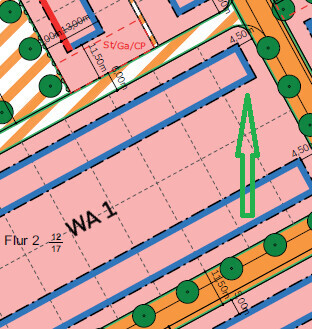
Plot size: 576 sqm (6,200 sq ft)
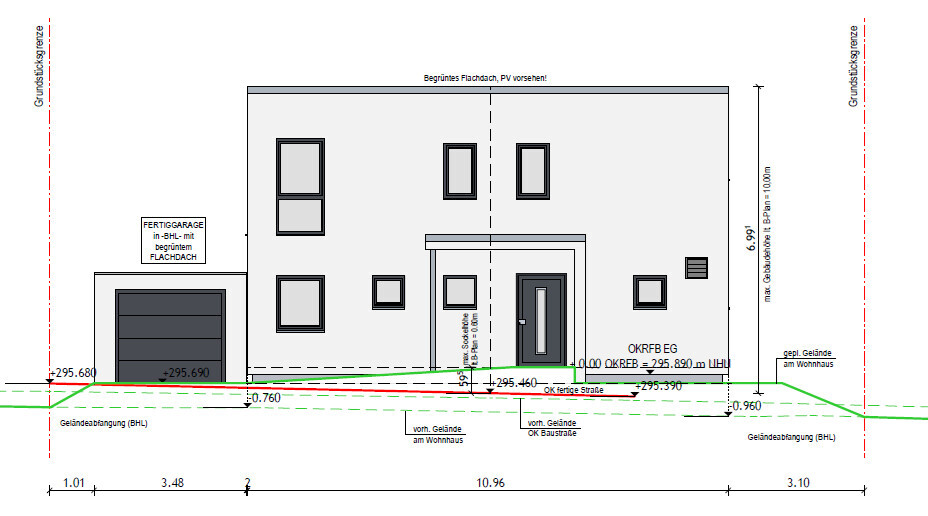
Slope: Yes, slight. According to the site plan, the top "right" corner is at 295.4 meters (970 feet), lower at 293.88 meters (964 feet), left side goes from 295.17 meters (968 feet) to 293.43 meters (963 feet)
Floor area ratio: 0.3
Building envelope, building line and boundary: Applies to house number 16
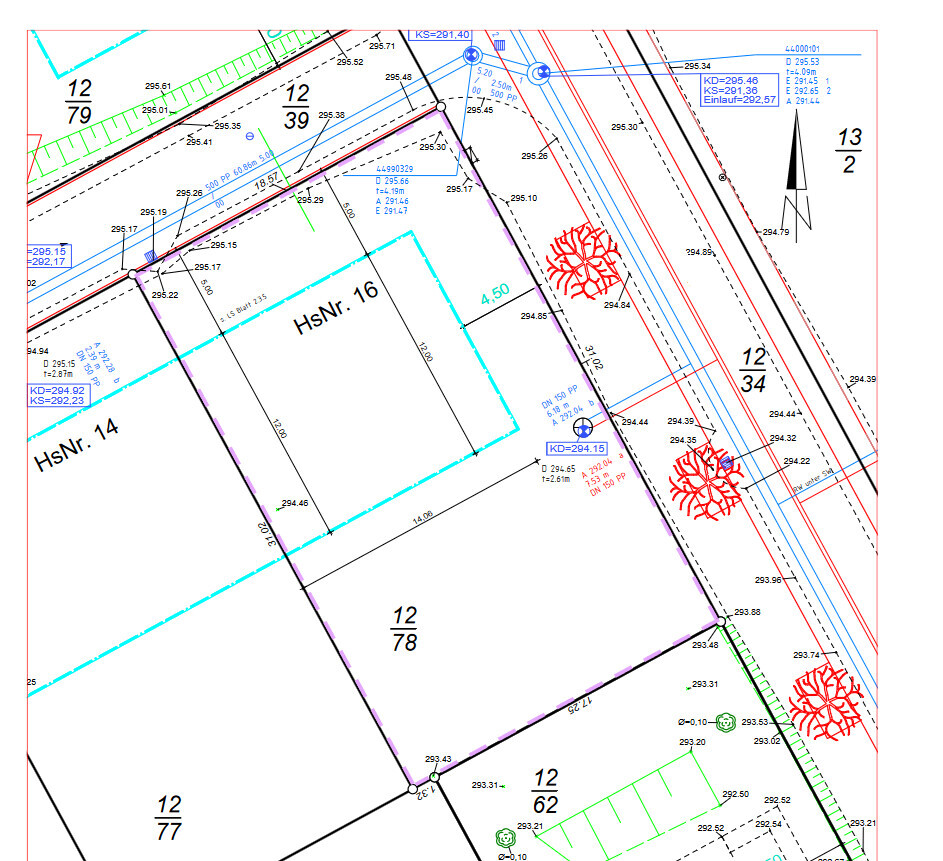
Surrounding buildings
Number of parking spaces: 2
Number of stories: 2 full floors required, plus optional recessed floor (setback floor)
Roof type: Flat roof, max. 5° pitch
Maximum height/limits: Max. 10 m (33 ft) high
Additional requirements: Equipment (heat pump) must be integrated, not external. Maximum of 2 residential units. Specific exterior colors required, rainwater should infiltrate (soil report says this is unlikely). Roofs must be greened. No oil or gas heating allowed.
Client requirements
Style, roof type, building type: Actually, none specified.
Basement, floors: No basement, 2 floors.
Number of occupants, ages: 4 people — 2 adults, 2 children
Ground floor space needs: Daily life (living, kitchen, dining, technical room, guest room)
Upper floor: Family (2 children's rooms, master bedroom, separate bathrooms), home office
Office: Home office, second workspace for occasional use such as a work window sill for example in the bedroom
Guests per year: Currently few.
Open or closed architecture, conservative or modern style: Either is fine.
Open kitchen, kitchen island: We are still considering. Initial wish was separate pantry like in the floor plan. An island would be nice if space allows.
Number of dining seats: Normally 4, rarely up to 8.
Fireplace: None.
Music/stereo wall: Multi-room audio with central unit in technical room.
Balcony, roof terrace: Neither.
Garage, carport: 1 garage
Other wishes: Central vacuum system, laundry chute, smart home (KNX) (I am mostly doing this myself, yes, I am a certified electrician, can program, but will also get additional help)
House design
Who designed the plan:
- Planner from a construction company: Correct, with some input from us. Based on an existing plan.
Price estimate by architect/planner: approx. 485,000 € (euros) for the house, approx. 210,000 € for the plot including basic services (survey, soil report, etc.)
Personal price limit for the house including features: approx. 800,000–850,000 € (including land)
Preferred heating technology: Heat pump
If you had to give up, which details/extra features could you skip:
- Could skip:
- Cannot skip:
Why is the design like it is now? For example:
Standard design by the planner? Yes, with minor wishes from us (wall between study and child’s room 2, T-walls in bathrooms, porch roof, conservatory, pantry)
What do you find especially good or bad about it? So far it seems to fit; apart from possibly the pantry/dining room, we don’t see major issues yet. But that’s why I’m here now.
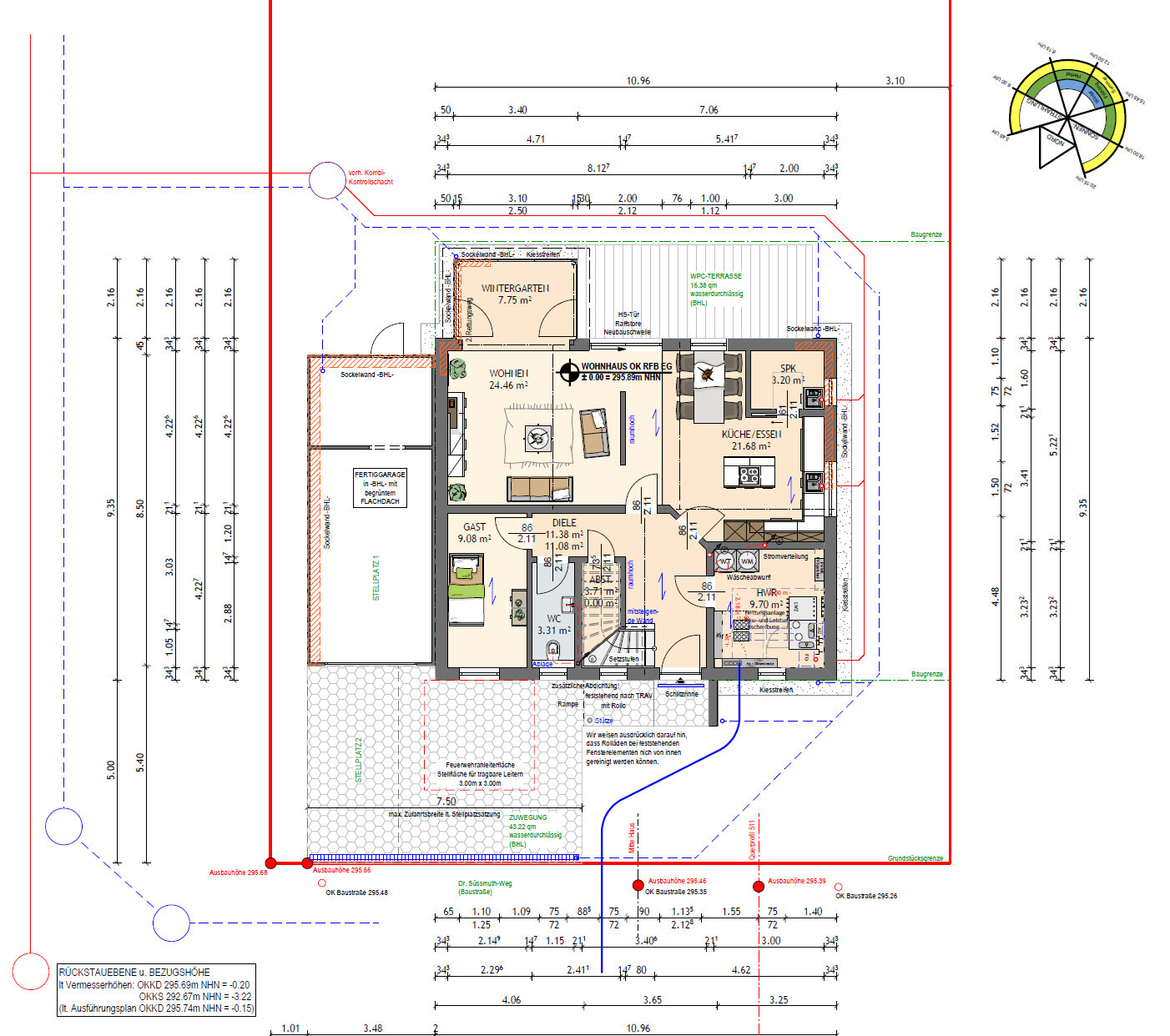
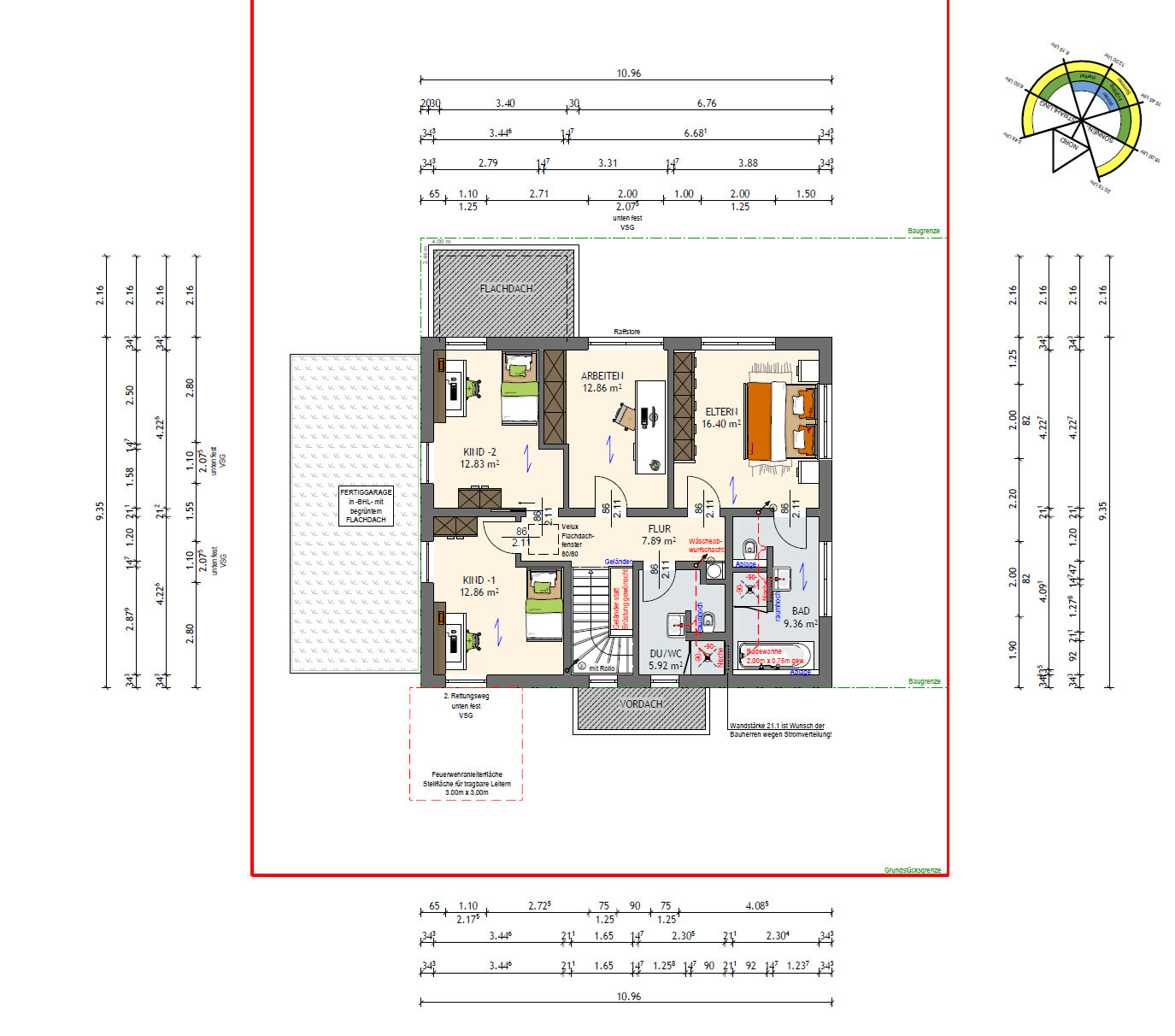
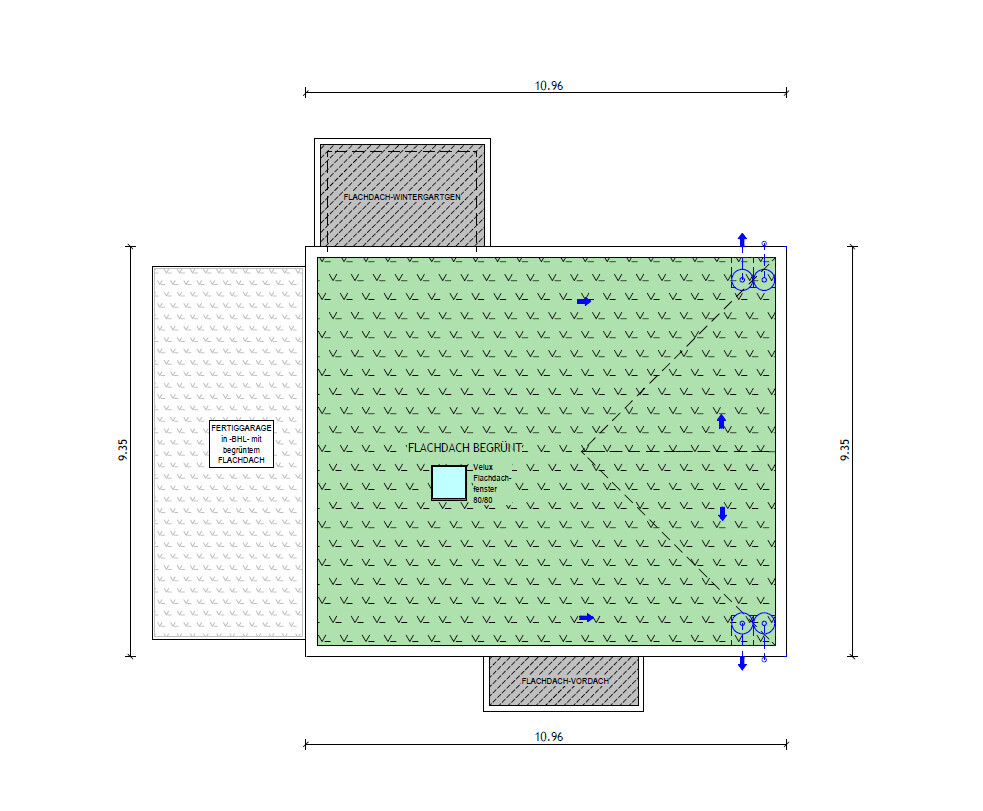
Edit: The furniture shown in the floor plans can be safely ignored. Planners seem to like adding these.
Best regards
Ganneff
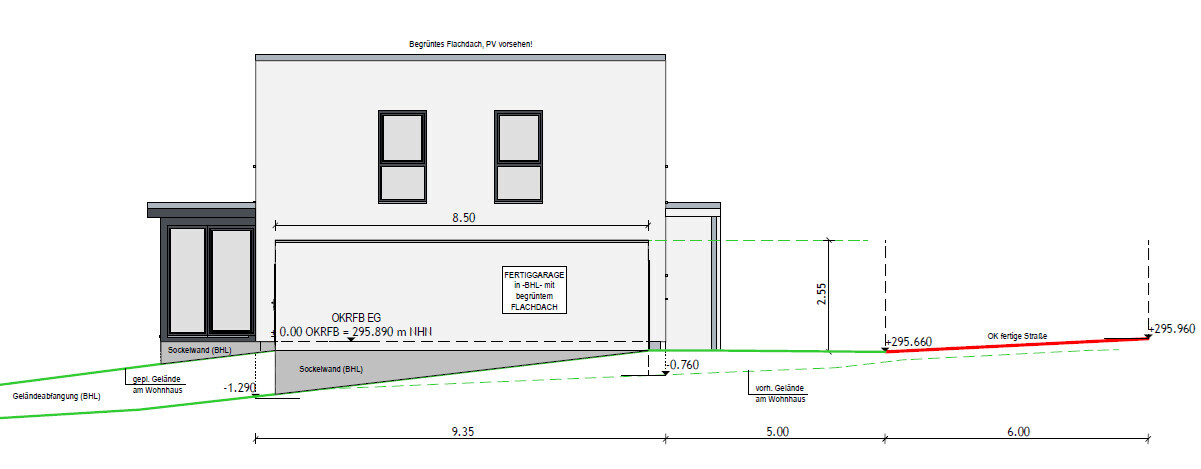
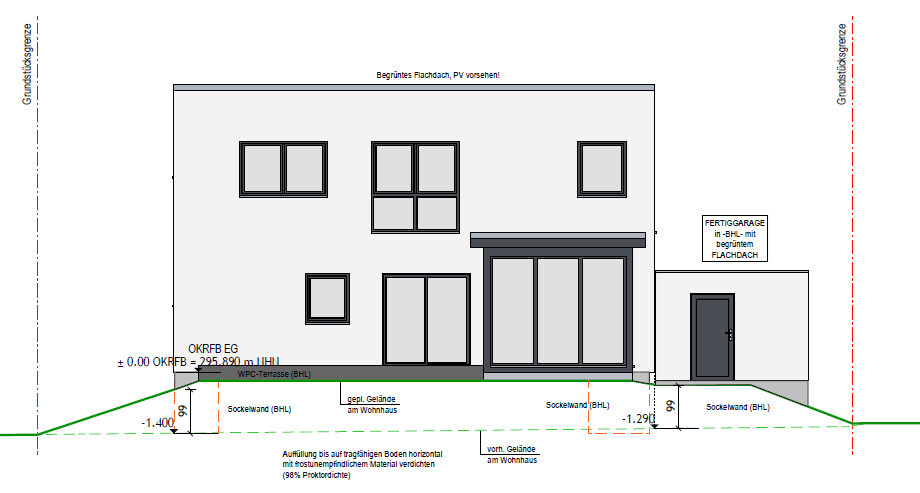
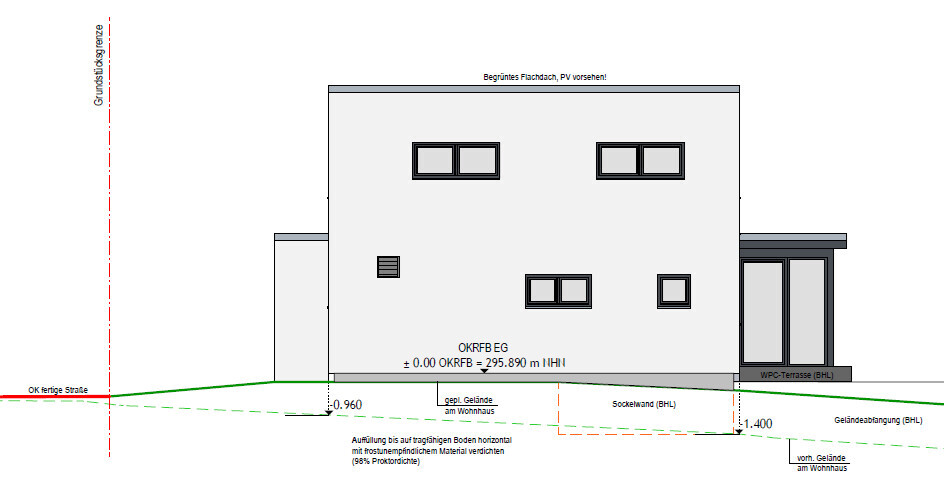
I have been reading along for some time now and finally dare to share a floor plan here.
First, here is the list of questions:
Zoning Plan / Restrictions
Plot size: 576 sqm (6,200 sq ft)
Slope: Yes, slight. According to the site plan, the top "right" corner is at 295.4 meters (970 feet), lower at 293.88 meters (964 feet), left side goes from 295.17 meters (968 feet) to 293.43 meters (963 feet)
Floor area ratio: 0.3
Building envelope, building line and boundary: Applies to house number 16
Surrounding buildings
Number of parking spaces: 2
Number of stories: 2 full floors required, plus optional recessed floor (setback floor)
Roof type: Flat roof, max. 5° pitch
Maximum height/limits: Max. 10 m (33 ft) high
Additional requirements: Equipment (heat pump) must be integrated, not external. Maximum of 2 residential units. Specific exterior colors required, rainwater should infiltrate (soil report says this is unlikely). Roofs must be greened. No oil or gas heating allowed.
Client requirements
Style, roof type, building type: Actually, none specified.
Basement, floors: No basement, 2 floors.
Number of occupants, ages: 4 people — 2 adults, 2 children
Ground floor space needs: Daily life (living, kitchen, dining, technical room, guest room)
Upper floor: Family (2 children's rooms, master bedroom, separate bathrooms), home office
Office: Home office, second workspace for occasional use such as a work window sill for example in the bedroom
Guests per year: Currently few.
Open or closed architecture, conservative or modern style: Either is fine.
Open kitchen, kitchen island: We are still considering. Initial wish was separate pantry like in the floor plan. An island would be nice if space allows.
Number of dining seats: Normally 4, rarely up to 8.
Fireplace: None.
Music/stereo wall: Multi-room audio with central unit in technical room.
Balcony, roof terrace: Neither.
Garage, carport: 1 garage
Other wishes: Central vacuum system, laundry chute, smart home (KNX) (I am mostly doing this myself, yes, I am a certified electrician, can program, but will also get additional help)
House design
Who designed the plan:
- Planner from a construction company: Correct, with some input from us. Based on an existing plan.
Price estimate by architect/planner: approx. 485,000 € (euros) for the house, approx. 210,000 € for the plot including basic services (survey, soil report, etc.)
Personal price limit for the house including features: approx. 800,000–850,000 € (including land)
Preferred heating technology: Heat pump
If you had to give up, which details/extra features could you skip:
- Could skip:
- Cannot skip:
Why is the design like it is now? For example:
Standard design by the planner? Yes, with minor wishes from us (wall between study and child’s room 2, T-walls in bathrooms, porch roof, conservatory, pantry)
What do you find especially good or bad about it? So far it seems to fit; apart from possibly the pantry/dining room, we don’t see major issues yet. But that’s why I’m here now.
Edit: The furniture shown in the floor plans can be safely ignored. Planners seem to like adding these.
Best regards
Ganneff
M
MachsSelbst23 Jun 2025 13:59Just because a brother once thought he was being treated unfairly, should children’s bedrooms now be designed to be as different in size as possible? That doesn’t seem reasonable.
However, I do agree that children should have as little influence as possible in decisions. Kids, especially young ones, want something different today and something else tomorrow. You can’t keep up with that, so it’s best not to, especially when it comes to the floor plan and any unusual door shapes.
However, I do agree that children should have as little influence as possible in decisions. Kids, especially young ones, want something different today and something else tomorrow. You can’t keep up with that, so it’s best not to, especially when it comes to the floor plan and any unusual door shapes.
MachsSelbst schrieb:
Just because one brother once imagined he was being treated unfairly, should children’s rooms now be planned to be as different in size as possible? That doesn’t sound plausible. No, that’s not what was said or meant.

MachsSelbst schrieb:
Just because one brother once imagined he was being treated unfairly, does that mean children’s rooms should now be designed to be as different in size as possible? That doesn’t sound plausible. No, that would obviously be an even more ridiculous “reason” than …
Arauki11 schrieb:
No, that’s not what was said or meant. … which I actually wanted to point out: mistakenly assuming room size in square meters as the key quality indicator for user satisfaction. Apparently, there are kids who would prefer to have a restaurant kitchen door for their room. I would have liked to have had a small plane landing strip (the wish was not fulfilled). In seventh grade, my classmate Klops wanted me to design a house for him that would primarily have a barn serving as an aviary for his (yet to be acquired) parrot. Two years later, my ideal children's room would have looked like Magnum’s apartment.
https://www.instagram.com/11antgmxde/
https://www.linkedin.com/company/bauen-jetzt/
M
motorradsilke23 Jun 2025 14:32MachsSelbst schrieb:
Just because a brother once imagined he was being treated unfairly, should we now plan children’s rooms to be as differently sized as possible? That doesn’t sound reasonable.
Where I do agree is to give children as little room as possible to make decisions. Kids, especially young ones, want one thing today and another tomorrow. You can’t keep up with that, so it’s best not to try—especially when it comes to the layout and any unusual door shapes.A door like that can be built by the kids themselves (or together at that age). The fittings are available at hardware stores. And if they lose interest later, you can always install a standard door.haydee schrieb:
Remember, you calculate 1 meter (3 feet) of clearance from the edge of the table for movement space. So if you want a table that is 1x2 meters (3x6.5 feet), you need a 3x4 meter (10x13 feet) template. It’s crazy how much space that requires. I didn’t do that – but I did model the chairs. That way you can see whether there’s still a reasonable way to move around or not.
Arauki11 schrieb:
I think that’s great and surely very helpful for you. Even if the effort just prevented 3 or 4 tight spots or tricky points, it’s already worth it. For me, drawing and moving things back and forth makes it a lot easier to grasp. Better not tell you what we’ve done here to simulate things for ourselves with the possibilities we each had. So both the input from this forum and some from elsewhere led to quite a few adjustments. The painting helped to make it clearer.
Arauki11 schrieb:
Exactly, that is a nice example. And if a child “regrets” their decision later, they’ve learned something and it can be corrected again. If you get your kids – or they do themselves – to plan their room in all the possible details on their own, that’s already a gain, provided there are no major cost drivers involved. Within what’s possible for them, the kids know what costs the whole project will involve. We always go through the costs with them, even regarding their wishes.
Of course, they don’t really understand the big numbers yet – but it’s nice to see what of a difference two years of life make, and they’re not completely unaware.
Arauki11 schrieb:
Exactly – and I totally understand that. But precisely because of that, you should at least roughly know the total costs of a feature like this and what equipment is required, so you don’t regret it later. Depending on orientation, window size and type, shading, insulation, etc., it can become a real greenhouse effect and impact the entire home. So if it’s not comfortably affordable, I’d skip it and free up money needed elsewhere; in other words: don’t do “half” measures when it has such a strong impact on the building and indoor climate. Many things can be corrected later if you made a mistake – but hardly this. At the moment, I’m waiting to see what the company comes back with regarding the requested changes. Then I’ll see how to proceed. The orientation is south, unblocked, so yes, plenty of sun. That’s why I’m (appropriately) planning shading.
Arauki11 schrieb:
What does that look like in terms of type and cost? We don’t have KNX; if needed, we just use regular switches in the old-fashioned way. This part of the cost is not really significant.
Basically, you always first need appropriate shading everywhere. Then the motors (and not the ones with the radio option…). And cables – here’s where the difference begins. Traditionally, the cables go from the shutter switches to the roller shutter motor. With KNX, instead of a switch, you have the KNX bus cable (a 4-wire cable, usually green) and KNX-compatible “switches.” Here, you don’t necessarily put two classic switches next to the shutters (you can, but where’s the advantage?), but rather have a central location in the room where the entire room control is housed. Plus other things like a weather station for wind/sun, sensors for temperature, humidity, and so forth.
Then you have the cables going directly to the motors from the distribution board. The actuators sit in the distribution board, and depending on the settings, they open, close, or position the shading at any intermediate point. Whether this is triggered by a person pressing a button or automatically by “too much sun, close the shades” is just a matter of programming. Also features like “if the patio door is open, don’t lower the shutter” can be programmed.
A bit more cost for the actuators in the distribution board, some more cabling. Programming work for the functions. Depending on what you can do yourself, it’s a little more expensive than traditional systems – but not enough to matter over the lifetime. (For example, an 8-channel shutter actuator costs about €280.) Compared to the automation benefits, that’s quite reasonable.
What’s more interesting is what you mentioned earlier – what effect this has on heating and, rather, cooling costs and heat buildup.
11ant schrieb:
So, a restaurant kitchen door. The fact that these doors cost more than those in notaries’ or specialist doctors’ offices—and resemble the “Porsches” of commercial kitchen builders—is not a coincidence. These doors are only that expensive because the manufacturers explicitly make their profit from the bidirectional door hinges. If the kid had a choice, would they still want this door, or rather a rain shower with mood lighting and the latest iPhone and PlayStation models throughout their studies? If I subscribe to the PlayStation permanently, then I’ve lost everything else, no thanks, better leave that alone...
At the moment, I’m leaning toward a custom-made door, or one built with semi-professional help. Finding hardware with hinges that swing both ways shouldn’t be too difficult. Just a suitable frame to go with it, and that should be fine. Something like that.
11ant schrieb:
... what I actually wanted to point out: assuming room size in square meters (square feet) as the key quality indicator for user satisfaction is misleading. Apparently, there are kids who would prefer a restaurant kitchen door. I would have liked to have had a Fliewatüüt landing strip (my wish wasn’t fulfilled). In the seventh grade, a classmate named Klops wanted me to design a house primarily featuring a barn as an aviary for his (still to be acquired) parrot. Two years later, my preferred childhood bedroom would have looked like Magnum’s apartment. Ha, if I were to fulfill the biggest wish there, I’d have to include a horse stable. I think some amount of input and co-planning is good, but the final decision should rest with the adults. Then everything will work out.