
Hello,
I have been reading along for some time now and finally dare to share a floor plan here.
First, here is the list of questions:
Zoning Plan / Restrictions
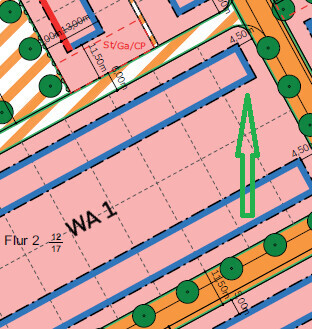
Plot size: 576 sqm (6,200 sq ft)
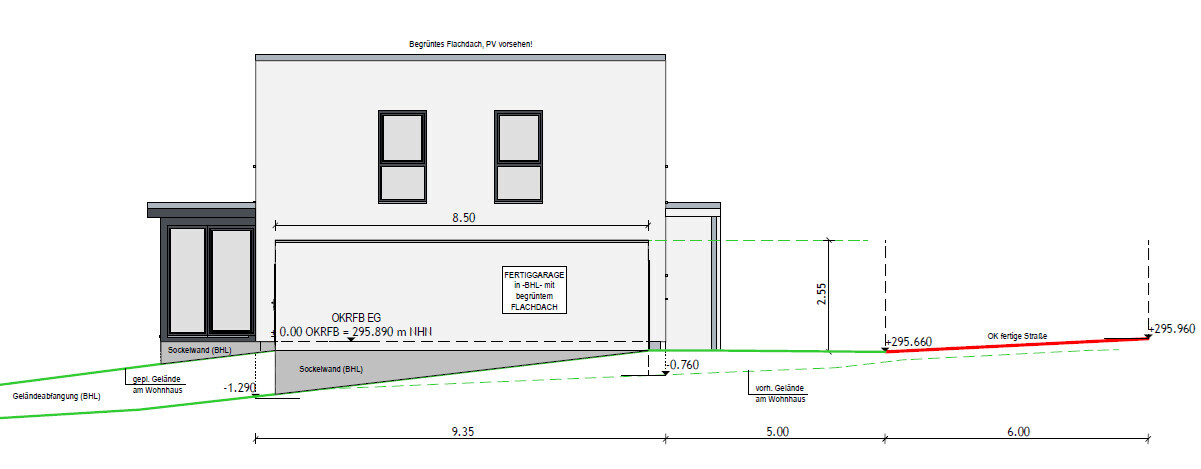
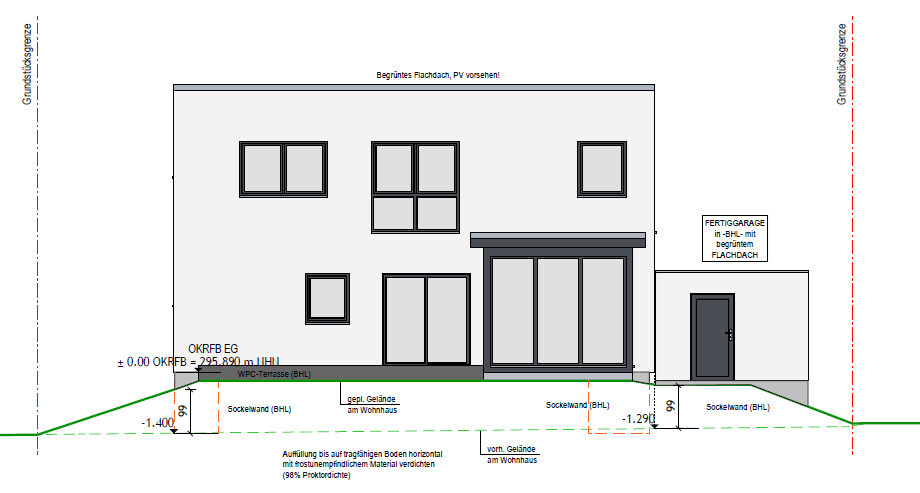
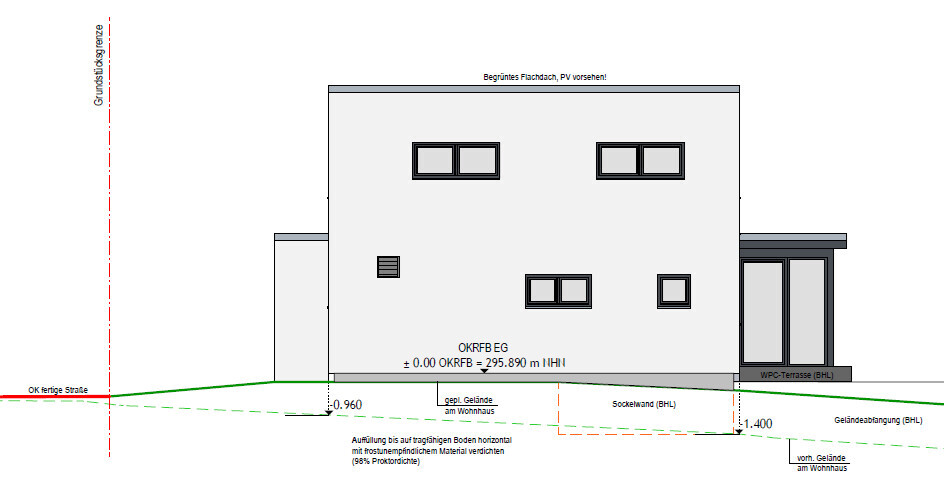
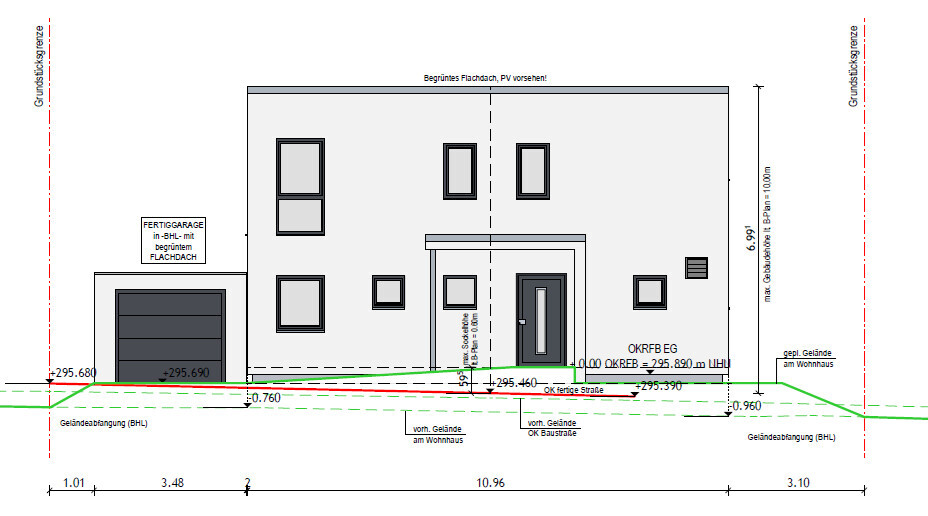
Slope: Yes, slight. According to the site plan, the top "right" corner is at 295.4 meters (970 feet), lower at 293.88 meters (964 feet), left side goes from 295.17 meters (968 feet) to 293.43 meters (963 feet)
Floor area ratio: 0.3
Building envelope, building line and boundary: Applies to house number 16
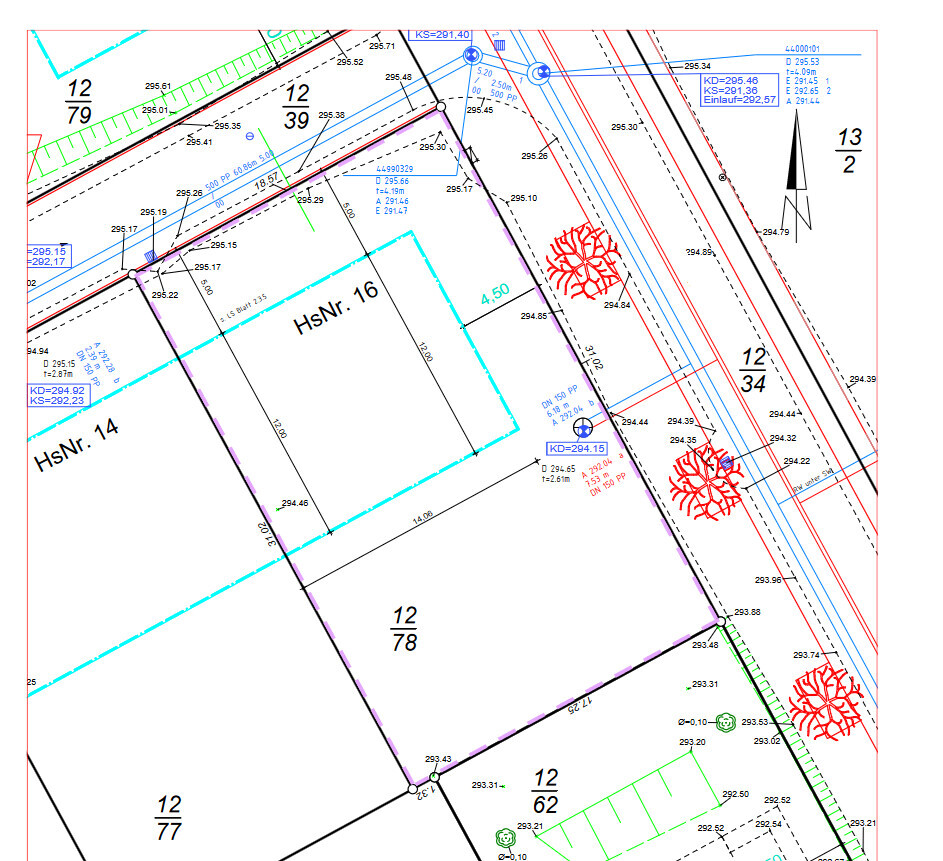
Surrounding buildings
Number of parking spaces: 2
Number of stories: 2 full floors required, plus optional recessed floor (setback floor)
Roof type: Flat roof, max. 5° pitch
Maximum height/limits: Max. 10 m (33 ft) high
Additional requirements: Equipment (heat pump) must be integrated, not external. Maximum of 2 residential units. Specific exterior colors required, rainwater should infiltrate (soil report says this is unlikely). Roofs must be greened. No oil or gas heating allowed.
Client requirements
Style, roof type, building type: Actually, none specified.
Basement, floors: No basement, 2 floors.
Number of occupants, ages: 4 people — 2 adults, 2 children
Ground floor space needs: Daily life (living, kitchen, dining, technical room, guest room)
Upper floor: Family (2 children's rooms, master bedroom, separate bathrooms), home office
Office: Home office, second workspace for occasional use such as a work window sill for example in the bedroom
Guests per year: Currently few.
Open or closed architecture, conservative or modern style: Either is fine.
Open kitchen, kitchen island: We are still considering. Initial wish was separate pantry like in the floor plan. An island would be nice if space allows.
Number of dining seats: Normally 4, rarely up to 8.
Fireplace: None.
Music/stereo wall: Multi-room audio with central unit in technical room.
Balcony, roof terrace: Neither.
Garage, carport: 1 garage
Other wishes: Central vacuum system, laundry chute, smart home (KNX) (I am mostly doing this myself, yes, I am a certified electrician, can program, but will also get additional help)
House design
Who designed the plan:
- Planner from a construction company: Correct, with some input from us. Based on an existing plan.
Price estimate by architect/planner: approx. 485,000 € (euros) for the house, approx. 210,000 € for the plot including basic services (survey, soil report, etc.)
Personal price limit for the house including features: approx. 800,000–850,000 € (including land)
Preferred heating technology: Heat pump
If you had to give up, which details/extra features could you skip:
- Could skip:
- Cannot skip:
Why is the design like it is now? For example:
Standard design by the planner? Yes, with minor wishes from us (wall between study and child’s room 2, T-walls in bathrooms, porch roof, conservatory, pantry)
What do you find especially good or bad about it? So far it seems to fit; apart from possibly the pantry/dining room, we don’t see major issues yet. But that’s why I’m here now.
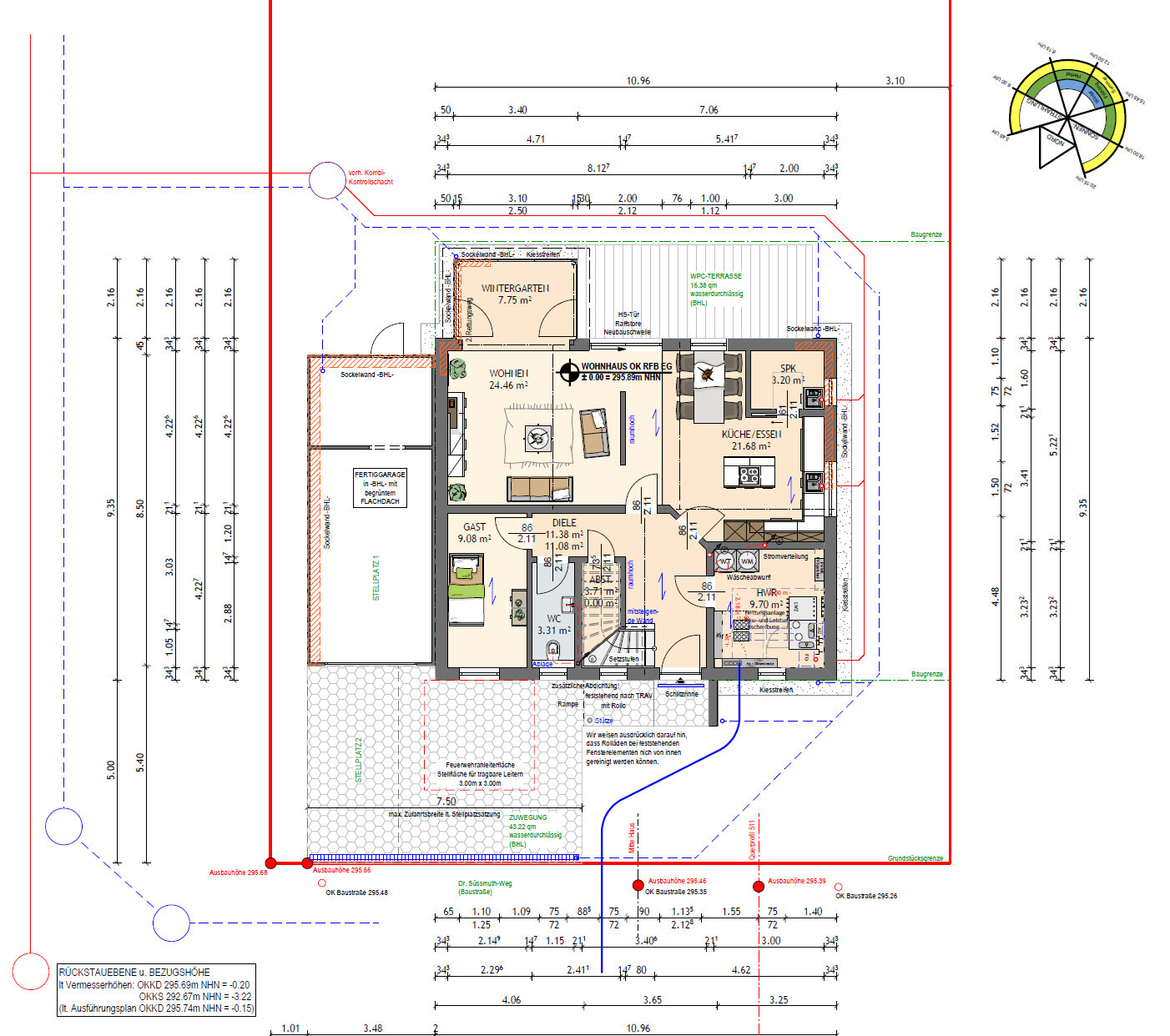
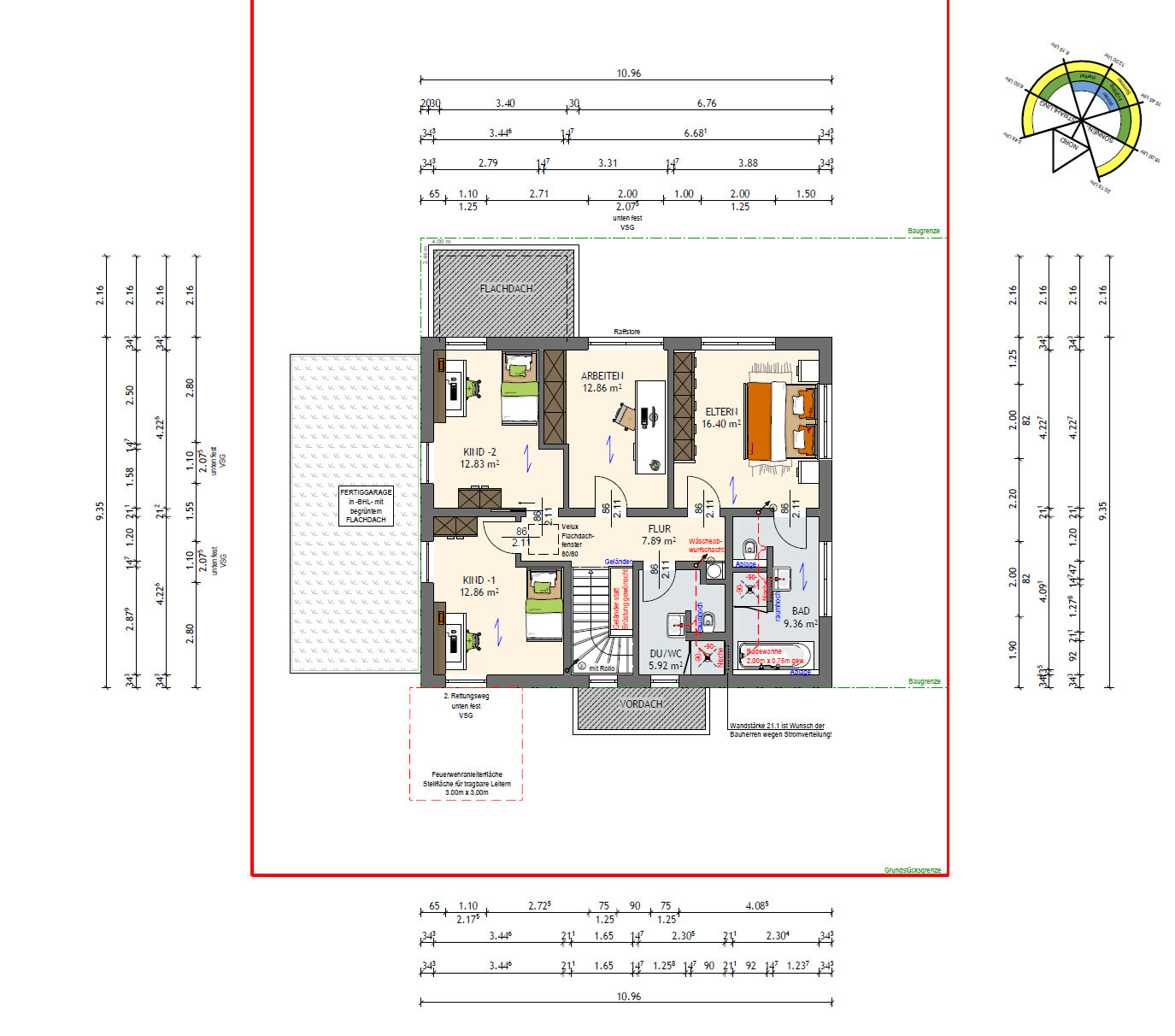
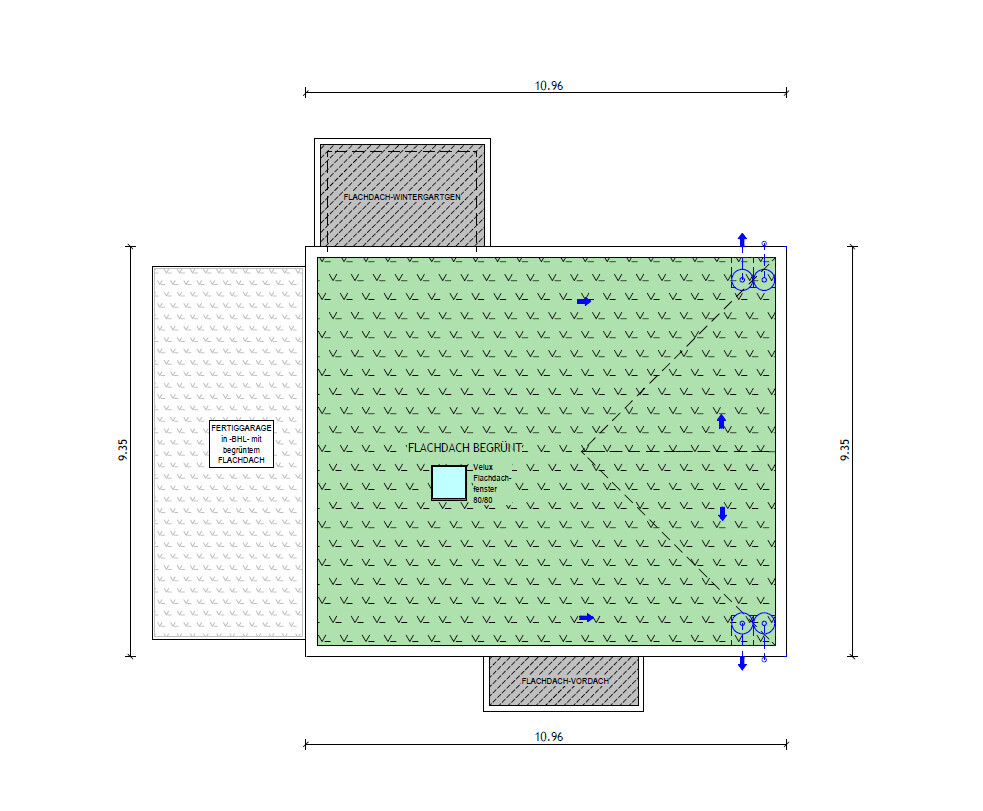
Edit: The furniture shown in the floor plans can be safely ignored. Planners seem to like adding these.
Best regards
Ganneff
I have been reading along for some time now and finally dare to share a floor plan here.
First, here is the list of questions:
Zoning Plan / Restrictions
Plot size: 576 sqm (6,200 sq ft)
Slope: Yes, slight. According to the site plan, the top "right" corner is at 295.4 meters (970 feet), lower at 293.88 meters (964 feet), left side goes from 295.17 meters (968 feet) to 293.43 meters (963 feet)
Floor area ratio: 0.3
Building envelope, building line and boundary: Applies to house number 16
Surrounding buildings
Number of parking spaces: 2
Number of stories: 2 full floors required, plus optional recessed floor (setback floor)
Roof type: Flat roof, max. 5° pitch
Maximum height/limits: Max. 10 m (33 ft) high
Additional requirements: Equipment (heat pump) must be integrated, not external. Maximum of 2 residential units. Specific exterior colors required, rainwater should infiltrate (soil report says this is unlikely). Roofs must be greened. No oil or gas heating allowed.
Client requirements
Style, roof type, building type: Actually, none specified.
Basement, floors: No basement, 2 floors.
Number of occupants, ages: 4 people — 2 adults, 2 children
Ground floor space needs: Daily life (living, kitchen, dining, technical room, guest room)
Upper floor: Family (2 children's rooms, master bedroom, separate bathrooms), home office
Office: Home office, second workspace for occasional use such as a work window sill for example in the bedroom
Guests per year: Currently few.
Open or closed architecture, conservative or modern style: Either is fine.
Open kitchen, kitchen island: We are still considering. Initial wish was separate pantry like in the floor plan. An island would be nice if space allows.
Number of dining seats: Normally 4, rarely up to 8.
Fireplace: None.
Music/stereo wall: Multi-room audio with central unit in technical room.
Balcony, roof terrace: Neither.
Garage, carport: 1 garage
Other wishes: Central vacuum system, laundry chute, smart home (KNX) (I am mostly doing this myself, yes, I am a certified electrician, can program, but will also get additional help)
House design
Who designed the plan:
- Planner from a construction company: Correct, with some input from us. Based on an existing plan.
Price estimate by architect/planner: approx. 485,000 € (euros) for the house, approx. 210,000 € for the plot including basic services (survey, soil report, etc.)
Personal price limit for the house including features: approx. 800,000–850,000 € (including land)
Preferred heating technology: Heat pump
If you had to give up, which details/extra features could you skip:
- Could skip:
- Cannot skip:
Why is the design like it is now? For example:
Standard design by the planner? Yes, with minor wishes from us (wall between study and child’s room 2, T-walls in bathrooms, porch roof, conservatory, pantry)
What do you find especially good or bad about it? So far it seems to fit; apart from possibly the pantry/dining room, we don’t see major issues yet. But that’s why I’m here now.
Edit: The furniture shown in the floor plans can be safely ignored. Planners seem to like adding these.
Best regards
Ganneff
Arauki11 schrieb:
Without real furniture and their dimensions, good planning is difficult. Even a small edge or feature can strongly affect an attractive floor plan or make a piece of furniture useless; both are unnecessary and a shame. I don’t really care about the roof shape; I prefer custom-designed floor plans that fit the residents exactly; that alone would be my goal. A nice facade or roof shape can always be found later. In fact, we were busy today painting, crafting, and basically “playing” with it. Here’s a photo of that:
This is roughly to scale. Not down to the last millimeter, especially the cardboard pieces, but quite close overall. It’s fascinating when you juggle 3 or 4 sofas, kitchen islands, and so on, all in different sizes.
This is just one of many possible combinations. This naturally raised questions from the future homeowner’s perspective (what sizes of conservatories are realistically possible? Perhaps instead of a conservatory, an oriel window—how about that? …), so it’s now on hold until I get some answers.
Arauki11 schrieb:
Although I don’t find the children’s involvement problematic, in my opinion a child should not and cannot have a significant influence on the core principles of housebuilding (floor plan, daily routines…).
[…]
Of course, the child should have a nice space, be involved, and especially be able to help design their own bedroom, but not interfere with the overall concept/floor plan. A small, seemingly insignificant change to the floor plan can completely ruin it – so I’d be cautious about that. Well. It is indeed a family project. The children have some influence and will keep it – but the final say (except for their own rooms) is with my wife and me. I think it’s good that they contribute. It’s not like they have free rein for changes.
The door thing is funny – the second child actually wants a swinging door (not a half saloon style, but a fully functional one that swings both ways). So everyone has their own wishes there.
Things like “size must be the same” sometimes arise naturally from life and previous experience.
Arauki11 schrieb:
Here, too, I think it’s important that you, as the breadwinner, have a nice workspace. After all, you’re enabling this house to be built. Since you apparently work a lot from home, you should pay particular attention to having an appropriate and pleasant workspace so you can work long hours, happily, healthily, and productively. Strike “a lot” and instead put “mostly.” It’s the same as with the kids – I’ve had much less space up to now, so it will be better anyway. That’s fine.
Arauki11 schrieb:
I generally agree, though based on my own experience, I would still advise caution. In fact, in our first house, we implemented a lot of unnecessary and expensive things mainly intended to please the children. We would have been better off investing in real comfort improvements for all of us or simply spending less money and still having a nice home.
I’m curious to see your new drawing. As I said, I would scrutinize the conservatory topic closely in terms of costs and actual design/use because the floor plan so far isn’t exactly spacious. That’s not necessary, but if I have a conservatory, I’d rather give more comfort to the main living and working areas than “sink” square meters and money there. Do you know the costs of good shading and cooling in the conservatory? No, I can’t specify the costs exactly. How could I, since I simply lack experience with this? I’ve always lived in apartments—well shaded ones, too—so I experience very little heat impact in general. Plus, my apartment was built at the end of the 1980s, so insulation is completely different from new construction. Likewise, I cannot say how well cooling via underfloor heating and heat pump will work.
Well, at least I can estimate one part—the costs for shading itself and its control (KNX).
ypg schrieb:
You can also call the conservatory an extension, an annex, or a lightwell. I think @Ganneff already understands where space is needed. I hope so. 🙂
This is the right approach – some people draw, others use templates. Each square represents 10cm (4 inches), which immediately shows the tight spots.

The hallway should also be widened by about 20cm (8 inches) at the expense of the utility room: it gets cramped when coming home.
The hallway should also be widened by about 20cm (8 inches) at the expense of the utility room: it gets cramped when coming home.
ypg schrieb:
That’s the right approach – some draw, others use templates. One square equals 10cm (4 inches), so you can immediately see the tight spots.
The hallway should also be widened by 20cm (8 inches) at the expense of the technical room: coming home will feel cramped otherwise.The kitchen in the top right is currently abandoned for the time being ("Waiting to see exactly how the conservatory/bay window will look"). One idea was to possibly replace the last 90cm (36 inches) cabinet there (or both) with a shallower unit. Depending on the window situation, that could also be a tall cabinet for an appliance. Or the entire row might be only 80cm (32 inches) deep instead of 90cm. If you have the island, where you can also place things, that could work. But – that’s a matter for the future.
I’ve noted the hallway issue. We’ll see – with all the technical equipment, there are clearance requirements that must be followed; I don’t want to disrupt everything by shifting 10 or even 20cm around.
Keep in mind that you should allow 1 meter (3 feet) of clearance from the edge of the table for movement. So, if you want a table that is 1 by 2 meters (3 by 6 feet), you will need a template measuring 3 by 4 meters (10 by 13 feet). That’s an enormous amount of space that has to be accommodated.
Ganneff schrieb:
This is roughly to scale. Not down to the last millimeter, especially the cardboard, but pretty close overall. It’s quite interesting when you juggle 3 or 4 couches, kitchen islands, and such in different sizes.I think that’s great and surely very helpful for you. Even if this effort only prevented 3 or 4 tight spots or tricky issues in the end, it’s definitely worth it. Drawing and moving things back and forth makes it more tangible for me at least. I better don’t tell you what we arranged on our side to simulate things with the options we had available.Ganneff schrieb:
Well, it’s definitely a family project. The kids have some influence and will keep it.I understand that and don’t want to be misunderstood—I would never consider an ego trip as positive, because truly EVERYONE can make a valuable contribution, and I have always seriously considered every suggestion, no matter how wild it sounded. I don’t know you personally, and just wanted to share what I have experienced or seen—and unfortunately sometimes caused myself—when you’re stuck somewhere. I always mean it only as constructive food for thought.Ganneff schrieb:
The thing with the doors is funny—the second child actually wants a swinging door (not a half saloon door, but a fully functional one that swings both ways). So everyone brought in their own wishes.Exactly, that is such a nice example. And if a child later “regrets” their choice, they’ve learned something from it and it can be changed. If you get your children involved, or they themselves want to plan their rooms down to every possible detail, that’s already a win—provided there are no budget breakers involved.Ganneff schrieb:
Things like “size has to be equal” sometimes come directly from life and previous experience.I don’t fully understand that on its own, and don’t have to. But I strongly disagree with the general statement that something “has to” be that way, given my current knowledge. From many projects I’ve been involved in over the years, I found that too many “musts” often cause problems elsewhere—whether in planning, functionality, or finances. I always recommend (and practice myself) freeing oneself from all kinds of “must-have” factors carried over from past life. My previous building projects always turned out completely different from what we initially envisioned or thought was “necessary.” The individuality of daily routines (which can vary greatly even among children) can result in a visually different outcome than originally planned, but one that works better for each individual. I always shy away from “musts” and ask exactly why… you have to be able to afford it or accept the consequences, which then appear somewhere else.Ganneff schrieb:
No, I can’t precisely specify the costs. How could I when I simply lack experience? I’ve always lived in apartments—and ideally shaded ones at that, so I generally have little heat exposure.Exactly—and I understand that. But for that reason, you should at least have a rough idea of the total cost of such a feature and what equipment it requires, to avoid regretting it later. Depending on orientation, window size and type, shading, insulation, etc., it can turn into a real heat trap and negatively affect the entire house. So if it’s not reasonably affordable in terms of comfort, I would leave it out and free up money where it’s needed elsewhere; in other words: definitely avoid “half measures” with such a strong impact on the building and indoor climate. Many things can be corrected later if you got it wrong—this is not one of them.Ganneff schrieb:
Besides, it’s an apartment built in the late 1980s, so insulation is very different compared to new builds. And I also can’t say how well cooling through underfloor heating and a heat pump will work.You should also gain your own experience and knowledge here, since everyone feels differently. For example, I don’t like rooms that are too warm—rather the opposite—and I heat spot-wise as needed. Warm rooms in summer, like right now, are comfort killers for me, which is why I spent €10,000 on an air conditioning system that I saved on elsewhere. I believe (without personal experience) that the cooling function of underfloor heating is mostly a marketing gimmick. Currently, our air conditioner runs very quietly and unobtrusively during the day, which we find highly comfortable. Also, external venetian blinds on the large windows keep the rooms bright without darkening—so for me, such blinds are a “must” (not on north-facing sides or bedrooms).Ganneff schrieb:
Anyway, I can currently specify part of the costs—the shading itself and its control (KNX).What does that look like in terms of type and cost? We don’t have KNX; we use old-fashioned switches when needed.
Ganneff schrieb:
Sometimes requirements like "the size must be the same" inevitably arise from life and previous experiences. My experiences are quite different:
1. My brother and I had mirror-image, identical-sized rooms, yet he still managed to convince himself that he "got the short end of the stick";
2. Several friends also had brothers with differently sized rooms – in one case, even the older brother had the smaller room – and despite that, they all turned out fine. None ended up addicted to drugs, alcohol, or in a mental institution; all are doing well;
3. The delusion of "equally loved children = equally sized rooms" is very common here – however, you are the first parents I’ve encountered with children already attending secondary school who have this mindset (with all others, at least child number 2 is only planned and child number 1 is still a tiny kid).
Ganneff schrieb:
The second child actually wants a swinging door (not just a half-saloon door, but a fully functional one that opens both ways) A restaurant kitchen door, then. The higher prices for those compared to those used by notaries and medical specialists and the luxury cars of restaurant fitters don’t come out of nowhere. Such doors can only be that expensive because they make their money explicitly from their double-acting door hinges. If the child could choose, would they still want that door instead of a rain shower with a light show and the latest iPhone and PlayStation models every year until graduation?
https://www.instagram.com/11antgmxde/
https://www.linkedin.com/company/bauen-jetzt/