
Hello,
I have been reading along for some time now and finally dare to share a floor plan here.
First, here is the list of questions:
Zoning Plan / Restrictions
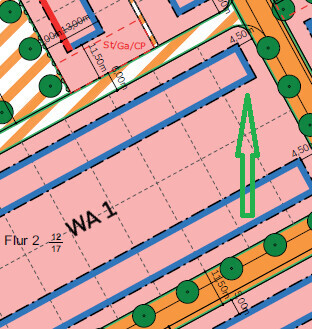
Plot size: 576 sqm (6,200 sq ft)
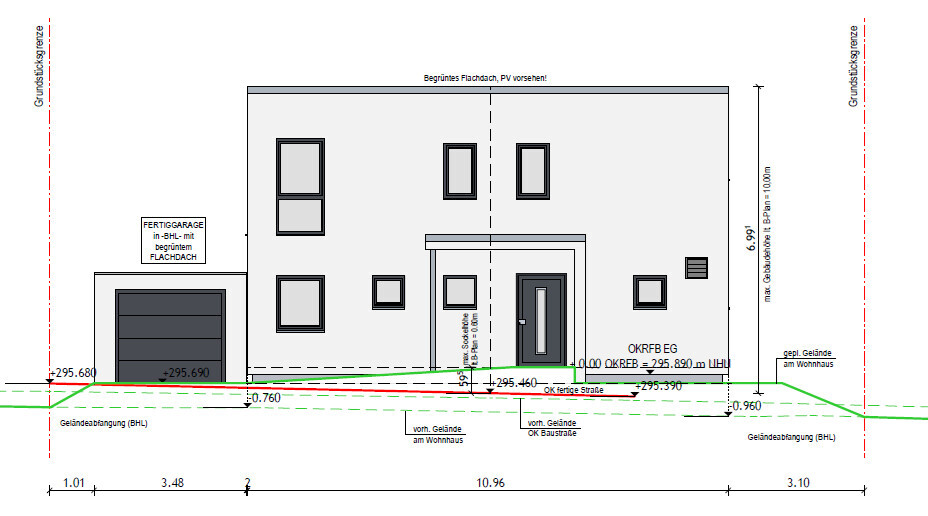
Slope: Yes, slight. According to the site plan, the top "right" corner is at 295.4 meters (970 feet), lower at 293.88 meters (964 feet), left side goes from 295.17 meters (968 feet) to 293.43 meters (963 feet)
Floor area ratio: 0.3
Building envelope, building line and boundary: Applies to house number 16
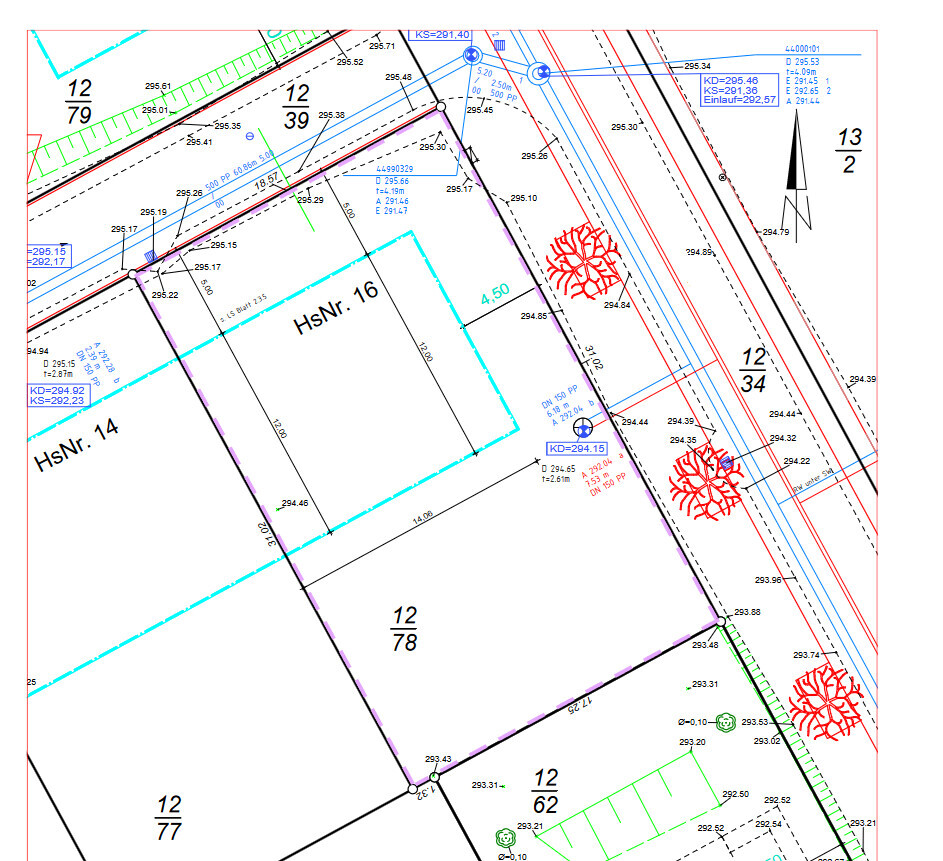
Surrounding buildings
Number of parking spaces: 2
Number of stories: 2 full floors required, plus optional recessed floor (setback floor)
Roof type: Flat roof, max. 5° pitch
Maximum height/limits: Max. 10 m (33 ft) high
Additional requirements: Equipment (heat pump) must be integrated, not external. Maximum of 2 residential units. Specific exterior colors required, rainwater should infiltrate (soil report says this is unlikely). Roofs must be greened. No oil or gas heating allowed.
Client requirements
Style, roof type, building type: Actually, none specified.
Basement, floors: No basement, 2 floors.
Number of occupants, ages: 4 people — 2 adults, 2 children
Ground floor space needs: Daily life (living, kitchen, dining, technical room, guest room)
Upper floor: Family (2 children's rooms, master bedroom, separate bathrooms), home office
Office: Home office, second workspace for occasional use such as a work window sill for example in the bedroom
Guests per year: Currently few.
Open or closed architecture, conservative or modern style: Either is fine.
Open kitchen, kitchen island: We are still considering. Initial wish was separate pantry like in the floor plan. An island would be nice if space allows.
Number of dining seats: Normally 4, rarely up to 8.
Fireplace: None.
Music/stereo wall: Multi-room audio with central unit in technical room.
Balcony, roof terrace: Neither.
Garage, carport: 1 garage
Other wishes: Central vacuum system, laundry chute, smart home (KNX) (I am mostly doing this myself, yes, I am a certified electrician, can program, but will also get additional help)
House design
Who designed the plan:
- Planner from a construction company: Correct, with some input from us. Based on an existing plan.
Price estimate by architect/planner: approx. 485,000 € (euros) for the house, approx. 210,000 € for the plot including basic services (survey, soil report, etc.)
Personal price limit for the house including features: approx. 800,000–850,000 € (including land)
Preferred heating technology: Heat pump
If you had to give up, which details/extra features could you skip:
- Could skip:
- Cannot skip:
Why is the design like it is now? For example:
Standard design by the planner? Yes, with minor wishes from us (wall between study and child’s room 2, T-walls in bathrooms, porch roof, conservatory, pantry)
What do you find especially good or bad about it? So far it seems to fit; apart from possibly the pantry/dining room, we don’t see major issues yet. But that’s why I’m here now.
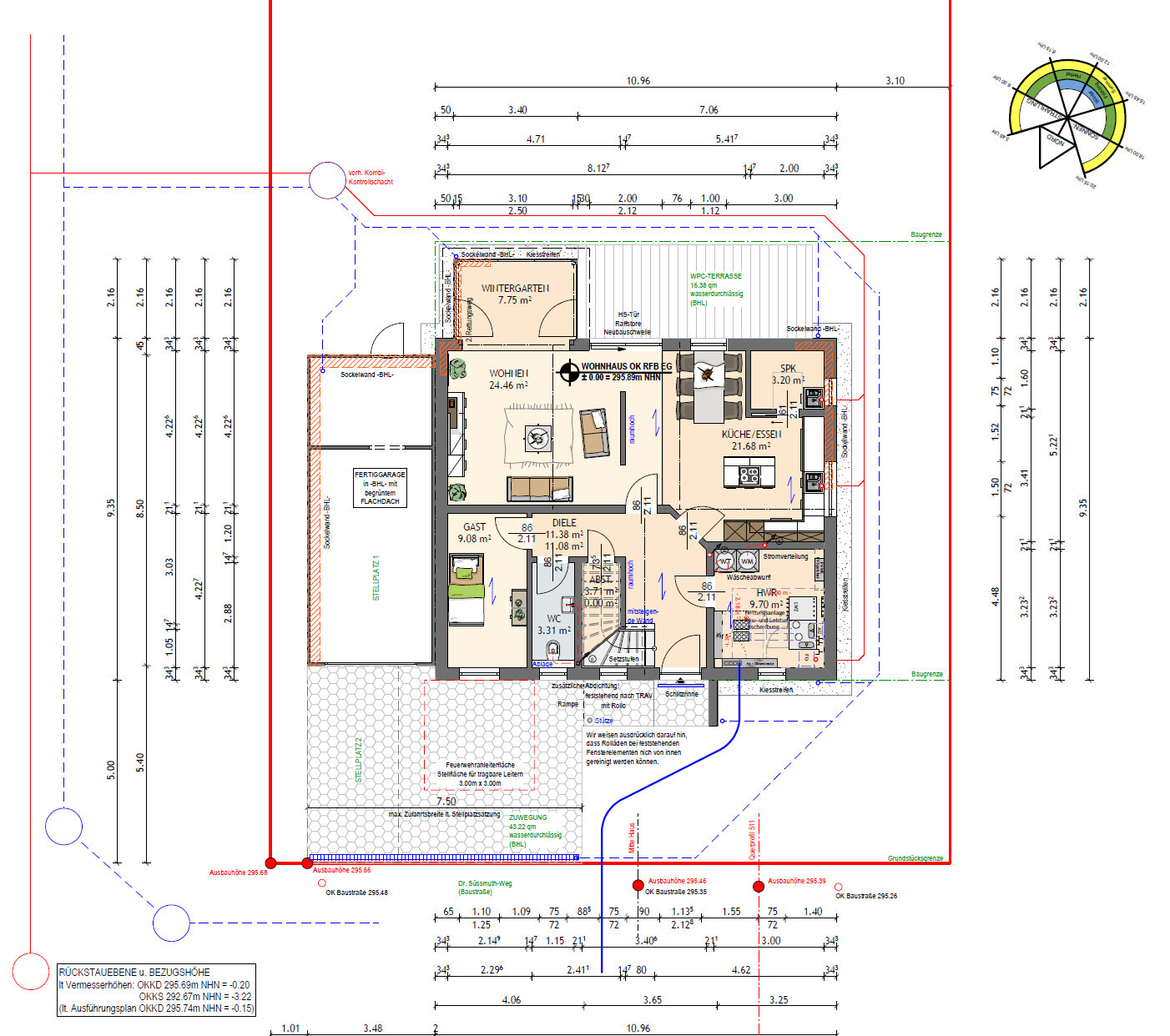
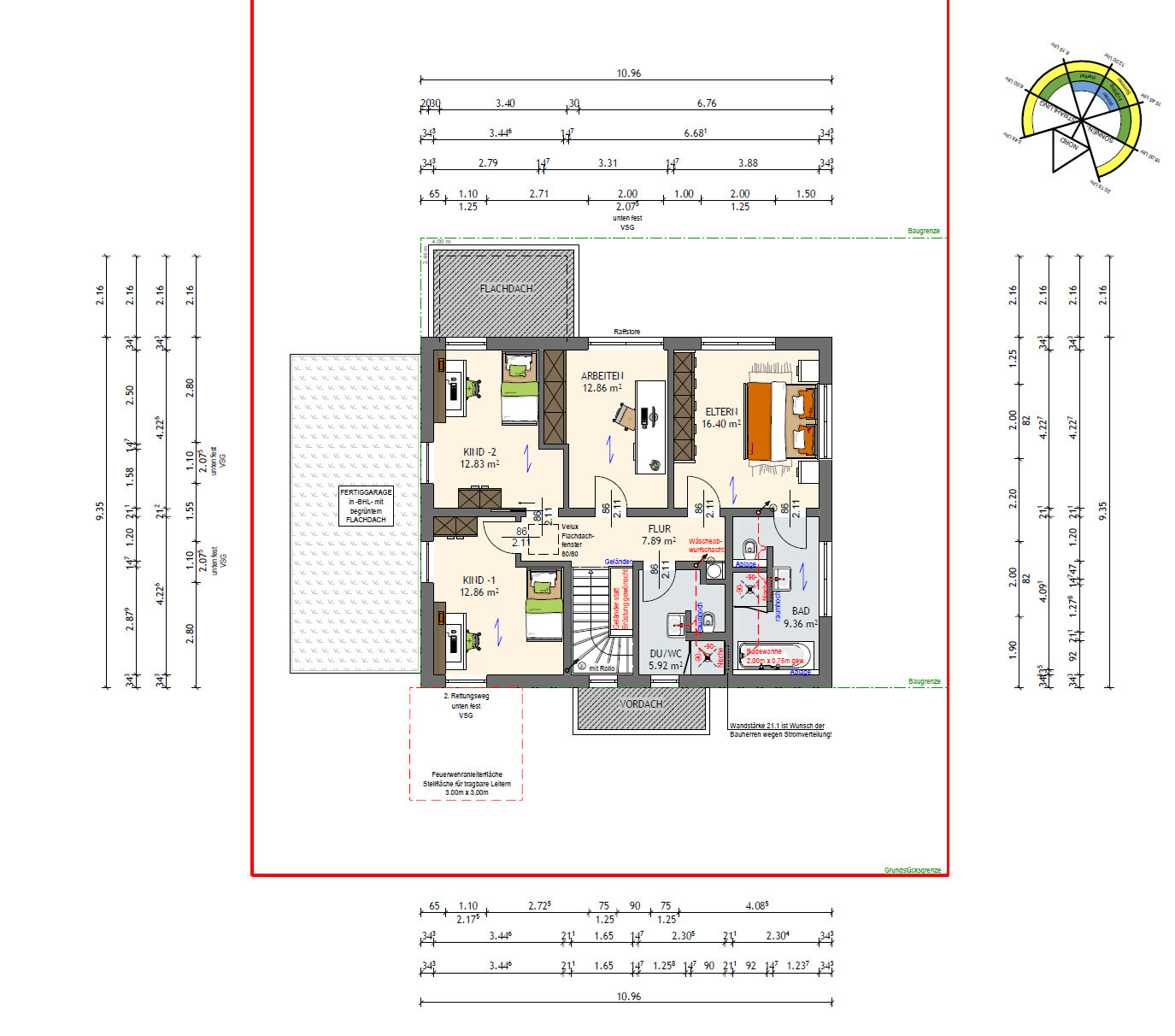
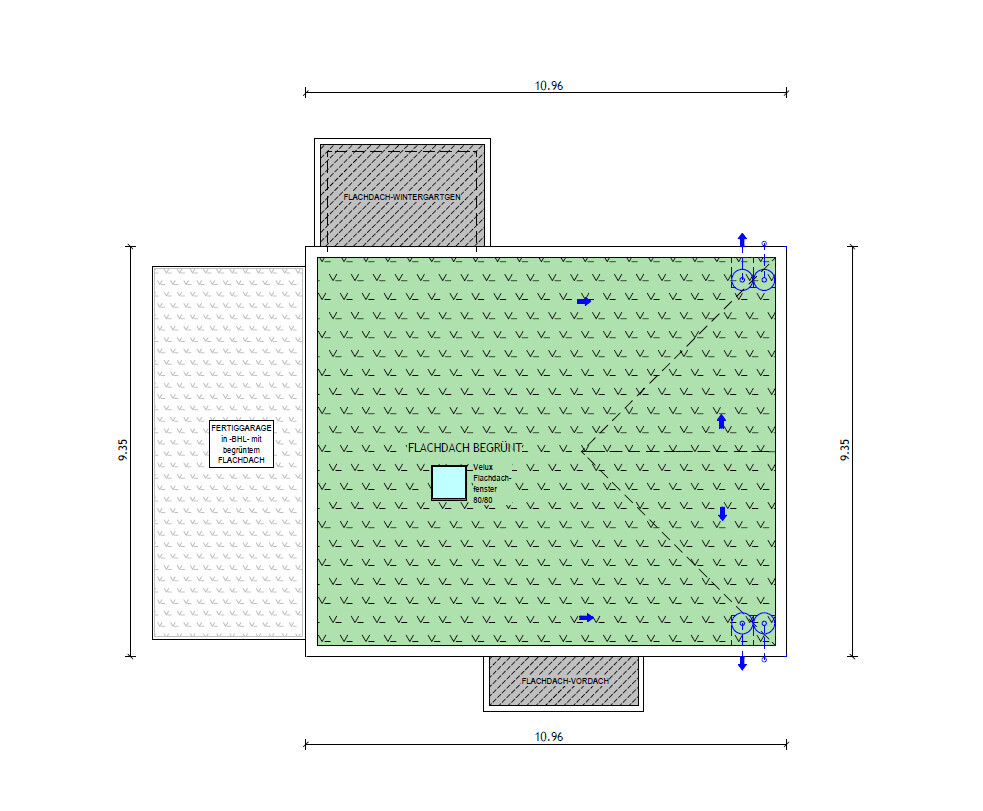
Edit: The furniture shown in the floor plans can be safely ignored. Planners seem to like adding these.
Best regards
Ganneff
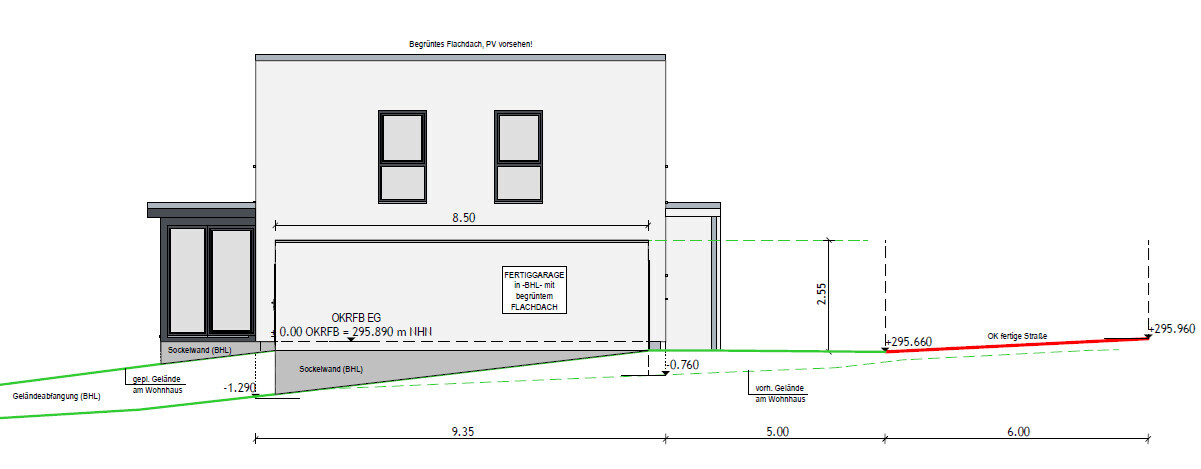
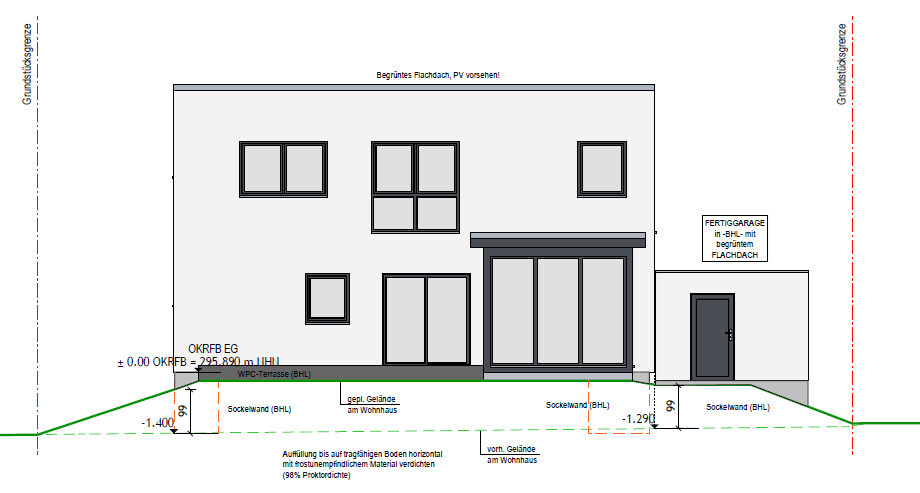
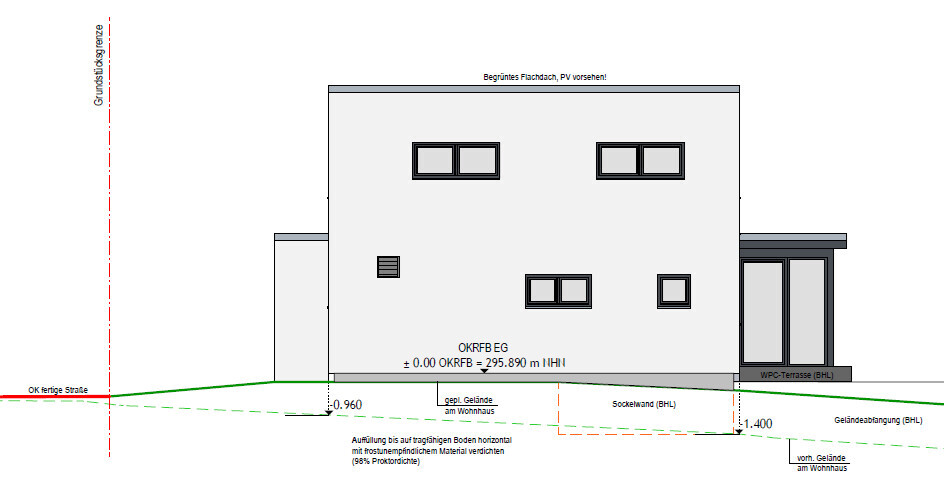
I have been reading along for some time now and finally dare to share a floor plan here.
First, here is the list of questions:
Zoning Plan / Restrictions
Plot size: 576 sqm (6,200 sq ft)
Slope: Yes, slight. According to the site plan, the top "right" corner is at 295.4 meters (970 feet), lower at 293.88 meters (964 feet), left side goes from 295.17 meters (968 feet) to 293.43 meters (963 feet)
Floor area ratio: 0.3
Building envelope, building line and boundary: Applies to house number 16
Surrounding buildings
Number of parking spaces: 2
Number of stories: 2 full floors required, plus optional recessed floor (setback floor)
Roof type: Flat roof, max. 5° pitch
Maximum height/limits: Max. 10 m (33 ft) high
Additional requirements: Equipment (heat pump) must be integrated, not external. Maximum of 2 residential units. Specific exterior colors required, rainwater should infiltrate (soil report says this is unlikely). Roofs must be greened. No oil or gas heating allowed.
Client requirements
Style, roof type, building type: Actually, none specified.
Basement, floors: No basement, 2 floors.
Number of occupants, ages: 4 people — 2 adults, 2 children
Ground floor space needs: Daily life (living, kitchen, dining, technical room, guest room)
Upper floor: Family (2 children's rooms, master bedroom, separate bathrooms), home office
Office: Home office, second workspace for occasional use such as a work window sill for example in the bedroom
Guests per year: Currently few.
Open or closed architecture, conservative or modern style: Either is fine.
Open kitchen, kitchen island: We are still considering. Initial wish was separate pantry like in the floor plan. An island would be nice if space allows.
Number of dining seats: Normally 4, rarely up to 8.
Fireplace: None.
Music/stereo wall: Multi-room audio with central unit in technical room.
Balcony, roof terrace: Neither.
Garage, carport: 1 garage
Other wishes: Central vacuum system, laundry chute, smart home (KNX) (I am mostly doing this myself, yes, I am a certified electrician, can program, but will also get additional help)
House design
Who designed the plan:
- Planner from a construction company: Correct, with some input from us. Based on an existing plan.
Price estimate by architect/planner: approx. 485,000 € (euros) for the house, approx. 210,000 € for the plot including basic services (survey, soil report, etc.)
Personal price limit for the house including features: approx. 800,000–850,000 € (including land)
Preferred heating technology: Heat pump
If you had to give up, which details/extra features could you skip:
- Could skip:
- Cannot skip:
Why is the design like it is now? For example:
Standard design by the planner? Yes, with minor wishes from us (wall between study and child’s room 2, T-walls in bathrooms, porch roof, conservatory, pantry)
What do you find especially good or bad about it? So far it seems to fit; apart from possibly the pantry/dining room, we don’t see major issues yet. But that’s why I’m here now.
Edit: The furniture shown in the floor plans can be safely ignored. Planners seem to like adding these.
Best regards
Ganneff
Ganneff schrieb:
Based on the version from @ypg. I am not allowed to move the WC to the left or "up," as it should not border the living room. Therefore, the rooms at the bottom left remain unchanged. I would then make the WC smaller and move the wall so that the door to the multipurpose room can be moved away from the corner. This way, a closet can be placed behind the door, and in the hallway, a narrower closet or chest of drawers can be used.
Note: The dining area becomes too small with the island and partition wall. Either the partition wall should be moved further to the left or adjusted accordingly (this is how we arranged the island since we also have the typical "square" kitchen layout). However, the island positioned crosswise has proven successful both visually and functionally in our experience.
W
wiltshire21 Jun 2025 20:1611ant schrieb:
A flat roof with zero slope mercilessly reflects the terrain or its modeling, especially when combined with a Snow White-style building shape (shoebox). The house simply appears roofless in the elevations. Despite the compact building form, I do not find the flat roof aesthetically disturbing. I like it better than some urban villa roof designs. Architects were already voluntarily building such roofs 100 years ago. House Esthers and Haus Lange in Krefeld are prominent examples—admittedly somewhat larger, longer, and situated on perfectly shaped terrain… I want to say, despite all the differences in these buildings, that the flat roof with zero slope is not a problem in itself.

No, the flat roof alone is not a problem, and ...
https://www.instagram.com/11antgmxde/
https://www.linkedin.com/company/bauen-jetzt/
wiltshire schrieb:... a hip roof on a side villa would undoubtedly have been even more terrifying. Unfortunately, many prefabricated house builders tend to avoid creating profile lines in the façade on the floor plan too much.
I like it better than some small urban villa-style houses.
https://www.instagram.com/11antgmxde/
https://www.linkedin.com/company/bauen-jetzt/
ypg schrieb:
I would make the toilet smaller and move the wall so the door to the multi-purpose room can be moved away from the corner. Then you could place a cabinet behind the door and a narrower cabinet or chest of drawers in the hallway.
Note: the dining area will become too small with the island and partition wall. Either the partition wall should be moved further to the left on the plan or adjusted somehow (we have the island positioned like this because we also have that typical “square” kitchen layout. However, the island placed across the room has proven to be both visually appealing and practical for us. Oh, the idea to make the toilet smaller and set it back is great, we’ll adopt that, thanks.
We didn’t get a chance to test the furniture arrangement this evening; that will be done tomorrow, and then the partition wall might be moved or changed as well.
I find your open approach refreshing; after a long dry spell, this might turn out to be an interesting thread again. Without real furniture and its dimensions, good planning is difficult. Even a single edge or function can severely affect an attractive floor plan or render a piece of furniture useless—both unnecessary and unfortunate. The roof shape hardly matters to me; I prefer individually thought-out floor plans that fit the residents perfectly; that alone would be my goal. A nice façade or roof shape can always be found later.
Although I don't mind involving the children, in my opinion, a child should not be able—or expected—to have a major influence on fundamental house design principles (floor plan, lifestyle flows, etc.). Of course, children should have cool rooms, designed to be special and individual, but decisions impacting the floor plan, meaning the entire house project, should not be left to them. I remember a travel agency where children increasingly made the real decisions about where the family vacation would go and which hotel to book. The major travel companies had already identified these new decision-makers, and suddenly their catalogs were filled with colorful water slides. For example, my niece had already declined her very nicely finished house because her son, at age 12, didn’t like it. I wonder what kind of specific experience a child that age could realistically bring to house building or living topics.
Of course, the child should have a nice space, be involved, and especially help design their own room; however, interfering with the overall concept or floor plan should be avoided. A small, seemingly insignificant change in the floor plan can completely ruin it—so I would be cautious.
Yes. Often, homeowners run out of budget for truly important things because they wanted some unnecessary extras upfront. I would first plan a truly individual floor plan and, if there is money left at the end, then there are plenty of options to convert that into additional comfort.
My first focus goes to the conservatory. If it isn't planned, built, and designed well—really with high quality—it takes light and openness away from the room behind it, especially sun and daylight. Without really good (and expensive) shading, preferably including air conditioning, a conservatory can be a nightmare. A spacious, covered terrace would be my preferred option here, as it offers an outdoor living room in summer. I have seen quite a few conservatories—I would never have wanted any of those for exactly these reasons, except for the well-planned (and costly) ones.
Sorry, but this is exactly what I mean. Of course, no child wants to have even a hint less space than the other (and adults usually feel the same), yet this supposed necessary equality hardly ever exists. One child has a sliding door, the other does not; different orientations also change the rooms. I would rather give each child's room a special character or maybe a theme that suits the individual child—there are thousands of ideas for this—instead of making an exact square footage copy that might hinder you later in the floor plan development. If it ends up equal, that's fine, but declaring it as a strict rule could be more harmful than helpful.
Then don’t build it that way, because you’ll have your spatial needs, or as parents, you need to really discipline yourselves and teach the kids to get by with the available space. But you have to be brutally honest with yourself here, otherwise, it will end up being a cluttered mess. In our first house, we planned hardly any cloakroom or storage space, and that troubled us for many years. As mentioned elsewhere, the floor plan MUST fit your life, and only you can (and must) decide that.
Here too, I think it’s important that, as the breadwinner, you have a pleasant work space. After all, you are enabling this house to be built. Since you apparently work from home a lot, you should pay particular attention to having an appropriate and comfortable workspace so you can work long hours happily, healthily, and enthusiastically.
I agree with the children—having four adults but only one shower/bathroom in a new build would be unthinkable. But I would still decide that with my wife based on our real-life situation. Whether the kids move out—who knows? In families around me, I’ve seen everything, including children still living in upstairs rooms in their late twenties and blocking the bathroom for hours.
I basically agree, even though I still caution from personal experience. With our first house, we ended up including a lot of unnecessary and expensive stuff, especially to please the kids. We would have been better off investing in real comfort for all of us or simply spending less money and still having a nice home.
I’m curious about your new drawing. As I said, I would scrutinize the conservatory topic carefully with regard to costs and actual design/use because the floor plan is not particularly generous so far. That doesn’t have to be the case, but if you have a conservatory, I would rather invest in making the main living and working areas more comfortable than “sink” square meters and money there. Do you know the cost of good shading and cooling in a conservatory?
Although I don't mind involving the children, in my opinion, a child should not be able—or expected—to have a major influence on fundamental house design principles (floor plan, lifestyle flows, etc.). Of course, children should have cool rooms, designed to be special and individual, but decisions impacting the floor plan, meaning the entire house project, should not be left to them. I remember a travel agency where children increasingly made the real decisions about where the family vacation would go and which hotel to book. The major travel companies had already identified these new decision-makers, and suddenly their catalogs were filled with colorful water slides. For example, my niece had already declined her very nicely finished house because her son, at age 12, didn’t like it. I wonder what kind of specific experience a child that age could realistically bring to house building or living topics.
Of course, the child should have a nice space, be involved, and especially help design their own room; however, interfering with the overall concept or floor plan should be avoided. A small, seemingly insignificant change in the floor plan can completely ruin it—so I would be cautious.
ypg schrieb:
First, I would address the basic needs, meaning reasonable living space for four people. A nice-to-have feature is expensive. Maybe for that money, you should plan the house 50cm (20 inches) larger?!
Yes. Often, homeowners run out of budget for truly important things because they wanted some unnecessary extras upfront. I would first plan a truly individual floor plan and, if there is money left at the end, then there are plenty of options to convert that into additional comfort.
My first focus goes to the conservatory. If it isn't planned, built, and designed well—really with high quality—it takes light and openness away from the room behind it, especially sun and daylight. Without really good (and expensive) shading, preferably including air conditioning, a conservatory can be a nightmare. A spacious, covered terrace would be my preferred option here, as it offers an outdoor living room in summer. I have seen quite a few conservatories—I would never have wanted any of those for exactly these reasons, except for the well-planned (and costly) ones.
Ganneff schrieb:
Kids’ rooms: One of the absolutely essential requirements is that they are the same size. Differences should be at most one decimal place, best not at all.
Sorry, but this is exactly what I mean. Of course, no child wants to have even a hint less space than the other (and adults usually feel the same), yet this supposed necessary equality hardly ever exists. One child has a sliding door, the other does not; different orientations also change the rooms. I would rather give each child's room a special character or maybe a theme that suits the individual child—there are thousands of ideas for this—instead of making an exact square footage copy that might hinder you later in the floor plan development. If it ends up equal, that's fine, but declaring it as a strict rule could be more harmful than helpful.
Ganneff schrieb:
And storage space—we know it’s limited; that is partly intentional and partly due to the plan. We’ve also considered a bit of storage space in the garage. My suggestion for more storage inside the house was rejected “from above.”
Then don’t build it that way, because you’ll have your spatial needs, or as parents, you need to really discipline yourselves and teach the kids to get by with the available space. But you have to be brutally honest with yourself here, otherwise, it will end up being a cluttered mess. In our first house, we planned hardly any cloakroom or storage space, and that troubled us for many years. As mentioned elsewhere, the floor plan MUST fit your life, and only you can (and must) decide that.
Ganneff schrieb:
There will be overnight guests, yes, but not often. I can imagine the home office downstairs (9m² (97 ft²) is enough), but the family wants me to stay upstairs. Both my wife and child strongly prefer that. We’re still quite flexible for some time if opinions change.
Here too, I think it’s important that, as the breadwinner, you have a pleasant work space. After all, you are enabling this house to be built. Since you apparently work from home a lot, you should pay particular attention to having an appropriate and comfortable workspace so you can work long hours happily, healthily, and enthusiastically.
Ganneff schrieb:
I proposed this earlier, but there was strong opposition; they want separate bathrooms. Better that than more space (considering they are used to very small living areas). Quote: “Then I left home at 18 or 20, and it’s wasted space.”
I agree with the children—having four adults but only one shower/bathroom in a new build would be unthinkable. But I would still decide that with my wife based on our real-life situation. Whether the kids move out—who knows? In families around me, I’ve seen everything, including children still living in upstairs rooms in their late twenties and blocking the bathroom for hours.
wiltshire schrieb:
I like the process of you planning as a family and expressing your wishes together. What will help you find the best solution within your conditions is imagining different typical life situations, moments you wish for and that bring you special joy. Describe the situations without architecture and then see how they work in one design or another.
I basically agree, even though I still caution from personal experience. With our first house, we ended up including a lot of unnecessary and expensive stuff, especially to please the kids. We would have been better off investing in real comfort for all of us or simply spending less money and still having a nice home.
I’m curious about your new drawing. As I said, I would scrutinize the conservatory topic carefully with regard to costs and actual design/use because the floor plan is not particularly generous so far. That doesn’t have to be the case, but if you have a conservatory, I would rather invest in making the main living and working areas more comfortable than “sink” square meters and money there. Do you know the cost of good shading and cooling in a conservatory?
Arauki11 schrieb:
As I mentioned, I would carefully evaluate the topic of a conservatory regarding costs and realistic design/use. You can also refer to the conservatory as an extension, annex, or atrium. I think @Ganneff already understands where space is needed.
Similar topics