
Hello,
I have been reading along for some time now and finally dare to share a floor plan here.
First, here is the list of questions:
Zoning Plan / Restrictions
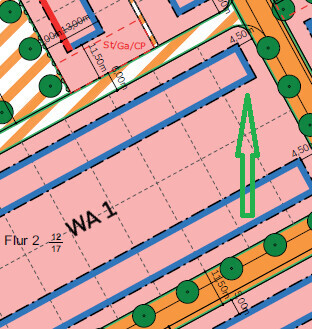
Plot size: 576 sqm (6,200 sq ft)
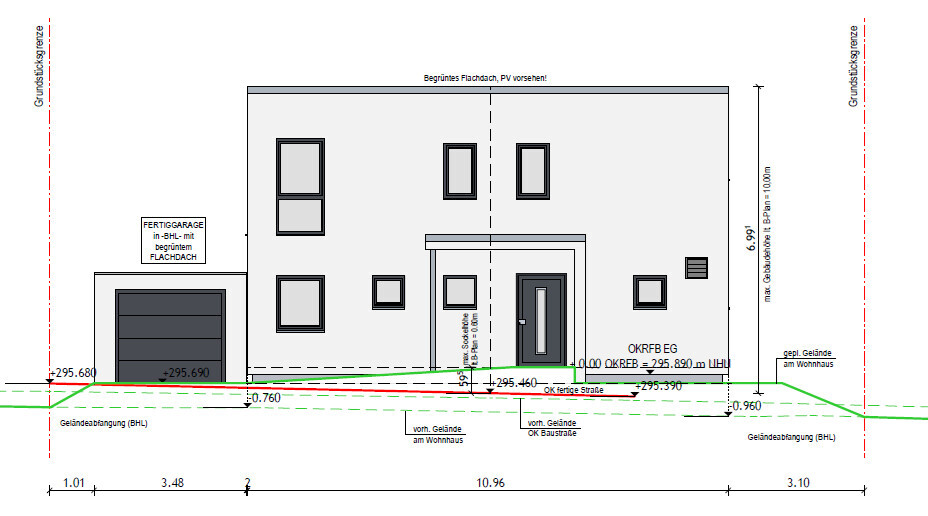
Slope: Yes, slight. According to the site plan, the top "right" corner is at 295.4 meters (970 feet), lower at 293.88 meters (964 feet), left side goes from 295.17 meters (968 feet) to 293.43 meters (963 feet)
Floor area ratio: 0.3
Building envelope, building line and boundary: Applies to house number 16
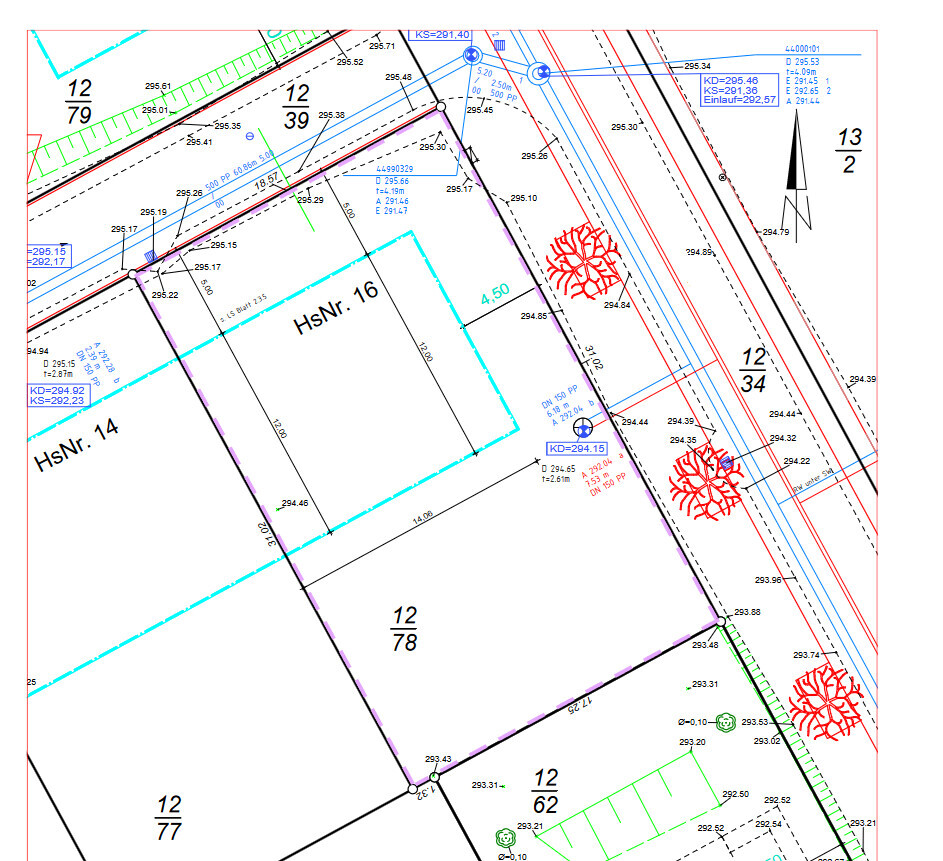
Surrounding buildings
Number of parking spaces: 2
Number of stories: 2 full floors required, plus optional recessed floor (setback floor)
Roof type: Flat roof, max. 5° pitch
Maximum height/limits: Max. 10 m (33 ft) high
Additional requirements: Equipment (heat pump) must be integrated, not external. Maximum of 2 residential units. Specific exterior colors required, rainwater should infiltrate (soil report says this is unlikely). Roofs must be greened. No oil or gas heating allowed.
Client requirements
Style, roof type, building type: Actually, none specified.
Basement, floors: No basement, 2 floors.
Number of occupants, ages: 4 people — 2 adults, 2 children
Ground floor space needs: Daily life (living, kitchen, dining, technical room, guest room)
Upper floor: Family (2 children's rooms, master bedroom, separate bathrooms), home office
Office: Home office, second workspace for occasional use such as a work window sill for example in the bedroom
Guests per year: Currently few.
Open or closed architecture, conservative or modern style: Either is fine.
Open kitchen, kitchen island: We are still considering. Initial wish was separate pantry like in the floor plan. An island would be nice if space allows.
Number of dining seats: Normally 4, rarely up to 8.
Fireplace: None.
Music/stereo wall: Multi-room audio with central unit in technical room.
Balcony, roof terrace: Neither.
Garage, carport: 1 garage
Other wishes: Central vacuum system, laundry chute, smart home (KNX) (I am mostly doing this myself, yes, I am a certified electrician, can program, but will also get additional help)
House design
Who designed the plan:
- Planner from a construction company: Correct, with some input from us. Based on an existing plan.
Price estimate by architect/planner: approx. 485,000 € (euros) for the house, approx. 210,000 € for the plot including basic services (survey, soil report, etc.)
Personal price limit for the house including features: approx. 800,000–850,000 € (including land)
Preferred heating technology: Heat pump
If you had to give up, which details/extra features could you skip:
- Could skip:
- Cannot skip:
Why is the design like it is now? For example:
Standard design by the planner? Yes, with minor wishes from us (wall between study and child’s room 2, T-walls in bathrooms, porch roof, conservatory, pantry)
What do you find especially good or bad about it? So far it seems to fit; apart from possibly the pantry/dining room, we don’t see major issues yet. But that’s why I’m here now.
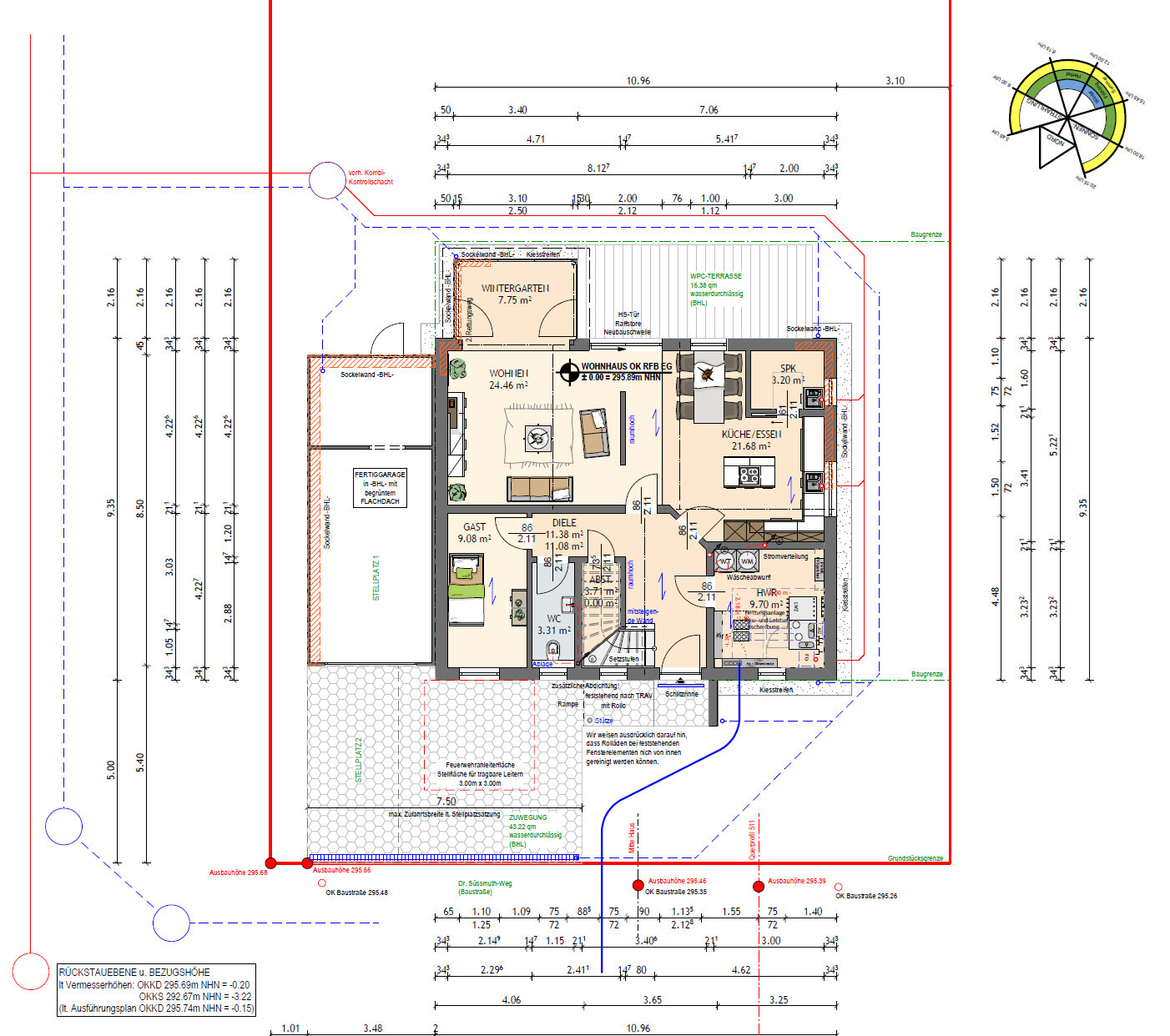
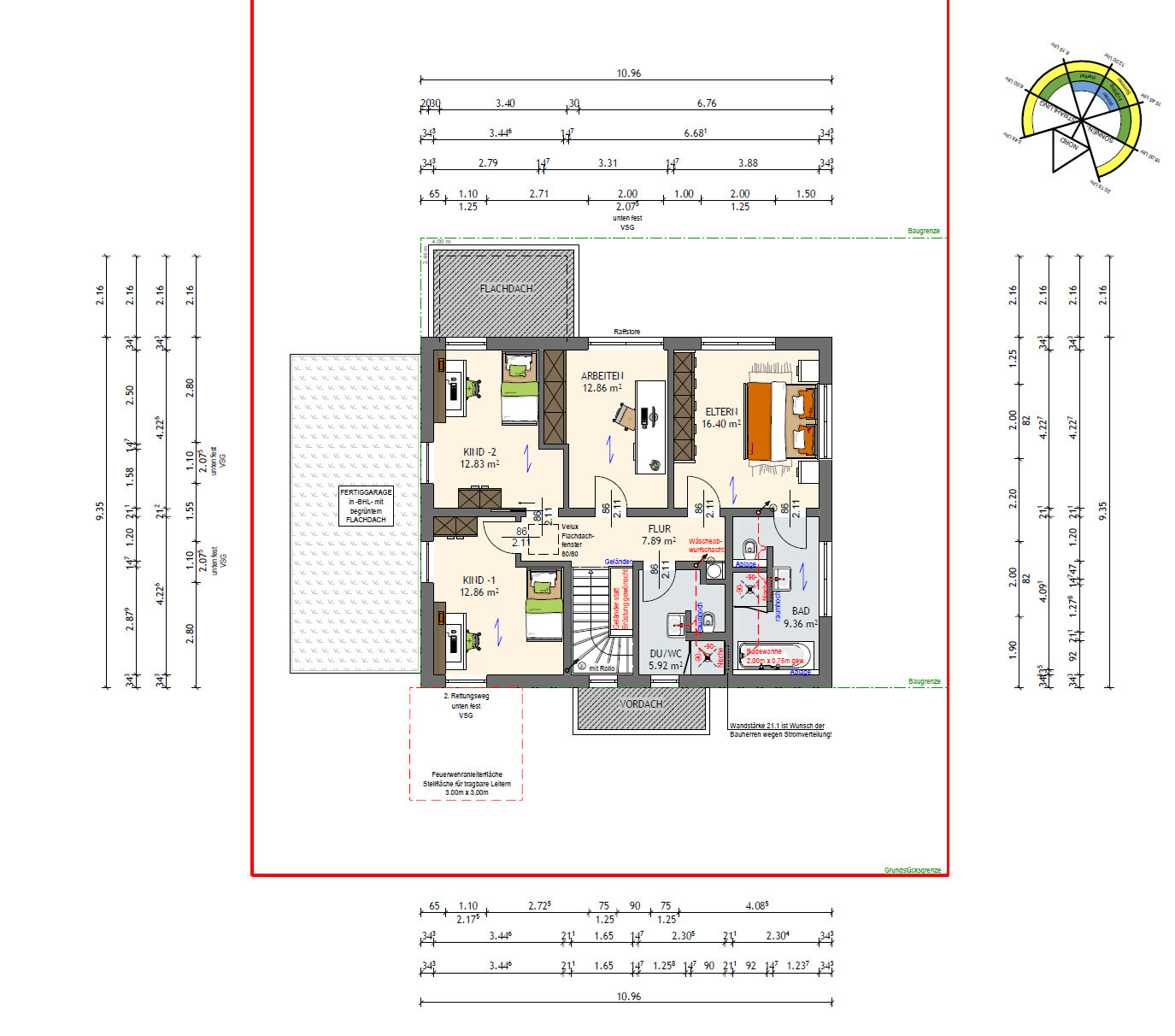
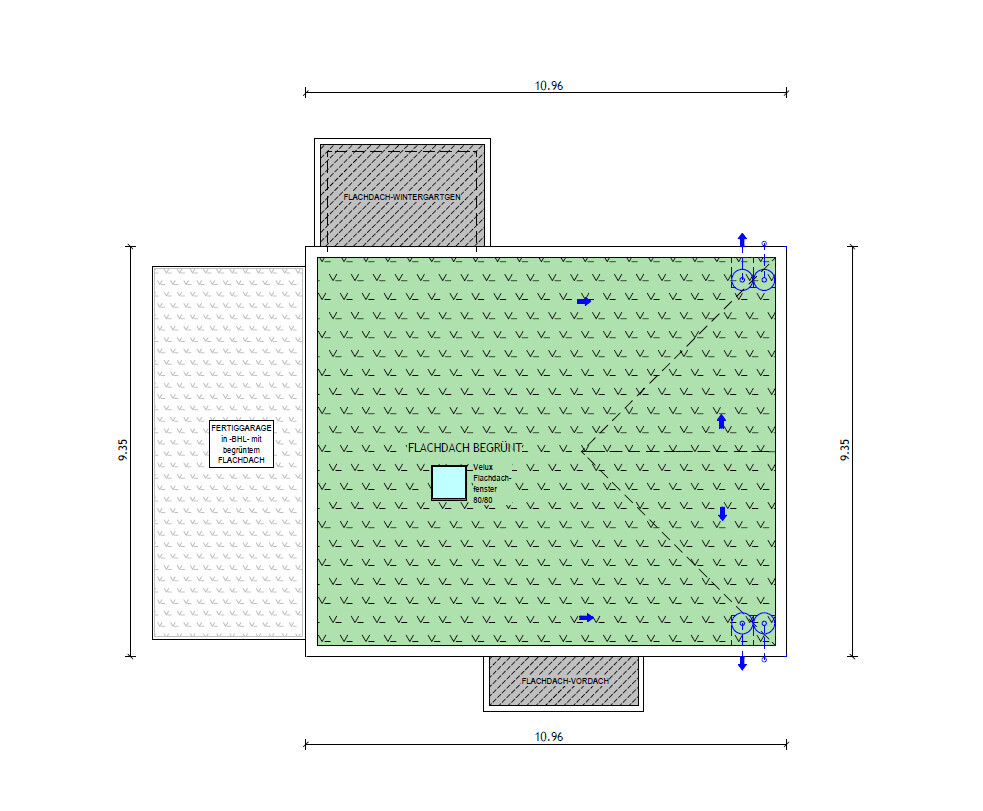
Edit: The furniture shown in the floor plans can be safely ignored. Planners seem to like adding these.
Best regards
Ganneff
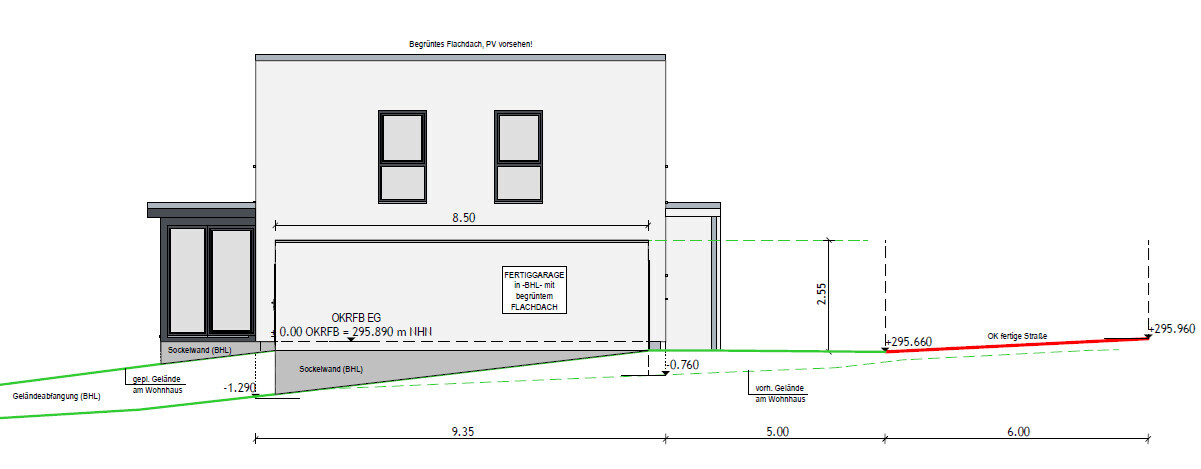
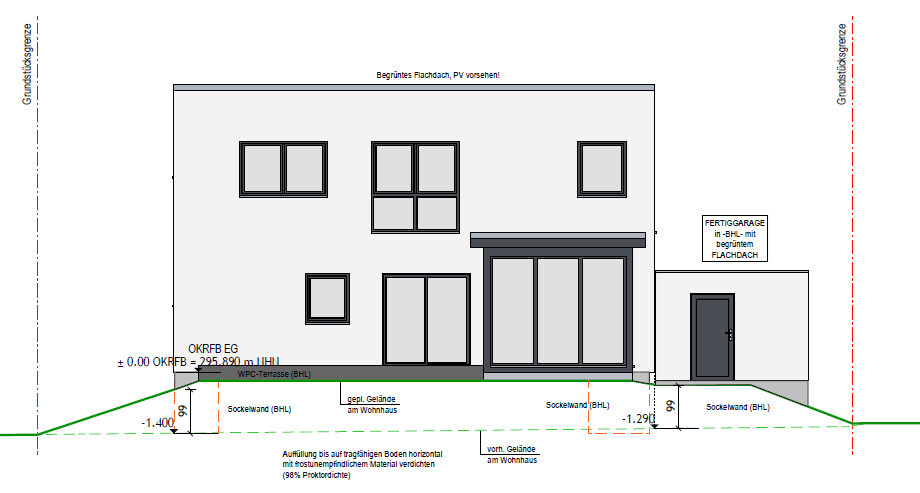
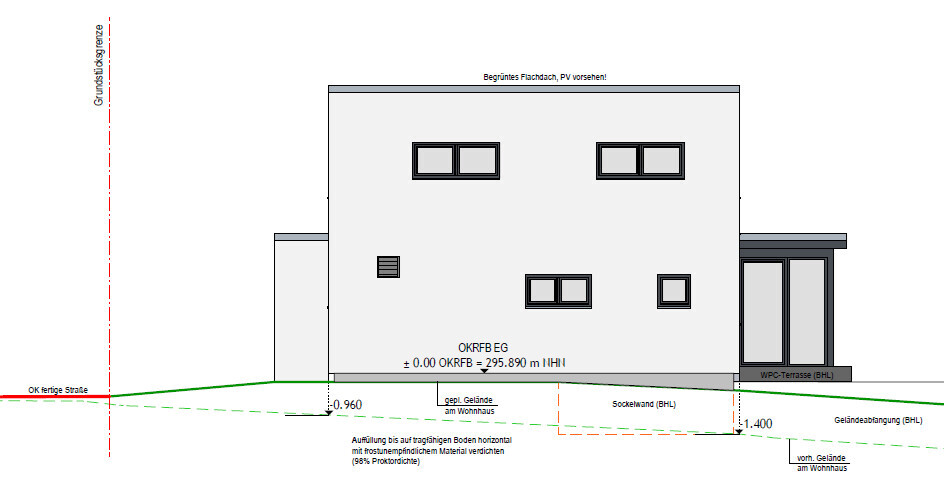
I have been reading along for some time now and finally dare to share a floor plan here.
First, here is the list of questions:
Zoning Plan / Restrictions
Plot size: 576 sqm (6,200 sq ft)
Slope: Yes, slight. According to the site plan, the top "right" corner is at 295.4 meters (970 feet), lower at 293.88 meters (964 feet), left side goes from 295.17 meters (968 feet) to 293.43 meters (963 feet)
Floor area ratio: 0.3
Building envelope, building line and boundary: Applies to house number 16
Surrounding buildings
Number of parking spaces: 2
Number of stories: 2 full floors required, plus optional recessed floor (setback floor)
Roof type: Flat roof, max. 5° pitch
Maximum height/limits: Max. 10 m (33 ft) high
Additional requirements: Equipment (heat pump) must be integrated, not external. Maximum of 2 residential units. Specific exterior colors required, rainwater should infiltrate (soil report says this is unlikely). Roofs must be greened. No oil or gas heating allowed.
Client requirements
Style, roof type, building type: Actually, none specified.
Basement, floors: No basement, 2 floors.
Number of occupants, ages: 4 people — 2 adults, 2 children
Ground floor space needs: Daily life (living, kitchen, dining, technical room, guest room)
Upper floor: Family (2 children's rooms, master bedroom, separate bathrooms), home office
Office: Home office, second workspace for occasional use such as a work window sill for example in the bedroom
Guests per year: Currently few.
Open or closed architecture, conservative or modern style: Either is fine.
Open kitchen, kitchen island: We are still considering. Initial wish was separate pantry like in the floor plan. An island would be nice if space allows.
Number of dining seats: Normally 4, rarely up to 8.
Fireplace: None.
Music/stereo wall: Multi-room audio with central unit in technical room.
Balcony, roof terrace: Neither.
Garage, carport: 1 garage
Other wishes: Central vacuum system, laundry chute, smart home (KNX) (I am mostly doing this myself, yes, I am a certified electrician, can program, but will also get additional help)
House design
Who designed the plan:
- Planner from a construction company: Correct, with some input from us. Based on an existing plan.
Price estimate by architect/planner: approx. 485,000 € (euros) for the house, approx. 210,000 € for the plot including basic services (survey, soil report, etc.)
Personal price limit for the house including features: approx. 800,000–850,000 € (including land)
Preferred heating technology: Heat pump
If you had to give up, which details/extra features could you skip:
- Could skip:
- Cannot skip:
Why is the design like it is now? For example:
Standard design by the planner? Yes, with minor wishes from us (wall between study and child’s room 2, T-walls in bathrooms, porch roof, conservatory, pantry)
What do you find especially good or bad about it? So far it seems to fit; apart from possibly the pantry/dining room, we don’t see major issues yet. But that’s why I’m here now.
Edit: The furniture shown in the floor plans can be safely ignored. Planners seem to like adding these.
Best regards
Ganneff
How old are the children? The age of the occupants somewhat influences a house design.
These are exactly the things I criticize first.
Secondly, here is the homework for what a design should also include: accurately drawing your furniture to scale. Sure, you can buy replacements in that size, but let’s be honest: no one feels comfortable with three people on a sofa that is only 180cm x 65cm (71 inches x 26 inches). The smaller one is 125cm (49 inches) wide. The kitchen table is 80cm (31 inches) wide, which is not suitable for fondues or raclette dinners. Haha, our sofa’s seating surface is already 65cm (26 inches). So, if you draw a lounge sofa – a corner sofa 270cm (106 inches) long – are you still confident?
There are way too many different window sizes (example: dining room window / kid’s room with two windows).
Basically, I think having two office/guest rooms is a bit ambitious. The kids’ rooms are proportionate in size, but having contingency rooms for occasional use doesn’t seem reasonable here. Also, there is a lack of proper storage space for suitcases, bags, and the miscellaneous stuff everyone has or needs. The freezer room is too small for multitasking.
Besides, there is no proper wardrobe area (not just coat hooks, but closets). Placing the pantry inside the room cuts into living space and creates a cramped feeling, and it’s only for items used rarely. Things used infrequently should not restrict living areas. Tip: remove the pantry and use the conservatory as an extension of the dining area, but limit it to about 1 meter (3 feet) deep and 5 meters (16 feet) wide!
This layout clearly shows that a T-shaped wall in the bathroom also takes up space: no real room left, just connecting passages. That’s a matter of preference. In the children’s bathroom, the toilet and shower should be swapped. But that also depends on the kids’ ages. Actually, a bathtub would be more appropriate there.
The staircase is debatable – does it justify its place next to the entrance/mudroom? It is a space-saving stair, commonly and justifiably found in small gable-roof houses.
What is the purpose of the conservatory here anyway?
Personally, I would plan the technical room next to the garage and allow the house to get more western sunlight. Accordingly, the bathrooms should be stacked vertically.
Let’s just say: the architect from the construction company did not deliver a stellar performance here.
I’m just reading this now:
Well then, you have to live with some compromises.
I don’t. Why should this wall be load-bearing?
Consider whether you want to live in such a bunker-like box without charming architectural projections or recesses. A flat roof can also look nice.
Ganneff schrieb:
Yes, with slight requests from us (wall between the office and kid 2, T-walls in the bathrooms, porch roof, conservatory, pantry)
These are exactly the things I criticize first.
Secondly, here is the homework for what a design should also include: accurately drawing your furniture to scale. Sure, you can buy replacements in that size, but let’s be honest: no one feels comfortable with three people on a sofa that is only 180cm x 65cm (71 inches x 26 inches). The smaller one is 125cm (49 inches) wide. The kitchen table is 80cm (31 inches) wide, which is not suitable for fondues or raclette dinners. Haha, our sofa’s seating surface is already 65cm (26 inches). So, if you draw a lounge sofa – a corner sofa 270cm (106 inches) long – are you still confident?
There are way too many different window sizes (example: dining room window / kid’s room with two windows).
Basically, I think having two office/guest rooms is a bit ambitious. The kids’ rooms are proportionate in size, but having contingency rooms for occasional use doesn’t seem reasonable here. Also, there is a lack of proper storage space for suitcases, bags, and the miscellaneous stuff everyone has or needs. The freezer room is too small for multitasking.
Besides, there is no proper wardrobe area (not just coat hooks, but closets). Placing the pantry inside the room cuts into living space and creates a cramped feeling, and it’s only for items used rarely. Things used infrequently should not restrict living areas. Tip: remove the pantry and use the conservatory as an extension of the dining area, but limit it to about 1 meter (3 feet) deep and 5 meters (16 feet) wide!
This layout clearly shows that a T-shaped wall in the bathroom also takes up space: no real room left, just connecting passages. That’s a matter of preference. In the children’s bathroom, the toilet and shower should be swapped. But that also depends on the kids’ ages. Actually, a bathtub would be more appropriate there.
The staircase is debatable – does it justify its place next to the entrance/mudroom? It is a space-saving stair, commonly and justifiably found in small gable-roof houses.
What is the purpose of the conservatory here anyway?
Personally, I would plan the technical room next to the garage and allow the house to get more western sunlight. Accordingly, the bathrooms should be stacked vertically.
Let’s just say: the architect from the construction company did not deliver a stellar performance here.
I’m just reading this now:
Ganneff schrieb:
But I can’t combine guest room and office.
Well then, you have to live with some compromises.
Ganneff schrieb:
I fear the latter.
I don’t. Why should this wall be load-bearing?
Consider whether you want to live in such a bunker-like box without charming architectural projections or recesses. A flat roof can also look nice.
hanse987 schrieb:
Has it been clarified whether the parking spaces in this arrangement are recognized as two separate spaces, since both cannot be used independently of each other?Yes. From the parking space regulation:Parking spaces must be easily accessible without crossing over other parking spaces. For single- and two-family houses, up to two tandem parking spaces are also recognized.ypg schrieb:
How old are the children? The age of the residents can influence a house design.They will probably be 11 and 13 when moving in.ypg schrieb:
Also, there is a lack of proper storage space for suitcases, bags, and all the miscellaneous stuff people have or need to have.That’s true about the storage space; currently, there is relatively little (under the stairs, and the rear part of the garage will be sectioned off).ypg schrieb:
Otherwise, there is no proper cloakroom (not just coat hooks, but cabinets). Adding a pantry into the room takes away space and creates a cramped feeling, especially since it’s only for items rarely used. Things used infrequently shouldn’t restrict the living space. Tip: remove the pantry and use the conservatory as a dining area extension, but preferably only 1 meter (3 feet) deep and 5 meters (16 feet) wide!Oh dear, okay, I guess the pantry is gone then, since nothing really worked so far...As for the cloakroom, there should be space right by the stairs opposite the utility room? It won’t hold lots of shoes and jackets, but it should be enough for a family, right?
ypg schrieb:
Regarding the staircase, one could debate whether it has its place here with a "mudroom" function. It is a space-saving staircase that is common and justified in small gable-roof houses.What would be a better solution here?ypg schrieb:
What is the conservatory intended for anyway?For staying there, seating, and plants, roughly speaking, it’s meant for that.ypg schrieb:
Personally, I would locate the technical room in the garage and give the house a bit more west-facing sun. Accordingly, the bathrooms should be stacked vertically. I’d say the architect from the construction company didn’t exactly deliver a masterpiece.So basically rotate left and right, at least for the lower half of the plan?ypg schrieb:
I don’t think so. Why should this wall be load-bearing?There will be a flat roof above that must be greened, so it has to carry quite a bit of weight.Ganneff schrieb:
There should be space for a wardrobe right next to the stairs, opposite the utility room, shouldn’t there? Well, it won’t hold a huge number of shoes and jackets, but it should be enough for a family, right? Yes, there would be space for a closet there. I hadn’t mentioned that space.
Ganneff schrieb:
What would be a better solution here? For example, a double switchback staircase. And then don’t have the first step in the mudroom area.
Ganneff schrieb:
The space is intended as a lounge area, seating, and room for plants, roughly speaking. First, I would address the basic needs—that means practical living space for four people. A nice-to-have feature is expensive. Maybe it would be better to plan the house 50cm (20 inches) larger for that money?!
Ganneff schrieb:
A flat roof above, which must be greened by requirement, so it has to bear a significant load. That wall probably a) should not be load-bearing, or b) a straight wall there would be just as strong.
Changing the staircase means starting over; enlarging the kids’ rooms might also require starting over.
My advice: have a bathroom upstairs and a utility room for laundry. That will ease the freezer room, and then you’ll have space there for non-essential kitchen appliances. Make the office smaller; if necessary, put doors to the children’s rooms in the sloping wall. Avoid a sloping wall toward the kitchen for design reasons.
Tip: read other discussions here to avoid mistakes that other homebuilders no longer make.
ypg schrieb:
Maybe it would make more sense to design the house 50cm (20 inches) larger for that budget?! Hmm, widening it is not possible, so if anywhere it would be deeper, there’s still some room for that. (According to the requirements, there is about 10cm (4 inches) left in width to keep within the 3m (10 feet) limit, but then something else conflicts with height and neighbors, so I avoid adjusting it in that direction).
What I find interesting is that the current living area is around 165sqm (1,776 sq ft) — that’s more than double what we have now — yet we still consider that it might be too small.
ypg schrieb:
Tip: read other discussions here to avoid mistakes that other building users have long stopped making. I’ve been reading along for a while, yes, but just reading doesn’t remove all blind spots, so I decided to ask myself. But you have already provided us with good input, thanks. I’ll discuss everything with my partner over the weekend.
Ganneff schrieb:
I’ll discuss all of this with my partner over the weekend.I said, don’t talk, draw. Personally, if a terrace is allowed legally outside the building envelope / building permit area, I would make use of the full 11 or 12 meters in depth and also orient it slightly, although narrow, toward the west. The south side will be the main garden, but the west is important for daylight and room orientation. Just my humble opinion. Entrance from the driveway side to avoid a covered entrance. Plan a double-spiral staircase and include two alcoves or recesses to make the house more appealing. In short: rotate the house.Similar topics