
ᐅ Concrete pouring quality: acceptable or problematic – experiences?
Created on: 5 Jun 2025 15:16
A
alive&kickingA
alive&kicking5 Jun 2025 15:16So … and now to the major “construction issues” (I’m already feeling uneasy)
They relate to the shell construction, execution of the waterproof concrete (white tank), concrete cover and perimeter insulation, Isokörbe (thermal insulation cubes).
Since all the following topics belong to the shell construction phase, I hope it’s okay to cover everything in one thread.
Our house is entirely reinforced concrete (I wouldn’t do it that way again), ready-mixed concrete, no precast wall elements, executed with a waterproof concrete design (white tank).
Before gathering all the data, if needed, here are some initial broad questions, to which I probably already know the answers.
1. Waterproof concrete (white tank):
A waterstop profile has been installed at the junction between the basement floor slab and basement walls, which in my opinion is also technically correct.
At the junction between basement walls and basement ceiling, this was (probably) not done. This may not be absolutely mandatory, but a horizontal joint sealing of the construction joints should be present if I have correctly understood the numerous threads on this topic. This is missing. The joint has already been backfilled, and garden/terrace areas are finished.
Anchor holes have been sealed with ??? some kind of expanding material… I can’t recall the name of the material used.
Is this a defect?
2. Perimeter insulation:
The perimeter insulation panels have gaps of about 1cm (0.4 inches) from the wall in some areas, which can allow water intrusion behind the insulation.
The basement was built during very low temperatures (November), and the 2-component adhesive used from Ma*** was very viscous and difficult to apply. Some bonding spots later detached, causing some insulation panels to loosen. The adhesive spots themselves were sometimes about 1cm (0.4 inches) thick.
The site manager’s statement from memory: “If water accumulates, how much water could enter? Besides, we are in a frost-free area.” Some corrections were made partially.
Is this a defect?
3. Concrete walls:
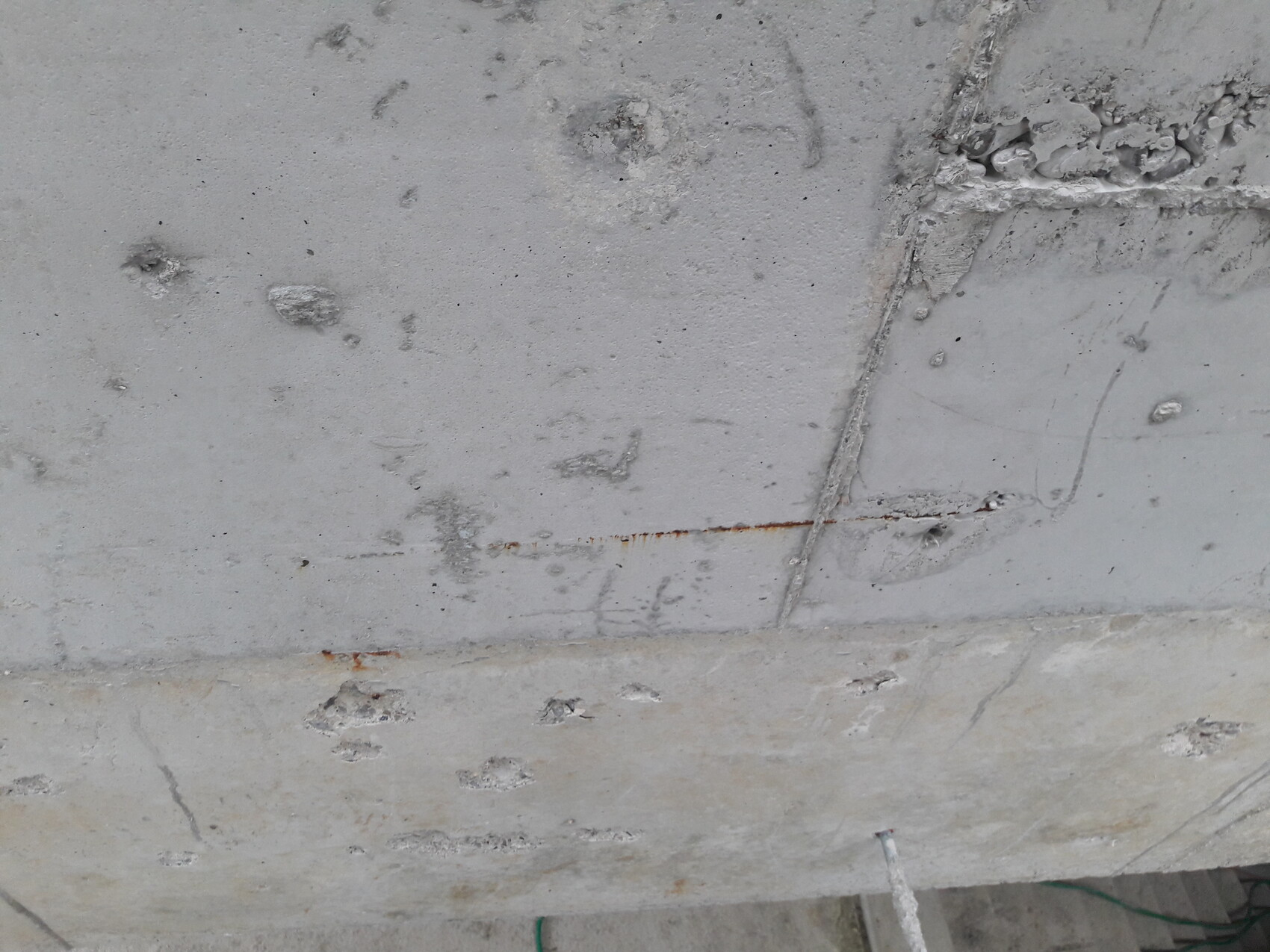
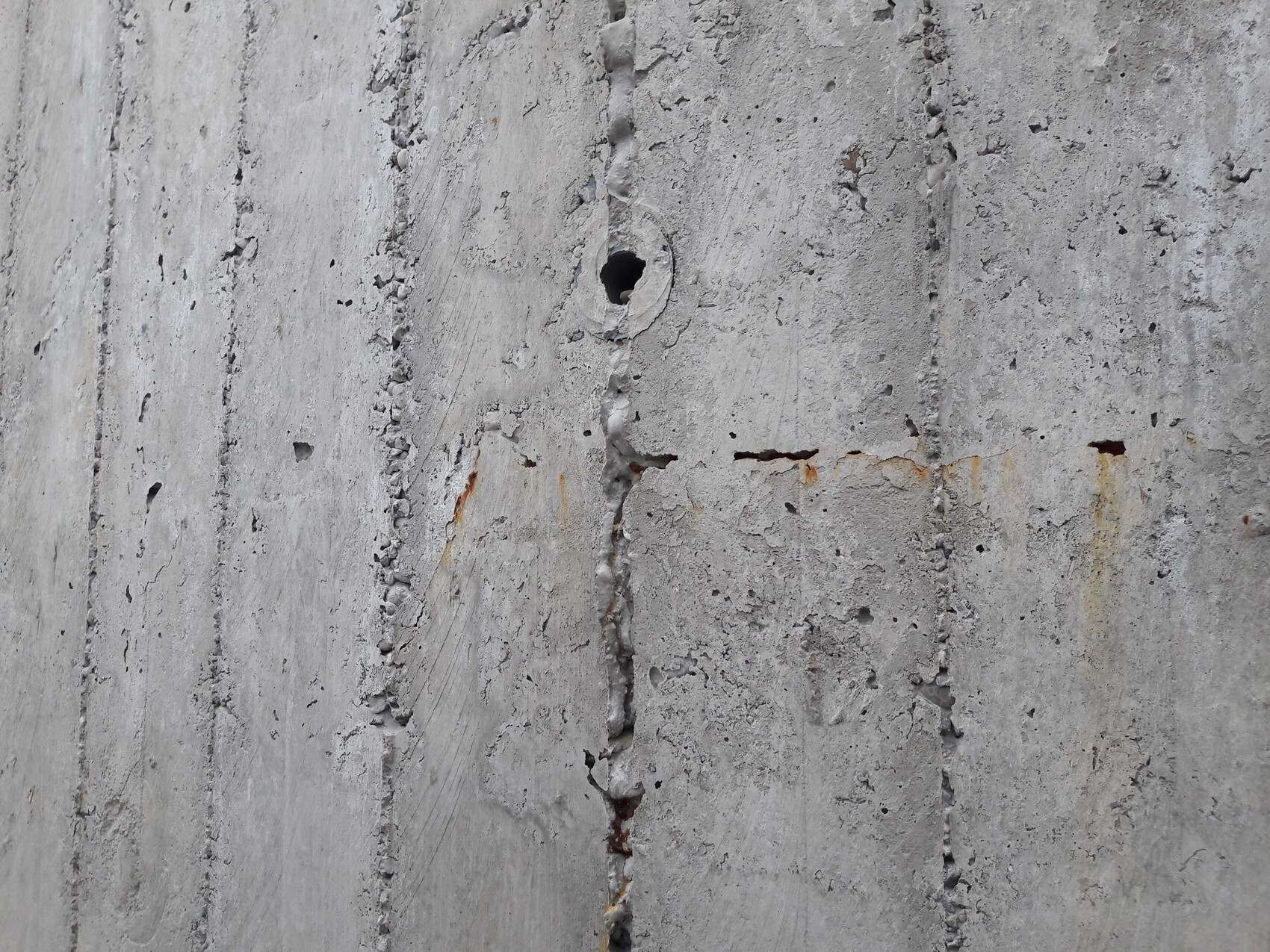
Our shell construction was paused over a winter due to the Corona situation. After that, rust stains appeared on exposed exterior and interior concrete walls (unnoticed by site management).
In my opinion, the cause is partly stone pockets and partly insufficient concrete cover (no spacers or displaced ones).
After much back and forth, a concrete repair specialist was engaged by the construction company. He exposed the affected areas, brushed off rust (no sandblasting) and applied corrosion protection and repair mortar (manufacturer from Augsburg).
My questions:
- Should the concrete cover of the adjacent reinforcement (which had not yet reacted) in the affected areas have been measured?
- What exposure class applies under ETICS / external wall insulation systems (EWI), and is a reduced concrete cover tolerated there?
- What happens if rust beneath the ETICS causes delamination?
Site manager’s statement: “What could really happen here, no structural function of these walls, plus they are covered by ETICS.”
(see example photos)
Is this a defect?
4. Cantilevered balcony upstand:
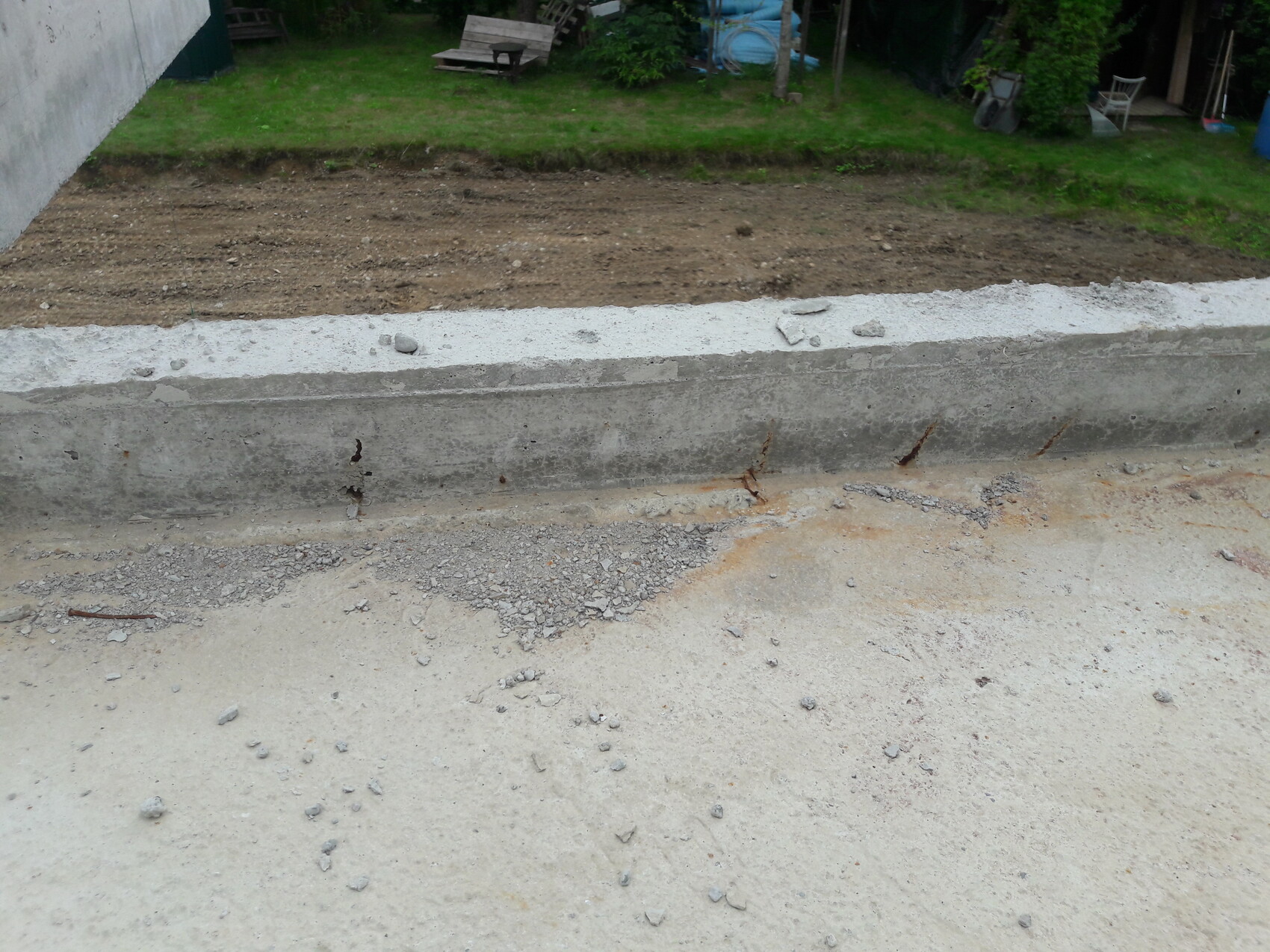
The balcony running around one corner (approx. 14m (46 feet)) was cast on-site, around Isokörbe, in one pour. It has an upstand about 10cm (4 inches) wide and about 20cm (8 inches) high. From the start, small stone pockets were visible in this upstand. Initially, we only wanted to paint, but after rust streaks appeared in many areas, we had to plaster it.
I never saw the formwork plans for the concreting, but I recall that during formwork works there was a discussion about the dimensioning of the Isokörbe. The construction company said the Isokörbe were too weak, the planner/site manager/structural engineer said they were okay. Possibly they agreed to make the upstand narrower for weight reasons, but that is speculation.
Question:
- Is it even possible to place bent reinforcement in a 10cm (4 inch) wide upstand without maintaining the minimum concrete cover?
(photo)
Is this a defect?
5. Isokörbe, waterproofing and dimensioning:
The balcony slab is sloped and waterproofed by the roofer. The waterproofing consists of 2 layers of bitumen membrane with slope plates underneath.
So, there is no waterproofing directly on the concrete surface of the balcony, nor on the Isokörbe.
The site manager said this is not a waterproofing system like on a roof terrace and it is acceptable if water slowly accumulates inside.
Was this executed correctly?
I would like to have the structural capacity of the Isokörbe checked. Would anyone here be interested in taking this on? If yes, please contact me.
Thank you very much for the support, also in the other threads.

They relate to the shell construction, execution of the waterproof concrete (white tank), concrete cover and perimeter insulation, Isokörbe (thermal insulation cubes).
Since all the following topics belong to the shell construction phase, I hope it’s okay to cover everything in one thread.
Our house is entirely reinforced concrete (I wouldn’t do it that way again), ready-mixed concrete, no precast wall elements, executed with a waterproof concrete design (white tank).
Before gathering all the data, if needed, here are some initial broad questions, to which I probably already know the answers.
1. Waterproof concrete (white tank):
A waterstop profile has been installed at the junction between the basement floor slab and basement walls, which in my opinion is also technically correct.
At the junction between basement walls and basement ceiling, this was (probably) not done. This may not be absolutely mandatory, but a horizontal joint sealing of the construction joints should be present if I have correctly understood the numerous threads on this topic. This is missing. The joint has already been backfilled, and garden/terrace areas are finished.
Anchor holes have been sealed with ??? some kind of expanding material… I can’t recall the name of the material used.
Is this a defect?
2. Perimeter insulation:
The perimeter insulation panels have gaps of about 1cm (0.4 inches) from the wall in some areas, which can allow water intrusion behind the insulation.
The basement was built during very low temperatures (November), and the 2-component adhesive used from Ma*** was very viscous and difficult to apply. Some bonding spots later detached, causing some insulation panels to loosen. The adhesive spots themselves were sometimes about 1cm (0.4 inches) thick.
The site manager’s statement from memory: “If water accumulates, how much water could enter? Besides, we are in a frost-free area.” Some corrections were made partially.
Is this a defect?
3. Concrete walls:
Our shell construction was paused over a winter due to the Corona situation. After that, rust stains appeared on exposed exterior and interior concrete walls (unnoticed by site management).
In my opinion, the cause is partly stone pockets and partly insufficient concrete cover (no spacers or displaced ones).
After much back and forth, a concrete repair specialist was engaged by the construction company. He exposed the affected areas, brushed off rust (no sandblasting) and applied corrosion protection and repair mortar (manufacturer from Augsburg).
My questions:
- Should the concrete cover of the adjacent reinforcement (which had not yet reacted) in the affected areas have been measured?
- What exposure class applies under ETICS / external wall insulation systems (EWI), and is a reduced concrete cover tolerated there?
- What happens if rust beneath the ETICS causes delamination?
Site manager’s statement: “What could really happen here, no structural function of these walls, plus they are covered by ETICS.”
(see example photos)
Is this a defect?
4. Cantilevered balcony upstand:
The balcony running around one corner (approx. 14m (46 feet)) was cast on-site, around Isokörbe, in one pour. It has an upstand about 10cm (4 inches) wide and about 20cm (8 inches) high. From the start, small stone pockets were visible in this upstand. Initially, we only wanted to paint, but after rust streaks appeared in many areas, we had to plaster it.
I never saw the formwork plans for the concreting, but I recall that during formwork works there was a discussion about the dimensioning of the Isokörbe. The construction company said the Isokörbe were too weak, the planner/site manager/structural engineer said they were okay. Possibly they agreed to make the upstand narrower for weight reasons, but that is speculation.
Question:
- Is it even possible to place bent reinforcement in a 10cm (4 inch) wide upstand without maintaining the minimum concrete cover?
(photo)
Is this a defect?
5. Isokörbe, waterproofing and dimensioning:
The balcony slab is sloped and waterproofed by the roofer. The waterproofing consists of 2 layers of bitumen membrane with slope plates underneath.
So, there is no waterproofing directly on the concrete surface of the balcony, nor on the Isokörbe.
The site manager said this is not a waterproofing system like on a roof terrace and it is acceptable if water slowly accumulates inside.
Was this executed correctly?
I would like to have the structural capacity of the Isokörbe checked. Would anyone here be interested in taking this on? If yes, please contact me.
Thank you very much for the support, also in the other threads.

Hello,
Regarding point 1: The holes must be sealed with fiber cement plugs, which are bonded using a two-component epoxy adhesive.
Regarding point 2: For “damp soil” without hydrostatic pressure, various manufacturers state that perimeter insulation can be spot-bonded with a two-component adhesive. Are you sure the adhesive was too thick due to the cold, or was the working time of 60–90 minutes exceeded? We were very precise when bonding, yet our insulation still protrudes by about 8mm (0.3 inches).
I’m not familiar with the rest. Based on the photos alone, our concrete basement looks clearly better.
Regarding point 1: The holes must be sealed with fiber cement plugs, which are bonded using a two-component epoxy adhesive.
Regarding point 2: For “damp soil” without hydrostatic pressure, various manufacturers state that perimeter insulation can be spot-bonded with a two-component adhesive. Are you sure the adhesive was too thick due to the cold, or was the working time of 60–90 minutes exceeded? We were very precise when bonding, yet our insulation still protrudes by about 8mm (0.3 inches).
I’m not familiar with the rest. Based on the photos alone, our concrete basement looks clearly better.
T
Teimo19886 Jun 2025 00:08Regarding point 5: I would say that the precast concrete slab should actually have been sealed. Then insulated and sealed again. But what is below it? Living space would of course be a serious issue, but since you mention a balcony, I assume that’s not the case.
On the topic of defects: what was contracted and what was paid for?
On the topic of defects: what was contracted and what was paid for?
A
alive&kicking6 Jun 2025 09:14Thank you for your replies
This was simply forgotten in our case; the site manager did not notice. Since the perimeter insulation was already installed and backfilled, an internal sealing with a swelling agent was applied afterward.
It might have been that the open time was exceeded; I was told it was due to the cold. What puzzled me was that the adhesive was noticeably thinner at the edges of the perimeter insulation boards.
Is it now a problem that water can get behind the insulation?
Those photos are not of the basement but of the upper floor, exterior wall. I don’t have any basement pictures because I wasn’t present during the formwork removal, and our site manager “accidentally” deleted all photos taken for documentation.
familie_s schrieb:
Point 1: The holes must be sealed with fiber cement plugs, which are bonded using a two-component epoxy adhesive.
This was simply forgotten in our case; the site manager did not notice. Since the perimeter insulation was already installed and backfilled, an internal sealing with a swelling agent was applied afterward.
familie_s schrieb:
Point 2: According to various manufacturers, for "damp soil" without hydrostatic pressure, the perimeter insulation can be spot-bonded with two-component adhesive. Are you sure the adhesive became too thick because of the cold, or was the open time of 60-90 minutes exceeded? We applied the adhesive very carefully, yet our insulation still protrudes about 8mm (0.3 inches).
It might have been that the open time was exceeded; I was told it was due to the cold. What puzzled me was that the adhesive was noticeably thinner at the edges of the perimeter insulation boards.
Is it now a problem that water can get behind the insulation?
familie_s schrieb:
Just judging by the photos, our concrete basement looks much better
Those photos are not of the basement but of the upper floor, exterior wall. I don’t have any basement pictures because I wasn’t present during the formwork removal, and our site manager “accidentally” deleted all photos taken for documentation.
A
alive&kicking6 Jun 2025 09:19Teimo1988 schrieb:
Regarding point 5, I would say that the concrete slab with embedded pipes should have been sealed as well. Then insulated and sealed again. But what is underneath? Living space would obviously be critical, but since you mention a balcony, I assume it’s not.
On the topic of defects: what was commissioned and what was paid for? Thank you for your reply.
Below is no living space, but partly roller shutter boxes and insulated diamond-shaped cladding.
My concern is whether this could lead to a problem, such as corrosion, and whether this should have been commissioned … keyword structural engineer/site manager.

alive&kicking schrieb:
I don’t have any photos of the basement since I wasn’t present during the formwork removal, and our site manager "accidentally" deleted all the photos taken for documentation.I probably would have "accidentally" reversed his payment as well. I wonder what kind of unusual instructions you gave your planners. It also clearly isn’t a typical house, but one where the owner should have been aware of the need for close, active supervision.https://www.instagram.com/11antgmxde/
https://www.linkedin.com/company/bauen-jetzt/
Similar topics