
ᐅ South-facing sloped plot, 700 sqm, single-family house about 150 sqm, looking for design ideas?
Created on: 28 May 2025 22:52
H
Hanger1
Hello everyone,
We have been working for some time now on how best to position our future single-family home on our plot. We want to utilize the existing slope as efficiently as possible and avoid losing too much green space.
Development Plan / Restrictions
Plot size approximately 700 sqm (8,400 sq ft)
Slope: yes, 10% south-facing slope
Site coverage ratio (Floor Area Ratio) 0.3
Floor space index 0.6
Number of parking spaces: 2 (garage or carport)
Orientation: Ridge direction can be freely chosen
Maximum heights / limits: The eaves height on the valley side must not exceed 6.65 m (21.8 ft)
Maximum 2 full floors
Setback distances according to the regulations of the Bavarian building code
Attached garages to the boundary are only permitted where garages are built together within the areas designated in the development plan
For other garages, a minimum distance of 1.20 m (4 ft) from the property boundary applies
Client Requirements
Approximately 150 sqm (1,615 sq ft) of living space
Basement, floors: open. However, due to the slope, a basement is likely. Possibly using the basement as a garage.
Number of occupants, ages: 2 adults, 2 children
House Design
Designer: Do-it-yourself
Could you please provide some input on the preliminary planning of a single-family home?
The building site has a south-facing slope of about 10%.
The road is located on the north and west sides.
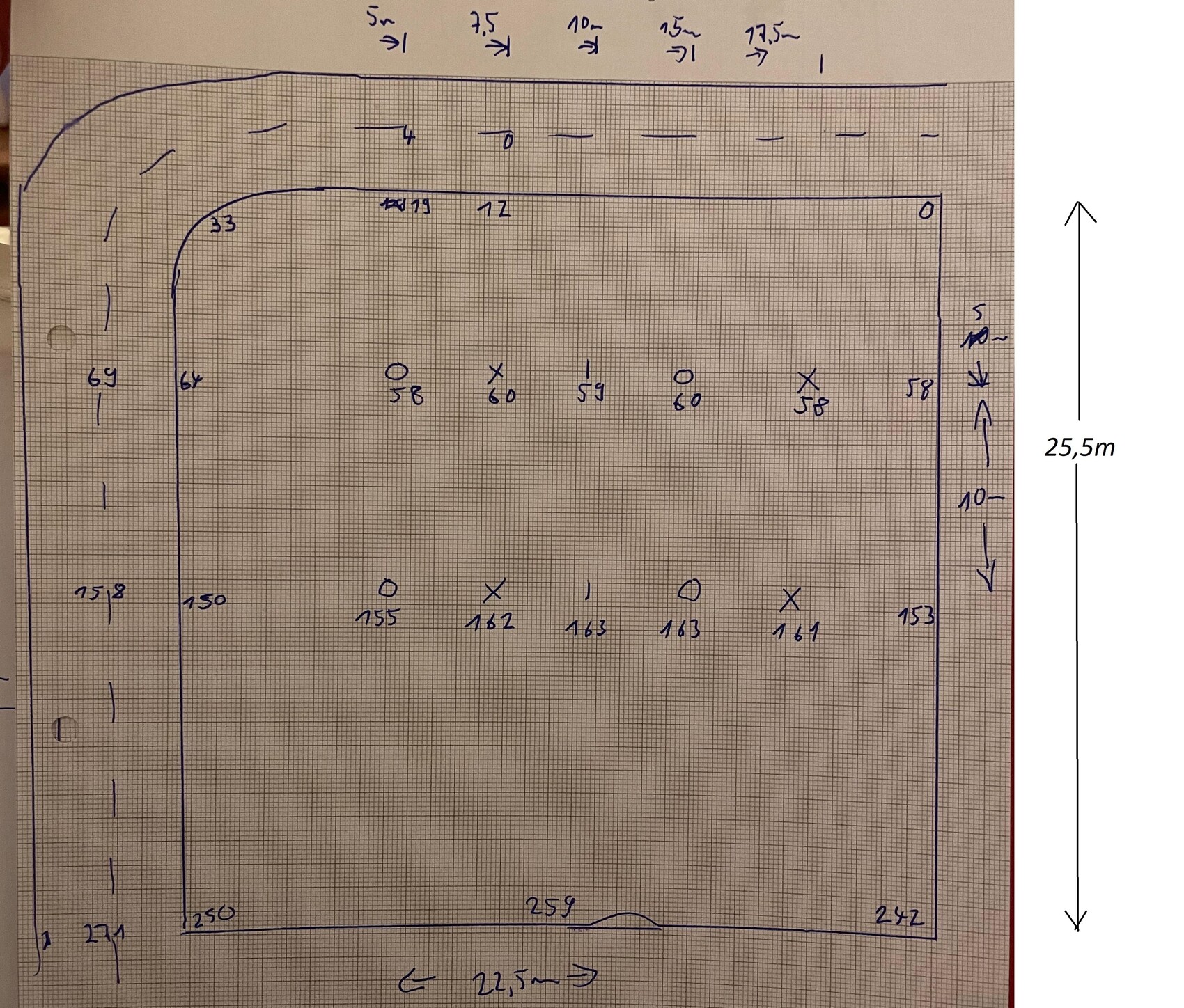
I have already marked the key points by laser. Zero point at northeast. The measurements are given in centimeters and should actually be negative since it is a south-facing slope.
The plan is for a single-family home of about 150 sqm (1,615 sq ft) with a garage or carport.
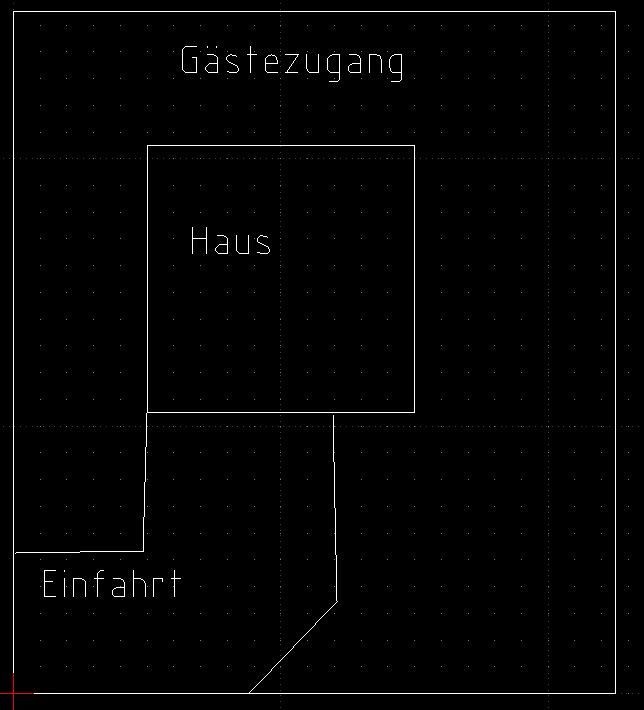
Option I a
5 m (16.4 ft) from north and west
House approximately 10 x 10 m (33 x 33 ft)
Garage integrated into the basement. Driveway access from south/west.
Guest entrance on the north side.
Advantage:
Everything fits within the 10 x 10 m (33 x 33 ft) footprint.
Disadvantage:
The garage driveway must be in front of the house, which results in a substantial loss of green space since there is only 7.5 m (24.6 ft) width available on the east side.
Option I b
House is positioned 5 m (16.4 ft) from north and east, leaving 7.5 m (24.6 ft) on the west street side. However, the driveway to the basement garage would definitely be too steep here.
Option II
Build the basement slightly higher and place the sleeping and bathroom areas in the basement so that the garden can be accessed directly from this level.
The upper floor has the main entrance on the north side, accessed by several steps. This floor contains the kitchen, dining, and living areas.
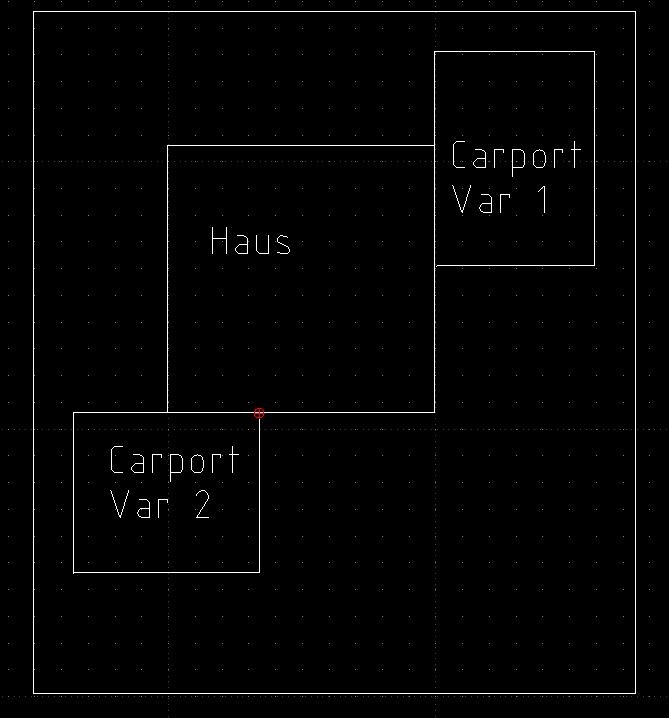
The garage or carport is built beside the house.
There is a balcony terrace on the upper floor, accessible from the dining area. The garden is reachable via stairs.
Advantage: Much more green space remains on the south side.
Disadvantage: Significantly more earthworks required. Overall less green area preserved.
Similar properties in the neighborhood:
2 full floors + basement + garage: In my opinion, the basement is only used as unnecessary storage space here. The costs are too high for this.
Slab foundation + 2 full floors + garage: Due to the slope, this requires extensive earthworks.
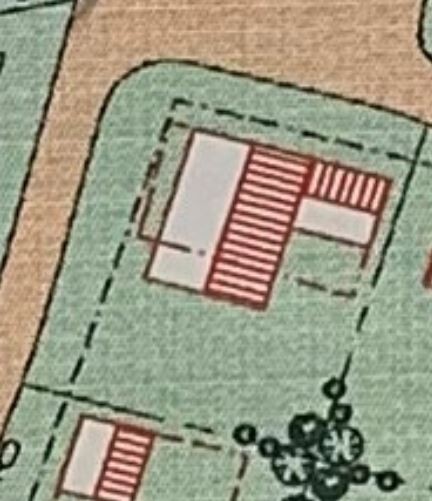
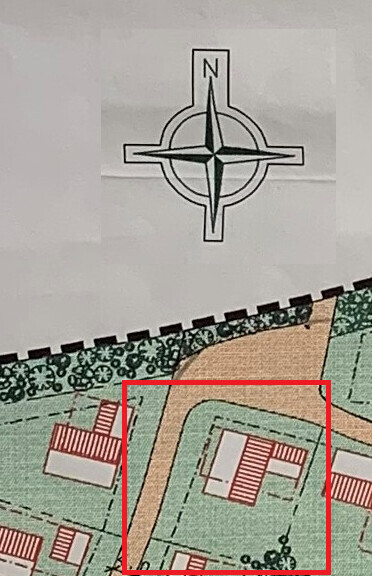
Attached are the height measurements, sketches of the options, and an excerpt from the development plan.
I would appreciate any input or other ideas very much.
We have been working for some time now on how best to position our future single-family home on our plot. We want to utilize the existing slope as efficiently as possible and avoid losing too much green space.
Development Plan / Restrictions
Plot size approximately 700 sqm (8,400 sq ft)
Slope: yes, 10% south-facing slope
Site coverage ratio (Floor Area Ratio) 0.3
Floor space index 0.6
Number of parking spaces: 2 (garage or carport)
Orientation: Ridge direction can be freely chosen
Maximum heights / limits: The eaves height on the valley side must not exceed 6.65 m (21.8 ft)
Maximum 2 full floors
Setback distances according to the regulations of the Bavarian building code
Attached garages to the boundary are only permitted where garages are built together within the areas designated in the development plan
For other garages, a minimum distance of 1.20 m (4 ft) from the property boundary applies
Client Requirements
Approximately 150 sqm (1,615 sq ft) of living space
Basement, floors: open. However, due to the slope, a basement is likely. Possibly using the basement as a garage.
Number of occupants, ages: 2 adults, 2 children
House Design
Designer: Do-it-yourself
Could you please provide some input on the preliminary planning of a single-family home?
The building site has a south-facing slope of about 10%.
The road is located on the north and west sides.
I have already marked the key points by laser. Zero point at northeast. The measurements are given in centimeters and should actually be negative since it is a south-facing slope.
The plan is for a single-family home of about 150 sqm (1,615 sq ft) with a garage or carport.
Option I a
5 m (16.4 ft) from north and west
House approximately 10 x 10 m (33 x 33 ft)
Garage integrated into the basement. Driveway access from south/west.
Guest entrance on the north side.
Advantage:
Everything fits within the 10 x 10 m (33 x 33 ft) footprint.
Disadvantage:
The garage driveway must be in front of the house, which results in a substantial loss of green space since there is only 7.5 m (24.6 ft) width available on the east side.
Option I b
House is positioned 5 m (16.4 ft) from north and east, leaving 7.5 m (24.6 ft) on the west street side. However, the driveway to the basement garage would definitely be too steep here.
Option II
Build the basement slightly higher and place the sleeping and bathroom areas in the basement so that the garden can be accessed directly from this level.
The upper floor has the main entrance on the north side, accessed by several steps. This floor contains the kitchen, dining, and living areas.
The garage or carport is built beside the house.
There is a balcony terrace on the upper floor, accessible from the dining area. The garden is reachable via stairs.
Advantage: Much more green space remains on the south side.
Disadvantage: Significantly more earthworks required. Overall less green area preserved.
Similar properties in the neighborhood:
2 full floors + basement + garage: In my opinion, the basement is only used as unnecessary storage space here. The costs are too high for this.
Slab foundation + 2 full floors + garage: Due to the slope, this requires extensive earthworks.
Attached are the height measurements, sketches of the options, and an excerpt from the development plan.
I would appreciate any input or other ideas very much.

Whatever may differentiate the elevation point classes O, X, and I: the slope of the plot clearly runs predominantly north-south, while it is almost level in the west-east direction. This leads to the recommendation to position the buildings as much as possible along the west-east axis – that is, rotated 90° compared to the example house in the zoning plan / brochure – and to place the garage preferably near the northern street. I also did not understand the “building envelope within the building envelope,” which, however, does not even apply to the example house (?)
On a slope, the primary consideration is the ideal alignment of contour lines with the house axis. Apart from that, the most favorable basic shape is a rectangle close to a square (about 5:4 ratio, as specified in many Bavarian zoning plans) with the main entrance on the eaves side in the middle third of the width.
These image catalogs mostly show mainstream designs, as well as many ideas that simply don’t fit into one’s own plot without being distorted beyond recognition. Standard or generic designs ensure that the majority of people in your circle find the design acceptable, and the drive-in home “protects” from neighbors’ greetings when coming or going. For a generation of homebuilders who preferred texting a friend on the schoolyard rather than walking the eight meters to them, this seems to be important.
But please only as a verbal discussion with rough sketching during design phase 2, and not beyond the resting period of the ‘dough’. Also, not with the goal of achieving one hundred percent perfection, which is not the purpose during the preliminary design stage. One (1!) preliminary design, discussion, possibly a second preliminary design, after iteration one of the two then the resting period—no infinite doodling to exhaustion!
During the resting period, the key decisions are made, and based on these insights, a discussion follows on whether to further develop the current preliminary design or to adjust an alternative “response to question 2.”
https://www.instagram.com/11antgmxde/
https://www.linkedin.com/company/bauen-jetzt/
Arauki11 schrieb:
I also believe, and recently decided this myself for that reason, that the rectangle is by far the most suitable house shape.
On a slope, the primary consideration is the ideal alignment of contour lines with the house axis. Apart from that, the most favorable basic shape is a rectangle close to a square (about 5:4 ratio, as specified in many Bavarian zoning plans) with the main entrance on the eaves side in the middle third of the width.
wiltshire schrieb:
The idea that you have to walk a few meters from the car to the front door sometimes causes so much panic that people lose sight of the overall solution.
ypg schrieb:
Pinterest, Instagram, YouTube—they basically only show me what is widely pictured and built, but not what is unique or special.
And so, cookie-cutter designs are built. Taste no longer comes from within.
These image catalogs mostly show mainstream designs, as well as many ideas that simply don’t fit into one’s own plot without being distorted beyond recognition. Standard or generic designs ensure that the majority of people in your circle find the design acceptable, and the drive-in home “protects” from neighbors’ greetings when coming or going. For a generation of homebuilders who preferred texting a friend on the schoolyard rather than walking the eight meters to them, this seems to be important.
wiltshire schrieb:
If the principle fits, then iterative adjustment begins,
But please only as a verbal discussion with rough sketching during design phase 2, and not beyond the resting period of the ‘dough’. Also, not with the goal of achieving one hundred percent perfection, which is not the purpose during the preliminary design stage. One (1!) preliminary design, discussion, possibly a second preliminary design, after iteration one of the two then the resting period—no infinite doodling to exhaustion!
During the resting period, the key decisions are made, and based on these insights, a discussion follows on whether to further develop the current preliminary design or to adjust an alternative “response to question 2.”
https://www.instagram.com/11antgmxde/
https://www.linkedin.com/company/bauen-jetzt/
W
wiltshire30 May 2025 15:46ypg schrieb:
I go to Google Search and only keep finding the same resultsGood advice! Look for images everywhere, not just in online image databases, but also in architecture and home magazines, take screenshots of film scenes or photos of TV freeze frames, take photos when you see something interesting, cut out pictures from newspapers… Print out digital images and create a mood board using scissors, cardboard, and glue. Physically engaging with and selecting what goes onto the board is extremely helpful. The result reveals a lot about you, and the house is meant to be for you.11ant schrieb:
The picture catalogs mostly show mainstream designs and many ideas that don’t fit your own plot, unless you drastically alter them beyond recognition.Forget about model home catalogs.wiltshire schrieb:
Look for images everywhere—not just in digital image databases, but also in architecture and home magazines. Take screenshots from movie scenes or photos of paused TV frames, You would need several winning lottery tickets just for the crime scene villas from a single season of Rosenheim Cops.
wiltshire schrieb:
Forget model home catalogs. Model homes are at least somewhat more realistic compared to the above when it comes to the lot size requirements that an average single-family home (detached, not semi-detached) lot can meet. Sometimes, you can even find feasible examples on 500 m² (5,380 sq ft) lots—at least theoretically. In practice, however, I strongly advise against relying on existing examples at all. There are so many ways to customize house designs that even for average homeowners with a simple rectangular floor plan, the "risk" of ending up with a house that looks just like everyone else’s can be reduced almost to zero. Many of these "tricks" are actually very affordable, starting with avoiding RAL 7016 (anthracite gray); it also involves choices beyond just full brick cladding versus no brick cladding at all.
https://www.instagram.com/11antgmxde/
https://www.linkedin.com/company/bauen-jetzt/
First of all, thank you very much for the many replies and input for the planning. The tips have already shown us a slightly different approach than what we had taken so far.
There was a mistake there.
The plot measures 25.4 x 22.8 m (meters) = 572 sqm (square meters) (to the northwest there is a rounding).
I did write the elevation measurements somewhat confusingly, unfortunately.
I have uploaded a new version. Dimensions like 100 equate to 10 m, elevation measurements like 70 mean 70 cm (centimeters) below the zero level.
As you already mentioned, the slope basically runs almost entirely from north to south along the north-south axis, for example: boundary at 19 cm, 5 m = 58 cm, 10 m = 155 cm.
The budget is still open, roughly 500-550 (thousand).
Our initial idea was to combine everything in one building to save costs, meaning an underground garage, and then the ground floor and upper floor for the house.
We assumed it makes sense to build a basement on this slope. Just using it for storage costs money, and the basement seems too expensive considering the budget.
An alternative idea would be to extend about 40 sqm (square meters) more with a basement so that the basement could have windows on the east, south, and west sides. We would use the basement as the actual upper floor (sleeping area), with the entrance on the north side leading to the living areas (kitchen, living room, etc.). This way, we could skip the upper floor but would still need storage space for vehicles.
Black dashed line = building limit
Brown dashed box with GA = location for garages
Model house catalogs, Instagram, etc., have so far been our biggest source of inspiration. Besides that, we drove around several residential developments to get ideas.
We think the idea of proportions close to 5:4 is very good. We initially took 10 x 10 m as a starting plan and staked it out on the plot to roughly imagine how large the house would be and how much space remains outside.
ypg schrieb:
However, I can’t make sense of the measurements. At the bottom and right sides it shows 22.5 and 25.5… but that doesn’t result in 700 sqm (square meters). Also, it’s a bit unclear, so you have to guess whether 5 mm represents one meter or another dimension, e.g., 2 cm equals 10 meters.
There was a mistake there.
The plot measures 25.4 x 22.8 m (meters) = 572 sqm (square meters) (to the northwest there is a rounding).
I did write the elevation measurements somewhat confusingly, unfortunately.
I have uploaded a new version. Dimensions like 100 equate to 10 m, elevation measurements like 70 mean 70 cm (centimeters) below the zero level.
As you already mentioned, the slope basically runs almost entirely from north to south along the north-south axis, for example: boundary at 19 cm, 5 m = 58 cm, 10 m = 155 cm.
ypg schrieb:
Whether you plan a basement, a habitable basement, a garage in the basement, a double garage next to the house, or something similar will still depend on the budget. So, how high is the budget for the house, outdoor areas, and ancillary construction costs? You can eliminate some options if the budget doesn’t allow for everything.
The budget is still open, roughly 500-550 (thousand).
Our initial idea was to combine everything in one building to save costs, meaning an underground garage, and then the ground floor and upper floor for the house.
We assumed it makes sense to build a basement on this slope. Just using it for storage costs money, and the basement seems too expensive considering the budget.
An alternative idea would be to extend about 40 sqm (square meters) more with a basement so that the basement could have windows on the east, south, and west sides. We would use the basement as the actual upper floor (sleeping area), with the entrance on the north side leading to the living areas (kitchen, living room, etc.). This way, we could skip the upper floor but would still need storage space for vehicles.
ypg schrieb:
What I wonder is: what is the legend for the marked lines? I see two building envelopes?
Black dashed line = building limit
Brown dashed box with GA = location for garages
Model house catalogs, Instagram, etc., have so far been our biggest source of inspiration. Besides that, we drove around several residential developments to get ideas.
We think the idea of proportions close to 5:4 is very good. We initially took 10 x 10 m as a starting plan and staked it out on the plot to roughly imagine how large the house would be and how much space remains outside.
Hanger1 schrieb:
We consider the idea of a rectangular ratio, for example 5:4, to be very good. We initially planned a 10 x 10 m (33 x 33 ft) layout and marked it out on the building site so we could get an idea of the house size and how much space would remain around it. For demonstration marking, I use 8 x 12 m (26 x 39 ft), which can be rotated by 90° (which makes no sense with a 10 x 10 m (33 x 33 ft) footprint) and then you immediately see the difference between aligning with the contour lines and across them. You want around 150 sqm (1,615 sq ft), which requires a footprint of about 125 sqm (1,345 sq ft) ("one-and-a-half stories") or nearly 95 sqm (1,022 sq ft) ("townhouse") — so in a 5:4 ratio roughly 8.7 x 11 m (29 x 36 ft). According to the 11ant basement rule, from a building depth of 8.7 m (29 ft), just under 45% would be "per basement" area.
Hanger1 schrieb:
Our initial idea was to accommodate everything within one building to save costs—that is, basement garage, ground floor, and upper floor all in one.
We assumed it made sense to build a basement on this slope. Just using the basement as storage costs money, but the basement itself would be too expensive given the budget.
An alternative idea would be to extend about 40 cm (16 inches) more with a basement so that windows could be placed on the east, south, and west sides of the basement. The basement could then serve as the actual upper floor (sleeping area). Simply because the ramp into an underground garage requires sufficient length to manage the height difference smoothly (and the basement under a living area requires this as well), I recommend a classic basement (not like modern designs today where the basement is level with the uphill terrain and the ground floor is at street level, but rather a basement under a raised ground floor). However, many zoning or building regulations only moderately accommodate this, often limiting the finished floor level of the ground floor to about 0.5 m (20 inches) above the road or similar.
https://www.instagram.com/11antgmxde/
https://www.linkedin.com/company/bauen-jetzt/
Similar topics