
ᐅ South-facing sloped plot, 700 sqm, single-family house about 150 sqm, looking for design ideas?
Created on: 28 May 2025 22:52
H
Hanger1Hello everyone,
We have been working for some time now on how best to position our future single-family home on our plot. We want to utilize the existing slope as efficiently as possible and avoid losing too much green space.
Development Plan / Restrictions
Plot size approximately 700 sqm (8,400 sq ft)
Slope: yes, 10% south-facing slope
Site coverage ratio (Floor Area Ratio) 0.3
Floor space index 0.6
Number of parking spaces: 2 (garage or carport)
Orientation: Ridge direction can be freely chosen
Maximum heights / limits: The eaves height on the valley side must not exceed 6.65 m (21.8 ft)
Maximum 2 full floors
Setback distances according to the regulations of the Bavarian building code
Attached garages to the boundary are only permitted where garages are built together within the areas designated in the development plan
For other garages, a minimum distance of 1.20 m (4 ft) from the property boundary applies
Client Requirements
Approximately 150 sqm (1,615 sq ft) of living space
Basement, floors: open. However, due to the slope, a basement is likely. Possibly using the basement as a garage.
Number of occupants, ages: 2 adults, 2 children
House Design
Designer: Do-it-yourself
Could you please provide some input on the preliminary planning of a single-family home?
The building site has a south-facing slope of about 10%.
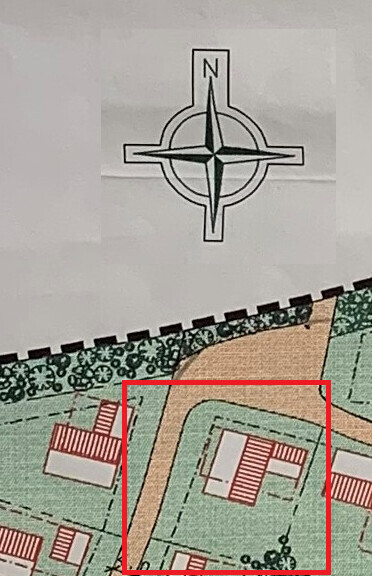
The road is located on the north and west sides.
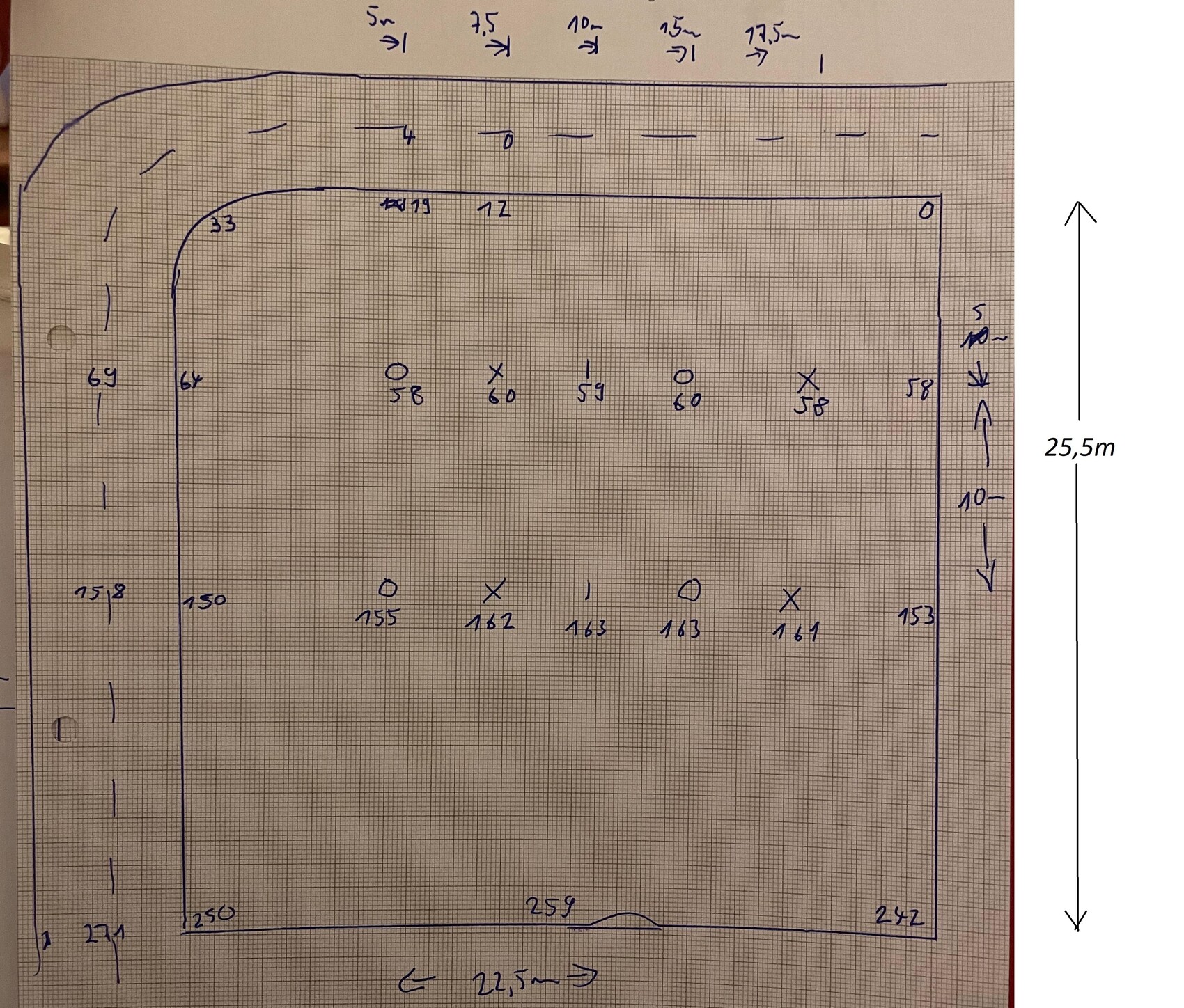
I have already marked the key points by laser. Zero point at northeast. The measurements are given in centimeters and should actually be negative since it is a south-facing slope.
The plan is for a single-family home of about 150 sqm (1,615 sq ft) with a garage or carport.
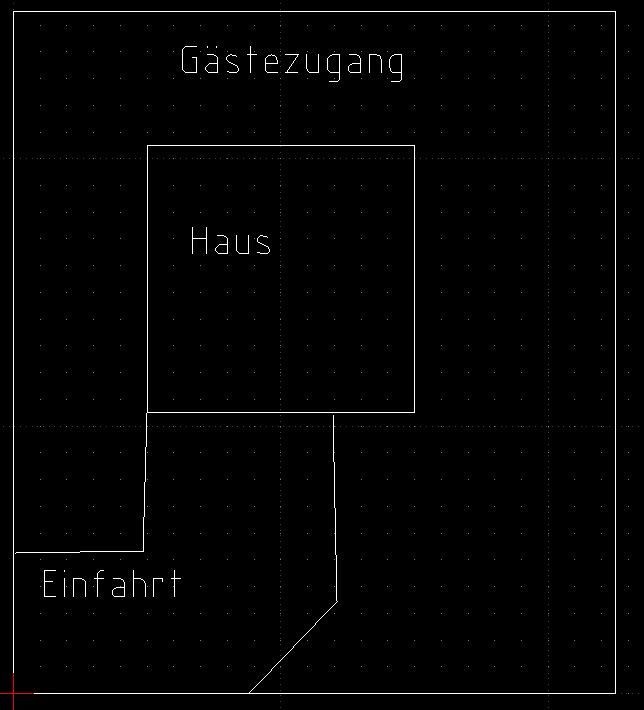
Option I a
5 m (16.4 ft) from north and west
House approximately 10 x 10 m (33 x 33 ft)
Garage integrated into the basement. Driveway access from south/west.
Guest entrance on the north side.
Advantage:
Everything fits within the 10 x 10 m (33 x 33 ft) footprint.
Disadvantage:
The garage driveway must be in front of the house, which results in a substantial loss of green space since there is only 7.5 m (24.6 ft) width available on the east side.
Option I b
House is positioned 5 m (16.4 ft) from north and east, leaving 7.5 m (24.6 ft) on the west street side. However, the driveway to the basement garage would definitely be too steep here.
Option II
Build the basement slightly higher and place the sleeping and bathroom areas in the basement so that the garden can be accessed directly from this level.
The upper floor has the main entrance on the north side, accessed by several steps. This floor contains the kitchen, dining, and living areas.
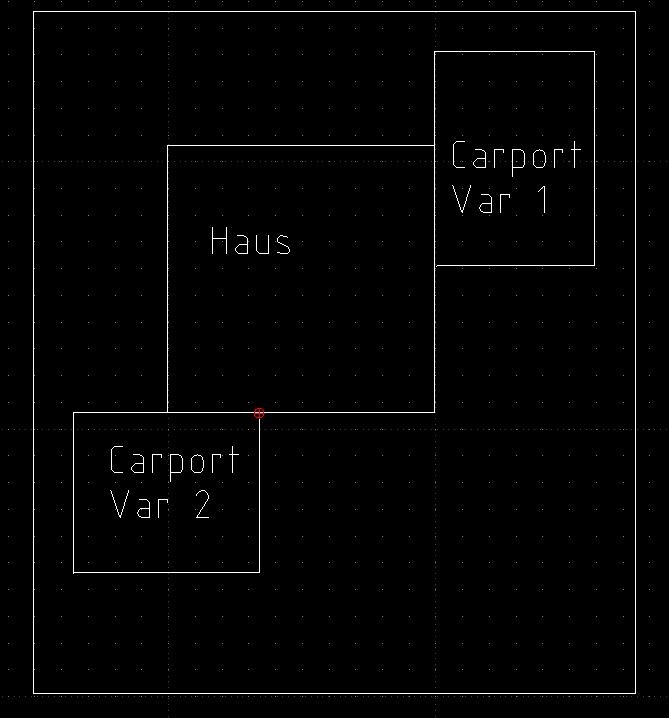
The garage or carport is built beside the house.
There is a balcony terrace on the upper floor, accessible from the dining area. The garden is reachable via stairs.
Advantage: Much more green space remains on the south side.
Disadvantage: Significantly more earthworks required. Overall less green area preserved.
Similar properties in the neighborhood:
2 full floors + basement + garage: In my opinion, the basement is only used as unnecessary storage space here. The costs are too high for this.
Slab foundation + 2 full floors + garage: Due to the slope, this requires extensive earthworks.
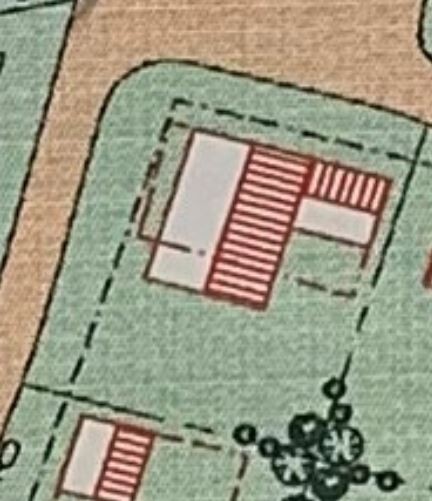
Attached are the height measurements, sketches of the options, and an excerpt from the development plan.
I would appreciate any input or other ideas very much.
We have been working for some time now on how best to position our future single-family home on our plot. We want to utilize the existing slope as efficiently as possible and avoid losing too much green space.
Development Plan / Restrictions
Plot size approximately 700 sqm (8,400 sq ft)
Slope: yes, 10% south-facing slope
Site coverage ratio (Floor Area Ratio) 0.3
Floor space index 0.6
Number of parking spaces: 2 (garage or carport)
Orientation: Ridge direction can be freely chosen
Maximum heights / limits: The eaves height on the valley side must not exceed 6.65 m (21.8 ft)
Maximum 2 full floors
Setback distances according to the regulations of the Bavarian building code
Attached garages to the boundary are only permitted where garages are built together within the areas designated in the development plan
For other garages, a minimum distance of 1.20 m (4 ft) from the property boundary applies
Client Requirements
Approximately 150 sqm (1,615 sq ft) of living space
Basement, floors: open. However, due to the slope, a basement is likely. Possibly using the basement as a garage.
Number of occupants, ages: 2 adults, 2 children
House Design
Designer: Do-it-yourself
Could you please provide some input on the preliminary planning of a single-family home?
The building site has a south-facing slope of about 10%.
The road is located on the north and west sides.
I have already marked the key points by laser. Zero point at northeast. The measurements are given in centimeters and should actually be negative since it is a south-facing slope.
The plan is for a single-family home of about 150 sqm (1,615 sq ft) with a garage or carport.
Option I a
5 m (16.4 ft) from north and west
House approximately 10 x 10 m (33 x 33 ft)
Garage integrated into the basement. Driveway access from south/west.
Guest entrance on the north side.
Advantage:
Everything fits within the 10 x 10 m (33 x 33 ft) footprint.
Disadvantage:
The garage driveway must be in front of the house, which results in a substantial loss of green space since there is only 7.5 m (24.6 ft) width available on the east side.
Option I b
House is positioned 5 m (16.4 ft) from north and east, leaving 7.5 m (24.6 ft) on the west street side. However, the driveway to the basement garage would definitely be too steep here.
Option II
Build the basement slightly higher and place the sleeping and bathroom areas in the basement so that the garden can be accessed directly from this level.
The upper floor has the main entrance on the north side, accessed by several steps. This floor contains the kitchen, dining, and living areas.
The garage or carport is built beside the house.
There is a balcony terrace on the upper floor, accessible from the dining area. The garden is reachable via stairs.
Advantage: Much more green space remains on the south side.
Disadvantage: Significantly more earthworks required. Overall less green area preserved.
Similar properties in the neighborhood:
2 full floors + basement + garage: In my opinion, the basement is only used as unnecessary storage space here. The costs are too high for this.
Slab foundation + 2 full floors + garage: Due to the slope, this requires extensive earthworks.
Attached are the height measurements, sketches of the options, and an excerpt from the development plan.
I would appreciate any input or other ideas very much.
You really put a lot of effort into the height annotations. Great job.
However, I can’t make sense of the measurements. At the bottom and right side, you have 22.5 and 25.5, but that doesn’t add up to 700 m² (7,535 sq ft).
Also, it’s a bit unclear whether 5 mm represents 1 meter, or if another scale applies, for example, 2 cm representing 10 meters.
That means a height difference of just 1 meter (3 feet) over 10 meters (33 feet). That’s not much.
Is the worst dimension for a house actually the best? That doesn’t apply here. A 10 x 10 m (33 x 33 ft) footprint is the standard dimension for a typical modern townhouse villa, basically a symmetrical hipped roof design. I consider that the worst choice.
If you work with the plot’s shape, the house would be about 8 x 13 m (26 x 43 ft) (or 9 x 12 m / 30 x 39 ft) oriented crosswise, following the slope, so there would be only about 80 cm (31 inches) of height difference over those 8 meters (26 feet).
Whether you then plan a basement, a partly above-ground basement, a garage in the basement, a double garage beside the house, or anything similar depends on the BUDGET. So, what is the budget for the house, landscaping, and additional construction costs? You can eliminate some options if the budget does not allow them.
What I wonder about is: how do you interpret the legend for the drawn lines? I see two building envelopes/planning boundaries?
P.S. It would be nice to keep the presentation positive, with black lines on a white background.
However, I can’t make sense of the measurements. At the bottom and right side, you have 22.5 and 25.5, but that doesn’t add up to 700 m² (7,535 sq ft).
Also, it’s a bit unclear whether 5 mm represents 1 meter, or if another scale applies, for example, 2 cm representing 10 meters.
Hanger1 schrieb:
The building site has a south-facing slope of about 10%
That means a height difference of just 1 meter (3 feet) over 10 meters (33 feet). That’s not much.
Hanger1 schrieb:
House about 10 x 10 m
Is the worst dimension for a house actually the best? That doesn’t apply here. A 10 x 10 m (33 x 33 ft) footprint is the standard dimension for a typical modern townhouse villa, basically a symmetrical hipped roof design. I consider that the worst choice.
Hanger1 schrieb:
Could you give me some input for the preliminary planning of a single-family house?
If you work with the plot’s shape, the house would be about 8 x 13 m (26 x 43 ft) (or 9 x 12 m / 30 x 39 ft) oriented crosswise, following the slope, so there would be only about 80 cm (31 inches) of height difference over those 8 meters (26 feet).
Whether you then plan a basement, a partly above-ground basement, a garage in the basement, a double garage beside the house, or anything similar depends on the BUDGET. So, what is the budget for the house, landscaping, and additional construction costs? You can eliminate some options if the budget does not allow them.
What I wonder about is: how do you interpret the legend for the drawn lines? I see two building envelopes/planning boundaries?
P.S. It would be nice to keep the presentation positive, with black lines on a white background.
W
wiltshire29 May 2025 08:55Hello and welcome!
It’s good that you are considering the orientation of the house and parking spaces first. However, I would suggest rethinking the two established principles:
1. Does the house really need to have a 10m (33 ft) square floor plan? Like @ypg, I consider this generally a suboptimal solution. This shape is usually chosen by people who prioritize a low price per square meter over a good floor plan. In most cases, a well-designed layout with less area is much more suitable for a family than a square floor plan with more space.
2. Do the cars need to be directly next to the house? The idea of having to walk a few meters from the car to the front door sometimes causes so much concern that people become blind to the overall solution.
If you want to build the garage in the basement and avoid the disadvantage of a long driveway – underfloor heating for a steep driveway adds about 10€/m² (about $10/ft²) to the cost of creating the access path. Operating costs are reasonable: the standard consumption per square meter is 300 Wh for keeping the surface free of ice and snow. The heating duration on a frost day is about 6 hours. At 30 cents/kWh, this equals approximately 54 cents/m² (5 cents/ft²) per day – on an area of 30m² (320 ft²) that rounds up to about €17 ($18) per day. Thirty days of this kind – some requiring more, others less energy – would cost roughly €500 ($540) per year. This may seem expensive. However, if it saves you 50m² (540 ft²) of paving work, which would also reduce your green space, the cost looks different.
How you view this type of energy consumption is another matter – this was the reason we decided against it. Still, the calculation was interesting.
It’s good that you are considering the orientation of the house and parking spaces first. However, I would suggest rethinking the two established principles:
1. Does the house really need to have a 10m (33 ft) square floor plan? Like @ypg, I consider this generally a suboptimal solution. This shape is usually chosen by people who prioritize a low price per square meter over a good floor plan. In most cases, a well-designed layout with less area is much more suitable for a family than a square floor plan with more space.
2. Do the cars need to be directly next to the house? The idea of having to walk a few meters from the car to the front door sometimes causes so much concern that people become blind to the overall solution.
If you want to build the garage in the basement and avoid the disadvantage of a long driveway – underfloor heating for a steep driveway adds about 10€/m² (about $10/ft²) to the cost of creating the access path. Operating costs are reasonable: the standard consumption per square meter is 300 Wh for keeping the surface free of ice and snow. The heating duration on a frost day is about 6 hours. At 30 cents/kWh, this equals approximately 54 cents/m² (5 cents/ft²) per day – on an area of 30m² (320 ft²) that rounds up to about €17 ($18) per day. Thirty days of this kind – some requiring more, others less energy – would cost roughly €500 ($540) per year. This may seem expensive. However, if it saves you 50m² (540 ft²) of paving work, which would also reduce your green space, the cost looks different.
How you view this type of energy consumption is another matter – this was the reason we decided against it. Still, the calculation was interesting.
In fact, I would completely let go of any preconceptions formed from my previous reading, viewing, or listening experiences. From my own repeated experience, something can develop that I end up really liking, even though I wouldn’t have thought of it at all at the beginning.
I would start by planning the floor plan, which is already a challenging task to optimize and customize for myself. After that, there will also be places for the car, garden house, and so on.
I would never compromise on my living space layout just so that my car parks “better.” Requirements like parking directly next to the house, having access to the house, or being only 3m (10 feet) away from the house are often treated as fixed rules, but they end up creating obstacles for the actual housebuilder.
I also believe, and recently decided for this reason myself, that a rectangular shape is generally a far more suitable house design.
I would start by planning the floor plan, which is already a challenging task to optimize and customize for myself. After that, there will also be places for the car, garden house, and so on.
I would never compromise on my living space layout just so that my car parks “better.” Requirements like parking directly next to the house, having access to the house, or being only 3m (10 feet) away from the house are often treated as fixed rules, but they end up creating obstacles for the actual housebuilder.
I also believe, and recently decided for this reason myself, that a rectangular shape is generally a far more suitable house design.
W
wiltshire29 May 2025 11:09Hanger1 schrieb:
Could you give me some input for the preliminary planning of a single-family house? Gladly. Here are some practical insights and tips:
1. Before you start drawing, spend a lot of time thinking about what is important to you in everyday life, what makes a good day at home, how you like to spend quality family time, work, time as a couple, your hobbies, etc. Writing this down is important. The list can be very long and may include wishes and dreams to be fulfilled later. Don’t think about rooms or floor plans yet – rather imagine a feature film about your life and everything you want to include. Prioritizing can come later. This list helps you develop your own criteria for what is important for the architectural design and what isn’t. Take a couple of days for this, and set it aside now and then to gain new ideas. This work is extremely useful later and crucial for creating a really good house that fits you.
2. Before you start drawing, each of you should create a mood board. Look for images of houses, gardens, architectural details, atmospheres, colors and stick them onto a large sheet of paper at least the size of a flip chart. It doesn’t matter if these things match or if they come from a landscape different from your building site, or anything else. It’s a creative template that will save a lot of time later and help ensure the result fits you.
These first two points also help when dealing with the initial shock of the budget and setting priorities for how things should be implemented, and thinking about alternative ways to achieve your goals. You often hear from people here who eventually think only about "room sizes and clearance widths" and forget why they are building the house in the first place.
3. Still before you start drawing: begin to consciously observe other houses and evaluate them based on your own criteria mentioned above. Take notes, photos, or videos of what you like and dislike, and comment on why. This approach helps you leave model house developments wiser rather than confused – even if only because none of the houses seem to fit.
4. Find an architect or building partner who is eager to work with you. This is important because only then will they respond to what you have already prepared. Give as few fixed specifications as possible, like a strict 10x10 meter (33x33 feet) external dimension. The freer the architect can respond to you, the more likely the design will suit your life. If you have drawn anything by then, do NOT share it, as this can be limiting.
5. When the architect presents the first design, be patient and first let them explain their ideas and how they thought about your needs. You can evaluate afterwards. If the concept works, iterative adjustments begin; if not, you may need a different design (unlikely if you’ve chosen the architect well).
This process requires patience, confidence, and stress-free enjoyment. If that’s not your thing, others will surely have different tips.
wiltshire schrieb:
More like a feature film about your life and everything you want to include in it. Wow! That’s a really great tip! I really like it. Thank you.
wiltshire schrieb:
2. Before you start drawing, everyone should create a mood board. Look for images of houses, gardens, architectural details, I’m a bit skeptical about that: when I search on Google, I always end up seeing the same things. Pinterest, Instagram, YouTube—they basically show me what’s popular and widespread, not what’s unique or special.
And that’s how cookie-cutter builds happen. Taste no longer comes from within yourself.
A current example: wall decorations, how to make a wall special? What gets shown? Acoustic panels. As if that could really make something special? Nope.
wiltshire schrieb:
The idea that having to walk a few meters from the car to the front door can be so dreadful sometimes makes people blind to the overall solution. That’s such a classic and fits with the advice where people without a car are told they absolutely need to have an indoor corridor so they don’t get wet. If it even ever rains—I’d dance in the raindrops.
Similar topics