
ᐅ Semi-detached house within a building plot measuring 8.5 m by 15 m (width x depth)
Created on: 20 May 2025 19:02
G
GregorBerger
Dear housebuilding forum,
After several years of searching, we have finally purchased a plot of land (with an existing building to be demolished) in our desired location. This also marks the end of my many years of purely passive participation in this forum. Since we were primarily looking for renovation projects rather than new builds, we naturally have some initial questions.
The plot, approximately 500 m² (5,400 sq ft), lies within the scope of a development plan that was last updated 20 years ago.
Basic data about the plot and development plan:
The development plan places no restrictions on, among other things:
The plan is to build a semi-detached house with another family. Both families have two children each and require two home offices, resulting in a need for six rooms per semi-detached unit. If we make progress here, I will create another thread in the floor plan forum and fill out the questionnaire.
Since the building envelope width of 8.5 meters (28 ft) is too narrow for semi-detached units side by side, they would have to be arranged one behind the other. Garden access and terraces would then be located on the narrow sides (one facing the street and one facing the main garden at the rear). This type of semi-detached house is quite rare. I have looked around in real life but have not found any examples. Only the Büdenbender semi-detached house Gemello SD 135 roughly corresponds to this layout (though not to the measurements).
I have had some informal discussions with an architect I know (who now only works on office buildings) and the building authority, without encountering any fundamental contradictions so far.
I have already applied the @11ant basement rule, according to which a basement seems obligatory because there is more than 2 meters (7 ft) of height difference within the building envelope. However, I do not understand how this relates to the “base (plinth)” restriction of max. 60 cm (24 in) in the development plan. My layperson assumption would be that one floor (the ground floor? the lowest residential floor? the lowest full floor?) may start a maximum of 60 cm (24 in) above street level.
My first questions for you:
Thank you in advance,
Gregor
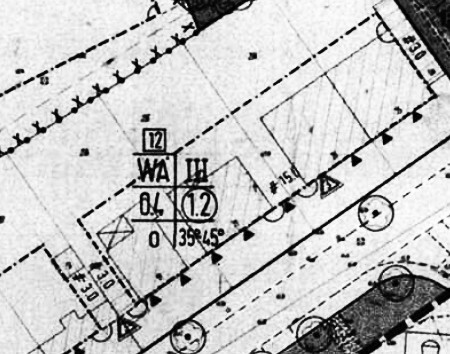
After several years of searching, we have finally purchased a plot of land (with an existing building to be demolished) in our desired location. This also marks the end of my many years of purely passive participation in this forum. Since we were primarily looking for renovation projects rather than new builds, we naturally have some initial questions.
The plot, approximately 500 m² (5,400 sq ft), lies within the scope of a development plan that was last updated 20 years ago.
Basic data about the plot and development plan:
- Building is permitted from 3 meters (10 ft) to 18 meters (59 ft) depth (so 15 m (49 ft) for the house)
- After deducting setback areas, a width of 8.5 meters (28 ft) is possible
- Slight slope across the building envelope with a rise of approximately 2.2 meters (7 ft)
- 3 full floors permitted
- Site occupancy index (ground coverage ratio) 0.4
- Floor area ratio 1.2 (cannot be fully utilized due to the aforementioned building envelope)
- Roof pitch 35–45°
- Knee wall (dormer wall) height 60 cm (24 in)
- Base (plinth) max. 60 cm (24 in) above the midpoint along the width of the access area, which is itself 30 cm (12 in) lower than the start of the building envelope
- General residential zone
- Open building style (detached buildings, no shared walls)
- Covered terraces allowed up to 1.5 meters (5 ft) outside the building boundary, provided the site occupancy index is not exceeded
- Roof indentations and structures permitted up to half the eaves length and at least 1 meter (3 ft) from the gable wall
- Fencing with native hedges. Along the street, an additional fence up to 1.2 meters (4 ft) high is permitted.
The development plan places no restrictions on, among other things:
- Building type
- Number of residential units per building
- Height limits
- Basements
- Parking spaces
The plan is to build a semi-detached house with another family. Both families have two children each and require two home offices, resulting in a need for six rooms per semi-detached unit. If we make progress here, I will create another thread in the floor plan forum and fill out the questionnaire.
Since the building envelope width of 8.5 meters (28 ft) is too narrow for semi-detached units side by side, they would have to be arranged one behind the other. Garden access and terraces would then be located on the narrow sides (one facing the street and one facing the main garden at the rear). This type of semi-detached house is quite rare. I have looked around in real life but have not found any examples. Only the Büdenbender semi-detached house Gemello SD 135 roughly corresponds to this layout (though not to the measurements).
I have had some informal discussions with an architect I know (who now only works on office buildings) and the building authority, without encountering any fundamental contradictions so far.
I have already applied the @11ant basement rule, according to which a basement seems obligatory because there is more than 2 meters (7 ft) of height difference within the building envelope. However, I do not understand how this relates to the “base (plinth)” restriction of max. 60 cm (24 in) in the development plan. My layperson assumption would be that one floor (the ground floor? the lowest residential floor? the lowest full floor?) may start a maximum of 60 cm (24 in) above street level.
My first questions for you:
- Are you familiar with similar houses, possibly with names for Googling or similar?
- Would you approach this topic differently?
- What does the rule about the base (plinth) mean?
Thank you in advance,
Gregor
11ant schrieb:
That would then .. mean a house built with great strain. A house that already feels overwhelming when viewed from your own property.
G
GregorBerger21 May 2025 21:04hanghaus2023 schrieb:
Thanks for the site plan.
I have added the terrain according to your information.
This way it can work.We were thinking along these lines as well. But probably an additional floor will be needed, see below with @11ant.hanghaus2023 schrieb:
Who will get the garden plot? Is it supposed to be legally subdivided with right of way?The building planning office verbally rejected a legal subdivision. They would only approve property subdivisions within the scope of development plans if both subdivided plots reach the front building line. They wouldn’t explain the legal basis for this to me. They added that the top priority is that all houses “face the street.” Interestingly, this is not described in the development plan. I have already written down the textual requirements further above for you.kbt09 schrieb:
One should also keep in mind that this means garden access for larger gardening tasks is not free and would only be possible through the garage or the house.I find that acceptable. A garden without direct access also has many advantages.kbt09 schrieb:
I know, but it’s still about 40 cm (16 inches) … and it’s still not clear how terraces could be arranged in a solution like this at all.One terrace behind the house (towards the main garden), and one in the front garden. The front garden should be shielded from the street by a tall hedge for privacy. This is the case with a nearby house as well. However, that is a multi-family house where the ground floor apartment has its garden facing the street. That might also work with a semi-detached house, right?11ant schrieb:
The limitation of the base (plinth) height primarily aims to prevent design abuse regarding building height.Very interesting. What kind of abuse could that be? The building height is not specified in meters but is limited: If fully utilized, the basement on the slope would protrude less than 1.40 m (55 inches) on average, then there would be three full floors plus an attic with a 60 cm (24 inches) knee wall and a 45° roof pitch. What kind of design abuse could increase height beyond that? Besides, we don’t want such a tall building (five floors with livable space).11ant schrieb:
If we assume a 1.8 m (6 feet) elevation difference within the building envelope, a floor-to-floor height of 2.8 m (9 feet 2 inches), and a base height / reference point of 0.6 m (24 inches), then the ground floor would protrude 3.4 m (0.6 m base + 2.8 m floor height) in front, and 1.6 m (2.8 m floor height + 0.6 m base minus 1.8 m slope) in the back – on average about 2.5 m (8 feet 2 inches) above the terrain,In this case, the plinth/base would be pointless, at least I don’t see the benefit. It would be better to plan the ground floor at street level (without a lower floor underneath), whereby the rooms at the back would be mostly underground and probably only allowed as non-habitable space. This floor would then stand about 1.30 m (51 inches) above the natural terrain on average (because the slope initially rises more steeply – more precise measurements might be needed), so it would not count as a full floor. Above that, one could build as many floors as necessary, max 3 plus attic; in our case probably rather 2 plus attic.ypg schrieb:
.. a house that is forced. A house that feels overwhelming already when you look at it from your own property.What do you mean by that? The neighboring house as sketched by 11ant, just with the ground floor at street level. I have already visited neighbors and did not feel overwhelmed at all.I detect concerns in all your posts, probably justified too. But I don’t manage to see which direction you would lean toward?
G
GregorBerger21 May 2025 21:11GregorBerger schrieb:
The neighboring house as outlined by 11ant, but with the ground floor at street level. Processing time expired. Another difference with the neighboring house: It is not a semi-detached house but a two-family house with a granny flat. Additionally, the slope has been excavated across the entire plot, so at the back of the house you have to climb steeply up into the garden, while the upper floor features an elevated terrace with a short staircase about 1m (3 feet) down into the garden. I could not find out the reason for the ground adjustment.

GregorBerger schrieb:
Very interesting. What kind of misuse could this be? Although the building height is not specified in meters, it is limited: Without a limit on the base height, there would be a strong temptation to raise the ground floor "garden side at grade," which risks increasing the overall building height.
GregorBerger schrieb:
The planning authority verbally rejected a real subdivision. They would only approve plot divisions within the scope of zoning plans if both subdivided plots reach the front building line. However, they refused to explain the legal basis for this. They also added that the highest priority is for the houses to be "all facing the street." Interestingly, this is not described in the zoning plan. I have already shared the written regulations with you above. Without making the front edge of the building plot align with the building line, I also see no legal basis for such a building obligation. The reason for rejecting the real subdivision is that the rear part would then legally be considered "unoccupied" and therefore would have no prospect of a building permit (unless the front plot granted corresponding rights of use).
I advise you not to struggle with this and instead build a traditional two-family apartment building with stacked units rather than a duplex (even if the upper apartment is a maisonette).
https://www.instagram.com/11antgmxde/
https://www.linkedin.com/company/bauen-jetzt/
GregorBerger schrieb:
I don’t see 53 m² (570 sq ft) of living space as a deal breaker. We have also looked at row houses with even less space. And there are floor plans for houses with similar exterior dimensions. Not as semi-detached houses, but so-called "urban villas" designed for an 8x8 m (26x26 ft) building plot can be found. Of course, these have windows on all sides and can only serve as rough inspiration.But there is certainly a good reason why you didn’t find what you were looking for with those houses: your room program.GregorBerger schrieb:
I have been reading your posts for years and always had the impression that you can make everything somehow fit.Yes, but at some point, you have to seriously reconsider whether an enormous effort with many compromises is worth it just to achieve something that no longer really reflects the original wish. I don’t assume you want to give friends part of the land out of kindness; this is a cost issue. How expensive was the plot? And how much of that cost do the building partners accept? One party is definitely getting the short end of the stick here.
GregorBerger schrieb:
One garden is at the back of the house (towards the main garden), the other in the front yard. The front yard is supposed to be visually shielded from the street by a tall hedge. This is the case with a nearby house as well. However, that is a multi-family house where the ground floor apartment has its garden facing the street. Would that also work with a semi-detached house?Well, there is a significant difference between deciding on a condominium unit and planning to build an expensive single-family house (here: a semi-detached house). GregorBerger schrieb:
Then rather plan the ground floor at street level (without a lower floor), although the rear rooms would then be largely underground and probably only usable as a utility area. This floor would then be on average about 1.30 m (4 ft 3 in) above the natural ground level (since the slope rises more steeply at the front) -Here we go: the rear initially loses a floor that the front part would have. GregorBerger schrieb:
I read concerns in all your posts, probably justified.That’s not quite right. You could say I tend to amplify the negative aspects. Personally, I try to see more than just stacking floors on top of each other. With these floor space dimensions, I don’t see the room program you described. So, you would basically have to build upwards. But...
GregorBerger schrieb:
You could then build as many floors as needed, max. 3 plus attic; in our case probably 2 plus attic....you said it: in your case, the unit at the street would probably be 2 plus attic, but please with the ground floor extension for, e.g., technical rooms and more. Then you can barely meet your room program. But I’ll say it right away: no one may come up with the idea that a straight staircase or a pantry or a dressing room has always been a dream and at least one or two of those wishes should be fulfilled.
So, what about the building partners? They don’t need that room program? They would have one less floor!
Of course, you can add a third floor and then a creative roof. I believe that was an option?
GregorBerger schrieb:
But I can’t seem to figure out which direction you would tend towards?Many things are possible. But I wouldn’t want to live the way you imagine the front part. I wouldn’t buy a plot for that. The question I ask myself is: what were you thinking when buying? I mean, there probably wasn’t a semi-detached house plan in place yet?
I already asked about the costs. And that’s where I start, for example: what else am I giving up just to save some money? I don’t find semi-detached or creative houses bad at all. I really like tiny houses and narrow houses. But that doesn’t really fit a 6-room house. And it’s about you, not me. So, reconsider your thoughts.
Besides, the differences and negative aspects for the front unit, in my opinion, are very significant—something you wouldn’t want to put up with for the next 20 years. The gap towards the rear unit is big. The person in the smaller unit watches as the one above drives past his house and 40 m² (430 sq ft) garden, owning 200 m² (2,150 sq ft) upstairs. And then there’s the emotional division where you basically have to pay for everything for the other unit (slope maintenance, retaining walls, etc.). No friendship will survive that, I’d bet!
My suggestion: consider setting up a nice two-story house. Use the garden on the upper floor for yourselves. You will also have space downstairs for bicycle storage. Possibly you could plan for a granny flat. But you would still have to borrow expensive money for that, which might not pay off.
Here are the two units of a semi-detached house with their ground floors and garden shares.
H
hanghaus202322 May 2025 09:12Could you please provide an elevation profile for the entire plot? Not just for the building area.
Similar topics