
ᐅ Semi-detached house within a building plot measuring 8.5 m by 15 m (width x depth)
Created on: 20 May 2025 19:02
G
GregorBerger
Dear housebuilding forum,
After several years of searching, we have finally purchased a plot of land (with an existing building to be demolished) in our desired location. This also marks the end of my many years of purely passive participation in this forum. Since we were primarily looking for renovation projects rather than new builds, we naturally have some initial questions.
The plot, approximately 500 m² (5,400 sq ft), lies within the scope of a development plan that was last updated 20 years ago.
Basic data about the plot and development plan:
The development plan places no restrictions on, among other things:
The plan is to build a semi-detached house with another family. Both families have two children each and require two home offices, resulting in a need for six rooms per semi-detached unit. If we make progress here, I will create another thread in the floor plan forum and fill out the questionnaire.
Since the building envelope width of 8.5 meters (28 ft) is too narrow for semi-detached units side by side, they would have to be arranged one behind the other. Garden access and terraces would then be located on the narrow sides (one facing the street and one facing the main garden at the rear). This type of semi-detached house is quite rare. I have looked around in real life but have not found any examples. Only the Büdenbender semi-detached house Gemello SD 135 roughly corresponds to this layout (though not to the measurements).
I have had some informal discussions with an architect I know (who now only works on office buildings) and the building authority, without encountering any fundamental contradictions so far.
I have already applied the @11ant basement rule, according to which a basement seems obligatory because there is more than 2 meters (7 ft) of height difference within the building envelope. However, I do not understand how this relates to the “base (plinth)” restriction of max. 60 cm (24 in) in the development plan. My layperson assumption would be that one floor (the ground floor? the lowest residential floor? the lowest full floor?) may start a maximum of 60 cm (24 in) above street level.
My first questions for you:
Thank you in advance,
Gregor
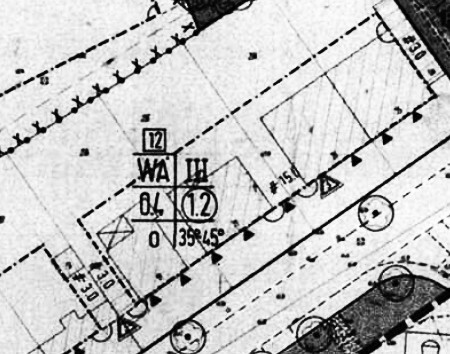
After several years of searching, we have finally purchased a plot of land (with an existing building to be demolished) in our desired location. This also marks the end of my many years of purely passive participation in this forum. Since we were primarily looking for renovation projects rather than new builds, we naturally have some initial questions.
The plot, approximately 500 m² (5,400 sq ft), lies within the scope of a development plan that was last updated 20 years ago.
Basic data about the plot and development plan:
- Building is permitted from 3 meters (10 ft) to 18 meters (59 ft) depth (so 15 m (49 ft) for the house)
- After deducting setback areas, a width of 8.5 meters (28 ft) is possible
- Slight slope across the building envelope with a rise of approximately 2.2 meters (7 ft)
- 3 full floors permitted
- Site occupancy index (ground coverage ratio) 0.4
- Floor area ratio 1.2 (cannot be fully utilized due to the aforementioned building envelope)
- Roof pitch 35–45°
- Knee wall (dormer wall) height 60 cm (24 in)
- Base (plinth) max. 60 cm (24 in) above the midpoint along the width of the access area, which is itself 30 cm (12 in) lower than the start of the building envelope
- General residential zone
- Open building style (detached buildings, no shared walls)
- Covered terraces allowed up to 1.5 meters (5 ft) outside the building boundary, provided the site occupancy index is not exceeded
- Roof indentations and structures permitted up to half the eaves length and at least 1 meter (3 ft) from the gable wall
- Fencing with native hedges. Along the street, an additional fence up to 1.2 meters (4 ft) high is permitted.
The development plan places no restrictions on, among other things:
- Building type
- Number of residential units per building
- Height limits
- Basements
- Parking spaces
The plan is to build a semi-detached house with another family. Both families have two children each and require two home offices, resulting in a need for six rooms per semi-detached unit. If we make progress here, I will create another thread in the floor plan forum and fill out the questionnaire.
Since the building envelope width of 8.5 meters (28 ft) is too narrow for semi-detached units side by side, they would have to be arranged one behind the other. Garden access and terraces would then be located on the narrow sides (one facing the street and one facing the main garden at the rear). This type of semi-detached house is quite rare. I have looked around in real life but have not found any examples. Only the Büdenbender semi-detached house Gemello SD 135 roughly corresponds to this layout (though not to the measurements).
I have had some informal discussions with an architect I know (who now only works on office buildings) and the building authority, without encountering any fundamental contradictions so far.
I have already applied the @11ant basement rule, according to which a basement seems obligatory because there is more than 2 meters (7 ft) of height difference within the building envelope. However, I do not understand how this relates to the “base (plinth)” restriction of max. 60 cm (24 in) in the development plan. My layperson assumption would be that one floor (the ground floor? the lowest residential floor? the lowest full floor?) may start a maximum of 60 cm (24 in) above street level.
My first questions for you:
- Are you familiar with similar houses, possibly with names for Googling or similar?
- Would you approach this topic differently?
- What does the rule about the base (plinth) mean?
Thank you in advance,
Gregor
GregorBerger schrieb:
Is each semi-detached house independently valued in a notional property division? In a notional property division, each part is considered separately, as each owner registers their notional (land) share as well as the shared ownership in the land registry. In the case of a two-family house, ownership is divided according to condominium law, similar to an apartment. That is my understanding.
Perhaps you could share an aerial view of the entire street layout if it is difficult to access the written conditions of the development plan. This might help determine how the front yard is allowed to be used.
Personally, I must admit that I have no desire to look out of my kitchen or living room window onto the neighbor’s carport or garage.
Personally, I must admit that I have no desire to look out of my kitchen or living room window onto the neighbor’s carport or garage.
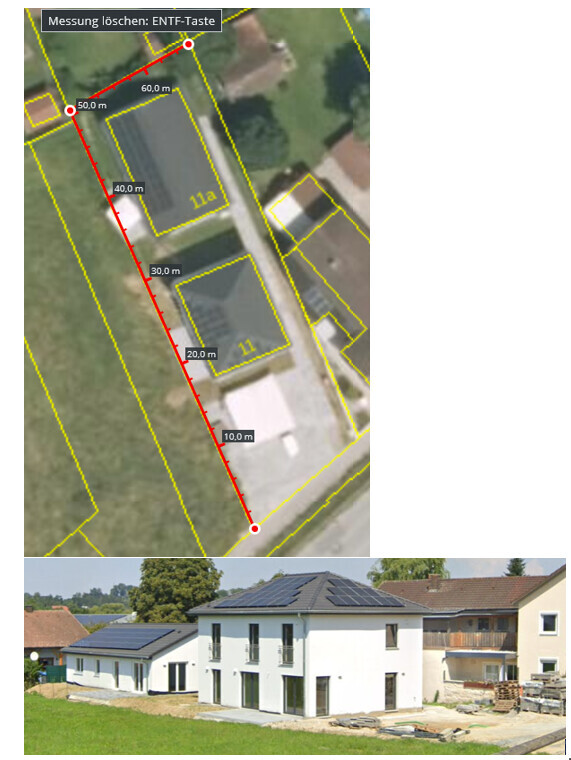
There is something similar on my way to work. The plot is about the same width but longer. There are also two detached houses, with a driveway and access path arranged similarly. The terraces are built right up to the property boundary; I have no idea how that works legally in their case. At the entrance, there is a prefabricated double garage, and on both the right and left sides there is a parking space each, along with the path leading to the houses.
H
hanghaus202321 May 2025 16:28kbt09 schrieb:
@Sooniiaa .. but that is an example without a slope, right?And a very large building area. Not comparable.
GregorBerger schrieb:
So, ground floor? Does that automatically mean that the first full storey is at least 60cm (24 inches) above street level, even if, on average, less than 1.4 meters (4.5 feet) of the building’s depth protrudes from the terrain? The limit on the base height primarily serves to prevent misuse of design in terms of building height. The reference point for height is typically the finished floor level of the ground floor, below which a basement level (lower ground floor or cellar) is assumed. However, the house can presumably also be partially built into the ground. The scenario assumed by the local development plan authority—in all likelihood, although it is probably not explicitly excluded—does not consider your special idea of a rotated semi-detached house, but rather a detached house. The average protruding height of the cellar or basement is “as always” relevant for the question of whether it already counts as a full storey (that is, included in the number of full storeys). Assuming a 1.8-meter (5 feet 11 inches) height difference within the building plot, a storey height of 2.8 meters (9 feet 2 inches), and a base height/reference point of 0.6 meters (24 inches), the ground floor therefore protrudes 3.4 meters (11 feet 2 inches) at the front (0.6 m base + 2.8 m storey height) and 1.6 meters (5 feet 3 inches) at the rear (2.8 m storey height + 0.6 m base minus 1.8 m slope), averaging 2.5 meters (8 feet 2 inches) above the terrain, which makes it a full storey (although for the rear half, it is more like a basement). The cellar is not considered a full storey here. If you are actually allowed to build three full storeys and your attic will not count as a full storey, then you could have two upper floors (and I would have to withdraw my concerns about whether the desired room layout can be realized). This would, however, mean a total eaves height of 9.0 meters (29 feet 6 inches) including a knee wall of 0.6 meters (24 inches) on top, which corresponds to 8.4 meters (27 feet 7 inches) above the reference height.
https://www.instagram.com/11antgmxde/
https://www.linkedin.com/company/bauen-jetzt/
Similar topics