
ᐅ Plot Selection in a New Residential Development for a Single-Family Home – Prioritization
Created on: 15 Apr 2025 21:22
-
-Malte-
Hello everyone,
After a long wait, our city (North Rhine-Westphalia) has finally started marketing a new residential development area on the outskirts. As part of the application process, plots for single-family homes and semi-detached houses are allocated according to a certain distribution logic. We expect to have the opportunity to purchase and will then need to choose quickly from the remaining available plots. The exact timing of when it will be our turn is unclear, so as a preparation, we would like to establish our personal ranking of all the plots.
What are our requirements?
As a family of four (38, 35, 5, 2), we want to build a single-family house (~150-160m² (1600-1720 sq ft) preferably without a basement, with a pitched roof) including a carport/garage. Basically, no special requirements that would directly affect the choice of the plot.
Regarding the plot, we primarily want a location for a single-family home that is as quiet as possible within the development area (noise/through traffic) (priority 1 requirement). Of course, orientation and overall size are also important, but come after the first factor.
What does the development plan specify?
Here are what I consider the most important details from the development plan, which apply equally to all offered plots:
Since linking is not allowed here: the full development plan can be quickly found online by searching “Bocholt Bebauungsplan 8-23 Loikumer Weg”.
Which plots are for sale?
There are 21 plots for single-family homes and 7 plots for semi-detached houses on sale. The price is uniform at €220/m² (€220 per sq m) including development costs. The plots are currently farmland and completely flat. I have attached an aerial photo, an excerpt from the development plan, and a non-binding building concept (only the numbered plots are available for sale).
For more information, the full brochure can also be found online by searching “Bocholt Wohnbaugrundstücke Mussum - Loikumer Weg”.
The development area will be a mixed-use zone: alongside single-family and semi-detached homes, there will be a daycare center, apartment buildings, and a playground. To the west of the development is a federal road, so the western section will be built as continuous development (noise protection facing the road; exact design still unknown). There are three larger apartment buildings to the north. Given the apartment buildings in the north and west, I expect increased through traffic and activity within the development — it will not be a purely quiet single-family home neighborhood. Therefore, when selecting plots, our main focus will be on achieving as much quietness as possible.
Questions for you?
We have been considering which plots have which advantages and even have a few favorites. I’m deliberately not naming them yet to get as unbiased feedback as possible. What would be your favorites, and what aspects would you focus on to best meet our requirements?
Best regards,
Malte
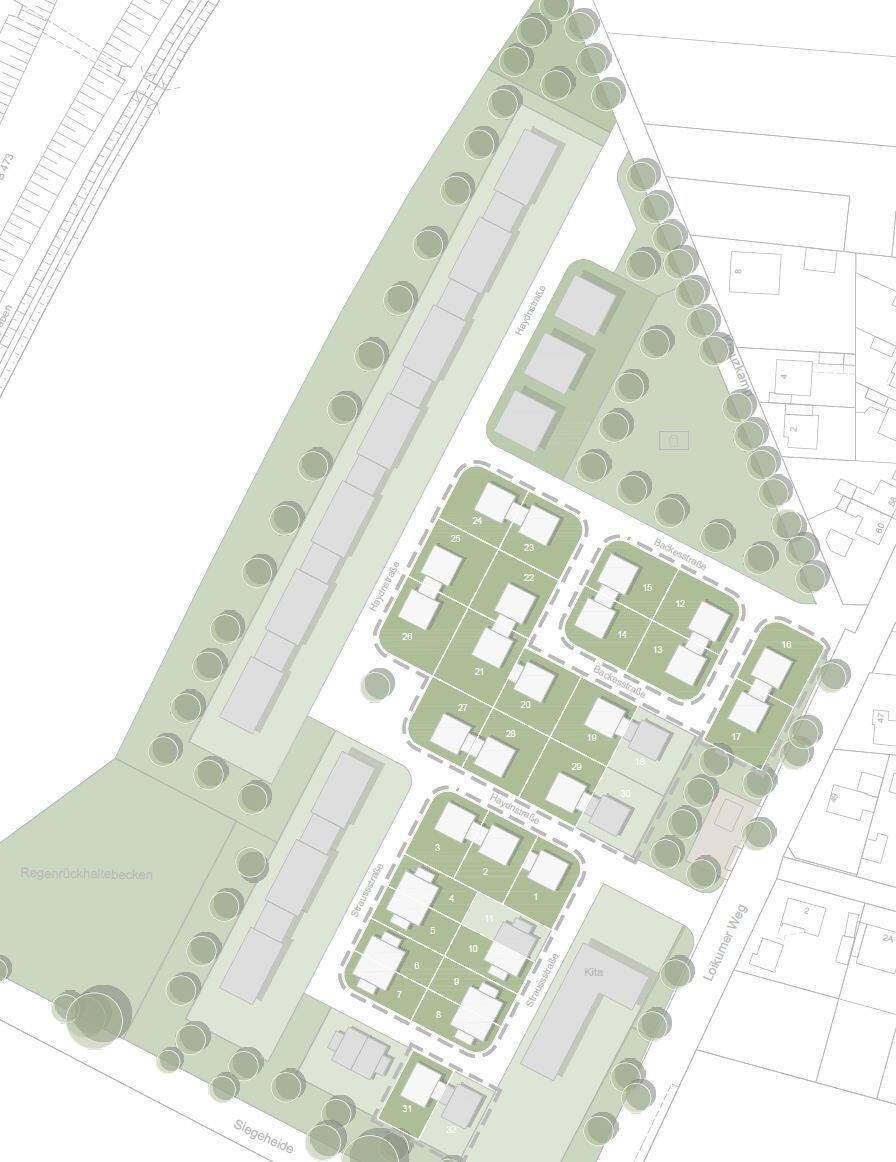
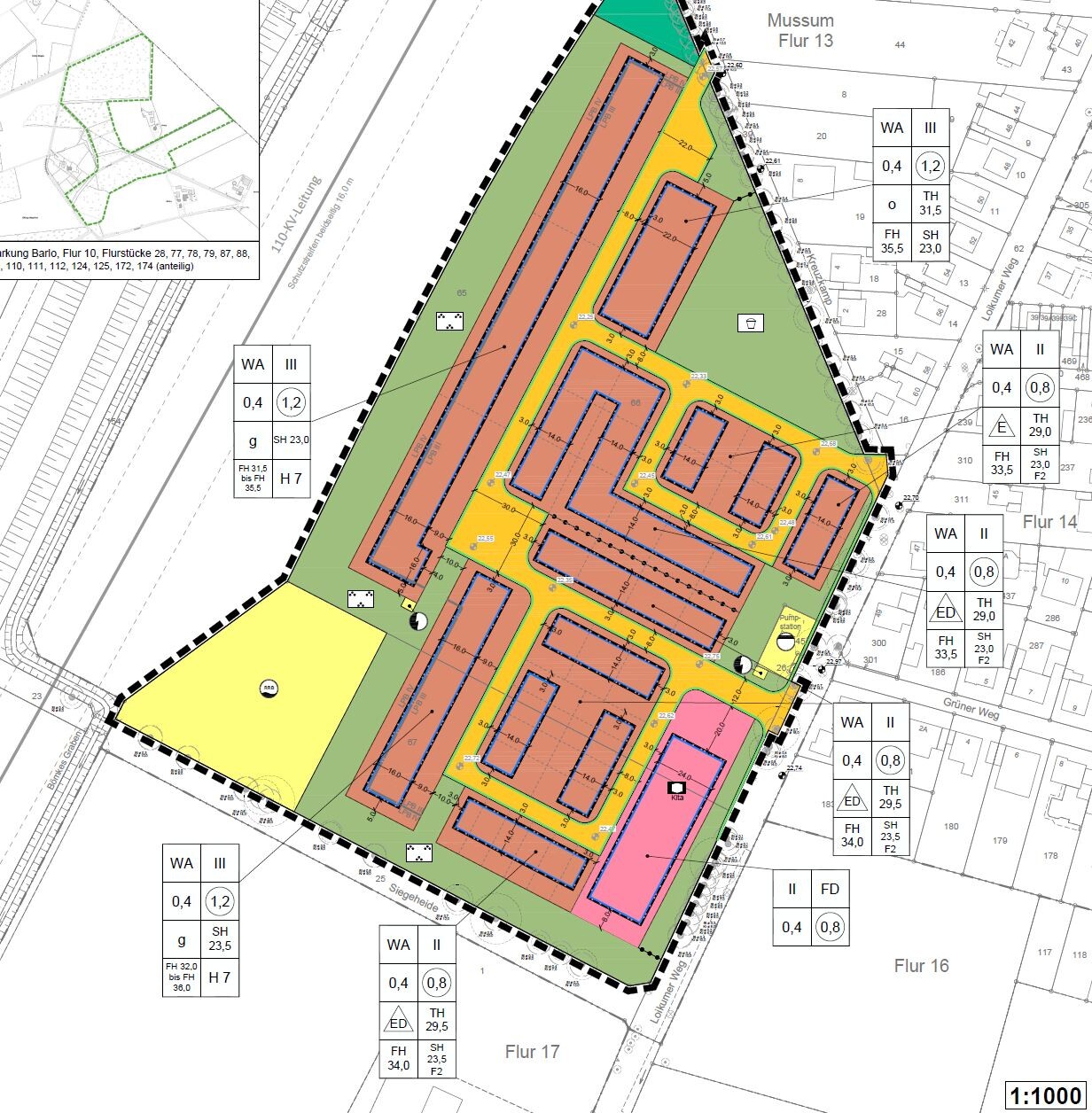
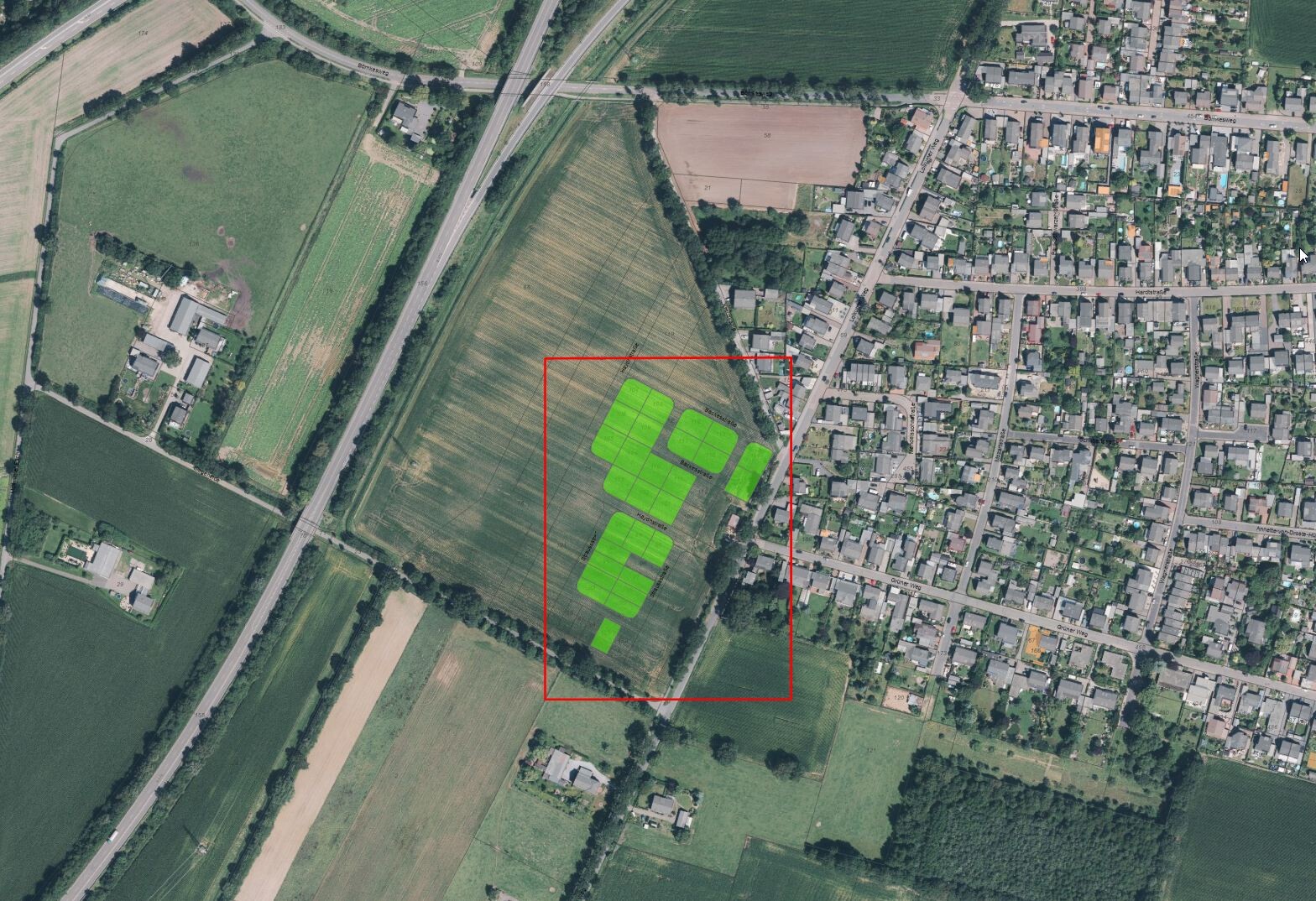
After a long wait, our city (North Rhine-Westphalia) has finally started marketing a new residential development area on the outskirts. As part of the application process, plots for single-family homes and semi-detached houses are allocated according to a certain distribution logic. We expect to have the opportunity to purchase and will then need to choose quickly from the remaining available plots. The exact timing of when it will be our turn is unclear, so as a preparation, we would like to establish our personal ranking of all the plots.
What are our requirements?
As a family of four (38, 35, 5, 2), we want to build a single-family house (~150-160m² (1600-1720 sq ft) preferably without a basement, with a pitched roof) including a carport/garage. Basically, no special requirements that would directly affect the choice of the plot.
Regarding the plot, we primarily want a location for a single-family home that is as quiet as possible within the development area (noise/through traffic) (priority 1 requirement). Of course, orientation and overall size are also important, but come after the first factor.
What does the development plan specify?
Here are what I consider the most important details from the development plan, which apply equally to all offered plots:
- 2 full stories with floor area ratio of 0.4 and total floor space ratio of 0.8
- Base height max. 0.5m (1.5 ft), eaves height max. 6.5m (21 ft), ridge height max. 11.0m (36 ft)
- Roof type:
- If two full stories:
- Flat roof or shed roof with pitch between 22° and 30°.
- Alternatively, stepped stories with flat roof or low-pitched roof up to 16°.
- If one full story: no specification regarding roof type or pitch
- Dormers, roof extensions, and loggias are not allowed
- Garages, carports & outbuildings only within the building zone or adjacent to the side boundary. A 5m (16 ft) clearance must be maintained before garage driveways (excluding carports). Exceeding the garden-side building line is permitted up to a depth of 2m (6.5 ft).
Since linking is not allowed here: the full development plan can be quickly found online by searching “Bocholt Bebauungsplan 8-23 Loikumer Weg”.
Which plots are for sale?
There are 21 plots for single-family homes and 7 plots for semi-detached houses on sale. The price is uniform at €220/m² (€220 per sq m) including development costs. The plots are currently farmland and completely flat. I have attached an aerial photo, an excerpt from the development plan, and a non-binding building concept (only the numbered plots are available for sale).
For more information, the full brochure can also be found online by searching “Bocholt Wohnbaugrundstücke Mussum - Loikumer Weg”.
The development area will be a mixed-use zone: alongside single-family and semi-detached homes, there will be a daycare center, apartment buildings, and a playground. To the west of the development is a federal road, so the western section will be built as continuous development (noise protection facing the road; exact design still unknown). There are three larger apartment buildings to the north. Given the apartment buildings in the north and west, I expect increased through traffic and activity within the development — it will not be a purely quiet single-family home neighborhood. Therefore, when selecting plots, our main focus will be on achieving as much quietness as possible.
Questions for you?
We have been considering which plots have which advantages and even have a few favorites. I’m deliberately not naming them yet to get as unbiased feedback as possible. What would be your favorites, and what aspects would you focus on to best meet our requirements?
Best regards,
Malte
H
hanghaus202320 May 2025 10:47-Malte- schrieb:
I assumed that any options to "loosen up" the corresponding gable roof above the first full storey for increased living space are not allowed. Am I mistaken here as well?As already mentioned in #39, I agree with @11ant.Your architect should also be able to assess this.
H
hanghaus202320 May 2025 10:53ypg schrieb:
A gable roof is not possible.Do you perhaps mean a gable roof on the second full story? I found this on the municipality’s website.
hanghaus2023 schrieb:
Perhaps you mean a gable roof on the second full story?
I found this on the municipality’s website.
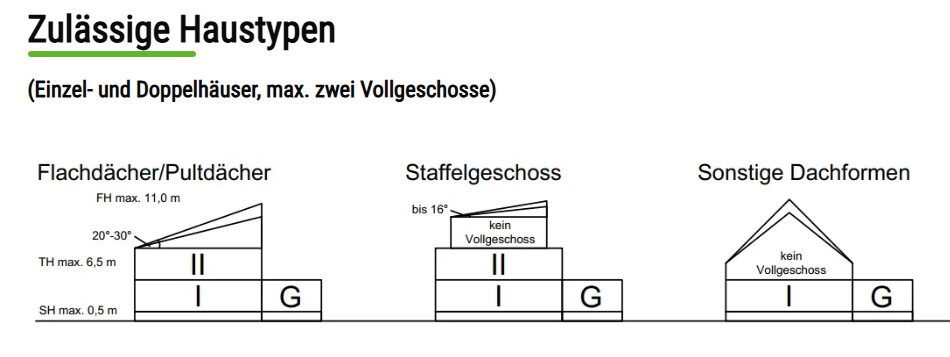
A few weeks ago, I looked up the zoning plan. Not doing so now, but from memory, I thought a gable roof as a full story was allowed above the first floor (ground floor). Due to time constraints, I’m not checking the zoning plan again now.
Thank you for the additional information. I hadn’t noticed that the city has since updated the presentation of the permitted house types on both the website and in the brochure. Originally, it showed that a gable roof was allowed over the second full storey. I might not have been the only one who inquired about this.
The three basic options are now clear, though. Which option makes the most sense for our space requirements will become apparent during the planning phase. At that stage, the architect might also clarify whether a transverse gable, a staggered shed roof, or other solutions could be possible.
The three basic options are now clear, though. Which option makes the most sense for our space requirements will become apparent during the planning phase. At that stage, the architect might also clarify whether a transverse gable, a staggered shed roof, or other solutions could be possible.
H
hanghaus202321 May 2025 10:26The illustration from post #44 is not from the development plan but from the marketing brochure. Unfortunately, I cannot find the development plan. Please show us the relevant sections of the development plan that relate to the design, including both text and drawings.
-Malte- schrieb:It’s not only about clarifying what is possible but primarily about what one can and wants to afford.
Now the three basic options are clear. Which one is ultimately the most suitable for our space program will become clear during the planning process. In this context, the architect could also clarify whether a cross gable, an offset shed roof, or other options would be possible.
hanghaus2023 schrieb:
The illustration from post #44 is not from the zoning plan but from the sales advertisement. Unfortunately, I cannot find the zoning plan. Please show us the relevant excerpts from the zoning plan related to the design aspects—both text and map. Since linking is not allowed here, I can only suggest performing a Google search for "Bebauungsplan 8-23 bocholt loikumer weg". Attached is an excerpt from the zoning plan as well as what I consider the particularly relevant textual regulations.
- Maximum of 2 full stories
- Floor area ratio (FAR) 0.4, floor space index (FSI) 0.8
- Maximum base height 0.5m (1.6 feet), eaves height max. 6.5m (21 feet), ridge height max. 11.0m (36 feet)
F 3 Height of building structures (§ 9 para. 1 no. 1 Building Code in conjunction with § 16 para. 2 and § 18 para. 1 Land Use Ordinance)
(see zoning plan assignment)
The maximum allowed base height refers to the height of the intersection between the outer edge of the vertical masonry of the respective building and the top edge of the finished floor slab on the ground floor (top edge of finished floor). If the ground floor consists of different levels, the highest level applies.
The maximum allowed eaves height for a building with a pitched roof and the analogous attic height for a building with a flat roof (FR) refers to the height of the intersection between the roof covering and the outer edge of the vertical masonry of the respective building or the top edge of the parapet for a flat roof. A higher eaves height than permitted can be allowed if it results from a floor plan with setbacks or projections. Its length is limited to a maximum of one-third of the total eaves length of the relevant building façade, measured between the outer walls of that building.
The maximum allowed ridge height (RH) for a building with a pitched roof or the height of the parapet for a recessed top floor refers to the highest point. Skylights and glass roofs as well as technical equipment, such as air-source heat pumps or solar collectors, photovoltaic systems may exceed the top edge of the parapet of a flat roof by up to 0.75 m (2.5 feet).
F 9 Roof pitch
Above the 2nd or 3rd full story, flat roofs or shed roofs with a roof pitch between 22° and 30° are permitted. Alternatively, recessed floors with a flat roof or a gently sloped roof up to 16° are allowed. Garages, carports, and ancillary structures according to §§ 12 and 14 of the Land Use Ordinance are only permitted with flat roofs.
F 11 Dormers
Dormers, roof structures, and loggias are not permitted. Ultimately, this corresponds with the illustration you posted here from the brochure/website regarding the possible house types.
hanghaus2023 schrieb:
It's not just about clarifying what is allowed but primarily what one can and wants to afford. That was exactly my intention, to get an initial idea regarding price/performance of the different house types. Since we would prefer to build on a slab foundation due to the ground conditions, I see the main challenge in efficiently accommodating the space requirements including storage. With a finished attic, you can use the easily accessible attic space, for example as an office, and thus free up reasonable space on the ground and first floors for technical equipment, family-friendly cloakroom, storage room, etc. Many standard floor plans don’t offer this, to be honest. Without a finished attic, one would probably simply have to enlarge the floor area.
I suspect that the requirement can be most budget-friendly met with a one-and-a-half-story house featuring a steep pitched roof and a finished attic, or am I mistaken? What do you think of a two-story house with a shed roof (required pitch is 22°–30°), where you could also situate an office or storage on the high side of the attic? Visually, this look is somewhat unusual to me because of the very dominant front façade.
Best regards
Similar topics