
ᐅ Is this floor plan suitable for a multigenerational house?
Created on: 19 May 2025 18:47
D
Dutchi695
Hello everyone,
this is my first post, so I apologize in advance if I haven’t provided all the necessary information – I put this together to the best of my knowledge and ability :-)
We are currently planning a multi-generational house and have already received some plans from the construction company. This is the current plan. The house is planned to be built on a plot of about 475sqm (5113 sq ft).
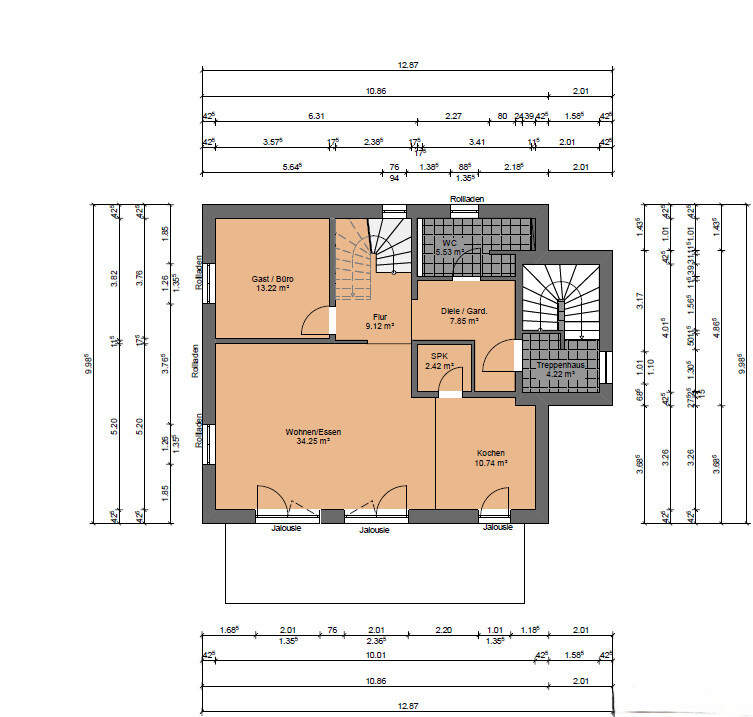
Due to the small size of the plot, the idea is for the parents-in-law to live on the ground floor, and for us (2 adults + 2 small children) to live on the upper floor and attic. We had also considered a semi-detached house with an asymmetric design, but that was too expensive and too large for the plot. Our goal is to still have enough garden space.
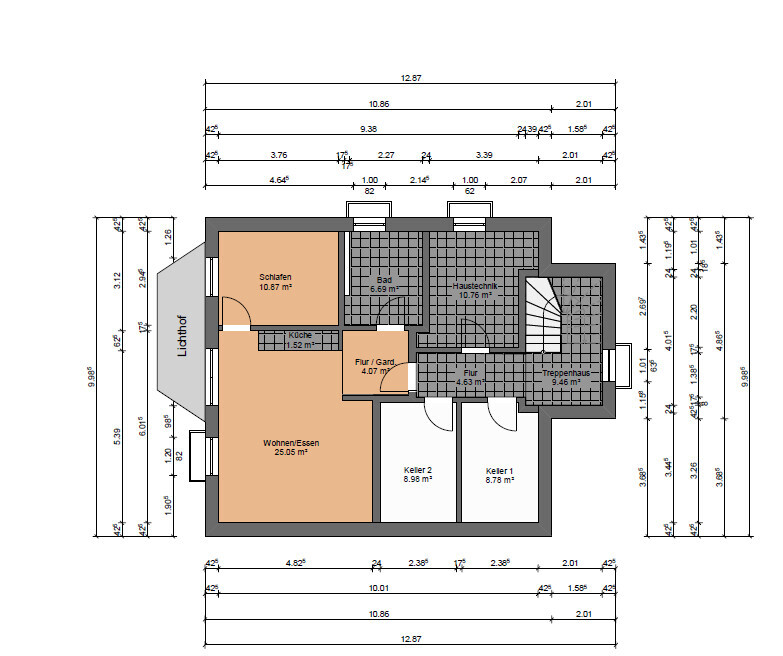
In the basement, provisions are planned for a granny flat or accessory dwelling unit that could be developed later if needed. Initially, this space will be used purely as a utility cellar.
Because of the photovoltaic requirement in Baden-Württemberg and the conditions for related subsidies, the house has been designed as a solid construction meeting KfW40 plus QNG standards. Electrically operated roller shutters or venetian blinds are standard throughout the living room and kitchen.
Development plan/restrictions
Plot size: approx. 475sqm (5113 sq ft)
Slope: no
Site occupancy index: 0.3
Floor area ratio: unknown
Building envelope, building line, boundary: open construction method
Edge development: 1 neighboring house on the left side
Number of parking spaces: 2 per dwelling unit
Number of floors: 2.5 + basement
Roof type: gable roof
Architectural style
Orientation
Maximum heights/limits: main building height 9.50m (31 ft), living area height 6.50m (21 ft)
Additional specifications
Homeowner requirements
Architectural style, roof type, building type
Basement, floors: Basement, ground floor, upper floor, and attic floor
Number of residents, ages: 2 parents-in-law + 2 adults + 2 children (1.5 years, 1 month)
Room requirements on ground floor and upper floor
Office: family use or home office?: One office for home office is planned on both the ground floor and upper floor, which will also serve as guest rooms
Number of guest stays per year: few
Open or closed architecture
Traditional or modern design
Open kitchen, kitchen island: Kitchen in L-shape plus kitchen island
Number of dining spaces: At least 6 on both ground floor and upper floor
Fireplace: no
Music/sound system wall: no
Balcony, roof terrace: Balcony planned on the upper floor
Garage, carport: double garage
Utility garden, greenhouse
Additional wishes/special features/daily routine, including reasons for design choices
House design
Planner: construction company
- Planner from a construction company
- Architect
- Do-it-yourself
What do you particularly like? Why?
What do you not like? Why?
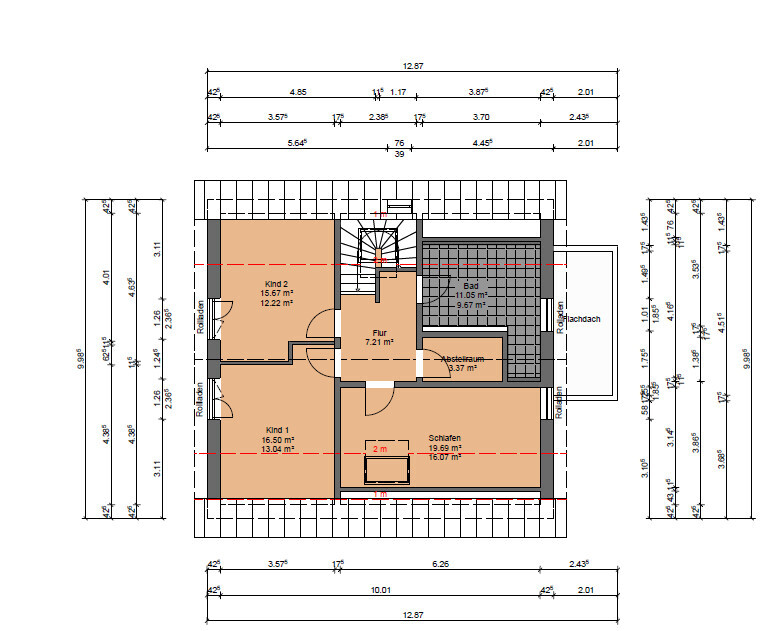
In my opinion, the children’s rooms in the attic are planned too small. This might work now when they’re toddlers, but as bedrooms for teenagers, I find them too small. We considered removing the storage room in the attic and adding it to the master bedroom so the children’s rooms could be larger. Or are we mistaken? As a replacement for the storage room, we possibly considered additional storage space under the staircase.
I have never lived under sloping ceilings, but unfortunately, there is no other way to design this (see above). However, they do significantly reduce the room size.
Price estimate according to architect/planner: The house, excluding incidental building costs and land, should cost around €800,000 (approx. $870,000) turnkey. We will have to do a significant amount of work ourselves to bring the price down.
Personal price limit for the house, including fittings: Our maximum budget for everything is €950,000 (approx. $1,035,000). Whether this is realistic remains to be seen ;-)
Preferred heating system: planned is an air-to-water heat pump plus underfloor heating
If you had to give up something, on which details/upgrades
- could you do without:
- couldn’t do without: basement
Why is the design the way it is now? For example:
The construction company already adapted the designs because previous versions were too expensive. The floor area was reduced from initially 100sqm (1076 sq ft) to 90sqm (970 sq ft). Due to the partly integrated staircase, the effective floor area is now a bit above 80sqm (860 sq ft).
Standard design from the planner?
Which/all wishes were implemented by the architect?
A mix of many examples from various magazines...
What do you think makes it particularly good or bad?
Do you see any potential improvements regarding the floor plans?
this is my first post, so I apologize in advance if I haven’t provided all the necessary information – I put this together to the best of my knowledge and ability :-)
We are currently planning a multi-generational house and have already received some plans from the construction company. This is the current plan. The house is planned to be built on a plot of about 475sqm (5113 sq ft).
Due to the small size of the plot, the idea is for the parents-in-law to live on the ground floor, and for us (2 adults + 2 small children) to live on the upper floor and attic. We had also considered a semi-detached house with an asymmetric design, but that was too expensive and too large for the plot. Our goal is to still have enough garden space.
In the basement, provisions are planned for a granny flat or accessory dwelling unit that could be developed later if needed. Initially, this space will be used purely as a utility cellar.
Because of the photovoltaic requirement in Baden-Württemberg and the conditions for related subsidies, the house has been designed as a solid construction meeting KfW40 plus QNG standards. Electrically operated roller shutters or venetian blinds are standard throughout the living room and kitchen.
Development plan/restrictions
Plot size: approx. 475sqm (5113 sq ft)
Slope: no
Site occupancy index: 0.3
Floor area ratio: unknown
Building envelope, building line, boundary: open construction method
Edge development: 1 neighboring house on the left side
Number of parking spaces: 2 per dwelling unit
Number of floors: 2.5 + basement
Roof type: gable roof
Architectural style
Orientation
Maximum heights/limits: main building height 9.50m (31 ft), living area height 6.50m (21 ft)
Additional specifications
Homeowner requirements
Architectural style, roof type, building type
Basement, floors: Basement, ground floor, upper floor, and attic floor
Number of residents, ages: 2 parents-in-law + 2 adults + 2 children (1.5 years, 1 month)
Room requirements on ground floor and upper floor
Office: family use or home office?: One office for home office is planned on both the ground floor and upper floor, which will also serve as guest rooms
Number of guest stays per year: few
Open or closed architecture
Traditional or modern design
Open kitchen, kitchen island: Kitchen in L-shape plus kitchen island
Number of dining spaces: At least 6 on both ground floor and upper floor
Fireplace: no
Music/sound system wall: no
Balcony, roof terrace: Balcony planned on the upper floor
Garage, carport: double garage
Utility garden, greenhouse
Additional wishes/special features/daily routine, including reasons for design choices
House design
Planner: construction company
- Planner from a construction company
- Architect
- Do-it-yourself
What do you particularly like? Why?
What do you not like? Why?
In my opinion, the children’s rooms in the attic are planned too small. This might work now when they’re toddlers, but as bedrooms for teenagers, I find them too small. We considered removing the storage room in the attic and adding it to the master bedroom so the children’s rooms could be larger. Or are we mistaken? As a replacement for the storage room, we possibly considered additional storage space under the staircase.
I have never lived under sloping ceilings, but unfortunately, there is no other way to design this (see above). However, they do significantly reduce the room size.
Price estimate according to architect/planner: The house, excluding incidental building costs and land, should cost around €800,000 (approx. $870,000) turnkey. We will have to do a significant amount of work ourselves to bring the price down.
Personal price limit for the house, including fittings: Our maximum budget for everything is €950,000 (approx. $1,035,000). Whether this is realistic remains to be seen ;-)
Preferred heating system: planned is an air-to-water heat pump plus underfloor heating
If you had to give up something, on which details/upgrades
- could you do without:
- couldn’t do without: basement
Why is the design the way it is now? For example:
The construction company already adapted the designs because previous versions were too expensive. The floor area was reduced from initially 100sqm (1076 sq ft) to 90sqm (970 sq ft). Due to the partly integrated staircase, the effective floor area is now a bit above 80sqm (860 sq ft).
Standard design from the planner?
Which/all wishes were implemented by the architect?
A mix of many examples from various magazines...
What do you think makes it particularly good or bad?
Do you see any potential improvements regarding the floor plans?
We built our house in a similar way with my parents back then and lived comfortably in Baden-Württemberg for many years. Our plot was on a slope and about twice as large, so it’s not directly comparable. My parents wanted a simple basement unit, which was not an option for me, so we built them a large, elegant apartment on the upper floor or attic with nearly 100 square meters (1,076 square feet) including a roof terrace. Looking back, I think I may have overdone it because my parents could have been just as comfortable with a well-planned 75-80 square meters (807-861 square feet). As my mother got older, it did become too big for her.
The fact that their apartment was on the upper floor (plus a long staircase to the main entrance) is something I would definitely do again for the following reason: as long as the parents were fit, they could easily manage the stairs and it was their form of exercise anyway. When my father was no longer able to do so, he could hardly move around independently, and we used a powered stair climber or helped him down 2-3 times a week; after all, we lived together in the same house. From my own experience—and also with my currently 90-year-old mother-in-law—if you can no longer manage stairs, you probably can’t move around freely outside either. I have noticed many more unsolvable mental health issues with elderly people. Later, my mother moved in with the grandchildren and lived there on the upper floor as well, with a small bathroom. She always said that was better because she could hold on to something everywhere.
What I want to say is: I would place the parents’ apartment on the upper floor and look for a smart layout with a nice view and a balcony. I would avoid a basement on flat land for cost reasons, but regarding the floor area ratio or other plot regulations, I have no idea. I would simply free myself from the often-read urge to accommodate the parents exclusively on the ground floor, as their problems and risks are everywhere where you can’t avoid them. Falls usually don’t happen at the house entrance stairs but often on small rugs, different floor coverings, etc.
The floor plan you showed lacks any furniture, which reflects your individual lifestyle and makes it not very useful.
Honestly, I don’t like looking at the floor plan for that reason; it’s not appealing and should be redone from scratch. Don’t rush the process; it takes time and conversations.
The children need direct access to the terrace; the parents (at least in my case) are fine with a nice roof terrace or something similar.
Maybe you could share more background, including about your parents.
The fact that their apartment was on the upper floor (plus a long staircase to the main entrance) is something I would definitely do again for the following reason: as long as the parents were fit, they could easily manage the stairs and it was their form of exercise anyway. When my father was no longer able to do so, he could hardly move around independently, and we used a powered stair climber or helped him down 2-3 times a week; after all, we lived together in the same house. From my own experience—and also with my currently 90-year-old mother-in-law—if you can no longer manage stairs, you probably can’t move around freely outside either. I have noticed many more unsolvable mental health issues with elderly people. Later, my mother moved in with the grandchildren and lived there on the upper floor as well, with a small bathroom. She always said that was better because she could hold on to something everywhere.
What I want to say is: I would place the parents’ apartment on the upper floor and look for a smart layout with a nice view and a balcony. I would avoid a basement on flat land for cost reasons, but regarding the floor area ratio or other plot regulations, I have no idea. I would simply free myself from the often-read urge to accommodate the parents exclusively on the ground floor, as their problems and risks are everywhere where you can’t avoid them. Falls usually don’t happen at the house entrance stairs but often on small rugs, different floor coverings, etc.
The floor plan you showed lacks any furniture, which reflects your individual lifestyle and makes it not very useful.
Honestly, I don’t like looking at the floor plan for that reason; it’s not appealing and should be redone from scratch. Don’t rush the process; it takes time and conversations.
The children need direct access to the terrace; the parents (at least in my case) are fine with a nice roof terrace or something similar.
Maybe you could share more background, including about your parents.
Arauki11 schrieb:
The children need direct access to the terrace, while the parents (which would also be the case for me) are satisfied with a nice rooftop terrace or similar. You’re right about that. However, with this layout, it’s really difficult to fit the room program into the available space. Alternatively, you could place the young adults’ bedrooms in the basement instead of the separate apartment. But that only makes sense if the plot is sloped; otherwise, it’s not practical to excavate an additional 20 to 30 square meters (215 to 323 square feet) on a 475 square meter (5,115 square feet) lot.
D
Dutchi69519 May 2025 23:47ypg schrieb:
Hello,
could you please share the site plan (plot) again? Also, the orientation of the house (north/south) and the age of the seniors?
Do you have any specific hobbies? What do you like about the house?
Are you not planning a balcony or something similar for the upper unit?
Thank you for the feedback. I have attached the site plan of the plot, hoping this will be sufficient.
For the upper floor, we actually have planned a balcony, I just forgot to mention it.
The house should face south, at least the front door and balcony are on the south side.
The parents-in-law are both just under 60.
Their hobbies definitely include spending a lot of time with the children, so it is important to us to still have some garden space. It will probably not be more than 200 cm² (2153 sq ft).
ypg schrieb:
What is this, for example?
A tip in advance: it’s useful to furnish design plans yourself using scale-accurate furniture templates, so you can clearly see any drawbacks or potential (dining area size, TV viewing distance, space in the children’s rooms). You should definitely work on this.
Templates are good for moving around furniture easily. Sorry, I didn’t copy everything correctly from the example text. There are no wishes from any magazines in the plans.
The idea of using scale-accurate templates is a good one — I will definitely look into that. Thank you very much.
D
Dutchi69520 May 2025 00:0211ant schrieb:
Good gracious. This won’t work. The density of requirements in this design is too high. This is not a multi-generational house, but rather a two-family-plus-guest-apartment house in the worst possible form. Go to an independent architect instead of letting a construction company cobble something together and then reduce it in size. And remove the guest apartment, which caused the overall design to become larger and then require downsizing. Build it with just one normal staircase and a spiral staircase in the upper floor/attic maisonette.Thank you very much for the feedback.
Perhaps I can briefly explain the history of how the plans developed.
The first design was an asymmetrical semi-detached house on a slab foundation and was well above budget. The requirements were 80sqm (860 sq ft) for my in-laws, and we calculated upwards of 135sqm (1,450 sq ft) for ourselves. We currently live in a 100sqm (1,075 sq ft), three-room apartment and are basically missing two rooms (one child’s room and one office). In relation to the plot, the planned house was unfortunately also too large.
For the second plan, we decided the in-laws would have the ground floor (they do not want to move into the basement) and we would have the first and attic floors, since the in-laws don’t want to climb many stairs as they get older. To maintain the character of a house, we didn’t want to have just one floor for ourselves.
However, this plan included a basement because we need storage space. We have already had to rent an external storage unit because our current basement compartment for the apartment has become too small (and it was not even 9sqm (97 sq ft)). This was the plan with 100sqm (1,075 sq ft) of floor area, and the staircase was not yet partially integrated. This plan was still over budget, so we worked together with the builder to look for potential savings.
Up to that point, there was no talk of a guest apartment – this idea was introduced by the builder to generate additional rental income.
The result was the third version with 90sqm (970 sq ft) of floor area and the partially integrated staircase, which saved costs again. Additionally, the staircase from the “staircore” between the first and attic floors was removed and placed centrally in the apartment, which also saved further costs.
We have currently decided against a guest apartment; however, these are mistakenly included in the above-mentioned plans. In fact, we are only making preparations for a potential guest apartment or holiday flat so that a future conversion would be easier, as the connections would already be in place.
What would the cost of a floor plan from an independent architect be? I have read online it can be about 10-15% of the construction costs.
What optimizations would you suggest?
D
Dutchi69520 May 2025 00:04kbt09 schrieb:
Urgent recommendation from my side... for example, for furnishing the bedroom on the ground floor.
I would also be interested, as there must be at least 4 parking spaces with the option for 2 additional spaces.Actually, we would have four parking spaces -> a double garage plus the two spaces in front. I attached the plan further up.D
Dutchi69520 May 2025 00:09ypg schrieb:
This will be a problem with less than 500 sqm (5,382 sq ft).
I assume that south is at the bottom, where it belongs, and that the granny flat is only there to compensate for the surplus space in the basement. I can’t think of a quick solution offhand.
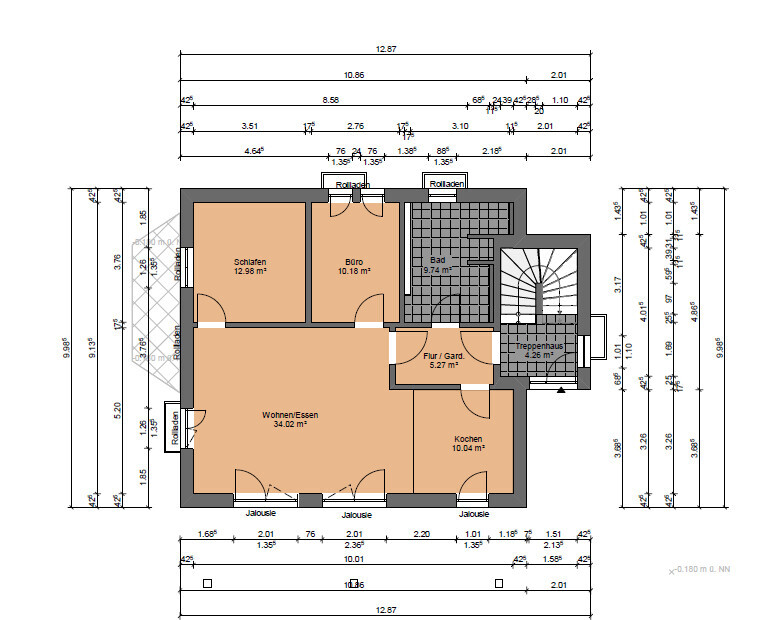
For the existing ground floor, I would extend the hallway a bit, plan a built-in wardrobe as a closet at its end, and swap the functions of the bedroom and office (adjust sizes) so that the bathroom is adjacent to the bedroom. The door to the office should then be adapted according to the living room furniture layout. The extended hallway also benefits the dining area by providing structure.
The children’s rooms are not too small. However, you should make sure that deep cabinets can be placed behind the windows, which means spacing the windows farther apart. I would avoid floor-to-ceiling windows because they compromise privacy. After all, the neighbor could see straight into the room at eye level. For the children, low built-in cabinets under the sloped ceiling at the knee wall work well, or place an inverted shelving unit like a Kallax there to make good use of the low knee wall space.
However, these tips do not solve the parking space issue. Currently, we have only decided to prepare the basement for a possible granny flat. It will most likely be used mainly as storage and possibly as a hobby room or party basement. If we need additional rental income, it could be converted into a granny flat / holiday apartment.
Thank you for the tips about the windows; I will make a note of that ;-) The current children’s room is about 15 sqm (161 sq ft) without sloped ceilings; with slopes, it would be “only” about 12 or 13 sqm (129 or 140 sq ft). But I lack experience with sloped ceilings.
Regarding parking, we were thinking of a double garage plus two parking spaces in front of it.
Similar topics