
We plan to build on a plot of land in Brandenburg, south of Potsdam.
Plot Information
The plot is currently mostly covered with pine trees, some of which are around 100 years old, along with a few yews, oaks, and bushes. The area has been unmanaged for at least 50 years. At least the rear third (northeast area) is intended to remain forested, as part of the adjacent larger woodland.
The plot is oriented approximately northeast – southwest.
Street access is on the southwest side (bottom of the plan). At this end of the plot, there are a few very tall pines with some yews and an oak in between. The oak is not very old but is an interesting multi-stem tree. I want to preserve this green screen, which will likely be challenging since construction vehicles require a certain size and height.
On the southeast side (right on the plan) there is an overly large and mostly unattractive boundary structure (garage and shed), which is not very appealing.
The neighboring plots on the northwest side (left on the plan) together have a similar amount of boundary structures but less intrusive and located further towards the top of the plan. Overall, the northwest side is greener because the neighboring buildings are set further back from the property boundary.
Development Plan / Restrictions
There is no formal development plan, but local regulations set general rules, such as ridge height, setback distances, and garage roof shape. If these are specified anywhere, floor area ratio and plot ratio probably only play a theoretical role for this project and plot size.
Plot size: >2000m² (21,528ft²)
Slope: none
Floor area ratio unknown
Plot ratio unknown
Building window, building line, and boundary >3m (10ft) setback
Outbuildings allowed along boundary
Number of parking spaces not specified
Number of storeys not specified
House roof shape: roof pitch 25°–50°, excluding roof extensions
Garage: gable roof facing street
Architectural style: no specific requirements
Orientation: gable end or eaves aligned to street
Maximum heights/restrictions: ridge height max. 9.0m (30ft)
Other specifications: ground floor top edge max. 80cm (2.6ft)
Client Requirements
Architectural style, roof type, building type: gable roof
Orientation: photovoltaic panels on the south-facing roof side, gable end facing street
Basement, storeys: basement + ground floor + first floor
Number of occupants, ages: 3+1, ages 17–55+
Space requirements on ground floor, first floor:
Ground floor: living room, kitchen, dining area, guest bathroom
First floor: bedrooms, bathroom
Two additional rooms on ground floor or first floor
Office: mainly home office for one person
Guests per year: 1 (about 20 extended weekends)
Open or closed architecture: window-obscuring bathroom and bedroom doors
Conservative or modern style: conservative
Preferred construction method: solid gas concrete blocks (e.g. Ytong or similar)
Open kitchen with cooking island: semi-open, preferably with (half) island
Number of dining seats: 4 (expandable to 8)
Fireplace: yes
Music/stereo/TV wall: rather simple / stereo system yes, no built-in wall unit / large screen
Balcony/roof terrace: balcony yes / roof terrace no
Garage/carport: garage
Utility garden, greenhouse: garden yes, greenhouse later
Additional Requests / Special Features / Daily Routine, including reasons why certain things are wanted or not:
The plot is quite narrow at just under 20m (65ft) wide for my desired house, which includes a partially integrated side double garage and a large sunny southwest terrace, so the best compromise must be found.
Due to the tall trees on the southwest, we expect western sun only during summer. Also, two neighbor’s pine trees cast shade from the south on the likely building site.
When not sleeping, we mainly live on the ground floor, so this has planning priority. The kitchen is an important room, so we prefer a (semi-)open connection to the living room. At least one of us regularly works from home, so a suitable workstation is necessary, but a dedicated home office room is not essential.
Light is important in the living area (kitchen and living room), so we want the top edges of the windows to be as high as possible with roller shutters.
The fireplace is a 95% must-have as a supplementary heat source (and hopefully a cozy feature). Good positioning is a priority, but if possible, we’d like a water-carrying fireplace connected to a buffer tank and/or an additional hot water heating circuit for the bathrooms (e.g., large towel radiators). A ground heat load is planned via an air-to-water heat pump for underfloor heating. Additionally, air conditioning is planned in the master bedroom and child’s room 1.
A central ventilation system is probably too expensive.
The master bedroom should accommodate a double bed and a row of wardrobes.
Child’s room 1 will still serve as a youth room for a few years, later becoming a second bedroom (due to reported nighttime noise of uncertain cause).
The multi-purpose room is not yet definitively assigned: either home office or utility room with space for washing machine and dryer, or storage room.
Preferred room orientations (due to morning sun): kitchen, bathroom, and bedroom facing the garden.
The gable end facing the street seems sensible since photovoltaics are planned on the roof, and the south-facing side (+/- 30°) is expected to have the least shading.
My wife’s wish for a balcony on the bedroom is “because it looks better.”
If built, we would like access to the balcony from the bedroom and the bathroom.
A basement is a 95% must-have due to various hobbies requiring significant space and tools. Also, all technical equipment is planned to be located in the basement.
A garage is essential (as large as possible for 1–2 cars, bicycles, and garden tools), but the house has higher priority. If necessary, the garage can be built later and/or an additional carport added on the street side, or even an underground garage (a small dream).
We now consider a connecting door between house and garage impractical. With the entrance on the gable side, the path is short and convenient anyway.
Gas concrete as preferred wall material was chosen because of its combination of easy handling during shell construction (which tends to avoid the common poor work that can cause thermal bridges), very good sound insulation, pleasant indoor climate, minor advantages during interior finishing, and previous DIY experience with the material. It is also non-combustible, avoids producing large amounts of hazardous waste, and structurally the walls are not potential habitats for insects or small rodents.
House Design
Design origin: by me
-Not designed by a construction company planner yet
-Architect is being sought
-Do-it-yourself approach: yes (reading, trying, thinking, reading, trying, ...)
What do you especially like? Why?
Entrance on street side (front view preferred over side entrance)
Layout of kitchen, bathroom, bedrooms
Kitchen with large work surface, appliance space, and storage
Sauna in the bright bathroom
Bright living room with fireplace
Hallways on ground and first floors and staircase with daylight
Coatroom near entrance (though small)
Small but fully functional guest WC on ground floor
What do you dislike? Why?
Costs likely at the budget limit
Easy access to attic not resolved
Attic usage not finalized
Little distance to right side property boundary
Relatively large hallway areas
Living area (according to CAD program): 135m² (EG 71m², OG 64m²) (1453ft² total; ground floor 764ft², first floor 689ft²)
Estimated price per architect/planner: unknown but would like to know
Personal price limit for the house, including equipment: 550,000 EUR
Personal preferred heating technology: oil/gas (more independent under various situations) and fireplace
Most likely heating system realistically planned: air-to-water heat pump (for various reasons) + fireplace
Possibly additional split air conditioners in master bedroom and child’s room 1
If you have to forgo something, which details or extensions
-can be omitted: balcony, double garage, finished attic
-cannot be omitted: light
Why is the design the way it is now?
The design is one of the results of two years of reading, viewing, own experiences, consideration, and experimentation. There are now many design variants; four or five are basically acceptable to us, each with different pros and cons.
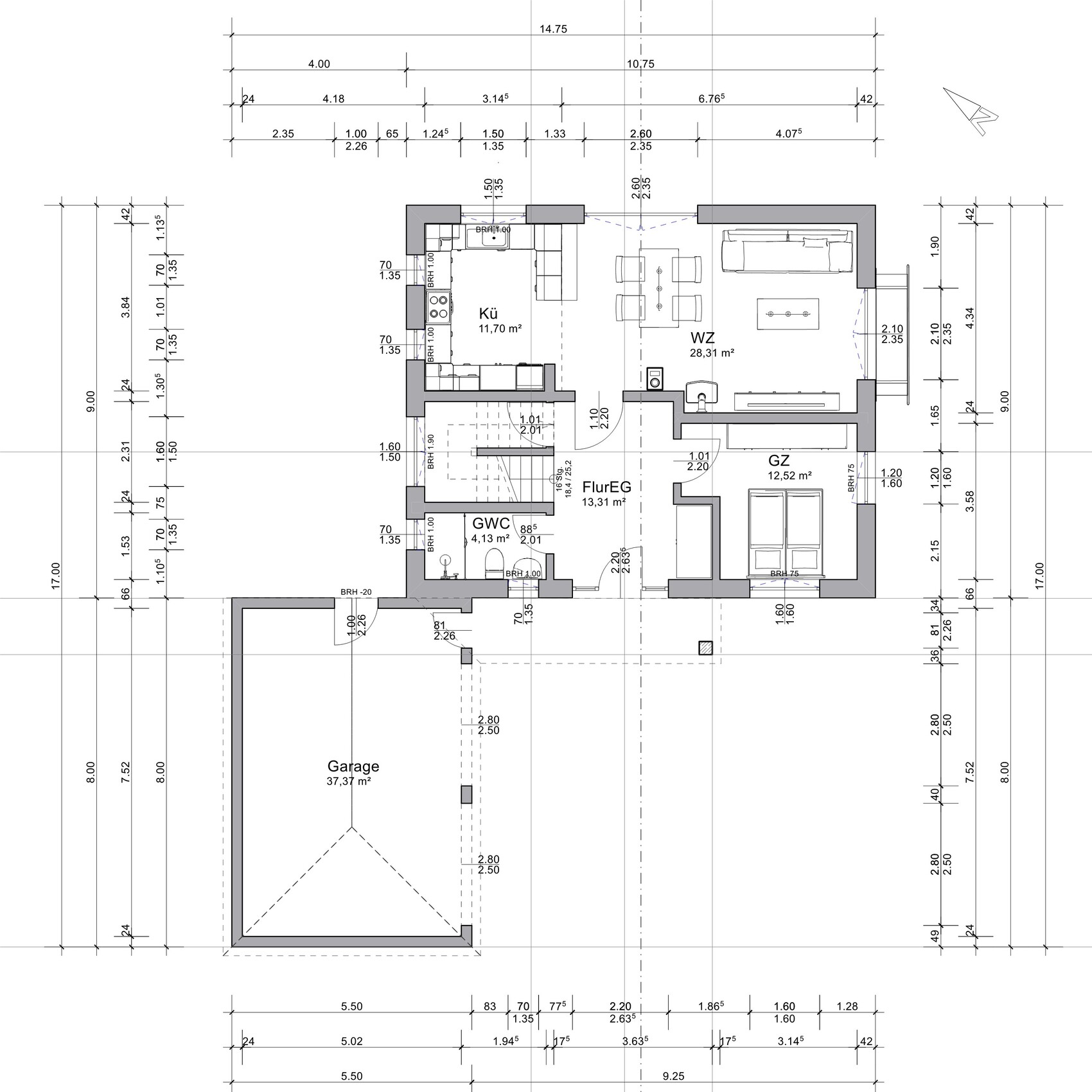
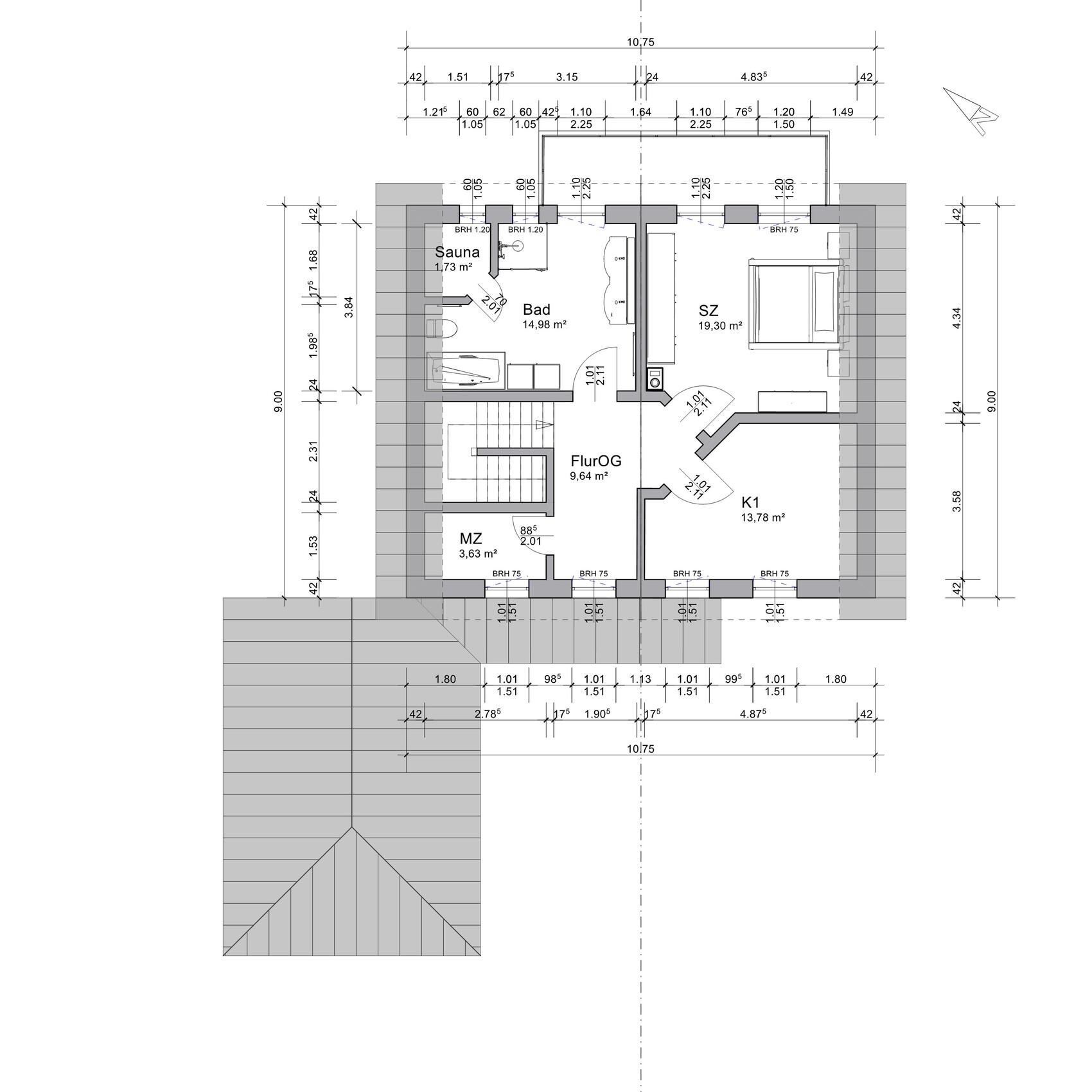
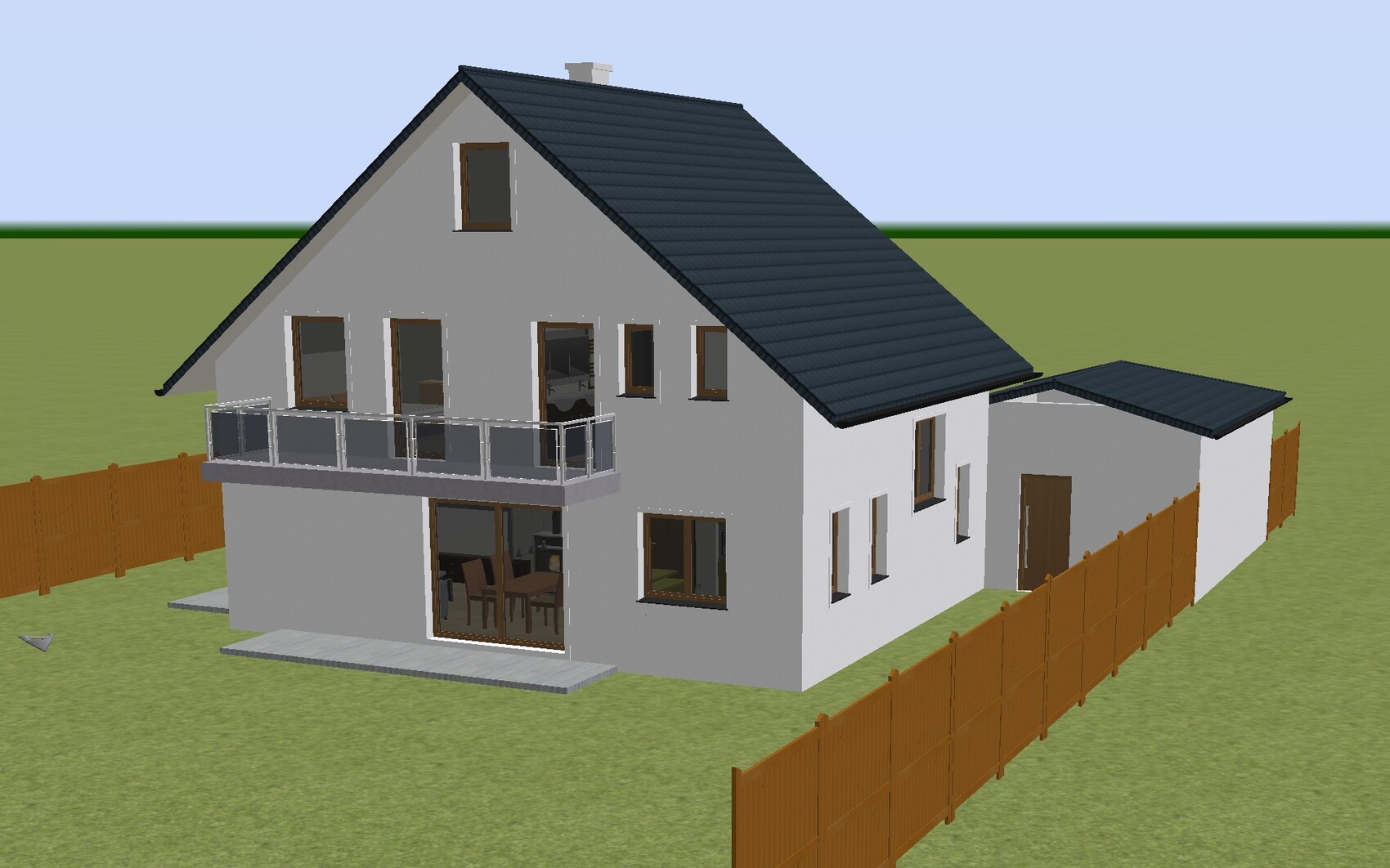
This is one of the options with the smallest living area. I transferred it into a mediocre (very stubborn) CAD system because it provides automatic dimensioning. The system also helps my 3D spatial imagination (e.g., stairs under roof slope, walls stacked, first-floor windows within the building volume, roof in general).
Many details are not finalized yet (e.g., stair to attic, windows, …) because of my lack of knowledge and experience. Also, some window and door types are simply not available in the CAD program; others are stubbornly displayed incorrectly.
The furniture layout shown is currently the best idea, but there are certainly better options (e.g., for the bathrooms).
Thank you in advance for your suggestions and help.
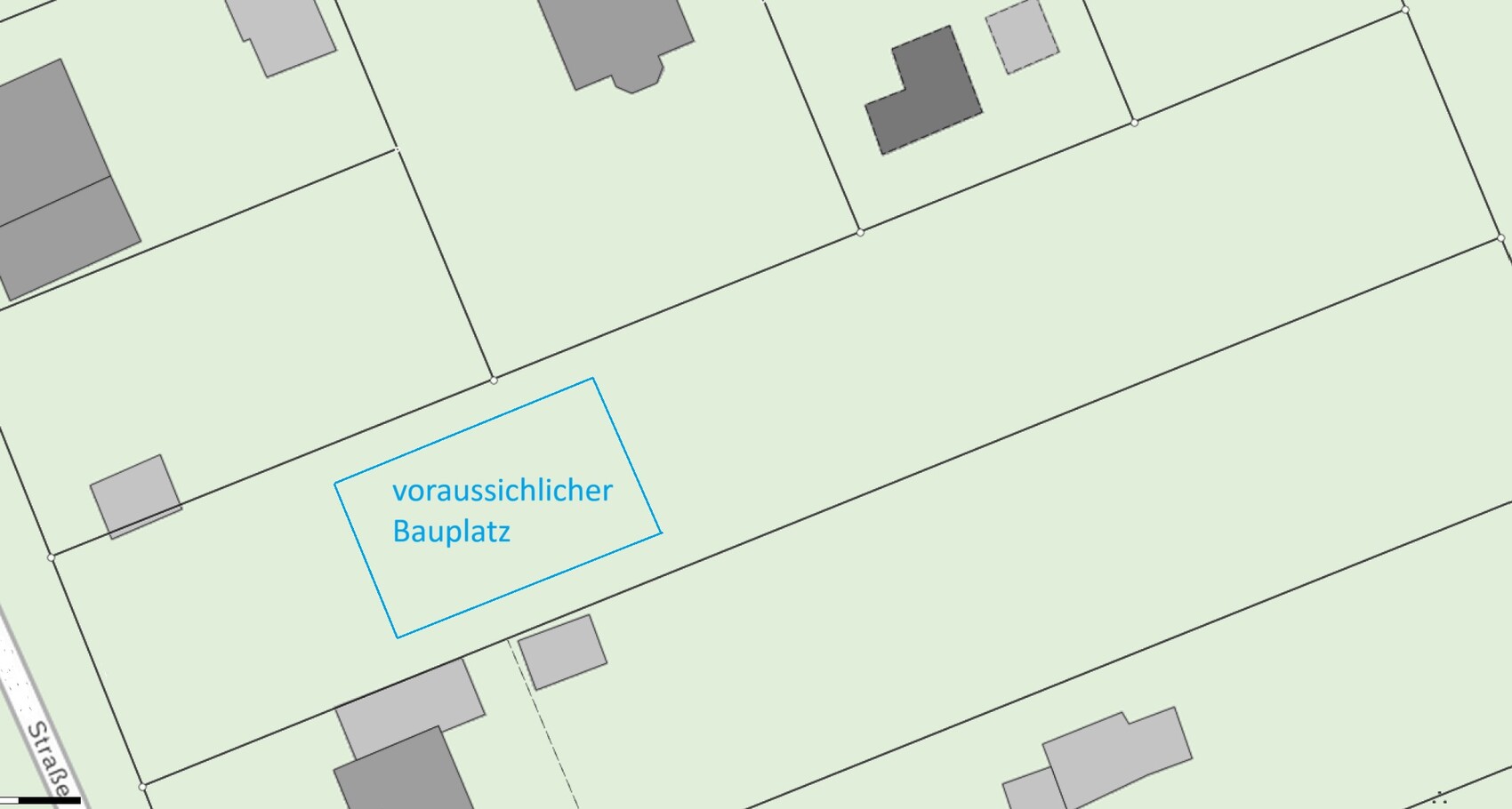

Plot Information
The plot is currently mostly covered with pine trees, some of which are around 100 years old, along with a few yews, oaks, and bushes. The area has been unmanaged for at least 50 years. At least the rear third (northeast area) is intended to remain forested, as part of the adjacent larger woodland.
The plot is oriented approximately northeast – southwest.
Street access is on the southwest side (bottom of the plan). At this end of the plot, there are a few very tall pines with some yews and an oak in between. The oak is not very old but is an interesting multi-stem tree. I want to preserve this green screen, which will likely be challenging since construction vehicles require a certain size and height.
On the southeast side (right on the plan) there is an overly large and mostly unattractive boundary structure (garage and shed), which is not very appealing.
The neighboring plots on the northwest side (left on the plan) together have a similar amount of boundary structures but less intrusive and located further towards the top of the plan. Overall, the northwest side is greener because the neighboring buildings are set further back from the property boundary.
Development Plan / Restrictions
There is no formal development plan, but local regulations set general rules, such as ridge height, setback distances, and garage roof shape. If these are specified anywhere, floor area ratio and plot ratio probably only play a theoretical role for this project and plot size.
Plot size: >2000m² (21,528ft²)
Slope: none
Floor area ratio unknown
Plot ratio unknown
Building window, building line, and boundary >3m (10ft) setback
Outbuildings allowed along boundary
Number of parking spaces not specified
Number of storeys not specified
House roof shape: roof pitch 25°–50°, excluding roof extensions
Garage: gable roof facing street
Architectural style: no specific requirements
Orientation: gable end or eaves aligned to street
Maximum heights/restrictions: ridge height max. 9.0m (30ft)
Other specifications: ground floor top edge max. 80cm (2.6ft)
Client Requirements
Architectural style, roof type, building type: gable roof
Orientation: photovoltaic panels on the south-facing roof side, gable end facing street
Basement, storeys: basement + ground floor + first floor
Number of occupants, ages: 3+1, ages 17–55+
Space requirements on ground floor, first floor:
Ground floor: living room, kitchen, dining area, guest bathroom
First floor: bedrooms, bathroom
Two additional rooms on ground floor or first floor
Office: mainly home office for one person
Guests per year: 1 (about 20 extended weekends)
Open or closed architecture: window-obscuring bathroom and bedroom doors
Conservative or modern style: conservative
Preferred construction method: solid gas concrete blocks (e.g. Ytong or similar)
Open kitchen with cooking island: semi-open, preferably with (half) island
Number of dining seats: 4 (expandable to 8)
Fireplace: yes
Music/stereo/TV wall: rather simple / stereo system yes, no built-in wall unit / large screen
Balcony/roof terrace: balcony yes / roof terrace no
Garage/carport: garage
Utility garden, greenhouse: garden yes, greenhouse later
Additional Requests / Special Features / Daily Routine, including reasons why certain things are wanted or not:
The plot is quite narrow at just under 20m (65ft) wide for my desired house, which includes a partially integrated side double garage and a large sunny southwest terrace, so the best compromise must be found.
Due to the tall trees on the southwest, we expect western sun only during summer. Also, two neighbor’s pine trees cast shade from the south on the likely building site.
When not sleeping, we mainly live on the ground floor, so this has planning priority. The kitchen is an important room, so we prefer a (semi-)open connection to the living room. At least one of us regularly works from home, so a suitable workstation is necessary, but a dedicated home office room is not essential.
Light is important in the living area (kitchen and living room), so we want the top edges of the windows to be as high as possible with roller shutters.
The fireplace is a 95% must-have as a supplementary heat source (and hopefully a cozy feature). Good positioning is a priority, but if possible, we’d like a water-carrying fireplace connected to a buffer tank and/or an additional hot water heating circuit for the bathrooms (e.g., large towel radiators). A ground heat load is planned via an air-to-water heat pump for underfloor heating. Additionally, air conditioning is planned in the master bedroom and child’s room 1.
A central ventilation system is probably too expensive.
The master bedroom should accommodate a double bed and a row of wardrobes.
Child’s room 1 will still serve as a youth room for a few years, later becoming a second bedroom (due to reported nighttime noise of uncertain cause).
The multi-purpose room is not yet definitively assigned: either home office or utility room with space for washing machine and dryer, or storage room.
Preferred room orientations (due to morning sun): kitchen, bathroom, and bedroom facing the garden.
The gable end facing the street seems sensible since photovoltaics are planned on the roof, and the south-facing side (+/- 30°) is expected to have the least shading.
My wife’s wish for a balcony on the bedroom is “because it looks better.”
If built, we would like access to the balcony from the bedroom and the bathroom.
A basement is a 95% must-have due to various hobbies requiring significant space and tools. Also, all technical equipment is planned to be located in the basement.
A garage is essential (as large as possible for 1–2 cars, bicycles, and garden tools), but the house has higher priority. If necessary, the garage can be built later and/or an additional carport added on the street side, or even an underground garage (a small dream).
We now consider a connecting door between house and garage impractical. With the entrance on the gable side, the path is short and convenient anyway.
Gas concrete as preferred wall material was chosen because of its combination of easy handling during shell construction (which tends to avoid the common poor work that can cause thermal bridges), very good sound insulation, pleasant indoor climate, minor advantages during interior finishing, and previous DIY experience with the material. It is also non-combustible, avoids producing large amounts of hazardous waste, and structurally the walls are not potential habitats for insects or small rodents.
House Design
Design origin: by me
-Not designed by a construction company planner yet
-Architect is being sought
-Do-it-yourself approach: yes (reading, trying, thinking, reading, trying, ...)
What do you especially like? Why?
Entrance on street side (front view preferred over side entrance)
Layout of kitchen, bathroom, bedrooms
Kitchen with large work surface, appliance space, and storage
Sauna in the bright bathroom
Bright living room with fireplace
Hallways on ground and first floors and staircase with daylight
Coatroom near entrance (though small)
Small but fully functional guest WC on ground floor
What do you dislike? Why?
Costs likely at the budget limit
Easy access to attic not resolved
Attic usage not finalized
Little distance to right side property boundary
Relatively large hallway areas
Living area (according to CAD program): 135m² (EG 71m², OG 64m²) (1453ft² total; ground floor 764ft², first floor 689ft²)
Estimated price per architect/planner: unknown but would like to know
Personal price limit for the house, including equipment: 550,000 EUR
Personal preferred heating technology: oil/gas (more independent under various situations) and fireplace
Most likely heating system realistically planned: air-to-water heat pump (for various reasons) + fireplace
Possibly additional split air conditioners in master bedroom and child’s room 1
If you have to forgo something, which details or extensions
-can be omitted: balcony, double garage, finished attic
-cannot be omitted: light
Why is the design the way it is now?
The design is one of the results of two years of reading, viewing, own experiences, consideration, and experimentation. There are now many design variants; four or five are basically acceptable to us, each with different pros and cons.
This is one of the options with the smallest living area. I transferred it into a mediocre (very stubborn) CAD system because it provides automatic dimensioning. The system also helps my 3D spatial imagination (e.g., stairs under roof slope, walls stacked, first-floor windows within the building volume, roof in general).
Many details are not finalized yet (e.g., stair to attic, windows, …) because of my lack of knowledge and experience. Also, some window and door types are simply not available in the CAD program; others are stubbornly displayed incorrectly.
The furniture layout shown is currently the best idea, but there are certainly better options (e.g., for the bathrooms).
Thank you in advance for your suggestions and help.
S
Sandstapler18 May 2025 09:57motorradsilke schrieb:
An underground garage is a no-go for me. Steep driveway up and down, never voluntarily. Haha. And in a single-family house maybe even driving backwards!
I have been living almost continuously for years in houses with underground garages. Some have a semi-circular driveway, about 50cm (20 inches) clearance on each side and so steep that my car sometimes considers switching to four-wheel drive. You get used to it.
And it might be like with controlled mechanical ventilation. Once you know it, you don’t want to live without it.
motorradsilke schrieb:
Although I would ALWAYS build a bungalow if the plot allows. You all have convinced me that I should seriously consider it.
Sandstapler schrieb:
For none of my hobbies is “space in the garden” even remotely an option. We’re not talking about two screwdrivers and a hammer here. And I definitely don’t want my hobby to depend on nice weather. An assumption inevitably arises from missing information.
If it’s something rather special or something with special requirements, then just name it clearly so that fellow discussants can understand. Maybe you could explain what hobby it is that can’t be done in a good garden shed?
Sandstapler schrieb:
Those are acceptable opinions but lacking in facts. “Too large,” as typed by me of course means only in the given context. Without context, such “too large” may appear to lack facts. There is no such thing as inherently too large— I know floor plans where that kitchen would appear way too tiny, while in a 30sqm (320 sq ft) student apartment it might be too big. So—only without context does it lack substance, and the context is given.
Sandstapler schrieb:
In the floor plan, the living room area is 4.30m (14 ft) deep and the two-seater sofa is missing. What should be too cramped there? I don’t think anyone here wants to dissuade you if you’re absolutely convinced; if you are, then go for it!
I often ask myself why someone builds a new house if everything was fine in the “old” one and is now just repeating it. Of course, one can live tightly; in a tiny house, living is even more cramped yet still nice. But then you live cramped in the living area while having plenty of space in “secondary areas” such as hallway, hobby room, bathroom… Only that important context makes your main living area feel small.
Sandstapler schrieb:
In the floor plan, the living room area is 4.30m (14 ft) deep and the two-seater sofa is missing. What should be too cramped there? Because in a “living” room people usually want to sit facing each other, and that’s not possible there. If it’s just a TV room, you might want less daylight and not the noisy, busy proximity of the kitchen; then you’d rather have a separate TV room.
Sandstapler schrieb:
I hate it when visitors have to squeeze past me when arriving so I can close the door. I understand, so I wouldn’t want that either, but I wouldn’t need 13sqm (140 sq ft) for the hallway because of that. The visitor, however, will spend more time in your dining and living room, going to the restroom, onto the terrace, into the kitchen etc., and at every step it pinches.
What bothers me about your floor plan is not that you enlarge the areas that have been annoying you so far—you do that—but I find it surprising that you go all out on garage, basement, hallway but, speaking roughly, move toward tiny house dimensions in the actual living area. I would plan it exactly the other way around for a living house where I want to live nicely and maybe longer with a third adult.
Sandstapler schrieb:
A narrower hallway leads to more space in the guest bathroom and/or guest room. Only if you consider the current plan a fixed point, which I wouldn’t recommend to you for various reasons mentioned here.
Sandstapler schrieb:
But if the collective opinion is that 2m (6 ft 7 in) width is sufficient, that’s good input. Thanks. Again, please only in the respective context; simply reducing a hallway to 2m (6 ft 7 in) can also be a mistake; I don’t think anyone here stated that so generally.
Sandstapler schrieb:
It consumes space, but that space was there first. And since there was space at this spot… That’s the visible result of Tetris instead of real planning.
Sandstapler schrieb:
Right now, there are three or four of us. The kitchen is relatively large for exactly that reason, that more than one person often works there.
Where else would you not be able to pass each other? But at some point, no one is just walking around anymore and everyone also wants to sit comfortably, not sliding away because someone wants to pass by.
Sandstapler schrieb:
I don’t understand. Why can’t you watch TV on the sofa while people sit at the table and drink coffee? It rarely happens with us either. We usually do both together. Quite simply because you currently sit a maximum of three side by side on a three-seater sofa, all looking in the same direction. I’m just imagining how it must be for the third person in the middle, who then constantly has to turn left and right alternately when speaking, like watching a tennis match.
Sandstapler schrieb:
Fireplace and sauna in the bathroom (and partly also basement) are pure living comfort. A controlled mechanical ventilation system is constant living comfort because you always breathe fresh air AND no longer have to ventilate manually several times a day. A cramped living and dining area and a living room where you can’t see each other when talking don’t represent comfort to me. Fireplace and sauna are nice-to-have for occasional use, while good air quality and freedom of movement in daily life are basic requirements, regardless of how they are achieved.
Sandstapler schrieb:
Since he got a better fireplace, the underfloor heating runs only in winter. Heating costs halved. That’s a blanket statement, and it’s especially about simultaneous use. Depending on orientation, windows, and insulation, you get a completely different result. Sometimes it’s chilly in the morning, then it warms up from 9 a.m. until 4 p.m. Depending on when we go to bed, sometimes we don’t need heating at all or only spot heating. How are you supposed to operate underfloor heating if it’s “off”? Much depends on individual lifestyle, as @motorradsilke explained. It’s definitely not “snap, half the costs.”
Sandstapler schrieb:
It’s not like I absolutely want a heat pump. I actually don’t like central heat pumps. Apparently, I’ll have to want one. A heat pump is an extremely sensible choice but by no means the only option. And who is forcing you to install one against your will...?
Sandstapler schrieb:
Worth considering, sure, which teenager wouldn’t be thrilled. But we wouldn’t be. We’re not a hotel with a restaurant. But we also don’t expect secret visitor traffic in the teenager’s room. It’s not about secrecy but privacy, which doesn’t necessarily require lockable doors but at least the option to do something alone without disturbance. One person cooks and listens to music; another wants to watch a show or enjoy coffee in peace. What might benefit the teenager could also be good for the aging adult. With our friends, he has hearing difficulties and always turns the TV very loud... difficult in an open living concept, which I solve here with headphones.
Sandstapler schrieb:
Wood as a primary energy source would be possible for a few years. But not future-proof, also politically. In a well-insulated house, demand drops drastically anyway, and user behavior adds to that. The future was always hard to predict, so my focus would be where I can reduce energy demand right from the start. What exactly is politically future-proof? I don’t want to start a political discussion. We simply don’t know the future; that was always the case and doesn’t really worry me.
Sandstapler schrieb:
I dare to doubt that. A reasonably stable and weatherproof little house isn’t free. The interior is basically the same anyway. I installed a used sauna outdoors, customized it a bit to my liking, for very little money and very close to the house. If you spend 10,000 to 20,000 (currency not translated), you get really large garden sheds, which are definitely much cheaper than a basement. Inside the house is always significantly more expensive, no doubt about it.
Sandstapler schrieb:
When living surrounded by greenery, the balcony door or a window is probably open quite often. I wonder if the controlled mechanical ventilation system delivers enough benefits there to justify acquisition and operating costs. We really live surrounded by greenery, not far from you even. You always have to get up and remember to open windows— in every room, even the teenager’s. I once turned off the mechanical ventilation when we were away for three days. We don’t do that anymore because we really noticed the difference. I was convinced here in the forum and didn’t know it before. The operating costs of my ventilation system are negligible.
There are a few people here in the forum who, due to their age or life situation, can understand your situation quite well. You don’t have to copy any of it and definitely keep your individuality, but at least consider the individual insights for yourself.
Sandstapler schrieb:
I hope this is okay.Of course, that is perfectly fine.Sandstapler schrieb:
Unfortunately, I forgot to mention that, for unknown reasons, the program stubbornly draws the cut edge of the gray roof surfaces at about 170cm (67 inches) above the finished floor level. I apologize.No problem if a program can’t follow the process. For the forum here, you simply forgot to provide the roof pitch and the knee wall height.Sandstapler schrieb:
Maybe, but for at least half the year it’s the cheapest way to dry the shower.No, it actually is the most expensive because you let heating energy escape through an open window. That’s why controlled residential ventilation is generally recommended.On the topic of hobbies
Sandstapler schrieb:
I’m curious what assumptions about hobbies and tool equipment this is based on.Sandstapler schrieb:
For none of my hobbies is “space in the garden” even remotely an option.Sandstapler schrieb:
And I definitely don’t want my hobbies to depend on good weather.If the hobby is such a secret, the responder has to generalize. Nobody objects here if something is explained logically. If it’s not just about a few portable tools like a hammer or screwdriver, which I actually assumed, I doubt you can just easily move or store the heavy equipment in the basement. That also applies to the bicycle or lawn mower. There have been ideas from homeowners about sawing wood in the basement, but you can’t just get boards easily into the basement or the finished piece back out – that’s always been the case and doesn’t change for a new house built at typical single-family home standards. Some tasks should just be avoided in a modern new build.
Personally, I generally criticize that living spaces are often cramped, but then you compensate with costs and put money into a basement. From my way of thinking, and you have argued similarly, everyday life should be spacious, bright, and comfortable. You achieve this by maintaining walkways, not placing furniture too close to windows, etc.
It is not about using garden space to carry out activities, but rather that the property has the potential to accommodate additional buildings, such as outbuildings where you can set up a workshop and similar. And yes, even a sauna is generally better placed outside, where you can go from the sauna to, for example, a jacuzzi or an ice tub. However you want it. I also understand if planned indoors, provided there is enough room.
Regarding the kitchen:
Sandstapler schrieb:
Those are acceptable opinions but lack facts.Then simply ask what about the kitchen is unergonomic. When I list "deficiencies," I certainly don’t go into details yet. And no, I do have opinions, but in the forum about floor plan discussions, I represent relative neutrality toward a functional and stylish design matching the residents. The questionnaire is also meant to help with that. In the end, I do not care what the construction budget is spent on or what is built.
Sandstapler schrieb:
Between the TV and coffee table, we have a 1.4m (55 inches) passage width. We have had no problem turning around in the living room. The living room area on the floor plan is 4.3m (14 feet) deep and the two-seat sofa is missing. What should be too tight there?Living room or other rooms: 30cm (12 inches) more or less can make a difference. Even a sliding door must be walkable. Here the chimney is a troublesome factor as well as the limited width. And yes, I would give that extra space to the chill-out area rather than the dining area or kitchen. If an area, like the dining area here, is also a passage to other functions, it should work as such. But it doesn’t here. Whether you can "turn around" in the living room does not really matter for watching TV.
Sandstapler schrieb:
Which type of fireplace will be installed eventually (free-standing/built-in/water-heating or not) will be decided at the right time together with the architect, stove fitter, and chimney sweep. And it will definitely be used.Sandstapler schrieb:
The chimney is in the way; no satisfactory solution has been found yet.I don’t care what heating technology you install in the end. @motorradsilke has already correctly positioned the chimney. But the fireplace will of course have a heat zone around it. That you tend to overlook.
Youth room:
Sandstapler schrieb:
Along the top wall of the plan, about 2m (79 inches) cabinet width with 2m (79 inches) height is possible, plus space under the sloped roof. Too small?Personally, that is too little for a youth room — an optimal closet is already 2.20m (87 inches) high, plus a storage or top height. Then you have to arrange a bed and desk… with the cut-off corner, you barely have room for free arrangement.Sandstapler schrieb:
I don’t understand. Why can’t people watch TV on the sofa and at the same time sit at the table drinking coffee? But that rarely happens with us; we usually do both together.This assumes a usual daily life of a typical family. That also includes sometimes having guests “separately,” watching a sports match (with friends), a Tupperware party (figurative for other social gatherings) and so on. Maybe that’s not the case with you currently. People adapt. That means if the space does not exist, events don’t happen.Sandstapler schrieb:
My original post states that I am still looking for an architect. Why am I being assumed for the second time to be working with a cheap planner?That’s because you already speak of a final plan when it’s merely a layperson’s draft and have become very attached to details — and let’s be honest: you’re convinced by the draft and no longer open to a more functional variant.Stairs:
Sandstapler schrieb:
They take up space, but the space was there first. And since space was available there…You always place the stairs first as the link between floors, then you design the flexible rooms.Sandstapler schrieb:
Skipping the landing leads either to a larger and/or “crooked” hallway or forces the removal of the guest shower.… and that leads to a completely different layout. You already recognized some tight spots before posting here. You see a few more now as well. That ultimately means your work, i.e., importing the draft into a program, was somewhat pointless. A patchwork like Tetris usually leads to much bigger issues.
The plot actually provides enough space, as @motorradsilke says, for a nice bungalow. However, the basement will not become a smaller problem but causes even more costs. You can estimate about 1000–1500€ per square meter (around 93–139 USD per square foot) for a basement. In your case, with 80m² (860 sq ft) floor area, that is 80,000 to 120,000€ (roughly 88,000 to 130,000 USD). This is disproportionate compared to everyday comfort.
The parapet heights of 75cm (30 inches) on the upper floor are also too low and not allowed.
Sandstapler schrieb:
Thank you in advance for your suggestions and help.You’re welcome.
I believe the problem here is that you are planning this on your own and are not confronting yourself with facts or information that you may be unaware of. You spend two years working on the perfect house and don't even ask this or that question in the forum. You assume your own knowledge and rely solely on that. Perhaps that is why the living area is planned almost identically to what you already know. Unfortunately, it is human nature to only read what interests or suits you – much else gets overlooked.
Heating costs are not halved. Around 90% or so of heating costs occur from October to April (O to O). A cozy fireplace, even a better one, supports but does not replace heating. The underfloor heating runs in parallel. This leads to overheating the room. You can manage this by opening the door wide, but it doesn’t actually save energy. You’re simply letting the excess heat escape.
By the way, we also have a fireplace. We just don’t have affordable wood, so it’s not used often. I understand the desire for one, but it should be planned just like a kitchen.
No, of course a sauna house doesn’t come for free. But it is still cheaper than living space costing 3000€/m² (3000€/m²). Also, such a building serves to expand one’s living space generously within their own property. Most people enjoy walking 20 meters to the sauna rather than just staying in the family bathroom.
Sandstapler schrieb:
No, but my brother. Since he got a better fireplace, his underfloor heating only runs in winter. Heating costs halved.
Heating costs are not halved. Around 90% or so of heating costs occur from October to April (O to O). A cozy fireplace, even a better one, supports but does not replace heating. The underfloor heating runs in parallel. This leads to overheating the room. You can manage this by opening the door wide, but it doesn’t actually save energy. You’re simply letting the excess heat escape.
By the way, we also have a fireplace. We just don’t have affordable wood, so it’s not used often. I understand the desire for one, but it should be planned just like a kitchen.
Sandstapler schrieb:
A reasonably stable and weatherproof small house doesn’t come for free. The interior is basically the same anyway.
No, of course a sauna house doesn’t come for free. But it is still cheaper than living space costing 3000€/m² (3000€/m²). Also, such a building serves to expand one’s living space generously within their own property. Most people enjoy walking 20 meters to the sauna rather than just staying in the family bathroom.
S
Sandstapler18 May 2025 14:49Before I start (and then forget it below), many thanks for your detailed input @Arauki11!
Fair enough. Although it has little to do with the floor plan, here it is:
I have been building some of my own furniture for 30 years. Mostly cabinets of all kinds. Depending on interest and time, sometimes even a complete bedroom set. The necessary tools and equipment definitely aren’t suitable for a shed—unless they are still made of cast iron and not thin sheet metal, as is common today. And the dust generation cannot be contained by a normal door (for example, in a bungalow room). It will be noisy on the first try, guaranteed. In the basement it’s more relaxed; if it gets a bit dusty outside the workshop, well, then it just gets a bit dusty. At worst, I get handed a broom and mop with a serious look.
Doing manual SMD assembly of circuit boards in a garden shed would almost be meme material.
That’s enough, I think.
I understand that but see it from a different perspective.
Not everything is good in the old house (as already described), but some parts have proven at least adequate for four people.
We have to move and will be three initially, probably two later. If it doesn’t feel tight now, it probably won’t later (ignoring age-related issues).
The living room and kitchen will both be bigger. The weak point is the dining area—it is larger too, but right now we don’t have a door behind it and no chimney in the way.
Interestingly, no one has complained about the bathroom. I find the current layout rather suboptimal. It’s missing a few centimeters everywhere.
True. Although we have never sat facing each other in the living room, the point is valid.
Valid point, although not a realistic scenario for us.
As I mentioned somewhere once, I prefer a corner sofa.
Possibly laws. Enacted by highly educated, experienced, and professionally competent… just kidding.
In our case, it’s mostly the younger generation who “hear poorly” when asked to help.
Of course, privacy is important, but that’s what individual rooms are for. The open living area and kitchen are shared spaces for us.
Honestly, I hope it stays that way.
Honestly, the small sauna in the bathroom should not be a significant cost factor. If it costs more than 2–3k, I will omit it or build it myself.
True, but without year-round climate control. That’s apples and oranges.
Also, see above.
Thanks again. Firsthand experience like this is most important for me on such questions.
It is on my to-do list for learning more.
Arauki11 schrieb:
If it’s something rather special or involves specific needs, then please name it clearly so participants can understand. Maybe you could explain which hobby it is that can’t be done well in a good garden shed?
Fair enough. Although it has little to do with the floor plan, here it is:
I have been building some of my own furniture for 30 years. Mostly cabinets of all kinds. Depending on interest and time, sometimes even a complete bedroom set. The necessary tools and equipment definitely aren’t suitable for a shed—unless they are still made of cast iron and not thin sheet metal, as is common today. And the dust generation cannot be contained by a normal door (for example, in a bungalow room). It will be noisy on the first try, guaranteed. In the basement it’s more relaxed; if it gets a bit dusty outside the workshop, well, then it just gets a bit dusty. At worst, I get handed a broom and mop with a serious look.
Doing manual SMD assembly of circuit boards in a garden shed would almost be meme material.
That’s enough, I think.
I often wonder why people build a new house when everything was fine in the “old” one and they basically want to repeat it.
Of course, you can live very tightly, like in a tiny house, and still nicely. But you live cramped in the living area, while in “secondary areas” such as hallway, hobby room, bathroom etc., you have plenty of space; it’s this important context that makes your open living space feel cramped.
I understand that but see it from a different perspective.
Not everything is good in the old house (as already described), but some parts have proven at least adequate for four people.
We have to move and will be three initially, probably two later. If it doesn’t feel tight now, it probably won’t later (ignoring age-related issues).
The living room and kitchen will both be bigger. The weak point is the dining area—it is larger too, but right now we don’t have a door behind it and no chimney in the way.
Interestingly, no one has complained about the bathroom. I find the current layout rather suboptimal. It’s missing a few centimeters everywhere.
Because in a “living” room you usually want to sit facing each other, and that’s not possible there.
True. Although we have never sat facing each other in the living room, the point is valid.
Simple. Because currently, at most three people sit next to each other on a 3-seat couch and all look in the same direction. I’m imagining how uncomfortable it must be for the third person in the middle, having to turn left and right alternately while speaking, like watching tennis.
Valid point, although not a realistic scenario for us.
As I mentioned somewhere once, I prefer a corner sofa.
A heat pump is definitely a very sensible option but not the only one. And who is forcing you to install one against your will…?
Possibly laws. Enacted by highly educated, experienced, and professionally competent… just kidding.
It’s not about secrecy but privacy, which doesn’t necessarily mean lockable rooms but at least the option to do something alone and undisturbed once in a while. One person cooks and listens to music, another wants to watch a show or quietly drink coffee. What benefits a teenager now might also benefit an aging person later. Among our friends, the husband hears poorly and always has the TV very loud…
In our case, it’s mostly the younger generation who “hear poorly” when asked to help.
Of course, privacy is important, but that’s what individual rooms are for. The open living area and kitchen are shared spaces for us.
Honestly, I hope it stays that way.
I set up an outdoor sauna, bought used and customized it a bit to my liking for very little money and close to the house.
Honestly, the small sauna in the bathroom should not be a significant cost factor. If it costs more than 2–3k, I will omit it or build it myself.
If you spend 10,000–20,000, you get really large garden sheds that are definitely much cheaper than a basement. Inside the house is always much more expensive; there’s no question about that.
True, but without year-round climate control. That’s apples and oranges.
Also, see above.
We really live in the countryside, not far from you even. You always have to remember to get up and open the window, and that applies to all rooms, including the teenager’s. The last time we turned off the controlled mechanical ventilation for three days when we were away, we won’t do that again because we really noticed the difference. I was convinced here in the forum and didn’t know before. Operating costs of my controlled ventilation are negligible.
Thanks again. Firsthand experience like this is most important for me on such questions.
It is on my to-do list for learning more.
Sandstapler schrieb:
It's interesting that no one has complained about the bathroom. I find the current layout rather suboptimal. It's missing a few centimeters (inches) everywhere. The bathroom is not what most people would want, that’s true. Just the cramped shower alone. But it is certainly doable. On average, you can get more comfort in a smaller bathroom. However, the available space for a bathroom is fixed. You don’t gain any extra space by designing it stylishly.
Similar topics