
ᐅ What type of masonry construction do you recommend for exterior walls?
Created on: 9 May 2025 21:42
B
Buddy90Hello everyone!
Today was the notary appointment, and the plot of land is mine!
Great!
At the moment, I’m working on the rough plans for what my future house should look like, how it should be built, and so on.
The fact is, I want to do a lot myself (hence planning to be DIY-friendly…). Of course, I will still have professional support for the critical tasks.
One major point for me (so the planning can actually start…) is which masonry structure do you recommend for the exterior walls?
I don’t want a brick veneer!
The required energy standard in the building area is KFW55. Isn’t this basically the same as the ENEV regulation and doesn’t require an energy consultant, or does it?
Central controlled residential ventilation, air-to-water heat pump, maximum photovoltaic (PV) system, and triple glazing are set from my side. That should provide enough energy credits, right?
Which wall construction can be done cost-effectively and well by a DIYer? I would have the plastering done professionally to ensure a clean finish.
1 - Poroton (clay block) unfilled + exterior insulation system (EIFS) + plaster
2 - Poroton filled + plaster
3 - Aerated concrete + plaster
4 - ?
For the interior walls, I am considering limestone sand-lime blocks for sound insulation. Or are there good alternatives nowadays?
It would be great if you could help me understand the pros and cons, proven masonry types, insulation and plaster thicknesses, and also rough price ranges.
Of course, an architect will supervise the entire process in the future! I just want to prepare well. It would also be interesting to know the most cost-effective wall construction while still meeting the KFW55 standard.
Thanks a lot!
Today was the notary appointment, and the plot of land is mine!
Great!
At the moment, I’m working on the rough plans for what my future house should look like, how it should be built, and so on.
The fact is, I want to do a lot myself (hence planning to be DIY-friendly…). Of course, I will still have professional support for the critical tasks.
One major point for me (so the planning can actually start…) is which masonry structure do you recommend for the exterior walls?
I don’t want a brick veneer!
The required energy standard in the building area is KFW55. Isn’t this basically the same as the ENEV regulation and doesn’t require an energy consultant, or does it?
Central controlled residential ventilation, air-to-water heat pump, maximum photovoltaic (PV) system, and triple glazing are set from my side. That should provide enough energy credits, right?
Which wall construction can be done cost-effectively and well by a DIYer? I would have the plastering done professionally to ensure a clean finish.
1 - Poroton (clay block) unfilled + exterior insulation system (EIFS) + plaster
2 - Poroton filled + plaster
3 - Aerated concrete + plaster
4 - ?
For the interior walls, I am considering limestone sand-lime blocks for sound insulation. Or are there good alternatives nowadays?
It would be great if you could help me understand the pros and cons, proven masonry types, insulation and plaster thicknesses, and also rough price ranges.
Of course, an architect will supervise the entire process in the future! I just want to prepare well. It would also be interesting to know the most cost-effective wall construction while still meeting the KFW55 standard.
Thanks a lot!

Buddy90 schrieb:
Today was the appointment with the notary, and the land is mine! So, which plot did you end up choosing?
Buddy90 schrieb:
Which wall construction is affordable and suitable for a DIY builder? Are you planning to do the masonry work yourself?
Buddy90 schrieb:
A major point for me (so that planning can even start…) is which masonry construction for the exterior walls do you recommend? My 11ant stone mantra says today, as always: follow your shell construction general contractor. The idea that planning can only start once the wall material decision has been made is (as my attentive readers know) nonsense. I also recommend this approach: Module A with an independent architect > resting phase with soft adjustments > further refinement of the individual preliminary design towards the final design, or adapting a catalog house / standard house / promotion house. If you want to experiment a bit with planning (and don’t forget: don’t bring your own design to the meeting with the architect!), then just assume the exterior walls to be 40 cm (16 inches) thick, and the interior walls 20 cm (8 inches) thick (individual walls can be downgraded to non-load-bearing later).
https://www.instagram.com/11antgmxde/
https://www.linkedin.com/company/bauen-jetzt/
Thank you for your response.
I have chosen plot number 83.
The entire project is planned to be carried out mostly as self-build work. For the critical points (such as setting out the corners of the shell, for example), I have professional assistance. The straight walls will be built by myself with the help of one or two good friends, following guidance from the expert, through hard work. I will probably be even more precise than a contracted mason working at a fixed price.
As I mentioned, this is my second self-build project. The first time, the house was built turnkey, but I visited the construction site at least once a day to inspect everything and communicate with the tradespeople.
The house design is also being planned to ensure it is "simple" to build. However, this can only be finalized once the architect is involved. Before that, I want to take a few months to research and weigh options carefully.
Therefore, there is no lead mason who says, “We normally build in this particular way.”
In your opinion, what is currently the most cost-effective wall construction method to meet the energy-saving regulation standards?
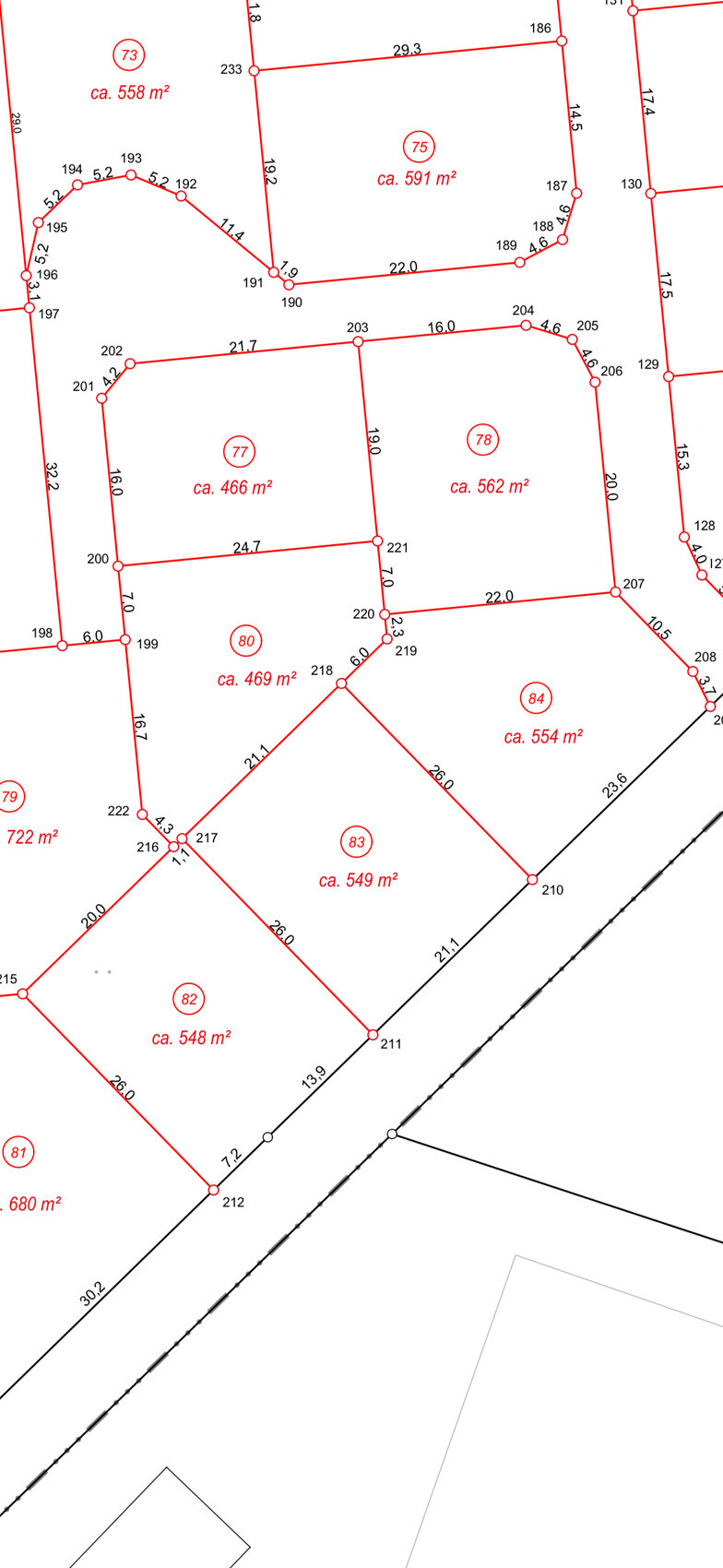
I have chosen plot number 83.
The entire project is planned to be carried out mostly as self-build work. For the critical points (such as setting out the corners of the shell, for example), I have professional assistance. The straight walls will be built by myself with the help of one or two good friends, following guidance from the expert, through hard work. I will probably be even more precise than a contracted mason working at a fixed price.
As I mentioned, this is my second self-build project. The first time, the house was built turnkey, but I visited the construction site at least once a day to inspect everything and communicate with the tradespeople.
The house design is also being planned to ensure it is "simple" to build. However, this can only be finalized once the architect is involved. Before that, I want to take a few months to research and weigh options carefully.
Therefore, there is no lead mason who says, “We normally build in this particular way.”
In your opinion, what is currently the most cost-effective wall construction method to meet the energy-saving regulation standards?
W
wiltshire10 May 2025 11:16If I were to build the walls myself, I would consider a Neopor ICF formwork system. ICF stands for "insulated concrete forms" – lightweight building components that are later filled with concrete. There are several suppliers offering prefabricated kits specifically designed for DIY projects.
You get good insulation values and potentially fewer health issues (back pain). Additionally, these systems are not much more complicated than assembling furniture from IKEA, and multiple people can work together on the build, even those without a lot of physical strength.
Years ago, I followed the construction of such a project at a colleague’s house, and they completed it quickly and efficiently.
You get good insulation values and potentially fewer health issues (back pain). Additionally, these systems are not much more complicated than assembling furniture from IKEA, and multiple people can work together on the build, even those without a lot of physical strength.
Years ago, I followed the construction of such a project at a colleague’s house, and they completed it quickly and efficiently.
H
hanghaus202310 May 2025 12:28For the initial planning, you don’t need to decide on the wall construction yet. Just assume about 40cm (16 inches), and that will work fine. Your preferred builder often uses their own system.
M
motorradsilke10 May 2025 13:18We built using Liaplan blocks. They are easy to work with on your own. The masons also told us that some people do it this way: have the mason lay the first row, then continue by themselves. The blocks are then only glued together.
Similar topics