
Hello everyone,
after taking some time to use our plot provisionally, we now want to build a house on it. It will serve as a second home while the children are small and later as the main residence for us parents. The plot rises by 3 meters over the first 19 meters from the street, see site plan. After that, it is flat. The house is planned to be located there. A large garage will be built into the hillside at the northern boundary.
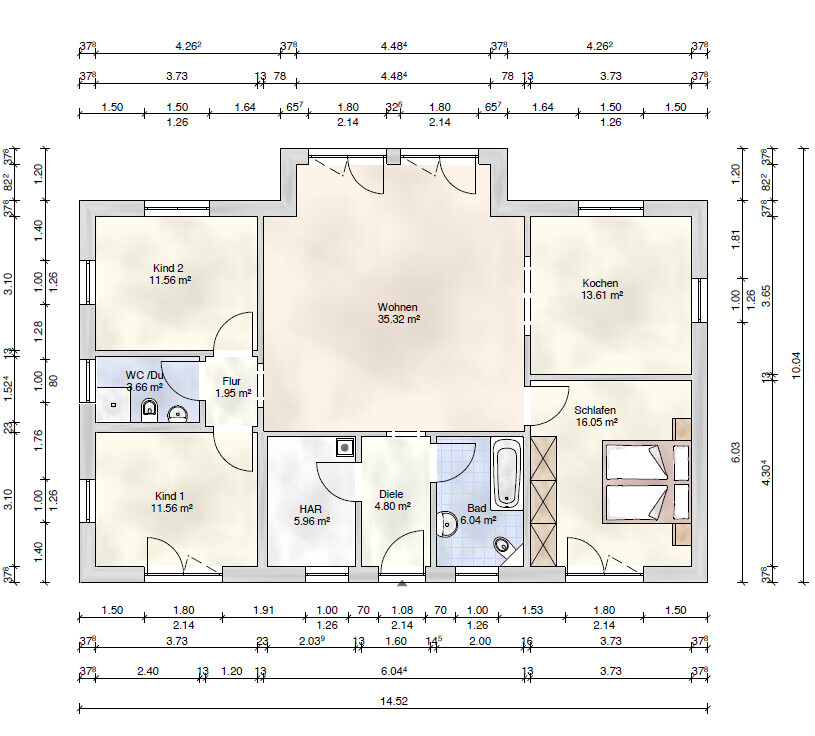
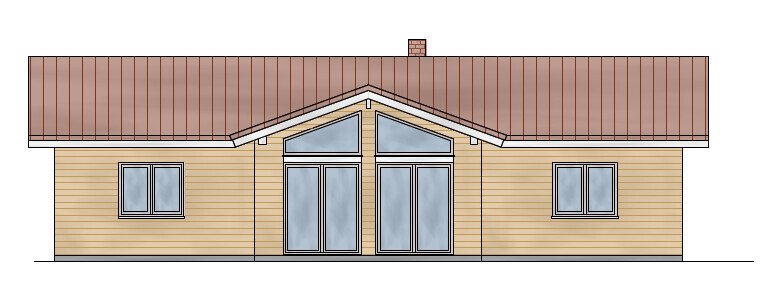
I would appreciate any advice on possible errors and optimizations. In particular, common modular dimensions for the kitchen units (facing each other). I want to optimize the connection to the garden. The facade is made of larch wood, and the ceiling in the living room is open.
Development plan/restrictions
Plot size: 1200 m² (12,917 sq ft)
Slope: yes
Building envelope, building line and boundary: approx. 19 m (62 ft)
Additional requirements: §34
Client requirements
Number of people, age: 4 persons
Room requirements on ground and upper floors
Office: family use or home office? Both
Open or closed architecture: open
Conservative or modern construction: modern
Open kitchen, cooking island: no
Number of dining spaces: 6 or more
Fireplace: yes
Music/sound system wall: preferred
Balcony, roof terrace: no
Garage, carport: yes
Utility garden, greenhouse
Other wishes/special features/daily routine, also explanations of why certain options are preferred or avoided
House design
Planner:
- Planner from a construction company
What do you particularly like? Why? Open living room without a ceiling.
What do you not like? Why?
Personal price limit for the house, including equipment: 280,000 €
If you have to give up, which details/additions
- can you give up: second bathroom
- cannot give up: fireplace
Why is the design like it is now? For example,
Standard design from the planner? Yes, including own modifications
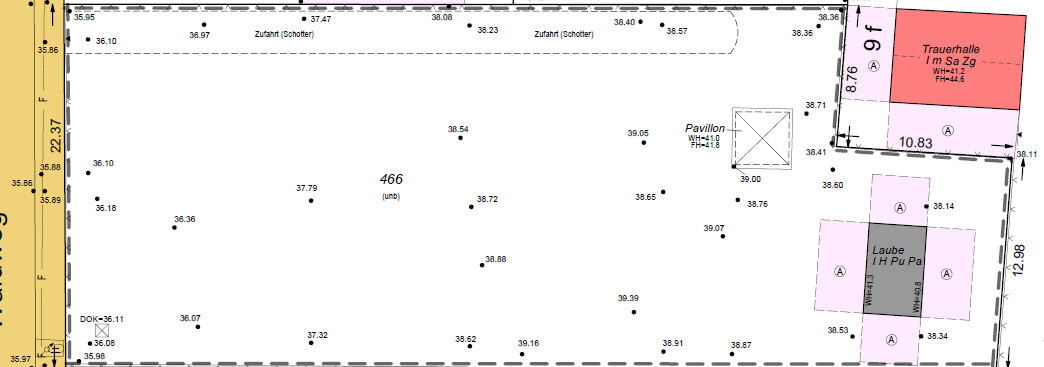
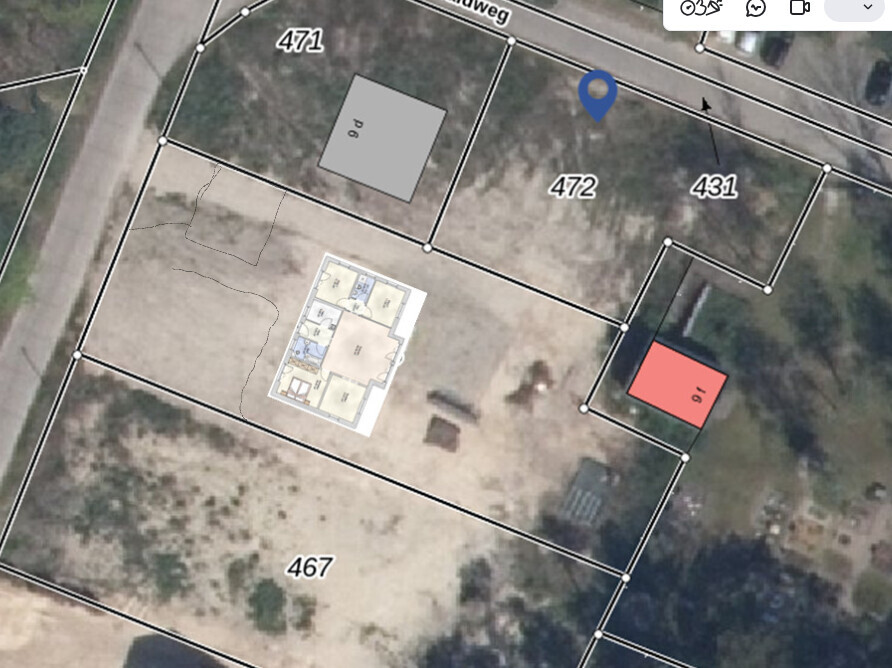
after taking some time to use our plot provisionally, we now want to build a house on it. It will serve as a second home while the children are small and later as the main residence for us parents. The plot rises by 3 meters over the first 19 meters from the street, see site plan. After that, it is flat. The house is planned to be located there. A large garage will be built into the hillside at the northern boundary.
I would appreciate any advice on possible errors and optimizations. In particular, common modular dimensions for the kitchen units (facing each other). I want to optimize the connection to the garden. The facade is made of larch wood, and the ceiling in the living room is open.
Development plan/restrictions
Plot size: 1200 m² (12,917 sq ft)
Slope: yes
Building envelope, building line and boundary: approx. 19 m (62 ft)
Additional requirements: §34
Client requirements
Number of people, age: 4 persons
Room requirements on ground and upper floors
Office: family use or home office? Both
Open or closed architecture: open
Conservative or modern construction: modern
Open kitchen, cooking island: no
Number of dining spaces: 6 or more
Fireplace: yes
Music/sound system wall: preferred
Balcony, roof terrace: no
Garage, carport: yes
Utility garden, greenhouse
Other wishes/special features/daily routine, also explanations of why certain options are preferred or avoided
House design
Planner:
- Planner from a construction company
What do you particularly like? Why? Open living room without a ceiling.
What do you not like? Why?
Personal price limit for the house, including equipment: 280,000 €
If you have to give up, which details/additions
- can you give up: second bathroom
- cannot give up: fireplace
Why is the design like it is now? For example,
Standard design from the planner? Yes, including own modifications
What the house needs to offer:
That’s what I meant by the house cost alone. Additional costs will come on top. However, water and electricity connections have already been completed. I have a full cost list mostly supported by quotes. In that respect, I have certainty for planning the financing.
1. Utilities
Water and electricity are already connected at the plot and run frost-protected up to the house connection cabinet (HAR). The size of the building services equipment depends on the building company and equipment manufacturer.
2. Zoning
Understood, that is a valid point. That’s why the children’s rooms are located separately on the other side. Originally, the bathroom was also accessed from the living room. That would make the route shorter, but privacy would be compromised. Ultimately, preferences differ. A central main room is at least desirable for us. Corridors really bother me in apartments.
3. Layout
That’s a good point. A narrow layout along the northern boundary could be an option.
That surprises me a lot. Why is access through the living room such a problem? I live in an apartment where a second corridor leads on from the living room. I found that very convenient.
- 3-4 rooms
- large living area with an open ceiling, view of the garden. Almost everything should take place here.
- Home office area required, will probably be set up in one of the children's rooms.
Rübe1 schrieb:
I’m wondering, as it’s always been repeatedly said here that nothing works below 3,000 per square meter, yet everyone is completely quiet. Just thinking of the earthworks alone, a 3 m (10 ft) height difference, connections to wastewater/stormwater, and you’re already around 2,500 all-in. Or is that all on top?
That’s what I meant by the house cost alone. Additional costs will come on top. However, water and electricity connections have already been completed. I have a full cost list mostly supported by quotes. In that respect, I have certainty for planning the financing.
ypg schrieb:
Who says that? Sure, nowadays technical rooms are not large, but you still need pipes and cables accessible between appliances and walls. Even a tradesperson moves around them, a water storage tank also takes up space, and so on.
And that needs to be explained to us, the forum. Where exactly will the water and electricity enter the house? The conduits must be frost-protected—where from and to the house?
If he’s staying in bed due to diarrhea and she has guests. Then you pass by the guests when you want to use the toilet. Or you have guests watching football. The wife wants to do wellness at the same time and crosses your party space. You avoid such planning by zoning; a hallway is helpful for this. Or at least a visual separation. You want it to be better than an apartment.
Because a crossbar layout dominates the plot and divides it into two parts.
Write down what the house needs and plan accordingly.
I must admit I suspect a misunderstanding here. Already back in 2021, you came with expensive suppliers and talked about turnkey for 250,000€. Schwörerhaus and Bien-Zenker don’t offer packages including the foundation slab, and the latter often offers different construction stages. In any case, someone telling you that all the technical equipment fits in one square meter does not seem credible.
Too hidden or not taken seriously enough.
1. Utilities
Water and electricity are already connected at the plot and run frost-protected up to the house connection cabinet (HAR). The size of the building services equipment depends on the building company and equipment manufacturer.
2. Zoning
Understood, that is a valid point. That’s why the children’s rooms are located separately on the other side. Originally, the bathroom was also accessed from the living room. That would make the route shorter, but privacy would be compromised. Ultimately, preferences differ. A central main room is at least desirable for us. Corridors really bother me in apartments.
3. Layout
That’s a good point. A narrow layout along the northern boundary could be an option.
nordanney schrieb:
I’ll only comment on this point.
With the floor plan—access to the bedrooms and children’s rooms through the living room, as well as access to the bathroom (from the bedroom) through the living and entrance area—you probably exclude 90% or more of all interested parties. For resale, that’s really bad. No one wants to buy their home at high cost like that. You might want to live like that, but you are an absolute exception.
That surprises me a lot. Why is access through the living room such a problem? I live in an apartment where a second corridor leads on from the living room. I found that very convenient.
H
hanghaus20237 May 2025 11:57Here is a design proposal with 100 m2 (1,076 sq ft). Would it be advisable to build something like this on a 10% slope?
N
nordanney7 May 2025 12:09Patrick. schrieb:
That surprises me a lot. Why is having access through the living room such a problem?When your children are older and constantly coming and going with lots of friends while you want to enjoy a quiet evening in the living room, you’ll understand the issue. Through-rooms should be avoided whenever possible since they always have traffic passing through. They are only built in exceptional cases (or are common in older buildings).Just as a suggestion, so you get what I mean and what others refer to as zoning: living areas separated from sleeping and bathrooms. A small hallway. Three rooms plus a spacious living area. Access to the terrace not only from the living room but also from the master bedroom, which even has a walk-in closet. Also, a cloakroom near the entrance. All within a compact 110 m² (1,184 sq ft).
You can find plenty of bungalow proposals from any house provider. Angled bungalows, in particular, offer good planning options.
One challenge is that you are planning something you actually want to live in years from now. In the meantime, it’s something else, like a holiday home.
At this point, you are apparently still quite far from that "age" and therefore don’t really know your interests, needs, etc. For example, we built a house here for the two of us, and if we had done that 20 years earlier, it definitely wouldn’t fit our lifestyle and circumstances now. I have changed, as have my feelings about privacy, noise levels, need for quiet, general interaction, and much more. How could I have predicted all that 10 or 20 years ago? I think building a house for the distant future is not a great idea. If you do, plan it without children, who will no longer be children but adults—and if you still want to live under the same roof by then, you should plan it completely differently, for example with separate entrances.
If you are now asking about a "good" floor plan, that surprises me—no one can tell you what will be "good" for you in 10–20 years. Of course, you can build some house that might more or less work, but I would never do it that way. Privacy (maybe someday even between spouses, and especially with grown-up children) will be necessary.
When you write here that the wood should be larch heartwood, that’s nice, but it especially shows that you are putting the cart before the horse, which often leads to problems. You have already chosen a house type and are now trying to squeeze rooms with unclear purposes into it. I’m afraid that won’t work well.
In what year do you want to start living there as your main residence? How old will you and the children be? Why not build a house for yourselves as a couple in which the entire family can live until then? For example, children can stay overnight in one room. That way, you will avoid searching for the mythical perfect solution that does everything.
As @ypg already mentioned, you should answer all questions and enter dimensions for all furniture, windows, doors, etc. with real measurements.
At this point, you are apparently still quite far from that "age" and therefore don’t really know your interests, needs, etc. For example, we built a house here for the two of us, and if we had done that 20 years earlier, it definitely wouldn’t fit our lifestyle and circumstances now. I have changed, as have my feelings about privacy, noise levels, need for quiet, general interaction, and much more. How could I have predicted all that 10 or 20 years ago? I think building a house for the distant future is not a great idea. If you do, plan it without children, who will no longer be children but adults—and if you still want to live under the same roof by then, you should plan it completely differently, for example with separate entrances.
If you are now asking about a "good" floor plan, that surprises me—no one can tell you what will be "good" for you in 10–20 years. Of course, you can build some house that might more or less work, but I would never do it that way. Privacy (maybe someday even between spouses, and especially with grown-up children) will be necessary.
When you write here that the wood should be larch heartwood, that’s nice, but it especially shows that you are putting the cart before the horse, which often leads to problems. You have already chosen a house type and are now trying to squeeze rooms with unclear purposes into it. I’m afraid that won’t work well.
In what year do you want to start living there as your main residence? How old will you and the children be? Why not build a house for yourselves as a couple in which the entire family can live until then? For example, children can stay overnight in one room. That way, you will avoid searching for the mythical perfect solution that does everything.
As @ypg already mentioned, you should answer all questions and enter dimensions for all furniture, windows, doors, etc. with real measurements.
nordanney schrieb:
When your children are older and constantly going in and out with lots of friends while you want to enjoy a nice evening in the living room, you’ll understand the problem. Through rooms should be avoided whenever possible, as they always have a lot of traffic. They are only built in exceptional cases (or are found in older buildings).
Just a suggestion to help you understand what I mean and what others mean by zoning. Living areas separated from sleeping/bathrooms. Small hallway. Three rooms plus a spacious living area. Access to the terrace not only from the living room but also from the master bedroom, which even has a walk-in closet. Also, a coat storage area in the entrance.
All within a compact 110sqm (1,184 sq ft)
You’ll find plenty of bungalow suggestions from any house provider. Especially L-shaped bungalows offer good planning options. Thank you for the clear explanation. L-shaped bungalows could be a good idea for the plot, with the long wing along the northern boundary and the short wing facing west. Until now, the large room was so important to us that, given the available floor area, the other rooms had to be scaled down.
The floor plan is very interesting. Is there a version with measurements available somewhere?
Patrick. schrieb:
What do you mean by the parents’ privacy? Regarding the older children/young adults and equally between spouses. Health issues are quite common with age, and in those cases, it’s important to maintain privacy between each other. He has hearing difficulties around acquaintances and always keeps his radio/TV loud or talks loudly on the phone. She is very bothered by that, as well as issues like snoring, being bedridden, etc.
Patrick. schrieb:
Initially, I wanted to plan with three rooms. I was strongly advised against this because it would be very disadvantageous for a possible resale (worst case). As long as you build a nice house with a well-thought-out floor plan, I don’t see a problem. I would never build a house differently against my own needs just because it might be easier to sell later. Also, while you might appeal to a larger audience that way, I don’t necessarily believe it would sell better (or more expensively). Instead of 50 interested parties, you might only have three. My current house wouldn’t necessarily be ideal for a family or would require some adjustments, but it is meant to be a comfortable home for us now, and I’m confident I could sell it well if needed. Such statements always seem too superficial to me and wouldn’t influence my planning.
Why don’t you show your original idea with three rooms and answer the questions here so we can better understand your situation?
Similar topics