
Hi everyone,
I’m a new homeowner (purchased an existing property) and recently had a new line installed for a heat pump. Now I need to get back to paving. Most YouTube videos assume very different starting conditions. My base is a quite rocky rubble.
Question 1: What is the best approach here? Should I first apply some kind of intermediate layer to level the surface (like soil without stones or something similar) and then put gravel on top? Or should I lay the gravel directly (even if it means using three times the amount)?
Question 2: I have two small problem areas already: a) During the work, many small stones slipped into the gaps of the intact rows, causing them to spread a bit more than normal. Is there a clever way to fix this without having to take anything apart? b) A few rows in the middle are slightly uneven (but that’s because the entire concrete wall underneath has already shifted). Is there a trick to fix it (like some kind of jack from below or similar)?
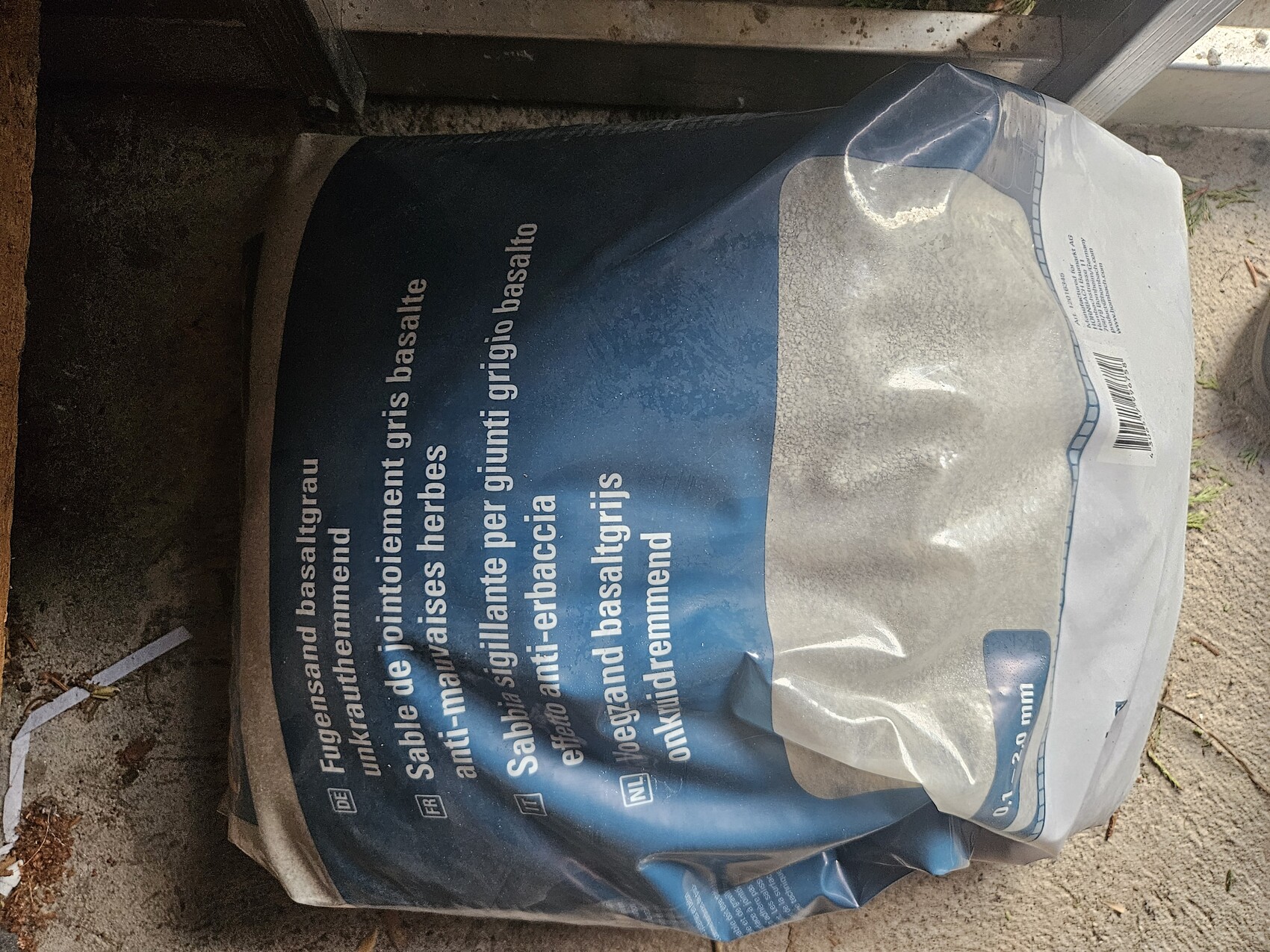
Question 3: What do you think is the best option for the joints? I haven’t found jointing sand in the right color yet, only something like in the photo.
Looking forward to your experience!
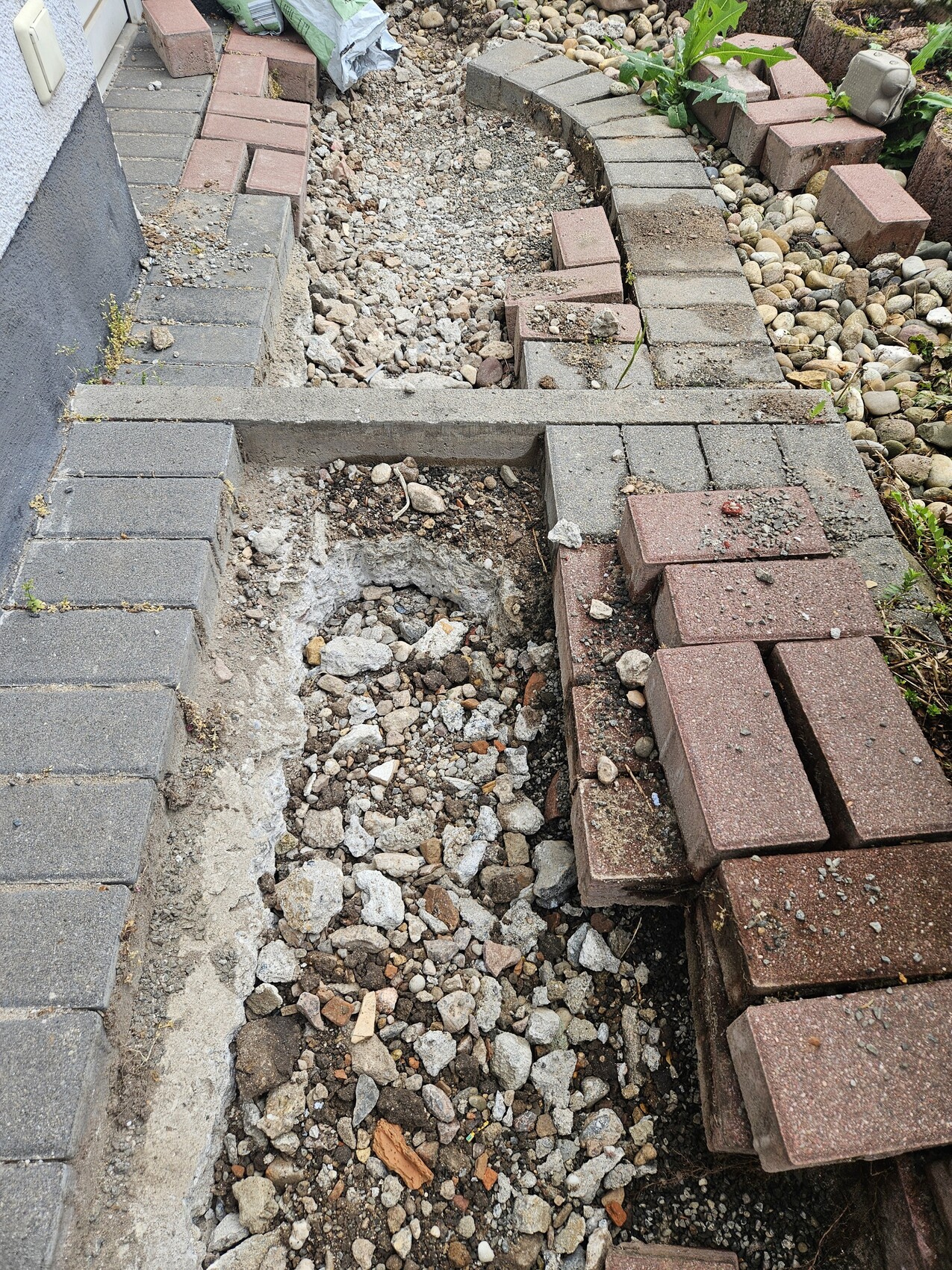
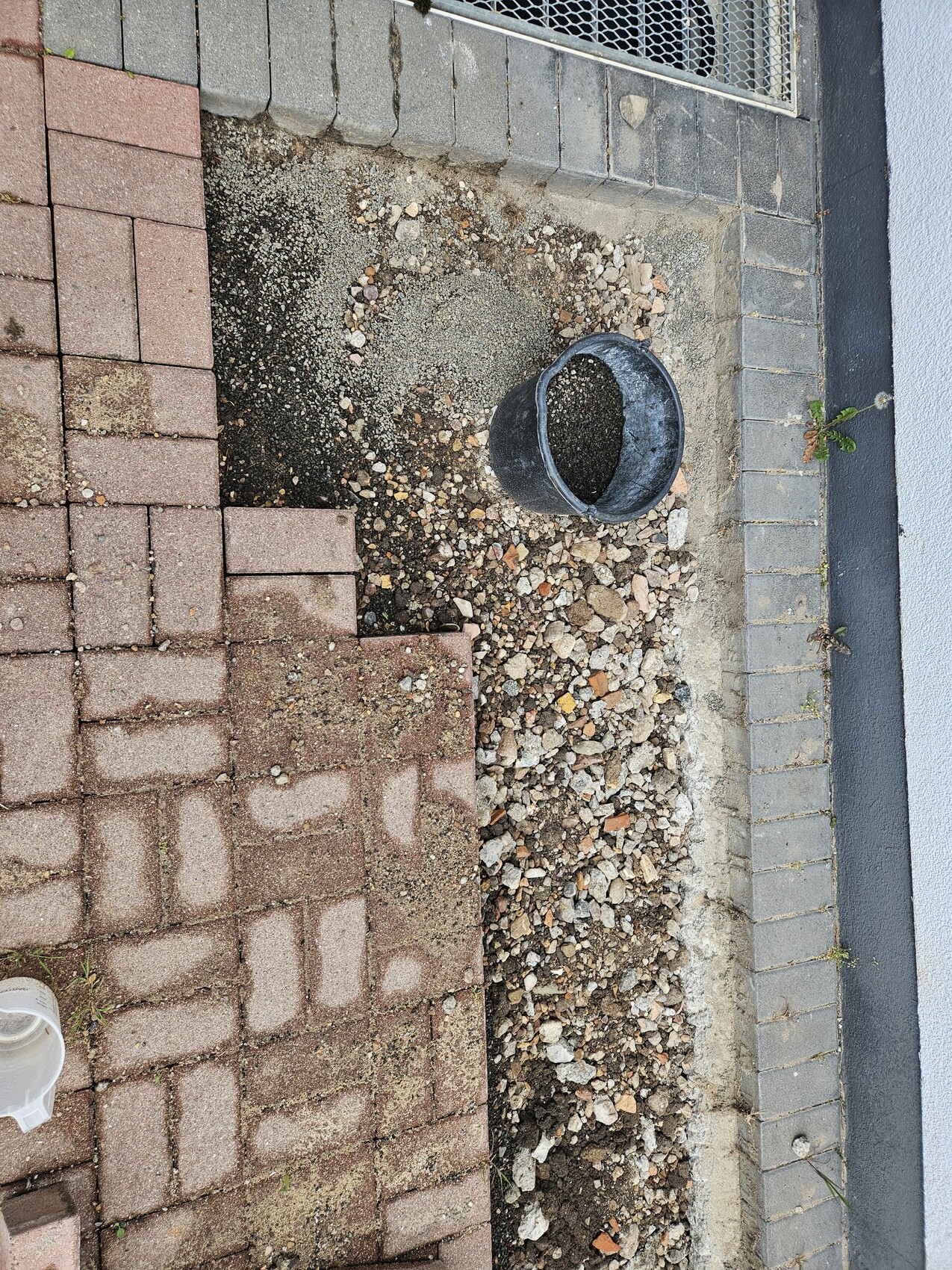
I’m a new homeowner (purchased an existing property) and recently had a new line installed for a heat pump. Now I need to get back to paving. Most YouTube videos assume very different starting conditions. My base is a quite rocky rubble.
Question 1: What is the best approach here? Should I first apply some kind of intermediate layer to level the surface (like soil without stones or something similar) and then put gravel on top? Or should I lay the gravel directly (even if it means using three times the amount)?
Question 2: I have two small problem areas already: a) During the work, many small stones slipped into the gaps of the intact rows, causing them to spread a bit more than normal. Is there a clever way to fix this without having to take anything apart? b) A few rows in the middle are slightly uneven (but that’s because the entire concrete wall underneath has already shifted). Is there a trick to fix it (like some kind of jack from below or similar)?
Question 3: What do you think is the best option for the joints? I haven’t found jointing sand in the right color yet, only something like in the photo.
Looking forward to your experience!
I would simply handle the small spots like this:
Remove the gravel leftovers
Compact the ground, for example with a sledgehammer
Fill with crushed stone and smooth it out with a trowel (2cm (1 inch) higher than the bottom edge of the laid stones)
Lay the paving stones and gently tap them with a rubber hammer until they are flush. Do everything carefully.
Remove the gravel leftovers
Compact the ground, for example with a sledgehammer
Fill with crushed stone and smooth it out with a trowel (2cm (1 inch) higher than the bottom edge of the laid stones)
Lay the paving stones and gently tap them with a rubber hammer until they are flush. Do everything carefully.
E
elminster20 Apr 2025 07:47To be honest, I don’t fully understand all the questions. Was there still some concrete underneath in parts? Where the stones are loose and the concrete is crumbly, I would chip it out.
Basically, I would also tamp down all the larger stones currently inside as firmly as possible. If you don’t have a hand tamper, you’ll have to make do with something else, but the larger stones shouldn’t remain loose or be too high. Afterwards, I would fill up with gravel. However, leveling 2cm (1 inch) above the existing stones might be a bit much, I would have thought…
Regarding the color of the jointing sand, I wouldn’t worry about it. It won’t be very noticeable.
Basically, I would also tamp down all the larger stones currently inside as firmly as possible. If you don’t have a hand tamper, you’ll have to make do with something else, but the larger stones shouldn’t remain loose or be too high. Afterwards, I would fill up with gravel. However, leveling 2cm (1 inch) above the existing stones might be a bit much, I would have thought…
Regarding the color of the jointing sand, I wouldn’t worry about it. It won’t be very noticeable.
Philfuel schrieb:
Fill with crushed stone and level it with a trowel (2cm higher than the bottom edge of the laid bricks) Exactly, you need crushed stone, which is the dark granulate. It’s best to remove all large stones above, add the granulate/crushed stone, and press and smooth it with a paving stone. Gently tap the stones in place with a rubber mallet if, as shown here, it’s just a small side path. I would go slightly below 2cm, maybe only half, since the stones won’t be walked on frequently.
Newbi23 schrieb:
Is there a trick (like a type of jack from underneath or something)? There is a tool to lift stones out. But I would recommend not just doing it partially, but removing everything at once.
I’m assuming here that the result should look reasonable but not professional?!
By the way, when I installed my access path in the front yard, I didn’t have YouTube. There were and still are books about creative design ideas for private garden paths, etc. Maybe you can find something with those keywords online or at an (online) bookstore.

Hi,
I would first thoroughly compact the rubble base and then apply crushed gravel directly on top – with a grain size of 2–5 mm (0.08–0.2 inches), nothing too coarse. I wouldn’t use soil or similar materials for leveling, as that can cause problems if it settles.
For the displaced joints, I’d clean them out using a narrow joint scraper and see if you can gently tap the stones back into place with a rubber mallet. If not, just refill with crushed gravel, and it will hardly be noticeable later.
If individual rows are uneven due to the base, simply patching from above won’t help. You’ll need to remove the stones and rebuild that section properly – more work, but anything less will cause issues in the long run.
For jointing material, I’d recommend classic joint sand, preferably with weed protection. The material in the photo looks like polymer-bound grout – it holds better, but you need to work very carefully with it, or it can quickly look bad.
Best regards
I would first thoroughly compact the rubble base and then apply crushed gravel directly on top – with a grain size of 2–5 mm (0.08–0.2 inches), nothing too coarse. I wouldn’t use soil or similar materials for leveling, as that can cause problems if it settles.
For the displaced joints, I’d clean them out using a narrow joint scraper and see if you can gently tap the stones back into place with a rubber mallet. If not, just refill with crushed gravel, and it will hardly be noticeable later.
If individual rows are uneven due to the base, simply patching from above won’t help. You’ll need to remove the stones and rebuild that section properly – more work, but anything less will cause issues in the long run.
For jointing material, I’d recommend classic joint sand, preferably with weed protection. The material in the photo looks like polymer-bound grout – it holds better, but you need to work very carefully with it, or it can quickly look bad.
Best regards
Similar topics