
ᐅ Estimated Construction Costs for a Single-Family Home in the Tübingen Area
Created on: 2 Apr 2025 21:54
D
D-Zug88
Hello everyone,
I’ll briefly describe our situation. We have reserved a plot of land for a single-family house. We would like to build a solid (whether Liapor or another type of "masonry," we are not really sure) structure on it. The plot is flat and square, measuring 417 m² (4490 sq ft).
We are allowed to build 2 full stories with SD, PD, FD, although only one SD is an option (maximum ridge height 9.5 m (31 ft), maximum wall height 6.10 m (20 ft)).
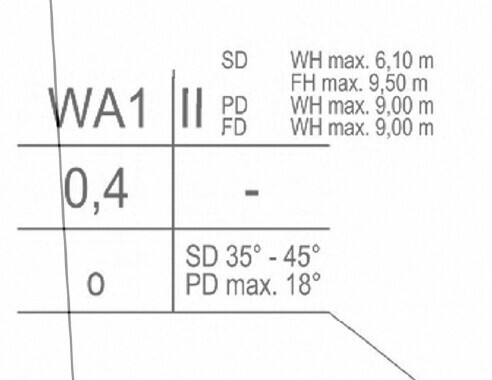
So far, we have received offers ranging from €3500/m² (local large contractor) to €2800/m² from, for example, Fingerhaus (probably excluded due to timber frame).
Now to our dream house:
- KfW 55 standard
- solid construction method (type not clear, will depend on budget; do Liapor and “masonry stone-on-stone” not differ much in cost?)
- 140 m² (1507 sq ft) living area
- 1.5 stories with a “high” knee wall
- basement (utility cellar, which can be finished later, connections for heating and electricity installed)
- house dimensions (determined by room requirements? 11 x 9 m (36 x 30 ft)? 11 x 10 m (36 x 33 ft)? Building area ratio of 0.4 is sufficient)
- including photovoltaic system with battery storage
- turnkey delivery
- Basement: technical room + laundry (15 m² (161 sq ft)) + large hobby room (approx. 30 m² (323 sq ft)) + fitness room (15 m² (161 sq ft)) + cellar (10 m² (108 sq ft)?) + hallway / stairs (? m²) = 70 m² (753 sq ft) + x
- Ground floor: living & dining area + kitchen (approx. 45 m² (484 sq ft)) + pantry (3 m² (32 sq ft)?) + guest room (>12 m² (129 sq ft)) + shower bathroom (4 m² (43 sq ft)?) + hallway / stairs (? m²) = 64 m² (689 sq ft) + x
- Upper floor: child 1 (16 m² (172 sq ft)) + child 2 (16 m² (172 sq ft)) + master bedroom + dressing room (20 m² (215 sq ft)) + bathroom (14 m² (151 sq ft)) + hallway + stairs (? m²) = 66 m² (710 sq ft) + x
Calculating room and floor area requirements (without the unknown x for stairs and hallways/entrance) we come to approximately 130 m² (1399 sq ft).
Our specific questions are,
a) Which “solid construction” companies do you generally recommend in the Tübingen area?
b) How much area should roughly be allowed for hallways and entrance / stairs? Yes, it depends on the floor plan, but we would like to estimate the total space requirements.
c) What rough price range should we expect in €/m² (living area) + €/m² (basement) for Liapor or other masonry? We do not want to consider additional costs like kitchen and garage here, but they are naturally included in the overall budget.
We hope you can help us. Please feel free to ask questions—I’ll respond promptly.
Have a nice evening!
I’ll briefly describe our situation. We have reserved a plot of land for a single-family house. We would like to build a solid (whether Liapor or another type of "masonry," we are not really sure) structure on it. The plot is flat and square, measuring 417 m² (4490 sq ft).
We are allowed to build 2 full stories with SD, PD, FD, although only one SD is an option (maximum ridge height 9.5 m (31 ft), maximum wall height 6.10 m (20 ft)).
So far, we have received offers ranging from €3500/m² (local large contractor) to €2800/m² from, for example, Fingerhaus (probably excluded due to timber frame).
Now to our dream house:
- KfW 55 standard
- solid construction method (type not clear, will depend on budget; do Liapor and “masonry stone-on-stone” not differ much in cost?)
- 140 m² (1507 sq ft) living area
- 1.5 stories with a “high” knee wall
- basement (utility cellar, which can be finished later, connections for heating and electricity installed)
- house dimensions (determined by room requirements? 11 x 9 m (36 x 30 ft)? 11 x 10 m (36 x 33 ft)? Building area ratio of 0.4 is sufficient)
- including photovoltaic system with battery storage
- turnkey delivery
- Basement: technical room + laundry (15 m² (161 sq ft)) + large hobby room (approx. 30 m² (323 sq ft)) + fitness room (15 m² (161 sq ft)) + cellar (10 m² (108 sq ft)?) + hallway / stairs (? m²) = 70 m² (753 sq ft) + x
- Ground floor: living & dining area + kitchen (approx. 45 m² (484 sq ft)) + pantry (3 m² (32 sq ft)?) + guest room (>12 m² (129 sq ft)) + shower bathroom (4 m² (43 sq ft)?) + hallway / stairs (? m²) = 64 m² (689 sq ft) + x
- Upper floor: child 1 (16 m² (172 sq ft)) + child 2 (16 m² (172 sq ft)) + master bedroom + dressing room (20 m² (215 sq ft)) + bathroom (14 m² (151 sq ft)) + hallway + stairs (? m²) = 66 m² (710 sq ft) + x
Calculating room and floor area requirements (without the unknown x for stairs and hallways/entrance) we come to approximately 130 m² (1399 sq ft).
Our specific questions are,
a) Which “solid construction” companies do you generally recommend in the Tübingen area?
b) How much area should roughly be allowed for hallways and entrance / stairs? Yes, it depends on the floor plan, but we would like to estimate the total space requirements.
c) What rough price range should we expect in €/m² (living area) + €/m² (basement) for Liapor or other masonry? We do not want to consider additional costs like kitchen and garage here, but they are naturally included in the overall budget.
We hope you can help us. Please feel free to ask questions—I’ll respond promptly.
Have a nice evening!
11ant schrieb:
This looks like a fully completed road ready for billing, so there will be more than just surface drainage. The photos support the assumption of a flat plot (which means that building a laundry room and a utility room between the foundation slab and the ground floor must be worth a surcharge of no less than 70k, even if you want to try tiling it yourself). A lot of money for the convenience of going one floor down to do laundry. From the above-ground utility room, you save the need for a sewage pump and you can still fit a rotary clothesline in the garden. The other beginners in the fitness studio also start with just a few plates, so be brave! Straight to the point now:
If we build with a basement and want to have a laundry room there, would a “pump” aka sewage lifting station be necessary to bring the water from “down there” up to street level?
If we build on a slab foundation, would no sewage lifting station be needed? Ultimately, the question is: is the basement worth it for me, considering the costs for a sewage lifting station, possibly drainage, and whether a retaining wall or some kind of reinforcement would be necessary to prevent the road from sinking?
I always assumed a flat plot was ideal for construction.
Honestly, I’m waking up a bit to the naive approach I had.
ypg schrieb:
These two statements could be worlds apart
Separated from this one:
If you mean by “finishing” you are not talking about dressing up a mechanical room and laundry, right?
It reads more like you want to turn these rooms into living spaces.
And yes, there is a mistake here, too.
But before someone corrects you, you should explain your basement plan.
Is the plot really completely level, or is the photo just taken at an angle? Unfortunately, there is no elevation data further to the left. ypg schrieb:
These two statements could be worlds apart
Separated from this one:
If you mean by “finishing” you are not talking about dressing up a mechanical room and laundry, right?
It reads more like you want to turn these rooms into living spaces.
And yes, there is a mistake here, too.
But before someone corrects you, you should explain your basement plan.
Is the plot really completely level, or is the photo just taken at an angle? There is no elevation data further left towards the boundary, help.
D-Zug88 schrieb:
There is no elevation data further left towards the boundary, help 🙁 Attached is an almost straight panorama

D-Zug88 schrieb:
If we were to build with a basement and wanted a laundry room there, would a pump, also called a lifting station, be necessary to move the water from "down there" up to street level? Water naturally flows downhill – that’s why there are water tanks based on the principle of communicating vessels and wastewater pipes are installed with a slope. The sewer has to be lower than the point where the wastewater is generated; otherwise, pumping assistance is needed. You can find the sewer heights in the cadastral map, the local development plan, or from the water utility company.
D-Zug88 schrieb:
If we build with a slab foundation instead, would a lifting station not be necessary? Ultimately, the question is: Is the basement worth the cost of a lifting station, possibly drainage, and would a retaining wall or some type of reinforcement be needed to prevent the street from "sinking"? The street will not sink because of your basement construction; this should already be sufficiently secured by the building setback area. Ultimately, the (though not really easy to find) 11ant basement rule states: "A basement that is 100 percent below the original ground level will have zero percent of its construction costs offset by necessary terrain modification costs." Therefore, the conclusion for flat plots is generally that basement costs should be considered entirely as luxury expenses.
D-Zug88 schrieb:
I always assumed that a flat plot would be ideal for building. That absolutely applies, at least inland, if there’s no valley view. However, this is less clear in tidal areas or other regions prone to flooding. And fundamentally, deep basements beneath modern wheelchair-accessible ground floors are a different matter compared to raised ground floors under classic elevated entrances.
https://www.instagram.com/11antgmxde/
https://www.linkedin.com/company/bauen-jetzt/
11ant schrieb:
The sewer line must be lower than the wastewater discharge point; otherwise, it won’t work without a pump. You can find the sewer elevations in the cadastral or zoning plan, or from the water utilities. You mean the general principle, right? I will inquire about it since I haven’t found any inspection chamber on the property itself—which I wouldn’t necessarily expect anyway.
In this particular case, the backwater level is almost at the same elevation as the current ground level. That means the two water columns would be nearly the same height: the water column in the sewer and at the ground floor of the house. The basement with the drainage is well below that. It now depends on how deep the street manhole extends into the ground, correct? I would need the basement drain to be higher than that, and there should be standard values for this. So I’d have to dig accordingly deep, right? The basement would be adjusted accordingly.
ypg schrieb:
When you say finishing, you don’t mean just tidying up the utility room and laundry, right? No, by finishing I mean eventually installing a radiator. That would require insulating the basement shell and preparing the pipes, correct?
11ant schrieb:
Water naturally flows downhill — that’s why water storage tanks work on the principle of communicating vessels, and wastewater pipes are laid with a slope. The sewer line must be lower than the wastewater discharge point, otherwise it won’t work without pumping. You can find the sewer elevations in the cadastral or zoning plans or from the water utility providers.
The street won’t sink due to your basement construction; this should already be sufficiently secured by the building setback zone. Ultimately, the (somewhat difficult to interpret) statement of the “11ant basement rule” is: “a basement located one hundred percent below the original ground level will not reduce its construction costs by any percentage of the unavoidable grading and landscaping costs.” The conclusion for flat lots is usually that the basement costs are entirely to be considered a luxury expense.
This absolutely applies, at least in inland areas without a valley view panorama. In tidal regions or other flood-prone areas, this is more nuanced. And fundamentally, deep basements beneath modern barrier-free ground floors are a different matter compared to raised ground floors with classic podium levels. I just read your basement rules and I’m partially lost. I guess it’s about how hilly the plot is—the hillier it is, the more expensive and impractical the basement becomes? No idea.
I really like the roadmap — we’ll do our homework. The roadmap feels like preparing a detailed requirements specification, which makes much more sense than just running off to find floor plans and ask how much it costs.
D-Zug88 schrieb:
I always assumed that a flat plot of land would be ideal for building. Yes, a flat plot is ideal if there is no basement.
D-Zug88 schrieb:
I didn’t find a maintenance hole (inspection chamber / cleanout) on the property itself – No, you will need to have one installed on your property for your drainage system.
D-Zug88 schrieb:
No, by finishing I meant later installing a radiator. Why?
ypg schrieb:
Yes, a flat plot is ideal without a basement.
No, you will have to arrange the drainage system for your property yourself as well.
Why? In case the kids want to use it as a hobby room or I want a small DIY area myself—workbench, etc. But honestly, you can easily get carried away with all the cool things you could do eventually. First, the plan that separates must-haves from nice-to-haves is important. Our specifications, so to speak.
We want a house that:
- Has an open kitchen with a pantry
- It is important to us that the living area is as open as possible to keep an eye on the kids and provide as much freedom as possible.
- Has a living area long enough to fit a table for about 12-14 people (max. once or twice a year)
- Includes a guest room on the ground floor, which can be converted into a bedroom in old age, with a standard 180x200 cm (71x79 inches) bed and a traditional wardrobe. Initially, it will serve as a home office or for grandparents to stay over on weekends.
- Has a shower bathroom on the ground floor that is easy to walk into but does not need to be fully accessible.
- Equal-sized children's rooms are important to us for fairness.
- The bedroom size has no priority and can benefit the children. However, the parents’ and one child’s rooms should be spatially separated.
- A large walk-in closet is not necessary, but nice to have, preferably with a window.
- The staircase should not be too steep; an intermediate landing is important. I’m clumsy, and I like having pictures and decorations in the stairwell.
- Acoustic separation between the living room and the upper floor is absolutely necessary.
- The mudroom needs to be completely separated from the main walkways.
- The upstairs bathroom should have a combined shower and toilet and a skylight / if there are two full floors above, it should have a bathtub (bathing is important to us).
- I would like to have a space somewhere where I can practice boxing (punching bag, a weight bench, some room for jumping rope).
- Storage space for bicycles, ride-on toys, suitcases, and all the bulky stuff that you have with up to two kids.
So, these were the basic things that are important to us:
I’m just unsure how to proceed after this list. Visit show homes? Visit housing developments? Get a feel for what we imagine versus reality?
Would we find ourselves in a catalog house right away or not, and then what?
Either way, go to an architect who creates a preliminary design, which we can then take to various volume builders or larger companies?
I think that starting from the must-haves, we'll end up with a fairly standard catalog house, with minor compromises here and there…
D-Zug88 schrieb:
I’m just not sure how to proceed after this list. Visit model homes? Visit home parks? Why not? Have you actually not seen anything in person yet?
D-Zug88 schrieb:
It’s important to us that the living area is as open as possible, to keep an eye on the kids and offer as much freedom as possible. That works.
D-Zug88 schrieb:
A guest room on the ground floor, which can be converted into a bedroom in old age, Allow for an extra 4-5 sqm (43-54 sq ft). The all-round solution where people also want to sleep downstairs, but the guest shower isn’t properly planned, doesn’t really work.
D-Zug88 schrieb:
A shower bathroom on the ground floor, which is easy to access but doesn’t have to be fully barrier-free. How much minimum space do you want to live in when you’re older? Add 2 sqm (22 sq ft) or more?
D-Zug88 schrieb:
I think space between landings is important, Okay, add 2.2 sqm (24 sq ft) or more.
D-Zug88 schrieb:
The dirty zone must be completely separated from normal traffic areas. Add at least 3 sqm (32 sq ft).
D-Zug88 schrieb:
The bathroom upstairs should have a combined T-shaped shower and toilet. Add 4 sqm (43 sq ft) or more.
D-Zug88 schrieb:
Would we find ourselves directly in a catalog house, or not? And then what? No, most don’t offer these extra must-haves.
D-Zug88 schrieb:
Go to the various Heinz von Heiden builders in the world? Definitely not a Heinz von Heiden fan.
Similar topics