
ᐅ Damp spot in drywall ceiling of bathroom caused by pipe ventilation
Created on: 26 Feb 2025 12:31
G
Gerd&JolantheG
Gerd&Jolanthe26 Feb 2025 12:31Hello everyone,
I have a technical question and hope to get some answers from you. I have a newly built house, completed in 2020.
Topic:
It concerns the upper floor (bathroom).
At the time, I planned to install an exhaust fan in the bathroom to help remove humidity. I already installed the ducting back then, and a roof vent was fitted by the roofer for this purpose.
The bathroom ceiling was closed with drywall except for a small opening where the fan was supposed to be installed.
Later, I decided against installing the fan since there are two windows for ventilation in the bathroom, and I didn’t like the fan hanging in the ceiling.
The small opening around the exhaust duct, which was left open, was then closed afterwards with drywall.
In the winter of 2023/2024, I noticed that the small area of the ceiling had a different color tone and became slightly damp. At first, I thought it was caused by not properly finishing the small drywall piece I added later.
However, the problem worsened over the last few months. A stain appeared, and eventually, water even dripped from that spot on the ceiling.
My assumptions:
1. Moisture is entering through the exhaust duct.
2. Moisture from the bathroom is getting into the small closed drywall section and settling there.
Since the moisture caused dripping from the ceiling, this mostly happens when taking hot baths or when the girls take hot showers, mostly in winter.
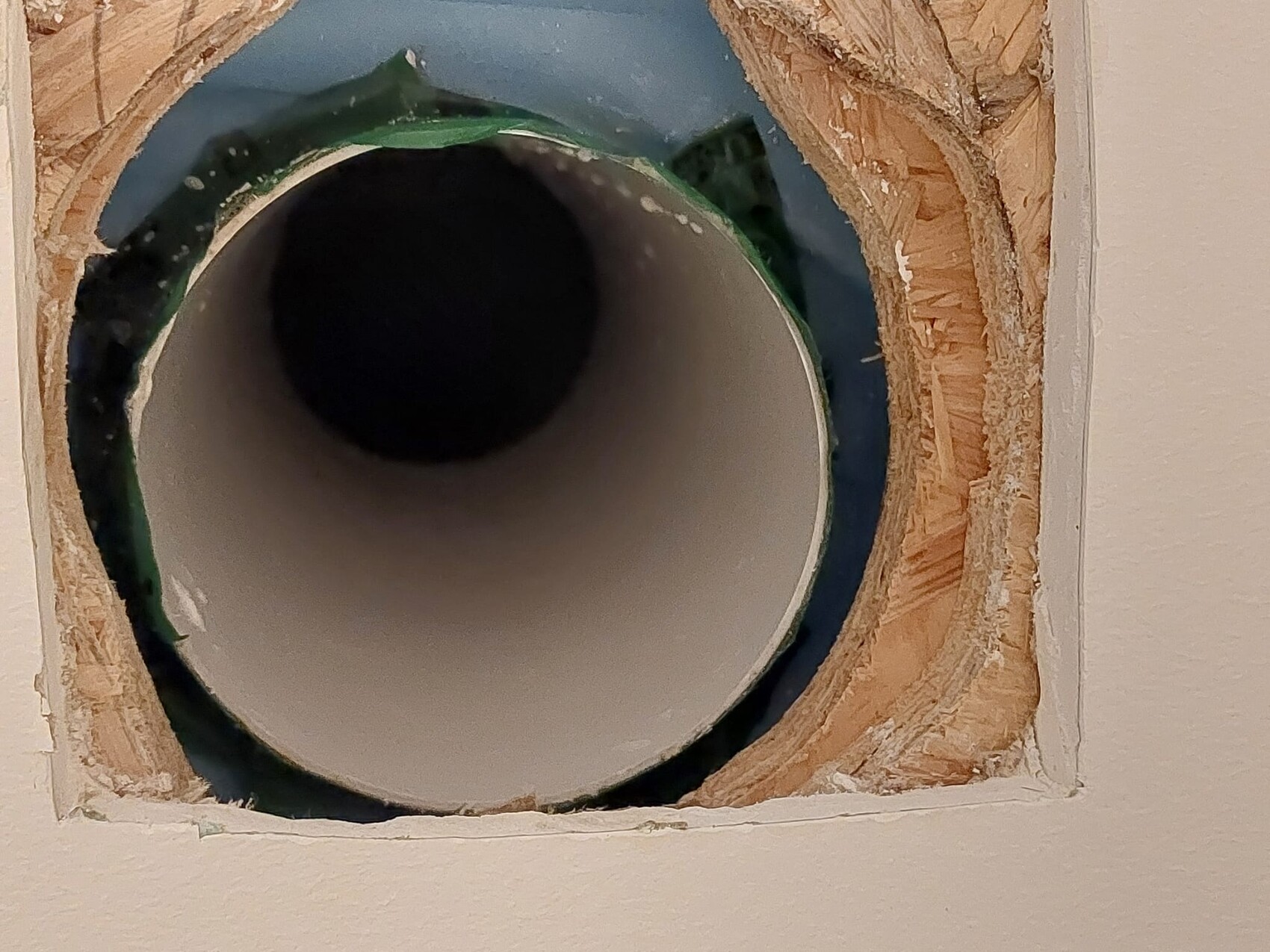
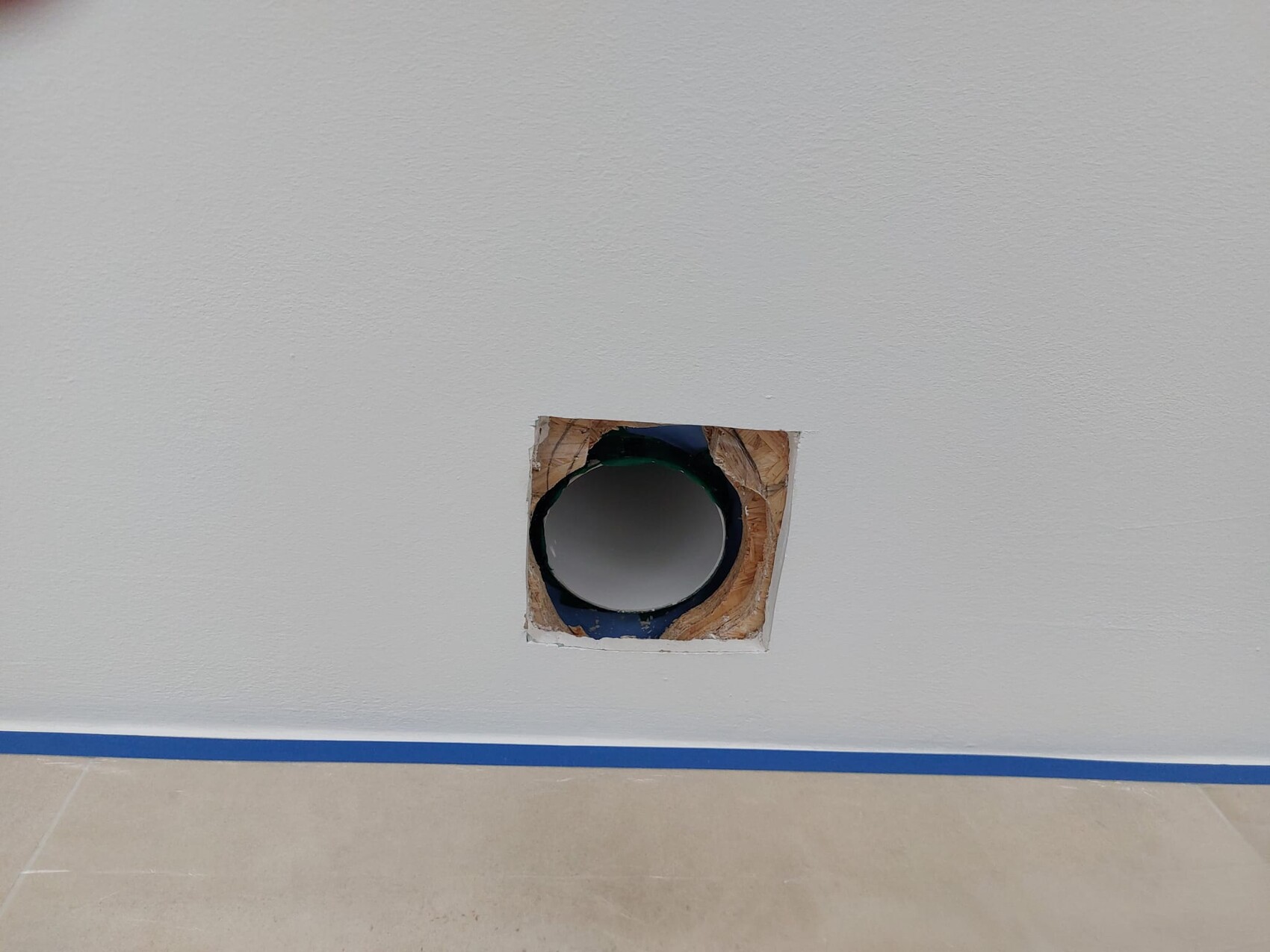
Last week, I opened the area and found that the moisture is unfortunately coming from the ventilation duct itself, not from poor sealing of the small drywall section.
Now I suspect it is condensation forming when hot water is used, but this is only a guess.
I would like to simply fill the duct from the inside since it is not in use, either with expanding foam or mineral wool, or both, and seal the bottom with extruded polystyrene foam (XPS). Then I would close the open ceiling with drywall.
My question to you: Can this be done this way, and would the problem (moisture) very likely be resolved?
Or does the roof need to be opened up and sealed from above in that area?
Thank you very much in advance.
I have a technical question and hope to get some answers from you. I have a newly built house, completed in 2020.
Topic:
It concerns the upper floor (bathroom).
At the time, I planned to install an exhaust fan in the bathroom to help remove humidity. I already installed the ducting back then, and a roof vent was fitted by the roofer for this purpose.
The bathroom ceiling was closed with drywall except for a small opening where the fan was supposed to be installed.
Later, I decided against installing the fan since there are two windows for ventilation in the bathroom, and I didn’t like the fan hanging in the ceiling.
The small opening around the exhaust duct, which was left open, was then closed afterwards with drywall.
In the winter of 2023/2024, I noticed that the small area of the ceiling had a different color tone and became slightly damp. At first, I thought it was caused by not properly finishing the small drywall piece I added later.
However, the problem worsened over the last few months. A stain appeared, and eventually, water even dripped from that spot on the ceiling.
My assumptions:
1. Moisture is entering through the exhaust duct.
2. Moisture from the bathroom is getting into the small closed drywall section and settling there.
Since the moisture caused dripping from the ceiling, this mostly happens when taking hot baths or when the girls take hot showers, mostly in winter.
Last week, I opened the area and found that the moisture is unfortunately coming from the ventilation duct itself, not from poor sealing of the small drywall section.
Now I suspect it is condensation forming when hot water is used, but this is only a guess.
I would like to simply fill the duct from the inside since it is not in use, either with expanding foam or mineral wool, or both, and seal the bottom with extruded polystyrene foam (XPS). Then I would close the open ceiling with drywall.
My question to you: Can this be done this way, and would the problem (moisture) very likely be resolved?
Or does the roof need to be opened up and sealed from above in that area?
Thank you very much in advance.
G
Gerd&Jolanthe26 Feb 2025 12:36Attached are two photos of the opening in the ceiling with the ventilation duct.
A
Allthewayup1 Mar 2025 22:03Does the pipe run through the house up to the roof vent? If so, it’s clear that warm air rises along the pipe, eventually condensing at a cooler point and causing water droplets to run down. Hot showers regularly accelerate this process. Seal the pipe with several appropriately cut round pieces of EPS insulation and first observe whether condensation continues to form behind the insulation. If it does, then the roof vent should ideally also be sealed near the exit point on the roof.
G
Gerd&Jolanthe6 Mar 2025 10:52Allthewayup schrieb:
The pipe runs through the house up to the roof vent? If so, it’s clear that warm air rises along the pipe, condenses at some colder point, and the droplets run down. Hot showers regularly speed up this process. Seal the pipe with several properly cut, round pieces of EPS insulation and then monitor if condensation continues to form behind the insulation. If it does, the roof vent near the exit point should also be sealed. Hi Allthewayup,
thank you very much for your reply.
The vent pipe runs only a short distance before it reaches the roof vent. The roof vent was installed by the roofer specifically for this pipe. When I reach into the pipe with my hand, I can feel two flaps with my fingertips, which I can slightly press open.
Regarding insulation, EPS insulation—would it be better insulated with stone wool or mineral wool, then sealed at the bottom with expanding foam, and finally covered with drywall and plastered?
I mostly experienced this problem in winter when temperatures in the basement are low. So I won’t be able to observe it now anymore.
Best regards
A
Allthewayup6 Mar 2025 14:50EPS is used because it doesn’t absorb moisture like mineral wool does. Actually, it doesn’t matter much what insulation you use, but I wouldn’t apply spray foam. First, you need to check whether condensation still occurs inside the pipe. Only when you can be certain that condensation has been prevented should you permanently seal it and close the ceiling again.

Insulation alone won’t be enough; you need a vapor barrier from the interior to the attic space. This is probably the OSB board on the rest of the roof. However, it becomes leaky where the pipe penetrates it. Ideally, the entire area should be sealed, preferably with a collar (although I don’t think there is any officially approved solution for OSB boards). Is it possible to access this from above? In other words, can you look at the pipe (and the OSB board) from the roof space?
Similar topics