
ᐅ Lighting Design for a Multi-Story Apartment with LED Indirect Lighting
Created on: 21 Feb 2025 12:35
G
goldfisch138
Hello everyone,
we have finalized the floor plan for our new build and are currently working on the final lighting design.
All lighting and electrical systems will be connected via KNX.
[IMG width="726px"]https://st.hzcdn.com/fimgs/7192e74307b114bb_8432-w500-h328-b0-p0--.jpg[/IMG]
Here is how I planned the lighting:
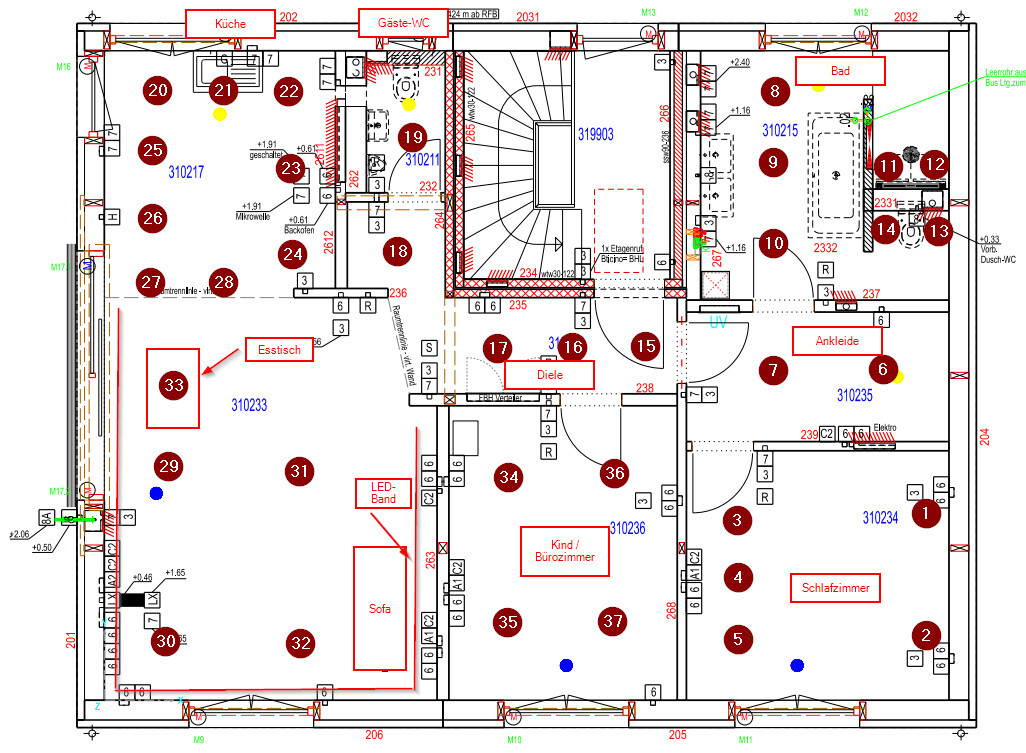
I will mainly use recessed ceiling spots, with changes only in the bedrooms and living/dining area.
Lamps 1 to 5 will be warm white fixtures. In the hallway, I planned three ceiling spotlights, but I’m still unsure whether to add an LED strip about 30cm (12 inches) above the finished floor as indirect lighting. The lighting transition from the hallway to the living/dining area is also still unclear to me. The dining table will be the focal point of the living/dining area and is currently planned to be illuminated by a ceiling light.
In the kitchen, I will place the spots in an L-shape over the work surface. I think a central placement is not ideal, as it tends to create shadows on the countertop. Regarding spots 23 and 24, I’m uncertain about their placement since that is where the appliance wall is.
Additionally, there will be an LED strip in the living room that can be adjusted between warm white and cool white depending on the atmosphere. Another LED strip will serve as backlighting behind the TV. The sofa has now been rotated compared to the plan above and is positioned against the wall facing the balcony.
I would appreciate it if you could share your experiences and also offer honest, even harsh, criticism. I have put a lot of thought into this and would now like to finalize the lighting design but want to gather your opinions and expertise beforehand.
Thanks in advance.
we have finalized the floor plan for our new build and are currently working on the final lighting design.
All lighting and electrical systems will be connected via KNX.
[IMG width="726px"]https://st.hzcdn.com/fimgs/7192e74307b114bb_8432-w500-h328-b0-p0--.jpg[/IMG]
Here is how I planned the lighting:
I will mainly use recessed ceiling spots, with changes only in the bedrooms and living/dining area.
Lamps 1 to 5 will be warm white fixtures. In the hallway, I planned three ceiling spotlights, but I’m still unsure whether to add an LED strip about 30cm (12 inches) above the finished floor as indirect lighting. The lighting transition from the hallway to the living/dining area is also still unclear to me. The dining table will be the focal point of the living/dining area and is currently planned to be illuminated by a ceiling light.
In the kitchen, I will place the spots in an L-shape over the work surface. I think a central placement is not ideal, as it tends to create shadows on the countertop. Regarding spots 23 and 24, I’m uncertain about their placement since that is where the appliance wall is.
Additionally, there will be an LED strip in the living room that can be adjusted between warm white and cool white depending on the atmosphere. Another LED strip will serve as backlighting behind the TV. The sofa has now been rotated compared to the plan above and is positioned against the wall facing the balcony.
I would appreciate it if you could share your experiences and also offer honest, even harsh, criticism. I have put a lot of thought into this and would now like to finalize the lighting design but want to gather your opinions and expertise beforehand.
Thanks in advance.
M
Molybdean22 Feb 2025 14:27ypg schrieb:
Always centered within the intended room. Toilet and shower both centered.Always place them so that you are not positioned between the spotlight and the area where you want the light.That’s why in smaller rooms it’s better to have one more spotlight. Otherwise, your own shadow can be disruptive.
W
wiltshire22 Feb 2025 15:42Molybdean schrieb:
The visible range is around ~100 Hz, sensitive eyes can perceive up to ~400 Hz.100 Hz PWM is quite common with poorly dimmed LEDs, often even lower.goldfisch138 schrieb:
Where would you place the spotlight?If you look at recessed ceiling lights and bulbs, you will find a specification for the beam angle. This, together with the distance from ceiling to floor, determines the illuminated area on the floor. We have installed lights from Luxvenum and Ansorg in some parts of the ceiling. On the latter manufacturer’s website, you can find very good technical drawings that help you assess beam angle, coverage area, and light output at different power levels. Don’t make the same mistake I did at first by thinking “more is better, I can always dim it.” Also keep in mind that some recessed lights are designed to allow adjustment of the light direction off the vertical axis.G
goldfisch13823 Feb 2025 03:06I have revised the plan once again. In the bathrooms, I have excluded spotlights in favor of mirror lighting. In the home office, I planned three spotlights in the center—task lighting will be provided by table lamps or similar devices plugged into outlets. In the living room, I am installing four spotlights combined with an L-shaped LED aluminum profile. The dining table will have its own light source, possibly a pendant light. I am still unsure about the placement of the lights in the kitchen. My idea was to position them directly above the countertop to ensure good illumination; however, since people often stand right at the countertop, this could cause shadows on the surface. In the hallway, I added a mirror, possibly with lighting.
W
wiltshire23 Feb 2025 10:33Here are my comments:
Bedroom: You can skip recessed ceiling lights if you install a good central light to provide functional illumination. I imagine the positioning of 1 and 2 to be uncomfortable; I would suggest using "bedside lamps" instead, either a socket or wall outlet.
Dressing room: Functional lighting is key here. Use several recessed ceiling lights positioned so that they shine between you and a mirror. When dressing, it’s important to distinguish colors accurately. That’s why high-CRI and a neutral color temperature are especially important in this area. The placement of 5 and 6 does not meet these requirements.
Bathroom: This setup is okay. I would place 8 and 10 closer together and align them geometrically centered. Remove 9. If you have a lighted mirror, you can also skip 11.
Office: Planning recessed ceiling lights without considering the furniture usually fails. It will look random.
Living-dining area: Recessed ceiling lights are not my favorite choice for the living area. You get some flexibility with adjustable models. Two outlets above the dining table seem reasonable.
Kitchen: Hard to judge without seeing the kitchen layout. Under-cabinet lighting can be very beneficial in some areas, reducing the need for ceiling lights.
Hallway: Deviations from symmetry require functional or visual integration, which I obviously cannot assess here.
WC: One central light is sufficient. Consider a wall fixture above the sink.
Bedroom: You can skip recessed ceiling lights if you install a good central light to provide functional illumination. I imagine the positioning of 1 and 2 to be uncomfortable; I would suggest using "bedside lamps" instead, either a socket or wall outlet.
Dressing room: Functional lighting is key here. Use several recessed ceiling lights positioned so that they shine between you and a mirror. When dressing, it’s important to distinguish colors accurately. That’s why high-CRI and a neutral color temperature are especially important in this area. The placement of 5 and 6 does not meet these requirements.
Bathroom: This setup is okay. I would place 8 and 10 closer together and align them geometrically centered. Remove 9. If you have a lighted mirror, you can also skip 11.
Office: Planning recessed ceiling lights without considering the furniture usually fails. It will look random.
Living-dining area: Recessed ceiling lights are not my favorite choice for the living area. You get some flexibility with adjustable models. Two outlets above the dining table seem reasonable.
Kitchen: Hard to judge without seeing the kitchen layout. Under-cabinet lighting can be very beneficial in some areas, reducing the need for ceiling lights.
Hallway: Deviations from symmetry require functional or visual integration, which I obviously cannot assess here.
WC: One central light is sufficient. Consider a wall fixture above the sink.
G
goldfisch13823 Feb 2025 11:12@wiltshire thanks for engaging with my post, I really appreciate it!
Numbers 1-2 are planned as wall lights – I haven’t chosen a model yet. We have still planned sockets here 🙂
The ceiling lights were mainly intended in case a wardrobe ends up placed in front of the bed, as the lady might not feel comfortable with the space.
Dressing room: I will probably place the surface-mounted ceiling lights centrally since the wardrobe will be positioned on the wall facing the bedroom and another against the exterior wall.
5 & 6 are in different rooms – I think you meant 6-7, but I understand the issue.
Number 11 simply refers to a light source, in this case the illuminated mirror.
So I’ll try to quickly share my current thoughts. I will place two desks along the wall facing the living room (No. 165) to create a "workspace." On the other side, there will initially be a wall cabinet for documents, cleaning supplies, etc. How to plan this so it can later become a child’s room without completely redoing the lighting concept, I’m not sure yet.
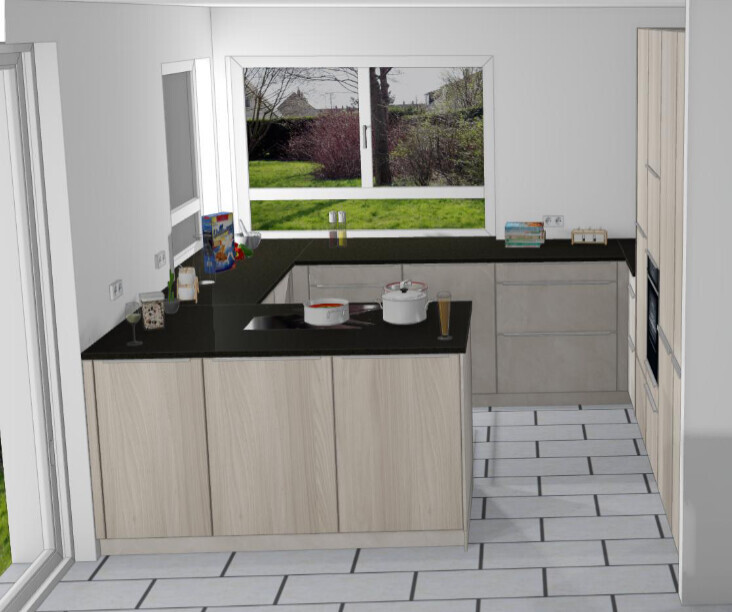
On the ground floor apartment there is an island – on the upper floor only a U-shaped layout. Front colors can be neglected for now.
So number 36 would again be an illuminated wall mirror. For light fixtures 14-16, I still need to decide what fits best visually.
Overall, we’re getting closer! 🙂
Numbers 1-2 are planned as wall lights – I haven’t chosen a model yet. We have still planned sockets here 🙂
The ceiling lights were mainly intended in case a wardrobe ends up placed in front of the bed, as the lady might not feel comfortable with the space.
Dressing room: I will probably place the surface-mounted ceiling lights centrally since the wardrobe will be positioned on the wall facing the bedroom and another against the exterior wall.
wiltshire schrieb:
The positioning of 5 and 6 doesn’t meet that.
5 & 6 are in different rooms – I think you meant 6-7, but I understand the issue.
wiltshire schrieb:
Bathroom: That can work. I would place 8 and 10 closer together and align them geometrically centered. Remove 9. If you have an illuminated mirror, you can also skip 11.
Number 11 simply refers to a light source, in this case the illuminated mirror.
wiltshire schrieb:
Study: Planning recessed ceiling lights without furniture usually doesn’t work out. It will look random.
So I’ll try to quickly share my current thoughts. I will place two desks along the wall facing the living room (No. 165) to create a "workspace." On the other side, there will initially be a wall cabinet for documents, cleaning supplies, etc. How to plan this so it can later become a child’s room without completely redoing the lighting concept, I’m not sure yet.
wiltshire schrieb:
Kitchen: Hard to judge without seeing the kitchen. Under-cabinet lighting is beneficial in some areas, then no ceiling lights are needed there.
On the ground floor apartment there is an island – on the upper floor only a U-shaped layout. Front colors can be neglected for now.
wiltshire schrieb:
Hallway: Deviations from symmetry require a functional or visual integration. Of course, I can’t judge that.
So number 36 would again be an illuminated wall mirror. For light fixtures 14-16, I still need to decide what fits best visually.
Overall, we’re getting closer! 🙂
G
goldfisch1383 Mar 2025 11:55@wiltshire could you briefly share your assessment of the kitchen lighting again – see the kitchen plan above
Similar topics