
Hello! We are currently building a single-family house to KfW40 standard and are supposed to have a Bosch air-to-water heat pump installed. Our heat pump was ordered back in December 2022, but it has not been delivered yet, and there is no clear indication of when it will arrive. Our construction company now says they can install the same model (Compress CS7400iAW ORMB-S) within two weeks, but with lower capacity, specifically 5 kW instead of 7 kW. According to our heating load calculation, our house requires 2.8 kW without hot water and a total of 3.4 kW including hot water. So, it seems that 5 kW should be sufficient. The question is – is this really the case, or am I misunderstanding something? Or should we wait for the 7 kW unit, even though delivery is completely uncertain? We are a family of five living in Schleswig-Holstein. I also asked about alternatives, for example, an air-to-water heat pump from Vaillant. I was told that this is an option, but it would have to be ordered new, with a delivery time of about three months, which should be more certain. Could someone recommend: take the 5 kW unit, wait for the 7 kW, or go with the Vaillant?
H
Häuschenbauer42 Feb 2025 11:11That is true as well. And if it happens, it probably isn’t a big issue if it is switched on for 1-2 days per year.
@nordanney
What is your view on the topic of hot water heating? Are there any advantages that support the 75/6? Or not in that case either?
@nordanney
What is your view on the topic of hot water heating? Are there any advantages that support the 75/6? Or not in that case either?
N
nordanney2 Feb 2025 11:50Häuschenbauer4 schrieb:
Are there any advantages in favor of the 75/6?No. That is the short answer. But unfortunately, a few more words are needed here.H
Häuschenbauer42 Mar 2025 13:01It’s me again. Today, I looked at the performance charts for the 55/6 and 75/6 models and marked the bivalence point for the electric heating element as well as the temperature at which the system starts to cycle, based on my primary energy demand (4.1 kW for heating + 1.5 kW for hot water = 5.6 kW).
Accordingly, everything really speaks in favor of the 55/6. Do you have any comments or suggestions?
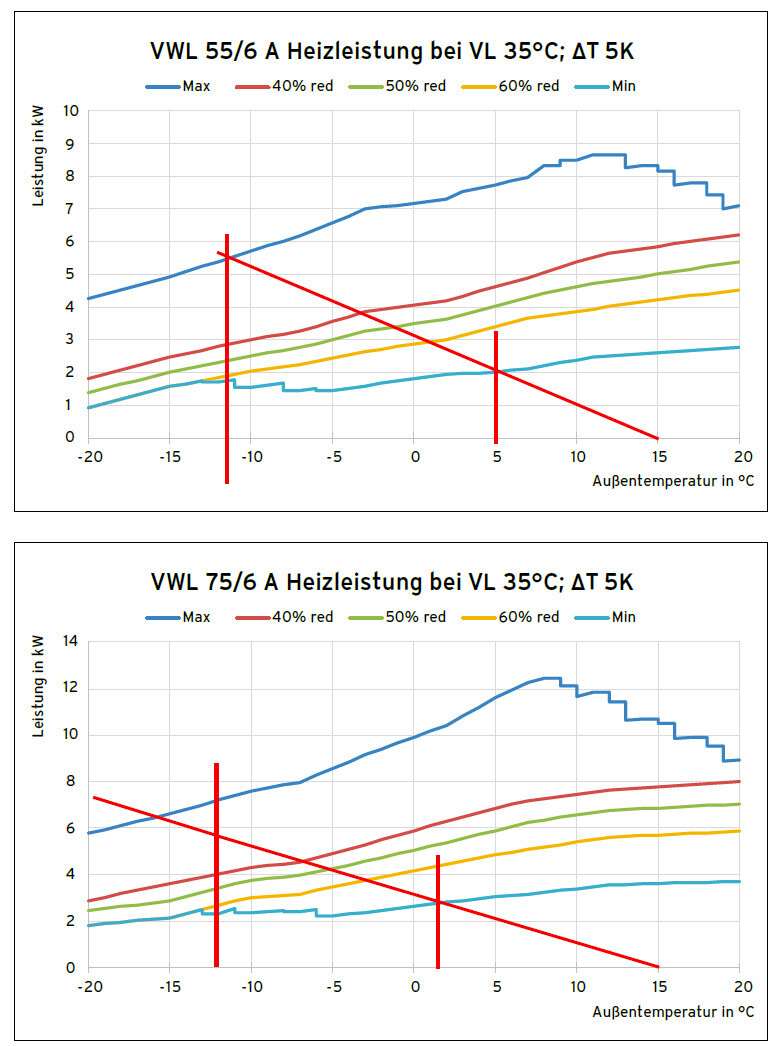
Accordingly, everything really speaks in favor of the 55/6. Do you have any comments or suggestions?
D
Daniel-Sp2 Mar 2025 13:32Hello,
since the heat pump either provides heating or domestic hot water, you can primarily base your calculations on the heating load requirement for heating.
since the heat pump either provides heating or domestic hot water, you can primarily base your calculations on the heating load requirement for heating.
D
derdietmar2 Mar 2025 13:54Hello,
the sizing of heat pumps is not straightforward. In the past, the common consensus was to size the heat pump slightly undersized rather than oversized. This was to avoid short cycling (frequent switching on and off of the compressor) at moderate temperatures.
However, heat pumps have since evolved. Today, modulating heat pumps—meaning variable-speed compressor models—are standard. These adjust their output to match the required heating demand. Therefore, a moderate oversizing of a heat pump is not problematic.
On the other hand, undersizing an air-to-water heat pump has a long-overlooked disadvantage. An air-to-water heat pump must defrost regularly because the compressor can ice up. This is normal and physically unavoidable. During the defrost cycle, heat energy is drawn from the heating circuit or buffer tank, and the heat pump temporarily reverses operation. Under adverse weather conditions with high humidity and outdoor temperatures around freezing, these defrost cycles can occur in short intervals. Depending on the unit, defrosting every 30 minutes is not uncommon.
To compensate for the energy loss, the heat pump must generate higher heating output between defrost cycles. A heat pump that is properly or slightly undersized may struggle here and, even at the highest modulation level, might not produce enough heat to offset the defrost losses. As a result, the house will slowly cool down. Unfortunately, this disadvantage, or this important background information, is neither considered in common sizing methods nor in manufacturers’ guidelines.
Best regards
the sizing of heat pumps is not straightforward. In the past, the common consensus was to size the heat pump slightly undersized rather than oversized. This was to avoid short cycling (frequent switching on and off of the compressor) at moderate temperatures.
However, heat pumps have since evolved. Today, modulating heat pumps—meaning variable-speed compressor models—are standard. These adjust their output to match the required heating demand. Therefore, a moderate oversizing of a heat pump is not problematic.
On the other hand, undersizing an air-to-water heat pump has a long-overlooked disadvantage. An air-to-water heat pump must defrost regularly because the compressor can ice up. This is normal and physically unavoidable. During the defrost cycle, heat energy is drawn from the heating circuit or buffer tank, and the heat pump temporarily reverses operation. Under adverse weather conditions with high humidity and outdoor temperatures around freezing, these defrost cycles can occur in short intervals. Depending on the unit, defrosting every 30 minutes is not uncommon.
To compensate for the energy loss, the heat pump must generate higher heating output between defrost cycles. A heat pump that is properly or slightly undersized may struggle here and, even at the highest modulation level, might not produce enough heat to offset the defrost losses. As a result, the house will slowly cool down. Unfortunately, this disadvantage, or this important background information, is neither considered in common sizing methods nor in manufacturers’ guidelines.
Best regards
Similar topics